TO: Boston Region Metropolitan Planning Organization
FROM: Betsy Harvey Herzfeld
RE:Mitigating Impacts on Minority and Low-income Populations through the Transportation Improvement Program
This document explores the results of the Boston Region Metropolitan Planning Organization’s (MPO) analysis to assess progress toward addressing the disparate impacts and disproportionate burdens (DI/DB) identified in the MPO’s 2023 Long-Range Transportation Plan (LRTP), Destination 2050. Disparate impacts are impacts stemming from policies or practices that adversely affect minority populations compared to nonminority populations. Disproportionate burdens are impacts that adversely affect low-income populations compared to non-low-income populations.
Mitigation of these impacts is accomplished by funding projects that offset them in the MPO’s capital program, the Transportation Improvement Program (TIP). Projects in the TIP are analyzed in the aggregate to identify their impacts using the following metrics (DI/DB metrics). These metrics were identified as disparate impacts and/or disproportionate burdens that may result from the MPO projects in Destination 2050:
Number of jobs accessible within a 45-minute transit trip (low-income population disproportionate burden)
Number of healthcare facilities within a 25-minute transit trip (minority population disparate impact)
Number of healthcare facilities within a 25-minute transit trip (low-income population disproportionate burden)
Parks and open space within a 45-minute drive (low-income population disproportionate burden)
Average travel time for drive trips (minority population disparate impact)
Average travel time for transit trips (minority population disparate impact)
Last year, we piloted an analysis in the Federal Fiscal Years (FFYs) 2025–29 TIP that assessed the extent to which TIP projects mitigated these disparate impacts and disproportionate burdens (PDF) (HTML). Subsequently, the MPO approved an updated DI/DB Policy (PDF) (HTML) in January 2025 that included a description of the MPO’s mitigation process based on the pilot.
Definitions
Disparate Impact: A facially neutral policy or practice that disproportionately affects members of a group identified by race, color, or national origin, and that may involve a denial of benefits or an imposition of burdens. (This definition refers only to minority populations.)1
Disproportionate Burden: Disproportionately high and adverse effects on low-income populations.
Minority Population: People who identify as Black or African American, Asian, Native Hawaiian or Pacific Islander, American Indian or Alaska Native, and/or Hispanic or Latino/a.
Low-income Population: People whose income is less than or equal to 200 percent of the federal poverty level for their family size.
LRTP DI/DB Analysis: An analysis used to determine if implementation of the projects included in the LRTP would result in disparate impacts and disproportionate burdens.
TIP DI/DB Mitigation Analysis: An analysis that evaluates a collection of TIP projects with the metrics for which the DI/DB LRTP analysis found disparate impacts or disproportionate burdens to determine whether the TIP projects would mitigate the impacts.
Approach to Disparate Impact and Disproportionate Burden mitigation
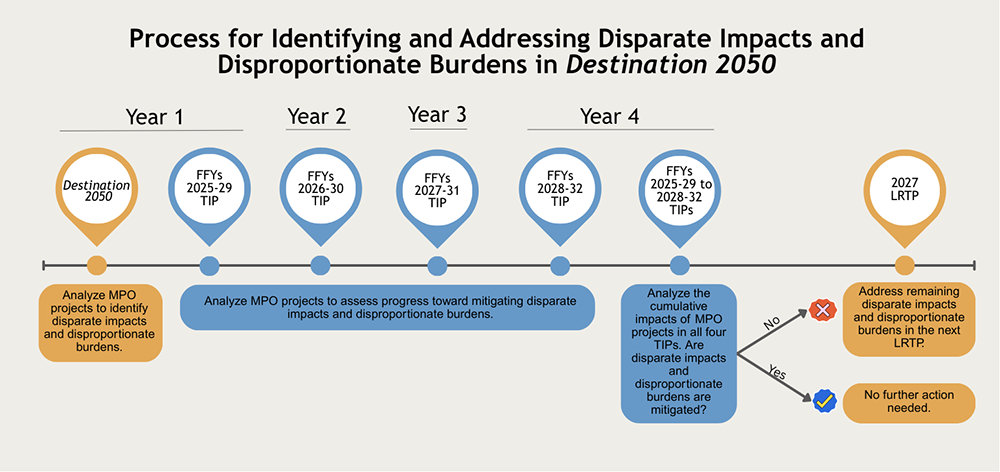
Mitigation of disparate impacts and disproportionate burdens takes place during the implementation of the four annual TIPs that follow Destination 2025 and precede the next LRTP update—the FFYs 2025–29, 2026–30, 2027–31, and 2028–32 TIPs.2 After the FFYs 2028–32 TIP, we will calculate the cumulative results for each metric across all four TIPs to determine if TIP projects, in the aggregate, would mitigate each of the disparate impacts or disproportionate burdens identified in the LRTP analysis.3 If a disparate impact or disproportionate burden is not mitigated, we will reanalyze the relevant metric in the next LRTP in addition to the other metrics listed above. The MPO may implement the TIP if disparate impacts and disproportionate burdens are not mitigated, but only if there is a reasonable alternative. Figure 1 illustrates this process.
Figure 1
Process for Identifying and Addressing Disparate Impacts and Disproportionate Burdens in Destination 2050
FFY = Federal Fiscal Year. LRTP = Long-Range Transportation Plan. MPO = Metropolitan Planning Organizaiton. TIP = Transportation Improvement Program.
Source: Boston Region MPO.
Table 1 shows a hypothetical example of how this approach would be applied to evaluate access to jobs.
Table 1
Hypothetical Mitigation Scenario: Access to Jobs
blank
Minority Population
Nonminority Population
Mitigation Needed
LRTP Disparate Impact
+100 jobs
+200 jobs
≥ 100 jobs
Mitigation through TIP, Year 1
15
20
100-15+20 = 105
Mitigation through TIP, Year 2
50
10
105-50+10 = 65
Mitigation through TIP, Year 3
20
5
65-20+5 = 50
Mitigation through TIP, Year 4
70
20
50-70+20 = 0
Cumulative Mitigation
155
55
0
LRTP = Long-Range Transportation Plan. TIP = Transportation Improvement Program.
Source: Boston Region MPO.
DI/DB Mitigation Analysis Methodology
To determine whether projects in the TIP would mitigate disparate impacts and disproportionate burdens, we analyzed the impacts of the MPO-funded projects, in the aggregate, using the six DI/DB metrics listed above. The analysis was conducted using Conveyal, a tool that estimates how changes to the transportation network resulting from new transportation projects may change the number of destinations people can reach within a given travel time. It can also estimate changes in travel times. Since Conveyal estimates changes in destination access as a function of the time it would take people to reach a destination, projects must contain one or more of the following improvements:
Addition of new transportation infrastructure (such as building a shared-use path) or service (such a new bus route)
Change in roadway geometry (such as the removal or addition of a travel lane)
Addition of traffic-calming elements (such as speed tables)4
While most MPO-funded projects meet these guidelines, there are a few that do not—namely, projects that do not directly change access, such as the installation of bicycle racks. Additionally, bikeshare expansion and maintenance projects are currently not included in the Conveyal analysis. We continue to work on representing these projects in Conveyal and expanding our understanding of the impacts of various project elements on travel speeds so that more projects can be included in the future.
DI/DB Mitigation Analysis Results
Impacts of the FFYs 2025–29 and 2026–30 TIPs
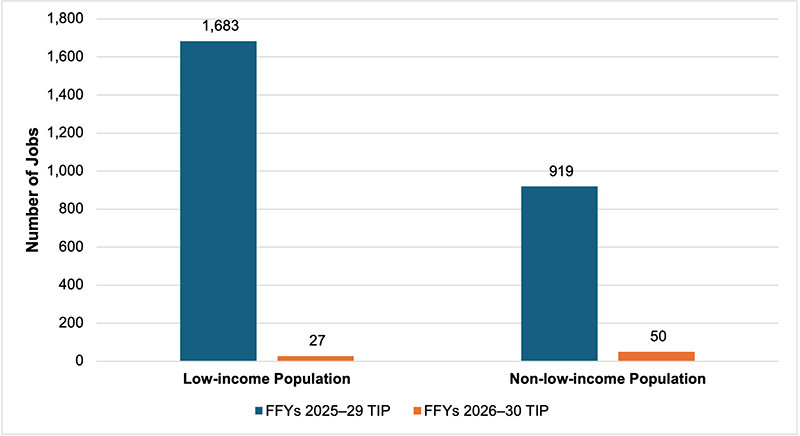
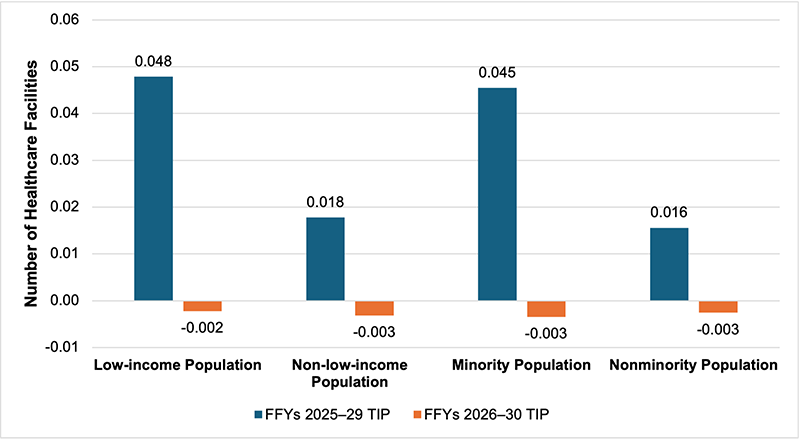
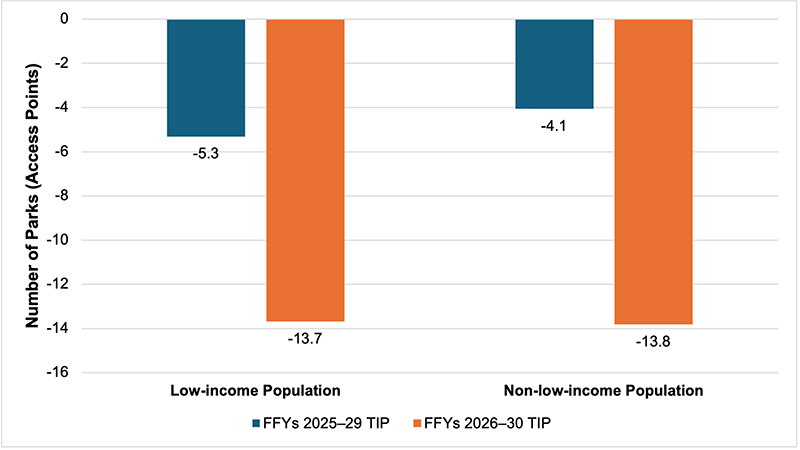
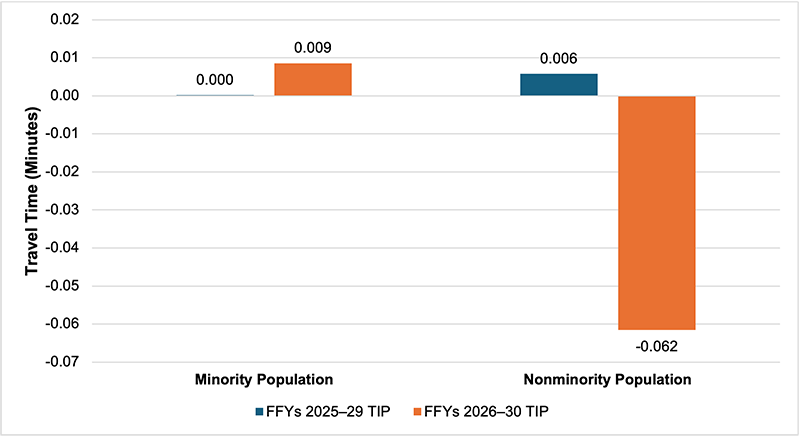
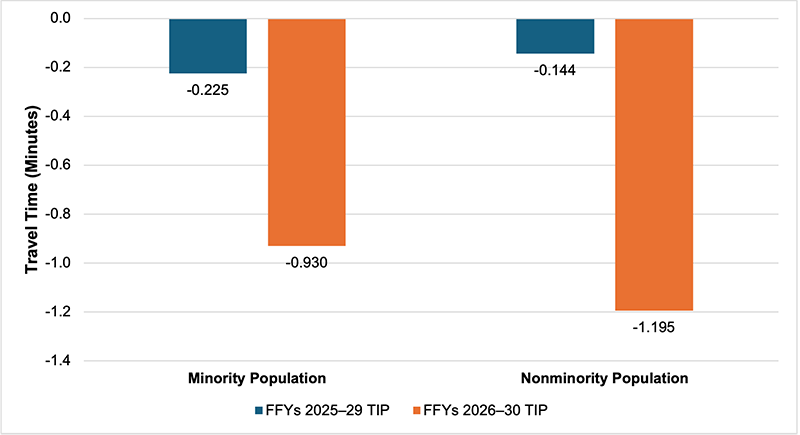
Figures 2 through 6 show the impacts of the FFYs 2026–30 TIP for the metrics for which there are disparate impacts or disproportionate burdens alongside those for the FFYs 2025–29 TIP.5 Key results include the following:
Access to jobs by transit (disproportionate burden): Access would improve for the low-income population in both TIPs more than for the non-low-income population.
Access to healthcare by transit (disparate impact and disproportionate burden): Access would improve for both the minority and low-income populations in the FFYs 2025–29 TIP but would decrease slightly for both populations in the FFYs 2026–30 TIP.
Access to parks (disproportionate burden): Access would decrease for the low-income population in both TIPs more than for the non-low-income population.
Average drive travel time (disparate impact): Travel time would increase for the minority population across both TIPs, while the nonminority population would experience a decrease in travel times in the FFYs 2026–30 TIP.
Average transit travel time (disparate impact): In both TIPs, travel time would decrease for both the minority and nonminority population, but by more for the nonminority populations.
The analysis evaluates the impacts of the TIP projects across the entire Boston region’s population; as a result, the changes in access and travel time appear small. However, this scale masks the improvements experienced by many people. Even a low percentage change indicates the project provides significant benefits, particularly for those who live nearest a project where changes to access are greatest. In many cases a negative or zero result is a direct consequence of traffic-calming safety measures designed to slow traffic. A project’s full benefits often extend beyond what is captured by metrics focused solely on destination access and travel time impacts.
Figure 2
Change in Access to Jobs by Transit (Disproportionate Burden)
in the FFYs 2025–29 and 2026–30 TIPs
FFY = Federal Fiscal Year. TIP = Transportation Improvement Program.
Source: Boston Region MPO, Conveyal, and Replica.
Figure 3
Change in Access to Healthcare by Transit (Disparate Impact and Disproportionate Burden) in the FFYs 2025–29 and 2026–30 TIPs
FFY = Federal Fiscal Year. TIP = Transportation Improvement Program.
Source: Boston Region MPO, Conveyal, Replica, MassGIS, and Massachusetts Department of Public Health Care Facility Licensure and Certification.
Figure 4
Change in Access to Parks and Open Space by Driving
(Disproportionate Burden) in the FFYs 2025–29 and 2026–30 TIPs
Source: Boston Region MPO, Conveyal, Replica, and MassGIS.
Figure 5
Change in Average Drive Travel Time (Disparate Impact)
in the FFYs 2025–29 and 2026–30 TIPs
FFY = Federal Fiscal Year. TIP = Transportation Improvement Program.
Source: Boston Region MPO, Conveyal, and Replica.
Figure 6
Change in Average Transit Travel Time (Disparate Impact)
in the FFYs 2025–29 and 2026–30 TIPs
FFY = Federal Fiscal Year. TIP = Transportation Improvement Program.
Source: Boston Region MPO, Conveyal, and Replica.
Mitigation Progress: FFYs 2025–29 TIP through FFYs 2026–30 TIP
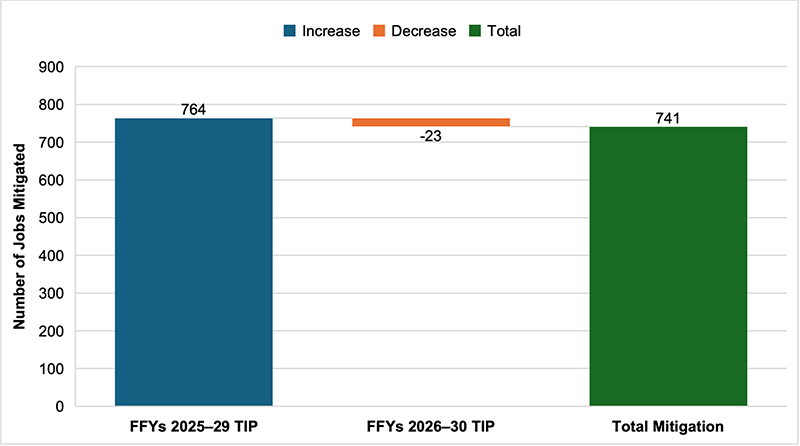
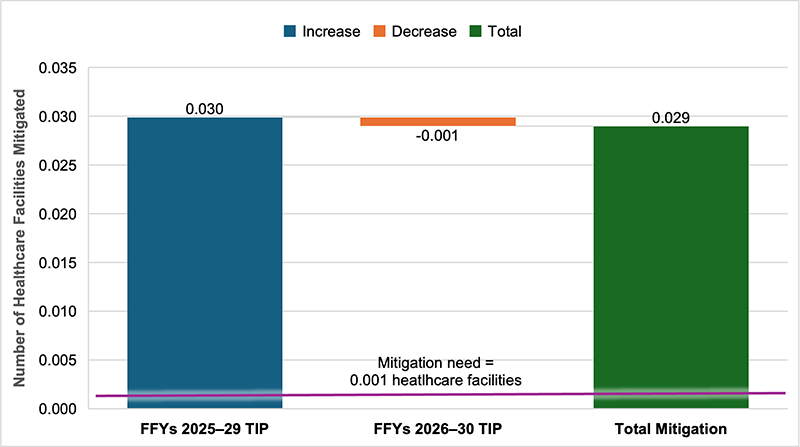
Figures 7 through 12 show the progress the MPO has made toward mitigating the disparate impacts and disproportionate burdens through the projects programmed in the FFYs 2025–29 and 2026–30 TIPs. The charts show the amounts of the disparate impacts and disproportionate burdens that have been mitigated by the projects programmed in the two TIPs (such as the number of jobs) compared to the mitigation needed. Key takeaways include the following:
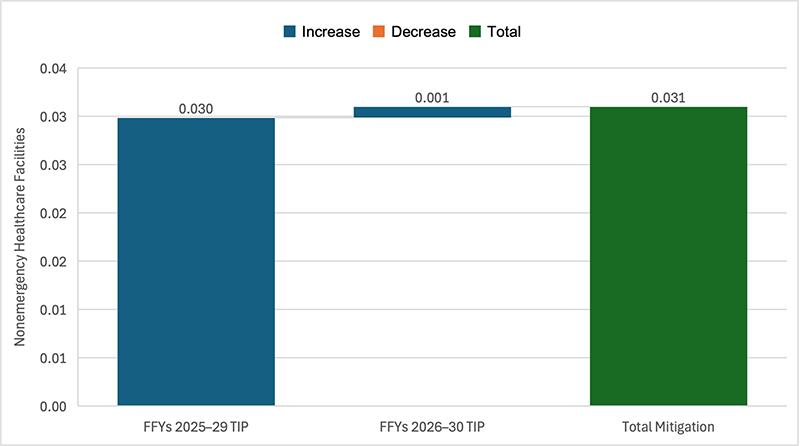
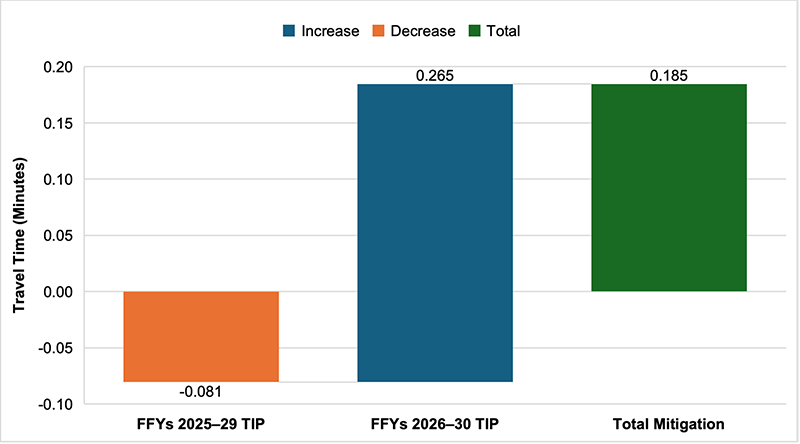
The MPO has made progress in mitigating the disparate impacts and disproportionate burdens for the access to jobs (low-income population) and access to healthcare (minority and low-income populations) metrics.
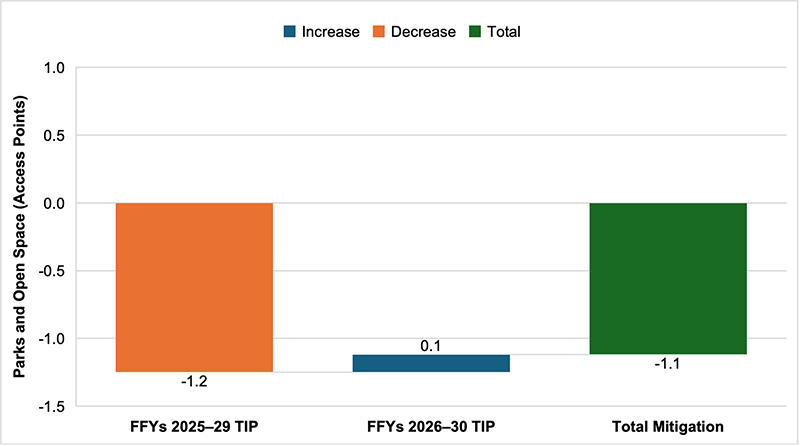
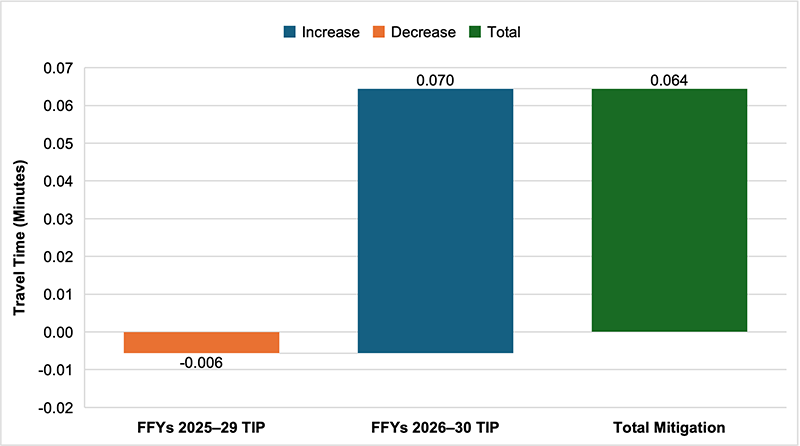
The MPO has not made progress in mitigating the disproportionate burden for access to parks and open space (low-income population), average travel time for drive trips (minority population), and average travel time for transit (minority population) metrics.
Figure 7
Mitigation Progress: Access to Jobs, by Transit (Disproportionate Burden)
TIP = Transportation Improvement Program.
Source: Boston Region MPO.
Figure 8
Mitigation Progress: Access to Healthcare, by Transit (Disparate Impact)
TIP = Transportation Improvement Program.
Source: Boston Region MPO.
Figure 9
Mitigation Progress: Access to Healthcare,
by Transit (Disproportionate Burden)
TIP = Transportation Improvement Program.
Source: Boston Region MPO.
Figure 10
Mitigation Progress: Access to Parks and Open Space,
by Driving (Disproportionate Burden)
TIP = Transportation Improvement Program.
Source: Boston Region MPO.
Figure 11
Mitigation Progress: Drive Travel Time (Disparate Impact)
TIP = Transportation Improvement Program.
Source: Boston Region MPO.
Figure 12
Mitigation Progress: Transit Travel Time (Disparate Impact)
TIP = Transportation Improvement Program.
Source: Boston Region MPO.
Tables 2 and 3 summarize the progress toward mitigation that is shown for each metric in the preceding charts.
Table 2
Mitigation of Disparate Impacts for the Minority Population through FFYs 2025-29 and 2026-31 TIPs
Metric
Desired Direction of Change
Minority Population Direction of Impact
Nonminority Population Direction of Impact
Mitigation Need
Mitigated
Mitigation Achieved?
Access to healthcare within 25-minute transit trip
Increase
Decrease
Decrease
+0.001 healthcare facilities
+0.029 healthcare facilities
Yes
Average travel time for drive trips
Decrease
Increase
Decrease
-0.014 minutes
+0.064 minutes
No
Average travel time for transit trips
Decrease
Decrease
Decrease
-0.056 minutes
+0.185 minutes
Yes
FFY = Federal Fiscal Year. TIP = Transportation Improvement Program.
Source: Boston Region MPO.
Table 3
Mitigation of Disproportionate Burdens for the Low-income Population through FFYs 2025-29 and 2026-31 TIPs
Metric
Desired Direction of Change
Low-income Population Direction of Impact
Non-Low-income Population Direction of Impact
Mitigation Need
Mitigated
Mitigation Achieved
Access to jobs within 45-minute drive trip
Increase
Increase
Increase
+143 jobs
+741 jobs
Yes
Access to healthcare within 25-minute transit trip
Increase
Decrease
Decrease
+0.008 healthcare facilities
+0.031 healthcare facilities
Yes
Access to parks and open space within 45 minute drive trip
Increase
Decrease
Decrease
+0.8 park access points
-1.1 park access points
No
FFY = Federal Fiscal Year. TIP = Transportation Improvement Program.
Source: Boston Region MPO.
Next Steps
Last year, the MPO began to track progress for the metrics for which disparate impacts and disproportionate burdens were found in Destination 2050. Over a four-year period, the MPO must address these issues through the projects included in the four consecutive, five-year TIPs (FFYs 2025–29, 2026–30, 2027–31, and 2028–32). It is important to track these results each year to see whether the MPO’s project selections mitigate the identified disparate impacts and disproportionate burdens. We will continue to conduct the DI/DB mitigation analysis for the next two TIPs, followed by a final analysis that assesses the combined impact of all four TIPs to determine whether the MPO has successfully mitigated the disparate impacts and disproportionate burdens identified in Destination 2050.
In FFY 2025 we completed a study, Exploring the Potential for Using Conveyal in Transportation Improvement Program Projects Evaluations (PDF) (HTML), to develop the destination access evaluation criteria. Once these criteria are established, the MPO will be able to evaluate projects individually to determine their impact on destination access. This will give the MPO a better idea of which projects can help mitigate remaining disparate impacts and disproportionate burdens in future TIPs. This new process will allow the MPO to evaluate individual project impacts—through project scoring—and collectively through a DI/DB mitigation analysis.
1 The 2025 DI/DB Policy update included the addition of people with limited English proficiency (LEP) as a third population to be analyzed for disparate impacts and disproportionate burdens, as people with LEP are also covered under Title VI as an extension of national origin protection. However, because the LRTP DI/DB analysis was conducted prior to this change, they are not included in the DI/DB mitigation analysis for the FFYs 2026–30 TIP. They will become part of both the LRTP and TIP DI/DB Mitigation analyses starting with the next LRTP.
2 Each LRTP is active for four years, which is why mitigation takes place in the four TIPs that follow the adoption of the LRTP.
3 These results may differ from the sum of the impacts found in each yearly TIP analysis. This is because some projects are funded over multiple TIPs and in the cumulative analysis we include them only once to not double count their impacts.
4 There are other ways to improve access to destinations, namely development of new destinations (such as building new healthcare facilities); however, the MPO does not have direct influence on the development of new destinations, so that is considered a constant in this analysis.
5 Results are based on current project design information—actual impacts may differ if designs change.
Appendix A—Methodology
Appendix A provides details about the disparate impact and disproportionate burden (DI/DB) mitigation analysis methodology.
How does the Transportation Improvement Program (TIP) DI/DB mitigation analysis differ from the DI/DB analysis done for the Long-Range Transportation Plan (LRTP)?
The LRTP DI/DB analysis was conducted using the MPO’s travel demand model (TDM23), while the TIP DI/DB mitigation analysis was conducted using the destination access tool Conveyal. We chose to use Conveyal instead of TDM23 for TIP DI/DB mitigation analysis because it is a faster, more flexible tool, qualities necessary for use in the TIP.
Several key differences include the following:
Conveyal does not consider factors that may affect a person’s ability to make a trip, whereas TDM23 reflects estimated travel demand that is derived from a variety of household characteristics, such as auto ownership.
Conveyal divides the region into hundreds of grid cells to use as trip origins, while TDM23 uses the centroids of transportation analysis zone (TAZ) as trip origins.
Conveyal and TDM23 process and apply demographic data differently from the US Census to get demographic-specific results. Conveyal uses a process called dasymetric mapping to estimate the population within Conveyal’s grid cells, while TDM23 applies the percentage of the population within each TAZ to metric outputs (such as emissions).
Conveyal uses a full representation of the region’s transportation network from the OpenStreetMap (which is updated every year) from October 2024, while TDM23 uses a simplified version of the network.
Conveyal uses General Transit Feed Specification (GTFS) schedules from fall 2024, while TDM23 uses GTFS schedules from 2019. This affects the transit schedules and routes being run (the Green Line Extension, for example, was not yet open in 2019).
Because of these differences, the results of the two analyses were not compared directly. Instead, we developed a conversion factor for each metric to convert the TDM23 outputs into Conveyal units. We took additional measures to obtain compatible results and minimize the differences between the two analyses. We replicated the TDM23 process as closely as possible with Conveyal, using the same data sources for those metrics and setting Conveyal parameters to be as close as possible to those in TDM23—such as having trips leave at the same time of day and reflecting congestion on roadways.
How are destinations defined and what are the data sources?
Destinations are defined in different ways for each destination access metric:
Jobs—Job destinations include any job in the Boston region. Data are from the 2019 Longitudinal Employer-Households Dynamics Origin-Destination Employment Statistics, which is compiled by the US Census Bureau.
Healthcare—Healthcare destinations are defined as any healthcare facilities that fall into one of the following categories:
Each healthcare facility is considered one destination, regardless of the size, number of healthcare providers, or patients served.
Parks and Open Space—Park and open space destinations are defined as any park or open space at least one-half acre in size. Data are from the 2021 version the MassGIS Protected and Recreational Open Space file. Because of the varying size of parks, rather than measuring access to the park itself, we analyzed access to the park’s points of access, defined as where a park intersects with the roadway, sidewalks, or bicycle lanes.
Appendix B—Project Lists
Appendix B lists the projects analyzed for disparate impacts and disproportionate burdens in the 2023 Long-Range Transportation Plan (LRTP), as well as those in the federal fiscal years (FFYs) 2025–29 and 2026–30 Transportation Improvement Programs (TIP) for the disparate impact and disproportionate burden (DI/DB) mitigation analysis.
What types of projects were included and how do they differ?
The LRTP DI/DB analysis included all MPO projects listed in the 2023 LRTP. The DI/DB mitigation analyses included MPO-funded projects in the TIP, except for the following:
Projects that do not directly change travel speeds and/or add new links to the transportation network and/or change roadway geometry
Bikeshare projects
We are currently working on developing a process for adding bikeshare projects to Conveyal and anticipate including these projects in future analyses.
Why are there more projects in the DI/DB mitigation analysis than in the DI/DB LRTP Analysis?
The TIP and the LRTP contain different types of projects. The LRTP lists regionally significant projects within fiscal constraint that are expected to be built in the region in the next 20 years. Broadly speaking, a regionally significant project is one that is on a facility that serves regional transportation needs—at a minimum, all principal arterial highways and fixed guideway transit. Projects in the TIP are those that the MPO is committed to funding, which includes projects listed in the LRTP if the MPO has elected to fund them, as well as other projects that are not in the LRTP but that the MPO believes are important to the region. Therefore, the TIP includes many more projects than those listed in the LRTP.
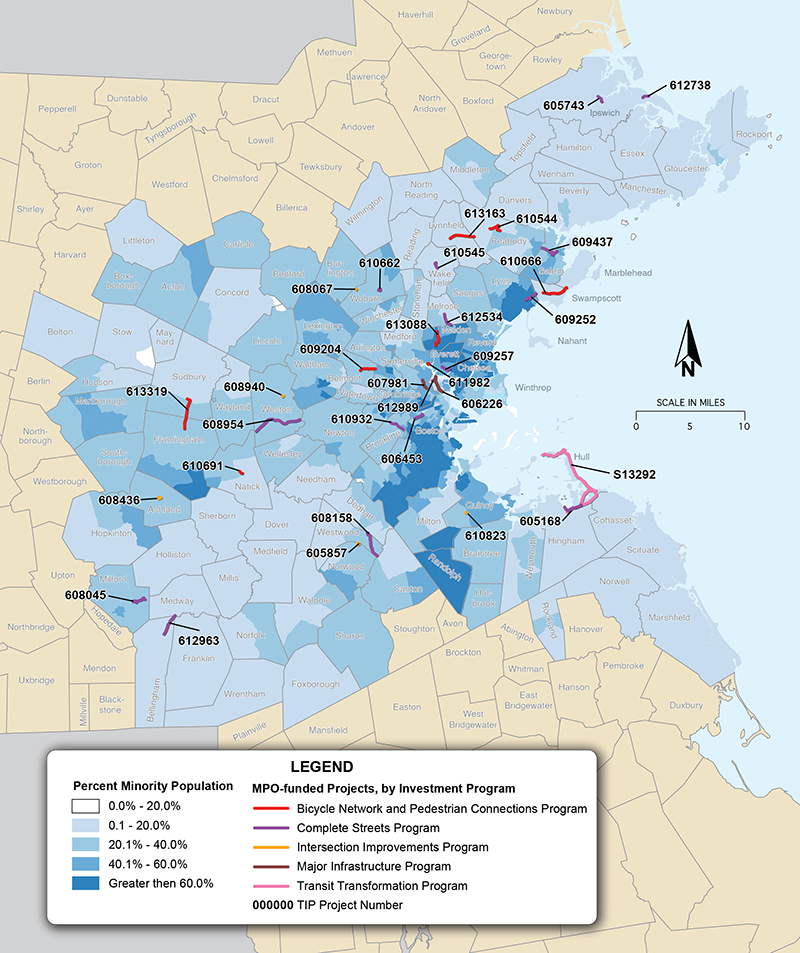
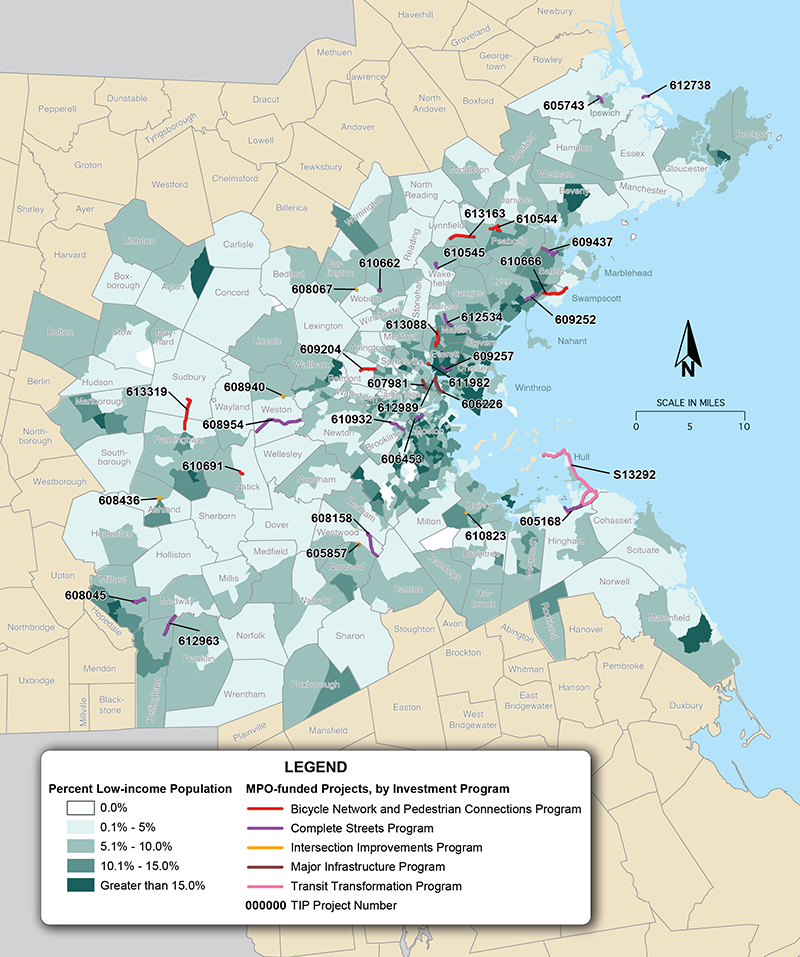
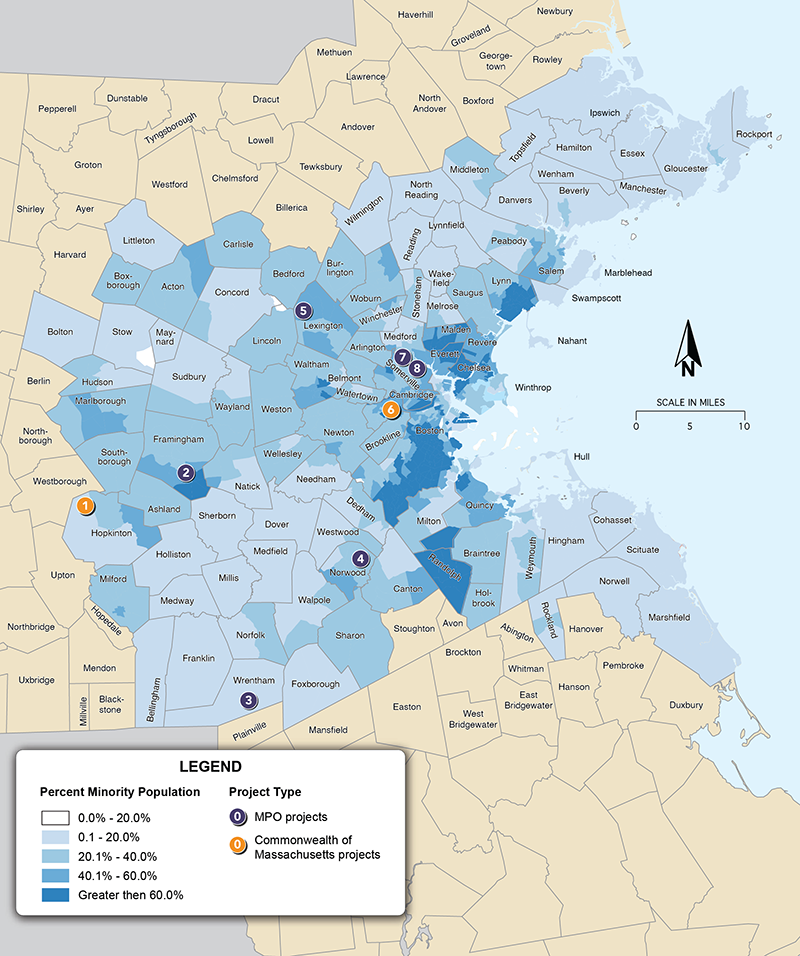
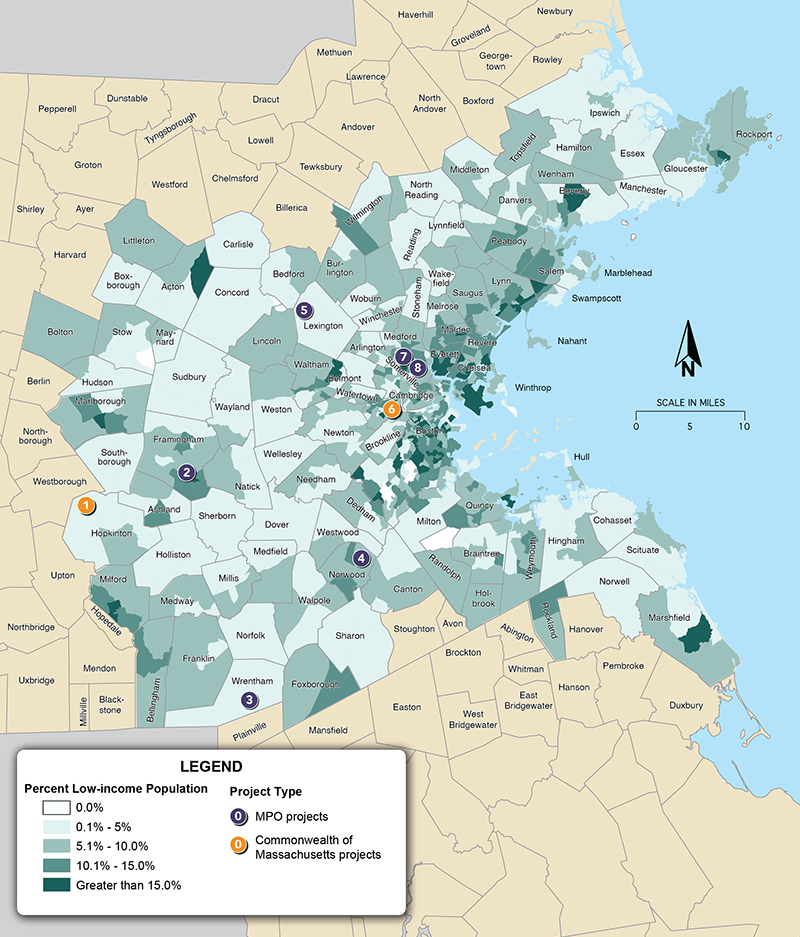
Tables B-1 and B-2 list the projects analyzed in the FFYs 2026–30 TIP DI/DB mitigation analysis and the LRTP DI/DB analysis, respectively. Figures B-1, B-2, and B-3 show the locations of the projects included in these analyses.
Table B-1
FFYs 2026–30 TIP DI/DB Mitigation Analysis Project List
Project ID
Proponent
Project Name
MPO Investment Program
605168
Hingham
Intersection improvements at Route 3A/Summer Street
Complete Streets
605743
Ipswich
Resurfacing and related work on Central and South Main Streets
Complete Streets
605857
Norwood
Intersection improvements at Route 1 and University Avenue
Intersection Improvement
606226
Boston
Reconstruction of Rutherford Avenue
Major Infrastructure
606453
Boston
Improvements on Boylston Street
Complete Streets
607981
MassDOT
Somerville - McGrath Boulevard construction
Major Infrastructure
608045
Milford
Rehabilitation on Route 16, from Route 109 to Beaver Street
Complete Streets
608067
MassDOT
Woburn - Intersection reconstruction at Route 3 and Bedford Road and South Bedford Street
Intersection Improvement
608158
Westwood/Norwood
Reconstruction of Canton Street to University Drive, including rehabilitation of bridge N-25-032=W-31-018
Complete Streets
608436
Ashland
Rehabilitation and rail crossing improvements on Cherry Street
Intersection Improvement
608940
Weston
Intersection improvements at Boston Post Road (Route 20) at Wellesley Street
Intersection Improvement
608954
Weston
Reconstruction on Route 30
Complete Streets
609204
Belmont
Community Path, Belmont component of the MCRT (Phase 1)
Bicycle and Pedestrian
609252
Lynn
Rehabilitation of Essex Street
Complete Streets
609257
Everett
Rehabilitation of Beacham Street
Complete Streets
609437
Salem/Peabody
Boston Street improvements
Complete Streets
610544
Peabody
Multi-use path construction of Independence Greenway at I-95 and Route 1
Bicycle and Pedestrian
610545
Wakefield
Main Street reconstruction
Complete Streets
610662
Woburn
Roadway and intersection improvements at Woburn Common, Route 38 (Main Street), Winn Street, Pleasant Street, and Montvale Avenue
Complete Streets
610666
Swampscott
Rail trail construction
Bicycle and Pedestrian
610691
Natick
Cochituate Rail Trail extension
Complete Streets
610823
Quincy
Intersection improvements at Willard Street and Ricciuti Drive
Intersection Improvement
610932
Brookline
Rehabilitation of Washington Street
Complete Streets
611982
Medford
Shared use path connection at the Route 28/Wellington underpass
Bicycle and Pedestrian
612534
Melrose
Lebanon Street improvement Project (Lynde Street to Malden city line)
Complete Streets
612738
Ipswich
Argilla Road reconstruction
Complete Streets
612963
Bellingham
Roadway rehabilitation of Route 126 (Hartford Road) from 800 feet north of the Interstate 495 northbound off-ramp to the Medway town line, including bridge B-06-017
Complete Streets
612989
Boston
Bridge preservation, B-16-066 (38d), Cambridge Street over MBTA
Complete Streets
613088
Malden
Spot Pond Brook Greenway
Bicycle and Pedestrian
613163
Lynnfield
Rail trail construction, from Ford Avenue to Nicholes Lane (phase 1)
Bicycle and Pedestrian
613319
Sudbury/Framingham
Bike path construction of Bruce Freeman Rail Trail, from the Sudbury Diamond railroad crossing to Eaton Road West
Bicycle and Pedestrian
S12697
Watertown
Pleasant Street Shuttle Service expansion
Community Connections
S12699
Stoneham
Stoneham shuttle service
Community Connections
S12700
CATA
CATA on demand microtransit service expansion – Rockport and Lanesville
Community Connections
S12701
MWRTA
MWRTA CatchConnect microtransit service expansion - Hudson and Marlborough
Community Connections
S12703
MRTA
MRTA microtransit service – on-demand service for Bolton, Boxborough, Littleton, Stow
Community Connections
S12918
MBTA
Jackson Square Station accessibility improvements
Transit Transformation
S12963
Chelsea/Revere
Regional on-demand microtransit pilot project
Community Connections
S12964
Revere
Bluebikes expansion to Northern Strand (Salem Street at North Marshall Street) and Griswold Park
You are invited to participate in our transportation planning process, free from discrimination. The Boston Region Metropolitan Planning Organization (MPO) is committed to nondiscrimination in all activities and complies with Title VI of the Civil Rights Act of 1964, which prohibits discrimination on the basis of race, color, or national origin (including limited English proficiency). Related federal and state nondiscrimination laws prohibit discrimination on the basis of age, sex, disability, and additional protected characteristics.
For people with hearing or speaking difficulties, connect through the state MassRelay service, www.mass.gov/massrelay. Please allow at least five business days for your request to be fulfilled.