Despite this comment letter being submitted on April 12, 2026, past the official public comment period of March 20, 2026, to April 10, 2026, it is posted here for consideration at the board's discretion.
Shravanthi Gopalan Narayanan
MPO Staff
Ten Park Plaza, Suite 2150
Boston, Massachusetts 02116
(submitted via email)
April 10, 2026
Re: Critical Urban Freight Corridors Update
Dear Ms. Narayanan,
Thank you for the opportunity to provide feedback on the Critical Urban Freight
Corridors (CUFC) trucks use in South Boston to access key industrial areas like
Conley Marine Terminal, the Raymond L. Flynn Marine Park, and the light
industrial areas north of West First Street. We want to specifically highlight that
the current thinking about which streets trucks do and should use does not factor
in the residential and hotel buildings that have been built over the last 15 years,
and thus introduces unsafe conditions for pedestrians on our streets.
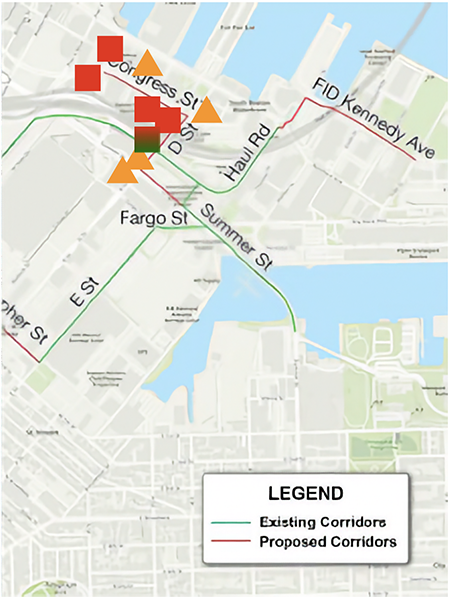
We support the need for truck access to the above-mentioned key employment
centers; however, we are writing to request that the new CUFC routes being
proposed for a portion of Summer Street, D Street, and Congress Street be
withdrawn.
This small 1/2 mile CUFC route change will introduce trucks to streets with four
multi-unit residential buildings and four hotels with over 1,110 units of housing
and 2,746 hotel rooms. It is safe to say that putting trucks on the streets that are
home to over 2,500 of our neighbors and to over 3,000 daily visitors to the City is
creating an unsafe condition.
We have seen how targeted infrastructure investments allow for the consolidation
of routes and remove trucks from City streets. This is evident with the Cypher
Street extension and the removal of trucks from First Street. We believe the
prioritization of the South Boston Waterfront Sustainable Transportation Plan's
proposed roadway connection from Pumphouse Road to Haul Road and Drydock
Avenue would be another infrastructure project that would further enable
smoother highway access for trucks and improve safety.
It should be noted that none of these investments are required to create conflictfree
zones. Our basic premise is that trucks should simply be required to use Haul
Road — the true separated truck route — to access both I-90 and I-93. Giving
them access to use D Street to reach I-90 and Congress Street to reach I-93 has
created conflict areas with pedestrians that are unsafe.
To summarize, the proposed changes to the CUFC to add portions of Summer
Street, D Street, and Congress Street create unsafe conflicts between trucks and
pedestrians and should not be supported. The investments needed to optimize
truck traffic to the highway system, as outlined in the South Boston Waterfront
Sustainable Transportation Plan, need to be prioritized, and most importantly,
trucks in South Boston must be required to use Haul Road as the single and only
access point to the interstate system.
Respectfully Submitted,
Tom Ready
cc:
Jen Rowe, City of Boston Streets Cabinet
Nayeli Rodriguez, City of Boston Environment, Energy, and Open Space Cabinet
John Romano, Municipal Affairs Liaison, MassDOT
Sarah K. Lee, Manager of Transportation Planning, Massport
Nick Collins, Massachusetts State Senator 1st Suffolk
David Biel, Massachusetts State Representative 4th Suffolk
Ed Flynn, District 2 Boston City Councilor

Multi Unit Residential Buildings
501 Congress Street
505 Congress Street
399 Congress Street
135 Seaport Boulevard

Hotels
425 Summer Street
450 Summer Street
606 Congress Street
1 Seaport Lane