

Boston Region MPO
Prepared by
The Central Transportation Planning Staff:
Staff to the Boston Region Metropolitan Planning Organization
Directed by the Boston Region Metropolitan Planning Organization, which is composed of the
Massachusetts Department of Transportation
Metropolitan Area Planning Council
Massachusetts Bay Transportation Authority
MBTA Advisory Board
Massachusetts Port Authority
Regional Transportation Advisory Council
City of Boston
City of Beverly
City of Everett
City of Framingham
City of Newton
City of Somerville
Town of Arlington
Town of Acton
Town of Brookline
Town of Burlington
Town of Hull
Town of Norwood
Town of Wrentham
Federal Highway Administration (nonvoting)
Federal Transit Administration (nonvoting)
This document was funded in part through grants from the US Department of Transportation. Its contents do not necessarily reflect the official views or policies of the US Department of Transportation.
Notice of Nondiscrimination Rights and Protections
You are invited to participate in our transportation planning process, free from discrimination. The Boston Region Metropolitan Planning Organization (MPO) is committed to nondiscrimination in all activities and complies with Title VI of the Civil Rights Act of 1964, which prohibits discrimination on the basis of race, color, or national origin (including limited English proficiency). Related federal and state nondiscrimination laws prohibit discrimination on the basis of age, sex, disability, and additional protected characteristics.
For additional information or to file a civil rights complaint, visit www.bostonmpo.org/mpo_non_discrimination.
To request this information in a different language or format, please contact:
Boston Region MPO Title VI Specialist
10 Park Plaza, Suite 2150
Boston, MA 02116
Phone: 857.702.3700
Email: civilrights@ctps.org
For people with hearing or speaking difficulties, connect through the state MassRelay service, www.mass.gov/massrelay. Please allow at least five business days for your request to be fulfilled.
Contact MPO staff:
By mail:
Boston Region MPO
MPO Activities Group, Central Transportation Planning Staff
10 Park Plaza, Suite 2150
Boston, MA 02116
By telephone:
857.702.3700 (voice)
For people with hearing or speaking difficulties, connect through the state MassRelay service:
Relay Using TTY or Hearing Carry-over: 800.439.2370
Relay Using Voice Carry-over: 866.887.6619
Relay Using Text to Speech: 866.645.9870
For more information, including numbers for Spanish speakers, visit https://www.mass.gov/massrelay
By email:
Starting with the FFYs 2027–31 TIP, TIP project descriptions and funding information are now available in a virtual TIP Project Dashboard
Certification of the Boston Region MPO
Transportation Planning Process
The Boston Region Metropolitan Planning Organization certifies that its conduct of the metropolitan transportation planning process complies with all applicable requirements, which are listed below, and that this process includes activities to support the development and implementation of the Regional Long-Range Transportation Plan and Air Quality Conformity Determination, the Transportation Improvement Program and Air Quality Conformity Determination, and the Unified Planning Work Program.
- 1. 23 USC 134, 49 USC 5303, and this subpart.
- 2. Sections 174 and 176 (c) and (d) of the Clean Air Act, as amended (42 USC 7504, 7506 (c) and (d) and 40 CFR part 93 and for applicable State Implementation Plan projects.
- 3. Title VI of the Civil Rights Act of 1964, as amended (42 USC 2000d-1) and 49 CFR Part 21.
- 4. 49 USC 5332, prohibiting discrimination on the basis of race, color, creed, national origin, sex, or age in employment or business opportunity.
- 5. Section 11101(e) of the Infrastructure Investment and Jobs Act (IIJA) (Public Law 117-58) and 49 CFR Part 26 regarding the involvement of disadvantaged business enterprises in U.S. DOT-funded projects.
- 6. 23 CFR part 230, regarding implementation of an equal employment opportunity program on Federal and Federal-aid highway construction contracts.
- 7. The provisions of the US DOT and of the Americans with Disabilities Act of 1990 (42 USC 12101 et seq.) and 49 CFR Parts 27, 37, and 38.
- 8. The Older Americans Act, as amended (42 USC 6101), prohibiting discrimination on the basis of age in programs or activities receiving federal financial assistance.
- 9. Section 324 of Title 23 USC regarding the prohibition of discrimination based on gender.
- 10. Section 504 of the Rehabilitation Act of 1973 (29 USC 794) and 49 CFR Part 27 regarding discrimination against individuals with disabilities.
- 11. Anti-lobbying restrictions found in 49 CFR Part 20. No appropriated funds may be expended by a recipient to influence or attempt to influence an officer or employee of any agency, or a member of Congress, in connection with the awarding of any federal contract.
______________________________________________
Phillip Eng, Interim Secretary and CEO
Massachusetts Department of Transportation
Chair, Boston Region MPO
Date
Global Warming Solutions Act Requirements for Transportation
This form will certify that the Transportation Improvement Program and Air Quality Conformity Determination for the Boston Region Metropolitan Planning Organization’s (MPO) Long-Range Transportation Plan is in compliance with all applicable requirements in the Massachusetts State Regulation 310 CMR 60.05: Global Warming Solutions Act Requirements for Transportation (GWSA). The regulation requires the MPO to conduct the following activities:
- Evaluate and report the aggregate transportation greenhouse gas (GHG) emissions impacts of Regional Transportation Plans (RTPs) and Transportation Improvement Plans (TIPs). (310 CMR 60.05(5)(a)1)
- In consultation with the Massachusetts Department of Transportation (MassDOT), develop and utilize procedures to prioritize and select projects in RTPs and TIPs based on factors that include aggregate transportation GHG emissions impacts. (310 CMR 60.05(5)(a)2)
- Quantify net transportation GHG emissions impacts resulting from the projects in RTPs and TIPs and certify in a statement included with RTPs and TIPs pursuant to 23 CFR Part 450 that the MPO has made efforts to minimize aggregate transportation GHG emissions impacts. (310 CMR 60.05(5)(a)3)
- Determine in consultation with the Regional Planning Agency (RPA) that the appropriate planning assumptions used for transportation GHG emissions modeling are consistent with local land use policies, or that local authorities have made documented and credible commitments to establishing such consistency. (310 CMR 60.05(5)(a)4)
- Develop RTPs and TIPs. (310 CMR 60.05(8)(a)2.a)
- Ensure that RPAs are using appropriate planning assumptions. (310 CMR 60.05(8)(a)2.b)
- Perform regional aggregate transportation GHG emissions impact analysis of RTPs and TIPs. (310 CMR 60.05(8)(a)2.c)
- Calculate aggregate transportation GHG emissions impacts for RTPs and TIPs. (310 CMR 60.05(8)(a)2.d)
- Develop public consultation procedures for aggregate transportation GHG emissions impact reporting and related GWSA requirements consistent with current and approved regional public participation plans. (310 CMR 60.05(8)(a)2.e)
- Prior to making final endorsements on the RTPs, TIPs, State TIPs (STIPs), and projects included in these plans, MassDOT and the MPOs shall include the aggregate transportation GHG emission impact assessment in RTPs, TIPs, and STIPs and provide an opportunity for public review and comment on the RTPs, TIPs, and STIPs. (310 CMR 60.05(8)(c))
- After a final GHG assessment has been made by MassDOT and the MPOs, MassDOT and the MPOs shall submit MPO-endorsed RTPs, TIPs, STIPs or projects within 30 days of endorsement to the Department of Environmental Protection for review of the GHG assessment. (310 CMR 60.05(8)(a)1.c)
for
Phillip Eng, Interim Secretary and CEO
Massachusetts Department of Transportation
Chair, Boston Region Metropolitan Planning Organization
____________________________________
Date
Executive Summary
Introduction
The Federal Fiscal Years (FFYs) 2027–31 Transportation Improvement Program (TIP) is the Boston Region Metropolitan Planning Organization’s (MPO) five-year capital investment plan for the Boston region’s transportation system.
Guided by the Boston Region MPO’s vision, goals, and objectives, the TIP prioritizes investments that fund arterial roadway and intersection improvements, maintenance and expansion of the public transit system, shared-use path construction, first-and-last-mile improvements for users of active transportation, and major highway reconstruction.
The Boston Region MPO is guided by a 23-member board with representatives of state agencies, regional organizations, and municipalities. Its jurisdiction extends roughly from Boston north to Ipswich, south to Marshfield, and west to municipalities along Interstate 495. Each year, the MPO conducts a process to decide how to spend federal transportation funds for capital projects. The Central Transportation Planning Staff (CTPS), which is the staff to the MPO, manages the TIP development process.
MPO staff coordinates the evaluation of project funding requests, proposes programming of current and new projects based on anticipated funding levels, supports the MPO board in developing a draft TIP document, and facilitates a public review of the draft before the MPO board endorses the final document.
FFYs 2027–31 TIP Investments
The complete TIP project list is available in Chapter 3 of this document and online at bostonmpo.org/tip. The TIP tables provide details of how funding is allocated to each programmed project and capital investment program. These tables are organized by federal fiscal year and are grouped by highway and transit programs.
Highway Program
The Highway Program of the TIP funds the priority transportation projects advanced by the Massachusetts Department of Transportation (MassDOT) and the cities and towns within the Boston region. The program is devoted primarily to preserving and modernizing the existing roadway network by reconstructing arterial roadways, resurfacing highways, and replacing bridges. In the FFYs 2027–31 TIP, roadway, bridge, bicycle, and pedestrian projects and programs account for more than $3 billion in funding to the Boston region.
In Massachusetts, Federal-Aid Highway Program funding is apportioned by MassDOT, which allocates funding to various statewide programs and to MPOs in the state. The funding provided to the MPOs, referred to as Regional Target funding, may be programmed for projects at the discretion of each MPO, whereas MassDOT has discretion to propose its recommended projects for statewide programs such as those related to bridge repairs and interstate highway maintenance.
Transit Program
The Transit Program of the TIP provides funding for projects and programs that address the capital needs prioritized by the three transit authorities in the region: the Massachusetts Bay Transportation Authority (MBTA), the Cape Ann Transportation Authority (CATA), and the MetroWest Regional Transit Authority (MWRTA). The Transit Program is predominantly dedicated to achieving and maintaining a state of good repair for all assets throughout the transit system.
The FFYs 2027–31 TIP includes $3.3 billion in transit investments by the transit authorities that will support state of good repair, modernize transit systems, and increase access to transit.
Regional Target Program Details
During FFYs 2027–31, the Boston Region MPO plans to fund 41 projects with its Regional Target funding. In total, 12 new projects were added to the MPO’s Regional Target Program during this TIP cycle. These projects included three in the Bikeshare Support program and seven in the Transit Transformation program. Two design projects were funded through the Bicycle and Pedestrian program. Details on these projects are available in Table ES-1.
Table ES-1
New Regional Target Projects Funded in the FFYs 2027–31 TIP
| Project Name |
Proponent |
MPO Investment Program |
FFYs of Funding |
Regional Target Dollars Programmed in FFYs 2027–31 |
|||
|---|---|---|---|---|---|---|---|
Brookline- Bluebikes Expansion, 5 Stations |
Brookline |
Bikeshare Support |
2027 |
$190,354 |
|||
CATA- Access for All |
CATA |
Transit Transformation |
2027 |
$492,229 |
|||
CATA- Cape Ann Dialysis Transportation |
CATA |
Transit Transformation |
2027 |
$508,446 |
|||
CATA- Magnolia Shuttle |
CATA |
Transit Transformation |
2027 |
$193,208 |
|||
MAPC- Boston, Brookline, Cambridge, and Somerville Bluebikes Replacement of 60 Stations |
Boston, Brookline, Cambridge, Somerville |
Bikeshare Support |
2027 |
$2,500,141 |
|||
MBTA- Locomotive Procurement |
MBTA |
Transit Transformation |
2027 |
$25,000,000 |
|||
Revere- Revere Beach Connector (Design Only) |
Revere |
Bicycle and Pedestrian |
2027 |
$500,000 |
|||
Quincy- Bluebikes Expansion, 10 Stations |
Quincy |
Bikeshare Support |
2027 |
$434,500 |
|||
MBTA- Symphony Station Accessibility Project |
MBTA |
Transit Transformation |
2027-28 |
$35,600,000 |
|||
MWRTA- Construction of Vehicle Maintenance and Fueling Facility |
MWRTA |
Transit Transformation |
2027-28 |
$25,000,000 |
|||
MBTA- Bus Priority and Accessibility Improvements |
MBTA |
Transit Transformation |
2028 |
$3,000,000 |
|||
Natick- Cochituate Rail Trail Extension (MBTA Station to Main Street, Design Only) |
Natick |
Bicycle and Pedestrian |
2028 |
$250,000 |
|||
Total |
N/A |
N/A |
N/A |
$93,668,878 |
|
||
Note: Funding amounts in this table include both federal and non-federal funds, including matching funds.
CATA = Cape Ann Transportation Authority. FFY = federal fiscal year. MAPC = Metropolitan Area Planning Council. MBTA = Massachusetts Bay Transportation Authority. MPO = metropolitan planning organization. MWRTA = MetroWest Regional Transit Authority. N/A = not applicable. TIP = Transportation Improvement Program.
Source: Boston Region MPO.
During the development of the FFYs 2027–31 TIP, the MPO adapted and implemented policies for programming Regional Target funds to better predict the progress of projects’ designs and minimize cost risk. Implementation of these policies highlighted that many TIP projects required a delayed programming year. In turn, many projects were delayed to FFY 2030 or 2031 and substantial amounts of funding became available to program in FFYs 2027, 2028, and 2029. Combined with project cost increases, these delays hindered the funding of new TIP projects in FFYs 2030 and 2031.
Four projects programmed for FFY 2026 in the previous TIP were delayed until FFY 2027 as part of both the development of the FFYs 2027–31 TIP and an accompanying Amendment 3 to the FFYs 2026–30 TIP. The unprogrammed balance in FFY 2026 was addressed through Amendment 3 by funding the following projects:
- CATA’s Access for All Service ($198,288)
- Cape Ann Dialysis Transportation Service ($241,404)
- Procurement of 10 compressed natural gas (CNG) vehicles for MWRTA ($3,400,000)
- Additional design funding for the Town of Holliston for improvements at Route 16 and Whitney Street ($350,000)
- Additional funding for the Town of Sherborn to design the reconstruction of Route 27 and Route 16 ($887,500)
- New design funding for the Town of Marblehead to support development of the Border to Boston Trail ($125,000)
- Support to expand the Bluebikes system in Boston, Brookline, Cambridge, Salem, Somerville, and Watertown ($5,944,032)
- Improvements to Downtown Crossing MBTA Station to improve and expand elevator access ($15,000,000)
In December 2025, the MPO adopted updated programming guidelines relating to project readiness. These guidelines informed the decision-making about the programming of Regional Target projects for the FFYs 2027–31 TIP by identifying the most suitable programming years for projects. The guidelines were developed using data derived from the performance of recently advertised Regional Target projects and reinforced the MPO’s Programming Policies to Address Project Cost Increases from 2021. More information on the updated project programming guidelines may be found in Appendix A.
During this TIP development cycle, five projects were removed from the Regional Target Program.
- Project 605743, Ipswich- Resurfacing and Related Work on Central and South Main Streets was removed after the Town indicated that it would no longer be advancing project design in a September 2025 letter to the MPO. The project was first funded in the FFYs 2019–23 TIP in FFY 2023.
- Project 608045, Milford- Rehabilitation on Route 16, from Route 109 to Beaver Street was removed after MassDOT conducted a maintenance project in the area that addressed a substantial portion of the proposed scope of work. MassDOT may initiate a separate project under a different project ID number that would address other elements of this project, but the current project will be deactivated. The project was first funded in the FFYs 2020–24 TIP in FFY 2024.
- Project 608436, Ashland- Rehabilitation and Rail Crossing Improvements on Cherry Street was removed because it lacked an updated pre-25 percent design submission. The project’s ability to attain the proponent’s objective for Federal Railroad Administration Quiet Zone approval was complicated by a January 2023 safety incident at the Main Street grade crossing, and the project had not meaningfully progressed in design since. The project was first funded in the FFYs 2020–24 TIP in FFY 2024.
- Project 610691, Natick- Cochituate Rail Trail Extension (MBTA Station to Mechanic Street) - Natick Center Connection was removed after a MassDOT review indicated geotechnical complexities in executing the project’s proposed design after the 25 percent design stage.
- Project 612738, Ipswich, Argilla Road Roadway Reconstruction was removed as it did not meet the MPO’s minimum design readiness threshold of a pre-25 percent design submission. The project was originally funded in FFY 2029 of the FFYs 2025–29 TIP.
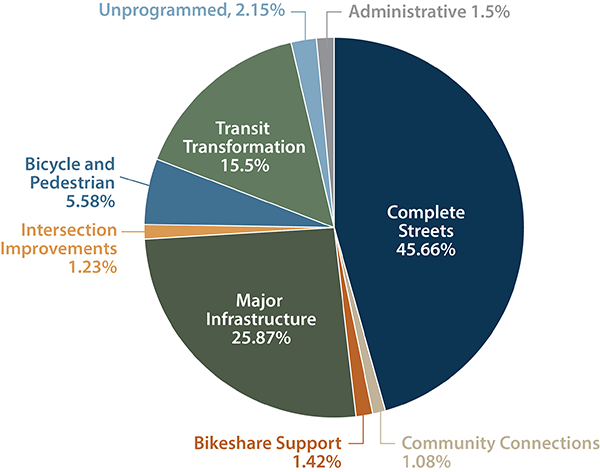
Figure ES-1 shows the distribution of Regional Target funding by investment program in the FFYs 2027–31 TIP. As shown in the figure, the Boston Region MPO’s Regional Target Program is devoted primarily to enhancing mobility and safety for all travel modes through significant investments in Complete Streets projects. A large portion of the MPO’s funding also supports the modernization of key regional roadways and transit infrastructure through investments in Major Infrastructure and Transit Transformation projects. The MPO has programmed more than 95.6 percent of its available funding over five years, electing to leave approximately $16.7 million unprogrammed.
Figure ES-1
FFYs 2027–31 TIP Regional Target Funding by MPO Investment Program
FFY = federal fiscal year. MPO = metropolitan planning organization. TIP = Transportation Improvement Program.
Source: Boston Region MPO.
Table ES-2 further details the number of projects and the allocation of funds across each program in the FFYs 2027–31 TIP. More details about every project funded through the MPO’s Regional Target Program are available in Chapter 3.
Table ES-2
FFYs 2027–31 Boston Region MPO Regional Target Investment Summary
| MPO Investment Program |
Number of Projects |
Regional Target Dollars Programmed |
|---|---|---|
Bicycle Network and Pedestrian Connections |
7 |
$43,595,151 |
Bikeshare Support |
3 |
$3,124,995 |
Bikeshare Support (not yet allocated to projects) |
1 |
$8,000,000 |
Community Connections (allocated to projects) |
1 |
$463,807 |
Community Connections (not yet allocated to projects)* |
1 |
$8,000,000 |
Complete Streets |
15 |
$356,736,419 |
Intersection Improvements |
2 |
$9,634,290 |
Major Infrastructure—Roadway |
3 |
$202,084,845 |
Transit Transformation (allocated to projects) |
7 |
$94,568,883 |
Transit Transformation (not yet allocated to projects) |
1 |
$26,500,000 |
Administrative |
N/A |
$11,750,000 |
Unprogrammed |
N/A |
$16,780,862 |
Total |
41 |
$781,239,252 |
Note: Funding amounts in this table include both federal and non-federal funds, including matching funds.
FFY = federal fiscal year. MPO = metropolitan planning organization. N/A = not applicable.
Source: Boston Region MPO.
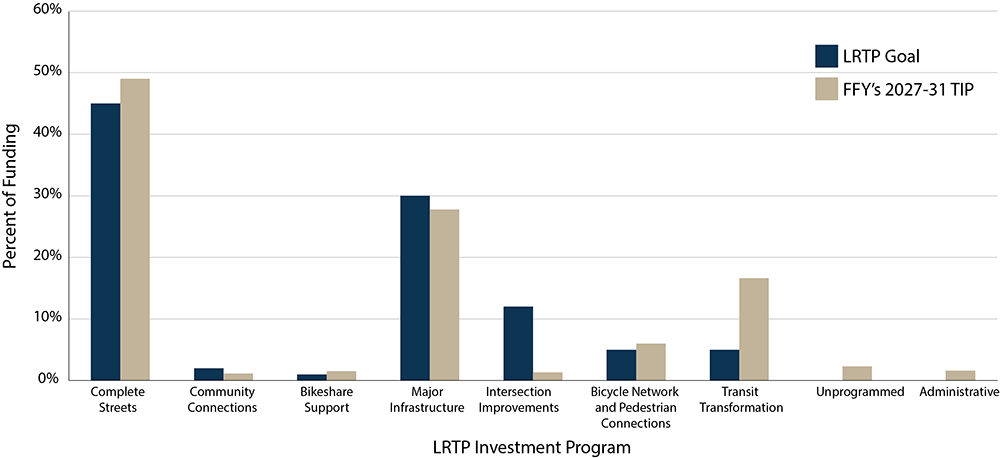
When making decisions about which projects to fund, the MPO considers how the allocation of funds to each investment program compares to the funding goals outlined in the MPO’s current Long-Range Transportation Plan (LRTP), Destination 2050. The funding goals for investment programs set forth in the LRTP reflect the types and mix of projects the MPO seeks to fund to help it achieve its goals and objectives for the region, from enhancing safety for all users to promoting mobility and accessibility across the region. More information on the MPO’s goals and objectives is available in Chapter 1, and a comparison between LRTP investment program goals and program funding levels in the FFYs 2027–31 TIP is shown in Figure ES-2.
Figure ES-2
FFYs 2027–31 TIP: Regional Target Funding Levels Relative to LRTP Investment Program Goals
FFY = federal fiscal year. LRTP = Long-Range Transportation Plan. TIP = Transportation Improvement Program.
Source: Boston Region MPO.
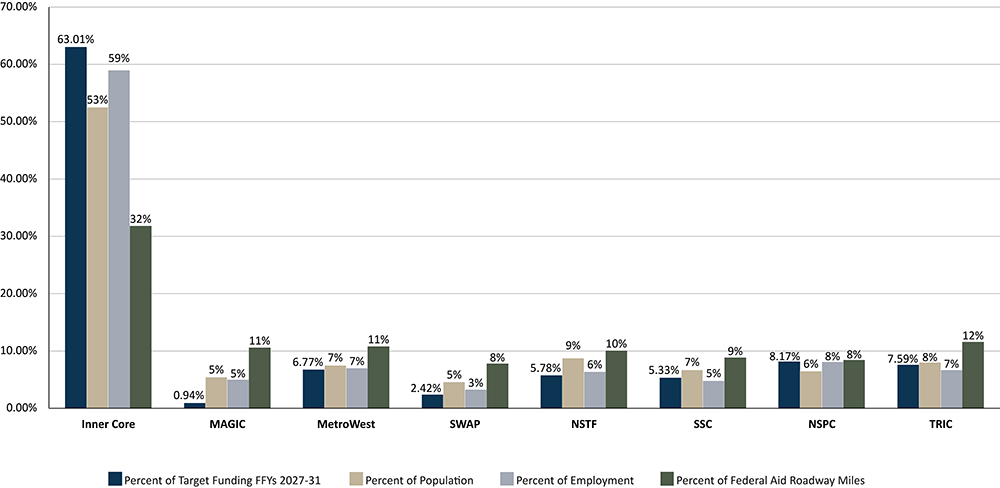
The investments made in the FFYs 2027–31 TIP will be implemented throughout the Boston region. Figure ES-3 illustrates the distribution of Regional Target funding among the eight subregions within the Boston Region MPO’s jurisdiction, as defined by the Metropolitan Area Planning Council (MAPC). This figure also shows how the distribution of funds compares to key metrics for measuring the need for funding by subregion, including the percent of regional population, employment, and Federal-Aid roadway miles within each subregion.
Figure ES-3
FFYs 2027–31 TIP: Regional Target Funding Levels Relative to Key Indicators
Note: Unprogrammed funds and funds held for the MPO’s Transit Transformation and Community Connections programs are not included in this figure.
FFY = federal fiscal year. MAGIC = Minuteman Advisory Group on Interlocal Coordination. MAPC = Metropolitan Area Planning Council. MetroWest = MetroWest Regional Collaborative. NSPC = North Suburban Planning Council. NSTF = North Shore Task Force. SSC = South Shore Coalition. SWAP = South West Advisory Committee. TIP = Transportation Improvement Program. TRIC = Three Rivers Interlocal Council.
Source: Boston Region MPO.
Additional information on the geographic distribution of Regional Target funding across the region, including a breakdown of funding by municipality, is included in Appendix D.
Financing the FFYs 2027–31 TIP
Highway Program
The TIP Highway Program was developed with the assumption that funding for Massachusetts from the Federal-Aid Highway Program would range between $838.1 million and $891.7 million annually over the next five years. These figures do not include matching funds provided for projects by the state or local entities. Projects are typically funded with 80 percent federal dollars and 20 percent state dollars, but the share may vary depending on the funding program. MassDOT customarily provides the local match (which can also be provided by other entities). Costs for project design are often borne by the proponent of the project, though the Boston Region MPO began allocating Regional Target funds for design support beginning with the FFYs 2025–29 TIP, a practice which continues through the FFYs 2027–31 TIP. With the addition of matching funds, approximately $1.04 billion to $1.10 billion was available statewide for projects in FFYs 2027–31.
The process of determining the MPO’s share of this federal funding for the Boston region follows several steps. First, MassDOT reserves funding for Grant Anticipation Notes (GANs) debt service payments. Then, the remaining Federal-Aid Highway Program funds are budgeted to support state and regional (i.e., MPO) priorities.
Next, MassDOT allocates funding across the following funding categories:
- Reliability Investments: These programs include the Bridge Program—comprising inspections, systematic maintenance, and National Highway System (NHS) and non-NHS improvements—the Pavement Program, the Roadway Improvements Program, and the Safety Improvements Program.
- Modernization Investments: These programs include the Americans with Disabilities Act (ADA) Retrofit Program, the Intersection Improvement Program, the Intelligent Transportation Systems (ITS) Program, and the Roadway Reconstruction Program.
- Expansion Investments: These programs include the Bicycle and Pedestrian Program and transit network expansions.
Finally, MassDOT allocates the remaining funding among the state’s 13 MPOs for programming. This discretionary funding for MPOs is suballocated by formula to determine the Regional Target amounts. The Boston Region MPO receives the largest portion of MPO funding in the state, with approximately 43 percent of Massachusetts’ Regional Target funds allocated to the region. MassDOT develops these targets in consultation with the Massachusetts Association of Regional Planning Agencies (MARPA). This TIP was programmed with the assumption that the Boston Region MPO will have between $159 million and $153 million annually for Regional Target amounts, which consist of federal funding and state funding for the local match.
Each MPO may decide how to prioritize its Regional Target funding. Given that the Regional Target funding originates from the Federal-Aid Highway Program, the Boston Region MPO typically programs the majority of funding for roadway projects; however, the MPO has flexed portions of its highway funding to the TIP Transit Program for transit expansion projects and through its Transit Transformation and Community Connections programs. The TIP Highway Program details the projects that will receive Regional Target funding from the Boston Region MPO and statewide infrastructure projects within the Boston region. Details on these investments are outlined in Chapter 3.
Transit Program
The Federal Transit Administration (FTA) allocates the funds programmed in the TIP Transit Program according to formula. The three regional transit authorities in the Boston Region MPO area that are recipients of these funds are the MBTA, CATA, and MWRTA. The MBTA, with its extensive transit program and infrastructure, is the recipient of the preponderance of the region’s federal transit funds.
The current federal transportation legislation, the Infrastructure Investment and Jobs Act, allocates funding to transit projects through the following formula programs:
- Section 5307 (Urbanized Area Formula Grants): Provides grants to urbanized areas to support public transportation based on levels of transit service, population, and other factors
- Section 5337 (Fixed Guideway/Bus): Seeks to maintain public transportation systems in a state of good repair through replacement and rehabilitation capital projects
- Section 5309 (Fixed Guideway Capital Investment Grants): Provides grants for new and expanded rail, bus rapid transit, and ferry systems that reflect local priorities to improve transportation options in key corridors
- Section 5339 (Bus and Bus Facilities): Provides funding to replace, rehabilitate, and purchase buses and related equipment, and to construct bus-related facilities
- Section 5310 (Enhanced Mobility of Seniors and Individuals with Disabilities): Provides funding to support transportation to meet the special needs of older adults and persons with disabilities
The TIP Development Process
Project Selection
When determining which projects to fund through the Regional Target funding process, MPO members collaborate with municipalities, state agencies, members of the public, advocacy groups, and other stakeholders. The MPO board uses evaluation criteria in its project selection process to help identify and prioritize projects that advance progress across the MPO’s six goal areas:
- Safety
- Mobility and Reliability
- Access and Connectivity
- Resilience
- Clean Air and Healthy Communities
- Transportation Equity
More information on the MPO’s goal areas can be found on the Destination 2050 web page: bostonmpo.org/lrtp.
As shown in Figure ES-1 and Table ES-2, the MPO has established investment programs designed to direct Regional Target funding towards MPO priority areas during the next 20 years:
- Intersection Improvements
- Complete Streets
- Major Infrastructure
- Bicycle Network and Pedestrian Connections
- Community Connections
- Bikeshare Support
- Transit Transformation
Projects that the MPO selects to receive Regional Target funding through the TIP development process are included in one of the seven investment programs listed above. More information about the MPO’s investment programs are available in Chapter 2.
The MPO incorporates performance-based planning and programming (PBPP) practices into its TIP development and other processes. These practices are designed to help direct MPO funds towards achieving specific and measurable outcomes for the transportation system. MPO investments directly relate to the PBPP framework and further the MPO’s goals and performance targets. The MPO will continue to closely link its performance targets, investment decisions, and monitoring and evaluation activities. More information on PBPP is available in Chapter 4.
Outreach and Data Collection
The outreach process for the TIP begins early in the federal fiscal year. Cities and towns designate TIP contacts and the MPO staff ask them to begin developing a list of priority projects to be considered for federal funding. MPO staff compiles the project funding requests into a Universe of Projects, which is a list of all projects identified as potential candidates to receive funding through the TIP.
Priority projects from regional transit authorities—the MBTA, MWRTA, and CATA—are typically identified as part of the authorities’ annual program development process. The MPO staff accepts the RTA’s applications for Transit Transformation funding in the fall. Projects that MPO staff receive applications for, that are not immediately selected for funding through the TIP, may be added to the Universe of Projects.
The Universe includes projects at varying levels of readiness, from those with significant engineering and design work complete to those still early in the conceptual or planning stage. MPO staff collects data on each project in the Universe so that the projects may be evaluated.
Project Evaluation
MPO staff evaluates projects based on how well they address the MPO’s goals. For MPO staff to conduct a complete project evaluation, projects eligible for Bicycle Network and Pedestrian Connections, Complete Streets, Intersection Improvements, and Major Infrastructure program funding must have a functional design report or the project plans must include the level of detail defined in a functional design report, a threshold typically reached when a project nears the 25 percent design stage. To complete an evaluation for projects under consideration through the MPO’s Community Connections program, project proponents must submit a completed application to MPO staff. More information on Project Evaluation is available in Appendix A.
TIP Readiness Day
An important step toward TIP programming takes place midway through the TIP development cycle at a meeting—referred to as TIP Readiness Day—that both MassDOT and MPO staff attend. At this meeting, MassDOT project managers provide updates about cost and schedule changes related to currently programmed projects. These cost and schedule changes must be taken into account as MPO staff helps the MPO board consider updates to the already programmed years of the TIP and the addition of new projects in the outermost year of the TIP.
In December 2025, the MPO adopted Revised Readiness Requirements to inform project programming alongside MassDOT recommendations. These requirements established a minimum design requirement for a project to be funded in each programming year of the TIP. More information on MPO programming policies is available in Appendix A.
Staff Recommendation and Draft TIP
Using the evaluation results and information about project readiness (i.e., the extent to which a project is fully designed and ready for construction), MPO staff prepares a series of recommendations for how to program the Regional Target funding in the TIP. The staff recommendation is always financially constrained—meaning, subject to available funding. There was approximately $785 million of Regional Target funding available to the Boston Region MPO for FFYs 2027–31.
In addition to prioritizing the Regional Target funding, the MPO board reviews and endorses the statewide highway program that MassDOT recommends for programming. The board also reviews and endorses programming of funds for the MBTA’s, CATA’s, and MWRTA’s transit capital programs.
Approving the TIP
After selecting a preferred programming scenario, usually in April, the MPO board votes to release the draft TIP for a 21-day public review period. The comment period typically begins in late April, and during this time the MPO invites members of the public, municipal officials, and other stakeholders in the Boston region to review the proposed program and submit feedback. During the public review period, MPO staff may host public meetings to discuss the draft TIP document and elicit additional comments.
After the public review period ends, the MPO board reviews all municipal and public comments and may change elements of the document or its programming. The MPO board then endorses the TIP and submits it to the Federal Highway Administration (FHWA) and the Federal Transit Administration (FTA) for approval. MassDOT incorporates the MPO-endorsed TIP into the State Transportation Improvement Program (STIP). The FHWA, FTA, and United States Environmental Protection Agency review the STIP for certification by September 30, the close of the federal fiscal year.
Updates to the TIP
Even after the TIP has been finalized, administrative modifications, amendments, and adjustments often must be introduced because of changes in project schedules, project costs, funding sources, or available revenues. This may necessitate reprogramming a project in a different funding year or programming additional funds for a project.
Notices of administrative modifications and amendments are posted on the MPO’s website. If an amendment is necessary, the MPO notifies affected municipalities, stakeholders, and members of the public via email. The MPO typically holds a 21-day public review period before taking final action on an amendment. In extraordinary circumstances, the MPO may vote to shorten the public comment period to a minimum of 15 days. Administrative modifications and adjustments are minor and usually do not warrant a public review period.
Stay Involved with the TIP
Public engagement is an important aspect of the transportation planning process. Please visit bostonmpo.org for more information about the MPO, to view the entire TIP, and to submit your comments. You also may wish to sign up for email news updates and notices by visiting bostonmpo.org/subscribe and submitting your contact information. To request a copy of the TIP in accessible formats, please contact the MPO staff by any of the following means:
Mail: Boston Region MPO c/o CTPS MPO Activities Group, 10 Park Plaza, Suite 2150, Boston, MA 02116-3968
Telephone: 857.702.3700 (voice)
For people with hearing or speaking difficulties, connect through the state MassRelay service:
Relay Using TTY or Hearing Carry-over: 800.439.2370
Relay Using Voice Carry-over: 866.887.6619
Relay Using Text to Speech: 866.645.9870
Email: publicinfo@ctps.org
Chapter 1: 3C Transportation Planning and the Boston Region Metropolitan Planning Organization
Introduction
Metropolitan Planning Organizations (MPO) were first given the authority to approve the use of federal funds for transportation planning and capital projects in a region through the Federal Highway Act of 1973. MPOs are established based on an agreement between the governor of a state and at least 75 percent of the local representation in a metropolitan area (typically representation through local elected officials) to provide a forum that engages state, regional, and local stakeholders in the transportation planning process. Each metropolitan area in the United States with a population of 50,000 or more is required by federal legislation to have an MPO.
MPOs establish regional transportation visions that are the overarching framework for decision-making about how to allocate federal transportation funds in a metropolitan area. This vision is informed by the input and needs of the full range of stakeholders in a region, including elected officials, municipal planners and engineers, transportation advocates, and residents.
The Boston Region MPO is the designated MPO for the 97 municipalities in eastern Massachusetts that comprise the MPO’s planning area. The Boston Region MPO develops plans for funding transportation projects and programs; maintains transportation models and data resources to support studies, system performance monitoring, and air quality determinations; and conducts an ongoing public engagement process.
The Transportation Planning Process
The federal government regulates the funding, planning, and operation of the surface transportation system through the federal transportation program, which was enacted into law through Titles 23 and 49 of the United States Code— Section 134 of Title 23 of the Federal Aid Highway Act, as amended, and Section 5303 of Title 49 of the Federal Transit Act, as amended.
The most recent reauthorization of the federal surface transportation law is the Infrastructure Investment and Jobs Act (IIJA). The IIJA sets policies related to metropolitan transportation planning and requires that all MPOs carry out a continuing, comprehensive, and cooperative (3C) transportation planning process. This process must result in plans and programs that support metropolitan community development and social goals and lead to the development and operation of an integrated, intermodal transportation system that facilitates the efficient, economic movement of people and goods.
The Boston Region MPO has established the following objectives for the process:
- A 3C transportation planning process resulting in plans, programs, and operations consistent with the planning objectives of the metropolitan area.
- Continuing, affirming the necessity to plan for the short- and long-range needs of the regional transportation system, emphasizing the iterative character of the progression from systems planning to project planning, programming, operations, and implementation. Frequent updating and reevaluation of data and plans is necessary.
- Comprehensive, including the effective integration of the various stages and levels of transportation planning and programming for the entire region and examining all modes to ensure a balanced planning effort. There are simultaneous analyses of various related non-transportation elements, such as land use, economic and residential development, demographics, sustainability, and community impact within an integrated planning and programming process.
- Cooperative, requiring effective coordination among public officials at all levels of government, and inviting the wide participation of all parties, public or private, at all stages of the transportation planning process. A key objective of the process is to resolve issues and controversies by providing a forum for negotiation and consensus building. At the same time, the process is not intended to operate, and cannot operate, to dilute the ultimate authority or responsibility of those state, regional, or local public officials who, pursuant to statute or under contract, review and/or implement transportation plans, programs, and projects.
- Compliance with the requirements of the IIJA, the Americans with Disabilities Act of 1990, the Clean Air Act of 1990, the Civil Rights Act of 1964, and Executive Order 13330 (regarding the coordination of human-services transportation)
More information about the federal, state, and regional guidance governing the transportation planning process, and about the regulatory framework in which the MPO operates can be found in Appendix E.
The Boston Region MPO
Planning Area
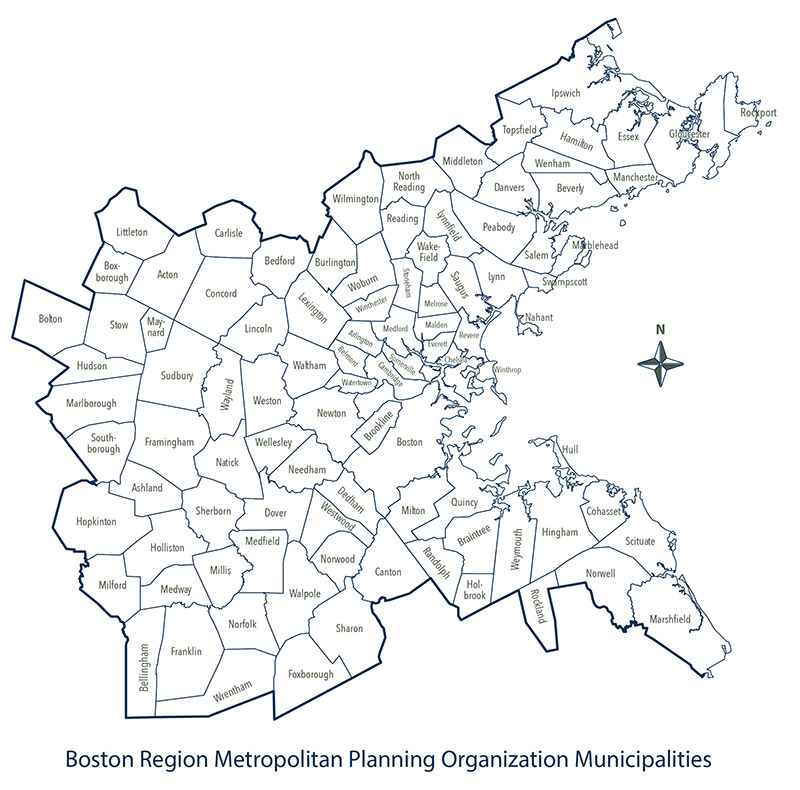
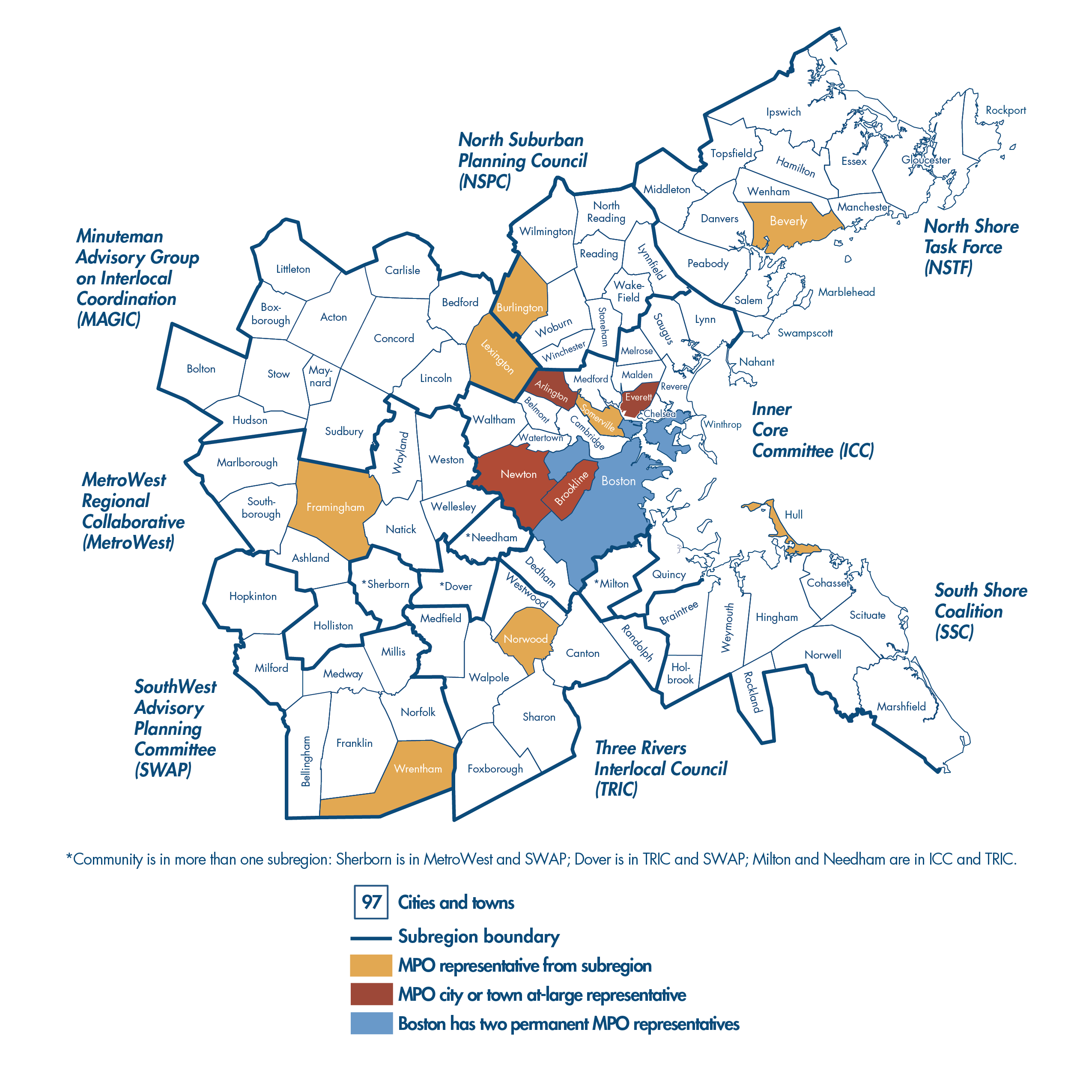
The Boston Region MPO’s planning area extends across 97 cities and towns. Figure 1-1 shows the map of the Boston Region MPO’s member municipalities.
Figure 1-1
Municipalities in the Boston Region
MPO Board Members and Staff
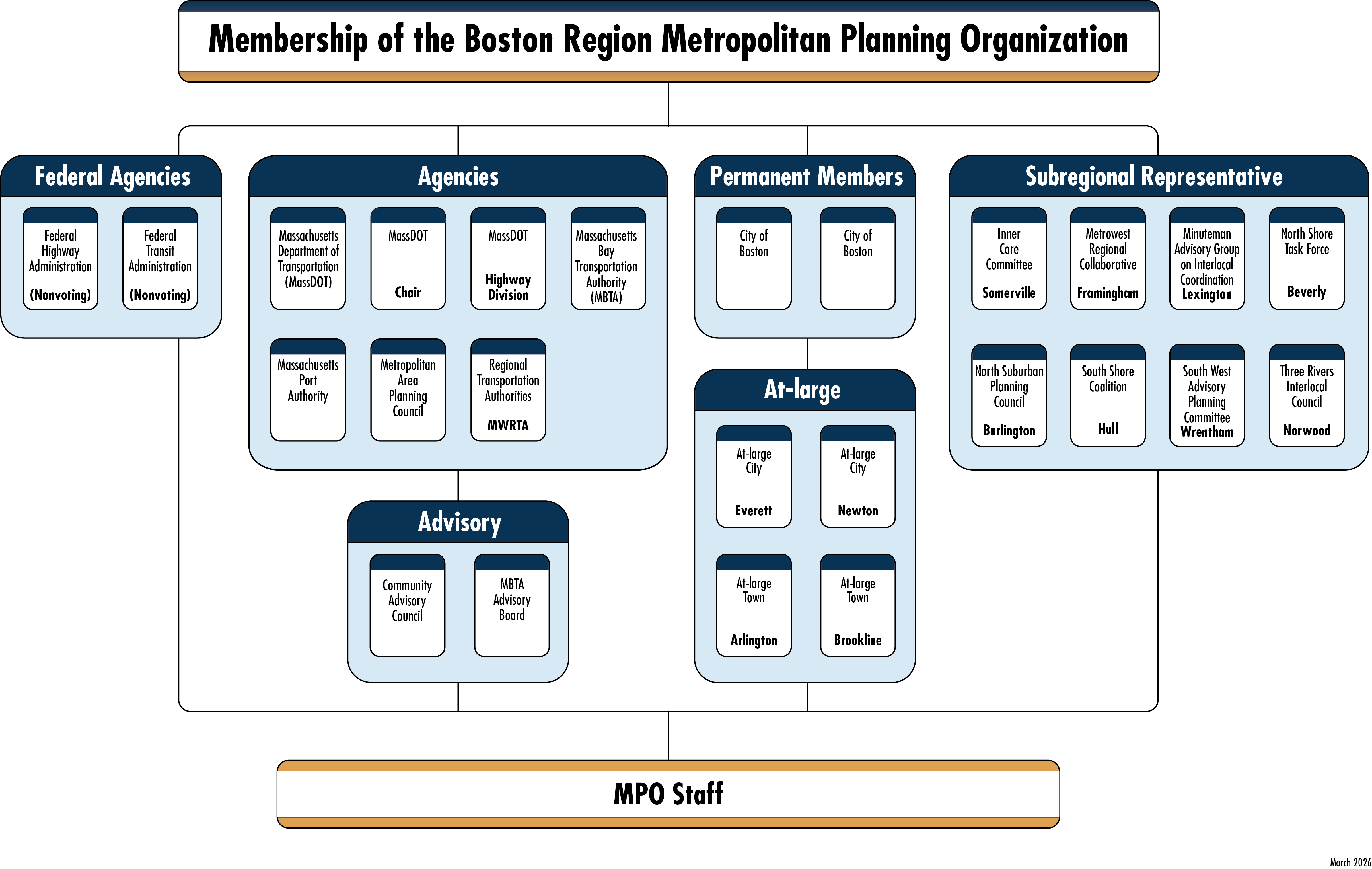
MPO decision-making is carried out by a board comprising 23 voting members, with comprehensive support from the MPO staff. Several state agencies, regional organizations, and the City of Boston are permanent voting members, while 12 municipalities are elected as voting members for three-year terms. Eight municipal members represent each of the eight subregions of the Boston region, and there are four at-large municipal seats. The Federal Highway Administration (FHWA) and Federal Transit Administration (FTA) participate on the MPO board as advisory (nonvoting) members. More details about the MPO’s permanent members can be found in Appendix F.
Figure 1-2 shows Boston Region MPO membership.
Figure 1-2
Boston Region MPO Membership
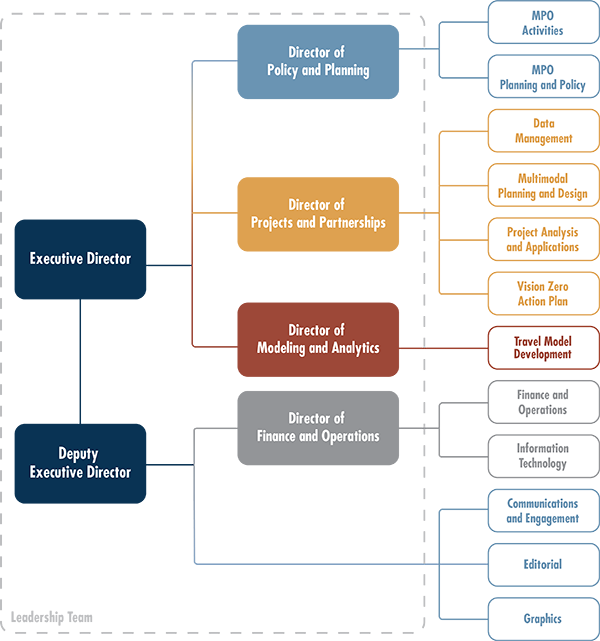
The Boston Region MPO staff is composed of transportation planners, data analysts, data scientists, engagement and communications experts, graphic designers, editors, and administrative support staff. The MPO also employs part-time data collectors to support its planning work.
Figure 1-3 shows the organization of the Boston Region MPO staff.
Figure 1-3
Boston Region MPO Organizational Chart
A Vision for the Region
Destination 2050, the MPO’s current Long-Range Transportation Plan (LRTP), was adopted in July 2023 and took effect October 1, 2023. The LRTP outlines the vision, goals, and objectives for the Boston region’s transportation system. More information about the LRTP can be found on the MPO’s website at https://www.bostonmpo.org/lrtp.
Certification Documents
As part of its 3C process, the Boston Region MPO produces the Transportation Improvement Program (TIP) and the Unified Planning Work Program (UPWP) annually, and the LRTP every four to five years. These documents, referred to as certification documents, are required for the federal government to certify the MPO’s planning process. Federal certification is a prerequisite for the MPO to receive federal transportation funds. A robust public engagement process accompanies the development of each certification document.
The Long-Range Transportation Plan
The LRTP guides decision-making on investments that will be made in the Boston region’s transportation system over the next two decades. It defines an overarching vision of the future of transportation in the region, establishes goals and objectives that will lead to achieving that vision, and allocates projected revenue to transportation projects and programs consistent with the established goals and objectives.
The Transportation Improvement Program
The TIP is a capital investment program of multimodal transportation improvements, consistent with the LRTP, that describes and prioritizes transportation projects that are expected to be implemented during a five-year period. TIP projects include major highway reconstruction and maintenance, arterial and intersection improvements, public transit expansion and maintenance, paths and other facilities designated for people walking, biking, and rolling, and bikeshare capital improvements.
The TIP contains a financial plan that shows the current or proposed revenue sources for each project.
An MPO-endorsed TIP is incorporated into the State Transportation Improvement Program (STIP) for submission to the FHWA, FTA, United States Environmental Protection Agency, and the Massachusetts Department of Environmental Protection for approval. Investments programmed in the TIP and STIP are also reflected in Massachusetts Department of Transportation’s (MassDOT) Capital Investment Plan, which shows capital expenditures in the state over a five-year period.
The Unified Planning Work Program
The UPWP describes the transportation planning work that will be conducted by MPO staff during the course of a federal fiscal year, which runs from October 1 through September 30. The document includes ongoing planning work as it will be advanced in the federal fiscal year, supportive activities undertaken by MPO staff to enable that work, such as information technology, graphics, and editorial support, and single-year planning initiatives as approved by the MPO Board. It also describes activities carried out by MPO staff that are funded through partner agencies or grant programs.
The UPWP documents the collaborative metropolitan transportation planning process by describing all regionally significant, federally funded transportation planning work in the region that will occur over the next year. This information, incorporated into the appendix of the document, includes work carried out by Metropolitan Area Planning Council, MassDOT, Massachusetts Bay Transportation Authority (MBTA), MetroWest Regional Transit Authority (MWRTA), Cape Ann Transportation Authority (CATA), and municipalities and other partners in the Boston Region.
Performance-Based Planning
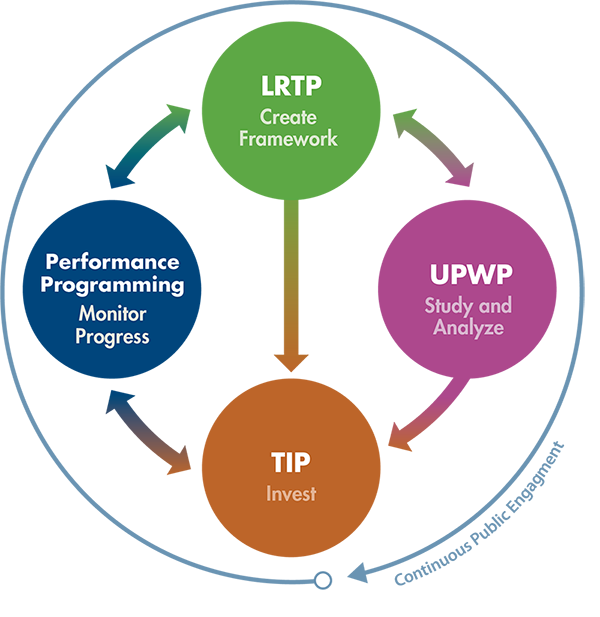
The three certification documents are intrinsically interconnected. The LRTP sets the vision, goals, and objectives framework to guide the ongoing work of the MPO captured in the UPWP and the investment decisions programmed in the TIP. Much of the planning work included in the UPWP is a means to study transportation issues and alternatives before advancing to further design, construction, and possible future programming through the TIP. Finally, performance-based planning processes ensure that the MPO’s planning and capital investments are driving progress towards the MPO’s goals.
Figure 1-4 depicts the relationship between the three certification documents and the MPO’s performance-based planning and programming process.
Figure 1-4
Relationship between the LRTP, TIP, UPWP, and
Performance-Based Planning Process
Chapter 2: The TIP Process
Introduction to the TIP Process
Transportation improvements are part of the solution to many critical regional, state, national, and even global problems, such as traffic congestion, air quality, fatalities and injuries on roadways, and environmental degradation. Therefore, one of the most important decisions a metropolitan planning organization (MPO) faces is deciding how to allocate limited funds for transportation projects and programs. Because there is insufficient funding available for all projects that would address these problems, an MPO’s investment choices must be guided by policies that help identify the most viable and effective solutions.
The Boston Region MPO is guided by the policies in its Long-Range Transportation Plan (LRTP), and the MPO develops a Transportation Improvement Program (TIP) to prioritize the expenditure of federal funds on transportation projects in the region. The MPO staff manages the development of both plans.
During the annual development process for the TIP, the MPO staff supports the MPO board by evaluating project funding requests from municipalities and state and regional transportation agencies. The staff proposes a range of alternative scenarios for the programming of new and ongoing projects based on anticipated yearly funding levels, and staff works with the board to create a draft TIP document. The staff also facilitates a public engagement process that affords the public an opportunity to comment on proposed projects and review the draft TIP before the MPO board endorses the final document.
Funding the TIP
Federal Funding Framework
The first step in allocating federal transportation funds is the passage by the United States Congress of a multiyear act that establishes a maximum level of federal transportation funding per federal fiscal year (FFY). The establishment of this level of funding is referred to as an authorization. The most recent authorization act, the Infrastructure Investment and Jobs Act (IIJA), was signed into law on November 15, 2021. The IIJA governed the development of the FFYs 2027–31 TIP. More information on the impacts of the IIJA on the development of the FFYs 2027–31 TIP is available throughout this report. Specific guidance on federal Planning Emphasis Areas is available in Appendix E.)
After the authorization level has been established, the United States Department of Transportation annually allocates funding among the states according to various federal formulas. This allocation is referred to as an apportionment. The annual apportionment rarely represents the actual amount of federal funds that are ultimately committed to a state because of federally imposed limitations on spending in a given fiscal year, referred to as the obligation authority. In Massachusetts, TIPs are developed based on the estimated obligation authority.
Federal Highway Program
The TIP Highway Program was developed with the assumption that funding for Massachusetts from the Federal-Aid Highway Program would range between $838.1 million and $891.7 million annually over the next five years. These figures do not include matching funds provided for projects by the state or local entities. Projects are typically funded with 80 percent federal dollars and 20 percent state dollars, but the share may vary depending on the funding program. Costs for project design are often borne by the proponent of the project. With the addition of matching funds, approximately $1.04 billion to $1.10 billion was available statewide for projects in FFYs 2027–31.
The process of determining the MPO’s share of this federal funding for the Boston region follows several steps. First, the Massachusetts Department of Transportation (MassDOT) reserves funding for debt service payments on Grant Anticipation Notes (GANs). Then, the remaining Federal-Aid Highway Program funds are budgeted to support state and regional (i.e., MPO) priorities. The funding for regional priorities is referred to as Regional Target funds.
Regional Targets
The Regional Targetsare discretionary funds for MPOs, suballocated by formula to each metropolitan planning region. The Boston Region MPO receives about 43 percent of the total funds available statewide for Regional Targets. MassDOT developed the target formula for determining this distribution of funds in consultation with the Massachusetts Association of Regional Planning Agencies (MARPA).
Each MPO in the state can decide how to prioritize its Regional Target funding. The Boston Region MPO does this by engaging its 97 cities and towns in an annual TIP development process. Given that the Regional Target funding originates from the Federal-Aid Highway Program, the Boston Region MPO board typically programs the majority of its target funding on roadway projects; however, the MPO board has flexed portions of its TIP Highway Program funding to the TIP’s Transit Program.
During the next five years, the Boston Region MPO’s total Regional Target funding will be approximately $781.2 million, an average of $150.83 million per year. The MPO’s Regional Target funds increased 3.5 percent per year in the FFYs 2027–31 TIP relative to the levels planned for in the development of the FFYs 2026–30 TIP. This increase resulted because payment on GANs was not necessary in FFY 2030. Funding levels in FFYs 2027 through 2031 remain largely the same from the previous TIP.
Federal Highway Administration Programs
The Federal-Aid Highway Program dollars discussed in this chapter are delivered through several Federal Highway Administration (FHWA) funding programs, each of which has unique requirements. Table 2-1 lists the programs in the IIJA that fund projects in the FFYs 2027–31 TIP.
Table 2-1
Federal Highway Administration Programs Applicable to the FFYs 2027–31 Transportation Improvement Program
Bipartisan Infrastructure Law Program |
Eligible Uses |
Bridge Formula Program (BFP) |
Efforts to replace, rehabilitate, preserve, protect, and construct highway bridges |
Carbon Reduction Program (CARBON) |
Projects that reduce transportation emissions or develop carbon reduction strategies. |
Congestion Mitigation and Air Quality Improvement (CMAQ) |
A wide range of projects to reduce congestion and improve air quality in nonattainment and maintenance areas for ozone, carbon monoxide, and particulate matter |
Highway Safety Improvement Program (HSIP) |
Implementation of infrastructure-related highway safety improvements |
Metropolitan Planning |
Facilities that contribute to an intermodal transportation system, including intercity bus, pedestrian, and bicycle facilities |
National Electric Vehicle Infrastructure (NEVI) Program |
Projects that support the strategic deployment of electric vehicle (EV) charging infrastructure and establish an interconnected EV network to facilitate data collection, access, and reliability |
National Highway Freight Program (NHFP) |
Projects that improve the efficient movement of freight on the National Highway Freight Network |
National Highway Performance Program (NHPP) |
Improvements to interstate routes, major urban and rural arterials, connectors to major intermodal facilities, and the national defense network; replacement or rehabilitation of any public bridge; and resurfacing, restoring, and rehabilitating routes on the Interstate Highway System |
Promoting Resilient Operations for Transformative, Efficient, and Cost-saving Transportation Program (PROTECT) |
Resiliency improvements, including improvements to community resilience and evacuation routes, and at risk coastal infrastructure. Highway, transit, and port projects are also eligible. |
Surface Transportation Block Grant Program (STBGP) |
A broad range of surface transportation capital needs, including roads; transit, sea, and airport access; and vanpool, bicycle, and pedestrian facilities |
Transportation Alternatives Program (TAP) |
A set-aside from the STBGP that funds the construction of infrastructure-related projects (for example, sidewalk, crossing, and on-road bicycle facility improvements) |
Source: Federal Highway Administration.
Federal Transit Program
Federal aid for public transit authorities is allocated by formula to urbanized areas (UZAs). MassDOT is the recipient of this federal aid in the Boston MA-NH-RI UZA. In UZAs with populations greater than 200,000, such as the Boston MA-NH-RI UZA, the distribution formula factors in passenger-miles traveled, population density, and other factors associated with each transit provider. The three regional transit authorities (RTAs) in the Boston Region MPO area are the Massachusetts Bay Transportation Authority (MBTA), MetroWest Regional Transit Authority (MWRTA), and Cape Ann Transportation Authority (CATA). The MBTA, with its extensive transit program and infrastructure, is the recipient of the preponderance of federal transit funds in the region.
The Federal Transit Administration (FTA) distributes funding to transit agencies through several different programs. As previously noted, the MPO converts some of its FHWA funding to FTA to support transit investments. Table 2-2 shows FTA programs in the IIJA that support transit investments in the FFYs 2027–31 TIP.
Table 2-2
Federal Transit Administration Programs Applicable to the FFYs 2027–31 Transportation Improvement Program
Bipartisan Infrastructure Law Program |
Eligible Uses |
Urbanized Area Formula Grants (Section 5307) |
Transit capital and operating assistance in urbanized areas |
Fixed Guideway/Bus (Section 5337) |
Replacement, rehabilitation, and other state-of-good-repair capital projects |
Bus and Bus Facilities (Section 5339) |
Capital projects to replace, rehabilitate, and purchase buses and related equipment, and to construct bus-related facilities |
Enhanced Mobility of Seniors and Individuals with Disabilities (Section 5310) |
Capital expenses that support transportation to meet the special needs of older adults and persons with disabilities |
Fixed-Guideway Capital Investment Grants (Section 5309) |
Grants for new and expanded rail, bus rapid transit, and ferry systems that reflect local priorities to improve transportation options in key corridors |
Source: Federal Transit Administration.
Investment Frameworks
MPO Investment Framework
Each MPO in the state prioritizes the Regional Target funding it receives through the processes established by FHWA and MassDOT. The Boston Region MPO’s LRTP defines the investment framework that informs the specific investment decisions made in the TIP by establishing
- the MPO’s transportation vision, goals, and objectives, which shape the MPO’s project evaluation criteria;
- MPO investment programs; and
- other guidelines that help the MPO determine how to allocate funding across its investment programs.
MPO Goals and Objectives
The MPO’s goals and objectives provide the foundation for the evaluation criteria that the MPO board uses when selecting transportation projects to be funded with Regional Target dollars. MPO staff compares candidate projects’ characteristics to these criteria to evaluate whether individual projects can help the MPO advance its various goals. The criteria used to select projects for this TIP are based on the MPO’s goals and objectives, adopted as part of Destination 2050, which is the LRTP the MPO endorsed in July 2023. These goals and objectives are listed in Chapter 1.
MPO Investment Programs
In Destination 2050 and the prior LRTP, Destination 2040, the MPO revised its investment programs to include a broader range of prospective projects. These investment programs focus on specific types of projects that the MPO expects will help achieve its goals and objectives for the transportation system. The MPO created these programs to give municipalities the confidence that if they design these types of projects, the MPO will be willing to fund them through the TIP:
- Complete Streets
- Intersection Improvements
- Bicycle Network and Pedestrian Connections
- Major Infrastructure (including major transit infrastructure improvements that could be funded with flexed highway funds)
- Community Connections
- Transit Transformation
- Bikeshare Support
The MPO established the Transit Modernization program in Destination 2040, which became the Transit Transformation program in Destination 2050. The Transit Transformation program represented a significant shift in the MPO’s investment strategy as funding would be allocated to transit projects on an annual basis. In prior years, the MPO funded transit projects on a one-off basis when funding was requested for specific projects in the region. However, by creating the programming infrastructure to reallocate Regional Target highway funds to transit projects annually, the Boston Region MPO has established itself as a leader among MPOs nationally by crafting an investment strategy that is truly multimodal.
Funding for the Community Connections, Transit Transformation, and Bikeshare Support Programs continues to be reserved in FFYs 2027–30 for allocation in future TIP cycles. Starting with the FFYs 2027–31 TIP, funding is also reserved for allocation to support project design based on the findings of a Project Design Pilot in FFY 2025.
More information on the projects selected for funding in each of the MPO’s investment programs can be found in Chapter 3.
Categorizing Projects
When developing the LRTP, the MPO sets funding allocation goals for each of its investment programs to ensure that limited Regional Target funding is programmed in ways that best achieve the goals for transportation in the region. Because the MPO considers the five-year distribution of TIP funds across its investment programs relative to the goals set forth in the LRTP (as shown in Figure 2-1), properly categorizing projects is a critical component of the MPO’s decision-making process.
Figure 2-1
Destination 2050 Funding Goals by MPO Investment Program
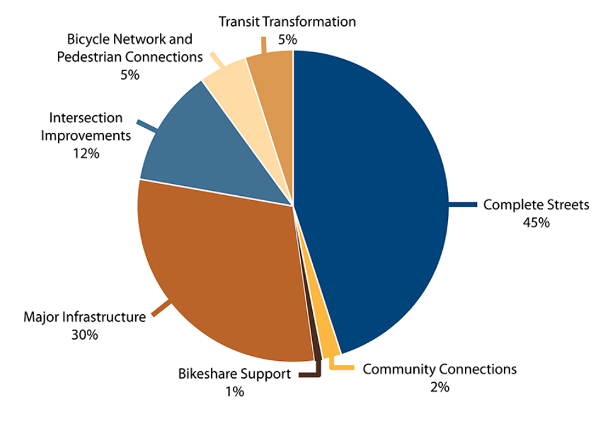
Source: Boston Region MPO.
Project Cost Estimates
In December 2025, the MPO adopted updated project design guidelines to support decision-making about the requisite design stages a project must reach to be funded in a given program year. These guidelines reinforce a prior policy adopted by the MPO board in September 2021 that set a 25 percent design threshold for projects to be programmed in the TIP to minimize the risk of project cost increases. Under these updated design guidelines, proponents of regionally prioritized projects are required to submit updated cost estimates to MPO staff no less than once every 1.5 years, and to progress design annually to affirm the project’s continued funding in the TIP.
MassDOT and Transit Agency Investment Frameworks
MassDOT and the MBTA each update their rolling five-year Capital Investment Plans (CIPs) on an annual basis. MassDOT’s CIP identifies priority roadway, bridge, and statewide infrastructure projects for the five MassDOT divisions and includes funding for specific transit projects such as the South Coast Rail. The MBTA’s CIP outlines the agency’s five-year investment strategy for transit projects in its service area. Both CIP processes use a similar framework that prioritizes funding according to statewide strategic goals for the transportation system. Reliability is the top priority for MassDOT and the MBTA, followed by modernization and then expansion. Both agencies have created investment programs for their respective CIPs that relate to these strategic goals and allocate funding to these programs in ways that emphasize their priority. These goals and investment programs are as follows:
- Reliability: These investments are oriented toward maintaining and improving the overall condition and reliability of the transportation system. They include capital maintenance projects, state-of-good-repair projects, and other asset management and system preservation projects. The MassDOT Highway Division programs in this area include the Bridge Program—including inspections, systematic maintenance, and National Highway System (NHS) and non-NHS improvements—the Pavement Program, the Roadway Improvements Program, and the Safety Improvements Program. MBTA reliability programs include its Revenue Vehicles Program; Track, Signals, and Power Program; Bridge and Tunnel Program; Stations Program; Facilities Program; and Systems Upgrade/Other investments.
- Modernization: These investments enhance the transportation system to make it safer and more accessible and to accommodate growth. These projects address compliance with federal mandates or other statutory requirements for safety and/or accessibility improvements; exceed state-of-good-repair thresholds to modernize existing assets; and provide expanded capacity to accommodate current or anticipated demand on transportation systems. The MassDOT Highway Division programs in this area include the Americans with Disabilities Act (ADA) Retrofit Program, the Intersection Improvement Program, the Intelligent Transportation System (ITS) Program, and the Roadway Reconstruction Program. MBTA programs in this area include the Red and Orange Line Improvements Program, the Commuter Rail Safety and Resiliency Program, the Accessibility Program, the Risk Management and Mitigation Program, the Automated Fare Collection (AFC) Program, the Rail Transformation Program, and the Customer Experience and Technology Improvements Program.
- Expansion: These investments provide more diverse transportation options for communities throughout the Commonwealth. They expand highway, transit, and rail networks and/or services, or they expand bicycle and pedestrian networks to provide more transportation options and address health and sustainability objectives. The MassDOT Highway Division programs in this area include the Bicycle and Pedestrian Program and the Capacity Program. The MBTA’s major expansion program is for the Red-Blue Connector extension of the Blue Line from Bowdoin Station to Charles/MGH Station.
Developing the TIP
Project Selection Process
Overview
The MPO applies its investment framework when developing the TIP. The MPO board’s process for selecting projects to receive Regional Target funding relies on evaluation criteria to help identify and prioritize projects that advance the MPO’s goals. The criteria are based on the MPO’s goals and objectives outlined in the LRTP. All projects are required to show consistency with the LRTP and other statewide and regional plans. Other considerations include the readiness of a project for construction and municipal support for the project. Background information about the TIP project evaluation process is presented in Appendix A.
The MPO typically updates its LRTP every four years. With each LRTP update, the MPO reviews and updates its goals, objectives, and investment programs. Following the adoption of Destination 2050 in July 2023, the MPO revised the TIP evaluation criteria to better align with the updated goals, objectives, and investment programs, including a new resilience goal area. The final criteria were informed by robust public engagement conducted during the development of Destination 2050, and developed through an update process that engaged MPO members, staff, and external stakeholders. The most significant update to the criteria for the FFYs 2025–29 TIP was the development of new and broader resilience evaluation metrics to align with the resilience goal area in Destination 2050. These criteria were employed during the project selection process for the FFYs 2027–31 TIP.
More information on these criteria is available in the Project Evaluation section of this chapter, as well as in Appendix A.
Outreach and Data Collection (October–November)
The TIP development process begins early in the federal fiscal year when cities and towns in the region designate staff as TIP contacts and begin developing a list of priority projects to be considered for federal funding. Each fall, the MPO staff asks these TIP contacts to identify their city’s or town’s priority projects and then MPO staff elicits input from interested parties and members of the general public.
These discussions about municipalities’ priority projects mark the start of a robust dialogue between MPO staff and project proponents that continues through the duration of the TIP cycle. In January 2026, MPO staff hosted Subregional Readiness Days—three meetings for municipalities to provide status updates on their projects to MPO staff. MPO staff also regularly hosted one-on-one virtual office hours throughout the year for proponents to ask more detailed questions about advancing specific projects for funding.
Once project proponents have decided to pursue TIP funding, they must begin the formal project initiation process. All new Bicycle Network and Pedestrian Connections, Complete Streets, Intersection Improvements, and Major Infrastructure projects must be initiated with the MassDOT Highway Division before they can be considered for programming in the TIP. These include projects seeking design funding as well as construction funds. MassDOT details this process on its project initiation web page, located here.
To be considered for programming, proponents of Community Connections, Bikeshare Support, and Transit Transformation projects must apply for funding directly to MPO staff, as these projects do not require initiation with MassDOT. Municipalities seeking to advance Transit Transformation projects must apply for funding via their transit provider (the MBTA, MWRTA, or CATA).
The MPO staff compiles project funding requests for projects into a Universe of Projects list, which consists of all identified projects being advanced for possible funding in a future TIP cycle. The Universe includes projects that are at advanced stages of project design, those that are undergoing preliminary engineering and design, and projects still in the conceptual planning stage. Applications for projects that are active municipal priorities and are feasibly ready to be programmed in the current TIP cycle continue forward into the MPO’s project evaluation process. Projects that are not ready for programming remain in the Universe for consideration in future TIP cycles.
Project Evaluation (December-February)
The MPO staff uses project evaluation criteria to objectively and transparently evaluate and select projects for programming in the TIP that advance the MPO’s vision for transportation in the region. This process favors projects that support the following goals:
- Facilitate an inclusive and transparent transportation-planning process and make investments that eliminate transportation-related disparities.
- Achieve zero transportation-related fatalities and serious injuries and improve safety for all users of the transportation system.
- Support easy and reliable movement of people and freight.
- Provide transportation options and improve access to key destinations to support economic vitality and quality of life.
- Provide transportation that supports sustainable environments and enables people to respond and adapt to extreme weather events and other changing conditions.
- Provide transportation free of greenhouse gas emissions and air pollutants and that supports good health.
As noted previously, the MPO undertook a process of revising the TIP evaluation criteria prior to the launch of the FFYs 2025–29 TIP to enhance the alignment between the TIP project selection process and the MPO’s updated goals, objectives, and investment programs outlined in Destination 2050. In terms of the overall structure of the criteria, this process resulted in the following outcomes:
- The creation of criteria for the MPO’s Transit Transformation program
- Revisions to the existing criteria for the MPO’s Bicycle Network and Pedestrian Connections, Complete Streets, Community Connections, and Intersection Improvements, allowing for each program to have a distinct set of criteria that better evaluates the specific aspects of each type of project
- Consolidation of Major Infrastructure criteria to be classified under Complete Streets or Transit Transformation, depending on the nature of the project
In addition to these broader structural changes, several updates were made to individual criteria to better accomplish the MPO’s goals in the LRTP:
- Safety criteria were revised to provide emphasis in all areas for investments that enhance usability for those at higher risk.
- The ways in which the MPO considers resiliency in project selection was broadened by adding a dedicated resiliency scoring category.
- New criteria were added to emphasize projects that provide access to existing or planned residential and mixed-use developments, with additional points for projects sited near 40B or Section 3A MBTA Communities developments and districts.1
Several other changes were made to the project evaluation criteria, which are detailed in Appendix A. Some of the projects in this FFYs 2027–31 TIP were scored prior to the criteria revisions, so both sets of criteria are referenced throughout this document.
In October 2025, the MPO board voted to adopt an updated Project Rescoring Policy. This policy requires project proponents to submit updated materials for project scoring if their project remains funded on the TIP after approximately five or more years beyond its original programming date. This policy was intended to address the substantial discrepancies in scoring methodologies among projects within the Regional Target Program. The FFYs 2027–31 TIP implements this policy to refresh scores for projects evaluated for inclusion in the FFYs 2021–25 TIP or earlier. The next rescoring effort covers projects evaluated from the FFYs 2022–26 through FFYs 2024–28 TIPs, ensuring updated data for development of the FFYs 2029–33 TIP.
To facilitate a complete evaluation, each project proponent must provide enough information for staff to meaningfully apply the evaluation criteria. Proponents of projects seeking construction funds for Core Investment Program projects must have at least a Pre-25 percent submission submitted and reviewed by MassDOT. Proponents of projects seeking design funding are required to provide a written scope or vision for development consistent with the information provided in a MassDOT Project Initiation Form. For Community Connections projects, proponents must submit a complete application to the MPO, including required supporting documentation such as budget sheets, letters of support from partner entities, and work estimates. Transit Transformation project applicants must submit an application with all relevant forms, budget sheets, and designs based on the scope of work proposed.
After MPO staff has completed an initial round of project scoring, draft scores are distributed to project proponents for their review. The MPO’s goal is to assess all projects fairly and accurately, making this review a critical component of the TIP process. Proponents are encouraged to submit feedback to MPO staff on their projects’ scores if they feel any criteria have been applied inaccurately. Proponents are also encouraged to submit additional supporting documentation on their projects if doing so would help clarify or correct any elements of the draft scoring. MPO staff takes all proponent feedback into consideration and makes any necessary adjustments to project scores before considering the evaluation process final and preparing the scores for presentation to the MPO.
For more details about the criteria used to score projects and project evaluation results for projects considered for programming in this TIP, see Appendix A.
TIP Readiness Day (February)
On TIP Readiness Day, MPO staff meet with members of the MassDOT Highway Division and Office of Transportation Planning to review cost and schedule changes related to currently programmed projects. The MPO board considers these updated project construction costs and changes to the expected dates for construction advertisement when making decisions about changes to TIP programming. These changes have an impact on the ability of the MPO to program its Regional Target funds for new projects in the five-year TIP. Between June 2021 and December 2025, the MPO board developed, reviewed, and employed policies intended to limit the frequency of project cost increases and delays for regionally prioritized projects. More information on these policies is available in Chapter 3.
Staff Recommendation and Project Selection (March-April)
Using the evaluation scores and information gathered about project readiness (when a project likely would be fully designed and ready for advertisement) and cost, staff prepares possible TIP project programming scenarios for the MPO board’s consideration. When developing these scenarios, MPO staff also considers whether a project was programmed in the LRTP, LRTP-based guidelines for allocating funds to different programs or project types, the distribution of investments across the region, and availability of sufficient funding. The MPO staff gathers feedback from board members, project proponents, and the public to inform a final staff recommendation. The recommendation is then presented to the MPO for approval before it is included in the draft TIP for public review.
More information on the projects funded in this FFYs 2027–31 TIP is available in Chapter 3.
Selection Process for Projects Prioritized by the State and Transit Agencies
As discussed above, the selection of transit, bridge, and statewide infrastructure projects for programming in the TIP draws primarily from the CIPs produced by MassDOT and the MBTA. These agencies evaluate projects for inclusion in CIP programs using criteria established by the independent Project Selection Advisory Council (PSAC). The following criteria are from the PSAC process guide project evaluation:
- System Preservation: Projects should contribute to a state of good repair on the system and align with asset management goals.
- Mobility: Projects should provide efficient and effective modal options for all users.
- Cost Effectiveness: Projects should result in benefits commensurate with costs and should be aimed at maximizing the return on the public’s investment.
- Economic Impact: Projects should support strategic economic growth in the Commonwealth.
- Safety: Projects should contribute to the safety and security of people and goods in transit.
- Social Equity: Projects should equitably distribute the social, economic, and health benefits of investments among all communities.
- Environmental and Health Effects: Projects should advance state goals of improving air quality and reducing greenhouse gas emissions and pollution.
- Policy Support: Projects should get credit if they support local or regional policies or plans, or state policies not addressed through the other criteria.
Projects that receive the highest priority are those that meet each agency’s goals for maintaining and improving the overall condition and reliability of the system; modernizing the system to make it safer and more accessible and to accommodate growth; and expanding and diversifying transportation options for communities. These project-prioritization processes may also reflect other planning initiatives, such as Focus40, the MBTA’s 25-year investment plan, or MassDOT’s modal plans. More information on regulatory and planning guidance governing TIP project prioritization is available in Appendix E.
Once project prioritization is complete, programming decisions are made based on these evaluations and information regarding project readiness, program sizing, and existing asset management plans.
The transit element of the TIP also includes the Federal-Aid Programs of CATA and MWRTA. Once selection processes are complete, MassDOT, the MBTA, MWRTA, and CATA submit their lists of bridge and roadway projects, bicycle and pedestrian improvements, statewide infrastructure items, and transit capital projects to the MPO for review.
Approving the TIP
Approval of the Draft TIP for Public Review
The MPO board considers the project evaluation results and staff recommendation when prioritizing projects for Regional Target funding. The board also considers public comments, the regional importance of projects, and other factors. In addition to prioritizing the Regional Target funding, the MPO board reviews MassDOT’s proposed statewide highway programming and the proposed capital programs for the MBTA, CATA, and MWRTA before voting to release a draft TIP for public review.
The MPO board votes to release the draft document for public review and invites members of the public, municipal and elected officials, and other stakeholders in the Boston region to review the proposed TIP. The MPO staff hosts outreach events during the public review period to elicit comments on the draft document. (See Appendix C for a full list of public comments submitted on this draft TIP.)
Approval of the Draft TIP
After the public review period ends, the MPO staff and board review all public comments, and the board may change the programming or the document as appropriate before endorsing the TIP. MassDOT staff incorporates the MPO-endorsed TIP into the State Transportation Improvement Program (STIP) and submits it to the FHWA and FTA for approval. The FHWA, FTA, and US Environmental Protection Agency review the STIP and certify it by September 30, the end of the federal fiscal year.
Updating the TIP
The TIP is a dynamic program that may be amended and adjusted throughout the year. Administrative modifications and amendments are often introduced because of changes in project status (advertisement readiness), project cost, project design scope, or available revenue. An amendment is a revision that requires public review and a demonstration of fiscal constraint.
Consistent with federal guidelines, the Boston Region MPO must release an amendment if there is (1) a change in project cost of $500,000 or more for projects valued at $5 million or less, or (2) a change of 10 percent or more of the project cost for projects valued greater than $5 million. TIP amendments are also released if there is a proposal to add or remove a project from the TIP or if the programming year of a project is changed. Cost changes that are less than the above threshold amounts may be considered in the form of administrative modifications or adjustments, which must still undergo MPO board action for approval. Administrative modifications or adjustments are also undertaken in the event that a project’s funding source changes. Although a public review period is not required for administrative modifications or adjustments, one may be offered at the MPO board’s discretion.
Regardless of the nature of an amendment, all proposed TIP amendments are presented in a public setting at an MPO meeting, and details are posted on the MPO’s website, bostonmpo.org. Public notices are distributed through the MPO’s email contact list, which members of the public may join by signing up on the MPO’s website. Municipal staff who are TIP contacts at the affected municipalities and the public are notified of pending amendments at the start of an amendment’s public review period.
A history of TIP Amendments can be found at this link.
Public Notice
Notices of draft TIP amendments include a summary of the amendment’s contents, dates of the public review period, contact information for submitting a comment to the MPO, and the date, time, and location that the MPO will vote on that amendment. Municipal representatives and members of the public are invited to submit written or oral testimony at the MPO meetings at which amendments are discussed or voted upon.
The MPO typically holds a 21-day public review period before taking final action on an amendment. In extraordinary circumstances, the MPO may vote to shorten the public review period to a minimum of 15 days. These circumstances are detailed in the MPO’s Public Engagement Plan.
The MPO’s website is the best place to find current information about the TIP. All changes to the draft TIP and changes to the endorsed TIP, such as amendments and modifications that have been approved by the MPO, are available on the TIP web page, bostonmpo.org/tip.
Comments or questions about the draft TIP materials may be submitted directly to the MPO staff via the website, email, or US mail, or voiced at MPO meetings and other public MPO events.
1 More information on the Multi-Family Zoning Requirement for MBTA Communities (Section 3A of MGL c. 40A) can be found at https://www.mass.gov/info-details/multi-family-zoning-requirement-for-mbta-communities.
Chapter 3: Highway and Transit Programming
The Transportation Improvement Program (TIP) tables included in this chapter present a listing of all the projects and programs funded with federal highway and transit aid in the Boston region during federal fiscal years (FFYs) 2027–31. These funding tables are also included as part of the State Transportation Improvement Program (STIP).
Table 3-1 presents a summary of the Boston Region Metropolitan Planning Organization’s (MPO) share of Regional Target funds from the Federal-Aid Highway Program. The allocation of these funds is constrained by projections of available federal aid. As shown in Table 3-1, the MPO has programmed much of the available discretionary funds within the limits of projected funding for highway funding programs. The FFYs 2027–31 TIP Regional Target Program complies with financial constraint requirements.
Table 3-1
Boston Region MPO Regional Target Program
Funding Summary
|
FFY 2027 |
FFY 2028 |
FFY 2029 |
FFY 2030 |
FFY 2031 |
Total |
Regional Target Obligation Authority |
$153,053,705 |
$155,424,629 |
$157,842,971 |
$155,744,426 |
$159,173,521 |
$781,239,252 |
Regional Target Funds Programmed |
$149,254,093 |
$151,247,030 |
$155,473,952 |
$149,610,060 |
$158,873,255 |
$764,458,390 |
Regional Target Funds Unprogrammed |
$3,799,612 |
$4,177,599 |
$2,369,019 |
$6,134,366 |
$300,266 |
$16,780,862 |
Source: Boston Region MPO.
The projects selected by the MPO for funding for the first time in the FFYs 2027–31 TIP are listed in Table 3-2.
Table 3-2
New Regional Target Projects Funded in the FFYs 2027–31 TIP
| Project Name |
Proponent |
MPO Investment Program |
FFYs of Funding |
Regional Target Dollars Programmed in FFYs 2027–31 |
|||
|---|---|---|---|---|---|---|---|
Brookline- Bluebikes Expansion, 5 Stations |
Brookline |
Bikeshare Support |
2027 |
$190,354 |
|||
CATA- Access for All |
CATA |
Transit Transformation |
2027 |
$492,229 |
|||
CATA- Cape Ann Dialysis Transportation |
CATA |
Transit Transformation |
2027 |
$508,446 |
|||
CATA- Magnolia Shuttle |
CATA |
Transit Transformation |
2027 |
$193,208 |
|||
MAPC- Boston, Brookline, Cambridge, and Somerville Bluebikes Replacement of 60 Stations |
Boston, Brookline, Cambridge, Somerville |
Bikeshare Support |
2027 |
$2,500,141 |
|||
MBTA- Locomotive Procurement |
MBTA |
Transit Transformation |
2027 |
$25,000,000 |
|||
Revere- Revere Beach Connector (Design Only) |
Revere |
Bicycle and Pedestrian |
2027 |
$500,000 |
|||
Quincy- Bluebikes Expansion, 10 Stations |
Quincy |
Bikeshare Support |
2027 |
$434,500 |
|||
MBTA- Symphony Station Accessibility Project |
MBTA |
Transit Transformation |
2027-28 |
$35,600,000 |
|||
MWRTA- Construction of Vehicle Maintenance and Fueling Facility |
MWRTA |
Transit Transformation |
2027-28 |
$25,000,000 |
|||
MBTA- Bus Priority and Accessibility Improvements |
MBTA |
Transit Transformation |
2028 |
$3,000,000 |
|||
Natick- Cochituate Rail Trail Extension (MBTA Station to Main Street, Design Only) |
Natick |
Bicycle and Pedestrian |
2028 |
$250,000 |
|||
Total |
N/A |
N/A |
N/A |
$93,668,878 |
|
||
Note: Funding amounts in this table include both federal and non-federal funds, including matching funds.
CATA = Cape Ann Transportation Authority. FFY = federal fiscal year. MAPC = Metropolitan Area Planning Council. MBTA = Massachusetts Bay Transportation Authority. MPO = metropolitan planning organization. MWRTA = MetroWest Regional Transit Authority. N/A = not applicable. TIP = Transportation Improvement Program.
Source: Boston Region MPO.
Four projects programmed for FFY 2026 in the previous TIP were delayed until FFY 2027 as part of both the development of the FFYs 2027–31 TIP and an accompanying Amendment 3 to the FFYs 2026–30 TIP. The unprogrammed balance in FFY 2026 was addressed through Amendment 3 by funding the following projects:
- CATA’s Access for All Service ($198,288)
- Cape Ann Dialysis Transportation Service ($241,404)
- Procurement of 10 compressed natural gas (CNG) vehicles for MWRTA ($3,400,000)
- Additional design funding for the Town of Holliston for improvements at Route 16 and Whitney Street ($350,000)
- Additional funding for the Town of Sherborn to design the reconstruction of Route 27 and Route 16 ($887,500)
- New design funding for the Town of Marblehead to support development of the Border to Boston Trail ($114,000)
- Support to expand the Bluebikes system in Boston, Brookline, Cambridge, Salem, Somerville, and Watertown ($5,944,032)
- Improvements to Downtown Crossing MBTA Station to improve and expand elevator access ($15,000,000)
In December 2025, the MPO adopted updated programming guidelines relating to project readiness. These guidelines informed the decision-making about the programming of Regional Target projects for the FFYs 2027–31 TIP by identifying the most suitable programming years for projects. The guidelines were developed using data derived from the performance of recently advertised Regional Target projects and reinforced the MPO’s Programming Policies to Address Project Cost Increases from 2021. More information on the updated project programming guidelines may be found in Appendix A.
During this TIP development cycle, five projects were removed from the Regional Target Program.
- Project 605743, Ipswich- Resurfacing and Related Work on Central and South Main Streets was removed after the Town indicated that it would no longer be advancing project design in a September 2025 letter to the MPO. The project was first funded in the FFYs 2019–23 TIP in FFY 2023.
- Project 608045, Milford- Rehabilitation on Route 16, from Route 109 to Beaver Street was removed after MassDOT conducted a maintenance project in the area that addressed a substantial portion of the proposed scope of work. MassDOT may initiate a separate project under a different project ID number that would address other elements of this project, but the current project will be deactivated. The project was first funded in the FFYs 2020–24 TIP in FFY 2024.
- Project 608436, Ashland- Rehabilitation and Rail Crossing Improvements on Cherry Street was removed because it lacked an updated pre-25 percent design submission. The project’s ability to attain the proponent’s objective for Federal Railroad Administration Quiet Zone approval was complicated by a January 2023 safety incident at the Main Street grade crossing, and the project had not meaningfully progressed in design since. The project was first funded in the FFYs 2020–24 TIP in FFY 2024.
- Project 610691, Natick- Cochituate Rail Trail Extension (MBTA Station to Mechanic Street) - Natick Center Connection was removed after a MassDOT review indicated geotechnical complexities in executing the project’s proposed design after the 25 percent design stage.
- Project 612738, Ipswich, Argilla Road Roadway Reconstruction was removed as it did not meet the MPO’s minimum design readiness threshold of a pre-25 percent design submission. The project was originally funded in FFY 2029 of the FFYs 2025–29 TIP.
Additional details of the specific projects programmed with Regional Target funding are shown in Section 1A of each annual element of the TIP tables (Table 3-7) at the end of this chapter. The other sections in Table 3-7 (Sections 1B, 2A, 2B, 2C, and 3B) list the following:
Projects funded with earmarks or discretionary grant funds
State-prioritized bridge repairs and rehabilitation, pavement maintenance, safety improvements, retrofits for accessibility (as required by the Americans with Disabilities Act), intersection improvements, roadway reconstruction, and bicycle and pedestrian projects
Tables 3-9, 3-10, 3-11, and 3-12 list the federally funded transit projects and programs in the Boston region that the Massachusetts Bay Transportation Authority (MBTA), MetroWest Regional Transit Authority (MWRTA), and Cape Ann Transportation Authority (CATA) plan to undertake.
TIP project descriptions and funding information are now available in a virtual TIP Project Dashboard. More information on this dashboard is available later in this chapter.
Investment Summary
This section summarizes the investments made by the Boston Region MPO, MassDOT, MBTA, CATA, and MWRTA that are documented in the FFYs 2027–31 TIP. Table 3-3 shows the Boston Region MPO’s investments of Regional Target funding—including both the number of projects and the dollar amount—by investment program. These investments are aimed at making progress towards the MPO’s goals for the region, including enhancing safety for all users, supporting easy and reliable movement of people and freight, providing transportation options and improving access to key destinations, supporting system resilience and sustainable environments, supporting clean air and healthy communities, and ensuring equitable access to the transportation system.
The MPO’s Regional Target Program increased in size by approximately $27 million between the FFYs 2026–30 TIP ($754.2 million) and the FFYs 2027–31 TIP to a total program size of approximately $781.2 million.
Table 3-3
FFYs 2027–31 Boston Region MPO Regional Target Investment Summary
| MPO Investment Program |
Number of Projects |
Regional Target Dollars Programmed |
|---|---|---|
Bicycle Network and Pedestrian Connections |
7 |
$43,595,151 |
Bikeshare Support |
3 |
$3,124,995 |
Bikeshare Support (not yet allocated to projects) |
1 |
$8,000,000 |
Community Connections (allocated to projects) |
1 |
$463,807 |
Community Connections (not yet allocated to projects)* |
1 |
$8,000,000 |
Complete Streets |
15 |
$356,736,419 |
Intersection Improvements |
2 |
$9,634,290 |
Major Infrastructure—Roadway |
3 |
$202,084,845 |
Transit Transformation (allocated to projects) |
7 |
$94,568,883 |
Transit Transformation (not yet allocated to projects) |
1 |
$26,500,000 |
Administrative |
N/A |
$11,750,000 |
Unprogrammed |
N/A |
$16,780,862 |
Total |
41 |
$781,239,252 |
Note: Funding amounts in this table include both federal and non-federal funds, including matching funds.
FFY = federal fiscal year. MPO = metropolitan planning organization. N/A = not applicable.
Source: Boston Region MPO.
Table 3-4 shows MassDOT’s FFYs 2027–31 TIP investments—including both the number of projects and the dollar amount—organized by MassDOT program. MassDOT’s investments are distributed across a variety of programs and will support bridge and pavement improvements, roadway improvements and reconstruction, new bicycle and pedestrian infrastructure, and safety improvements. More details on these investments are available on the project description pages in the second section of this chapter.
As detailed above for the MPO’s Regional Target Program, the Infrastructure Investment and Jobs Act (IIJA) significantly increased the funding available to MassDOT for programming projects in the statewide Highway Program. Most notably, the IIJA’s Bridge Formula Program allowed MassDOT to increase the funding allocated to federal-aid bridge projects. The passage of the 2021 Massachusetts Transportation Bond Bill and the new federal funding available through the IIJA has allowed for the creation of MassDOT’s Next Generation Bridge Program (NGBP). Like the Accelerated Bridge Program (ABP), the NGBP leverages state bonding capacity to accelerate the rehabilitation and replacement of critical or structurally deficient bridges in Massachusetts.
MassDOT’s Highway Program decreased in size by more than $1 billion between the FFYs 2026–30 TIP and FFYs 2027–31 TIP. The total number of projects in the Highway Program decreased from 89 projects in the FFYs 2026–30 TIP to 76 projects in the FFYs 2027–31 TIP.
Table 3-4
FFYs 2027–31 MassDOT Highway Program Investment Summary
| MassDOT Program |
Number of Projects |
MassDOT Dollars Programmed |
|---|---|---|
Accessibility Improvements |
1 |
$1,256,116 |
Bicycle and Pedestrian |
6 |
$47,470,619 |
Bridge On-System |
6 |
$227,211,267 |
Freight |
3 |
$97,085,841 |
Highway Resiliency Improvement Program |
2 |
$14,500,806 |
Intersection Improvements |
6 |
$45,871,004 |
Interstate Pavement |
7 |
$100,788,915 |
Non-Interstate Pavement |
6 |
$36,366,223 |
Roadway Reconstruction |
6 |
$91,030,917 |
Safe Routes to School |
13 |
$29,327,956 |
Safety Improvements |
12 |
$62,109,805 |
Total |
68 |
$753,019,469 |
Note: Funding amounts in this table include both federal and non-federal funds, including matching funds.
FFY = federal fiscal year. MassDOT = Massachusetts Department of Transportation.
Source: MassDOT.
Table 3-5 shows a summary of MassDOT’s Earmark Discretionary Program.
Table 3-5
FFYs 2027–31 MassDOT Earmark Discretionary Program Investment Summary
| MassDOT Program |
Number of Projects |
MassDOT Dollars Programmed |
|---|---|---|
Bridge Off-System (BFP) |
2 |
$18,765,644 |
Bridge On-System (BFP) |
10 |
$1,347,414,414 |
Earmark Discretionary |
9 |
$12,916,129 |
Roadway Reconstruction |
1 |
$53,075,000 |
Total |
22 |
$1,432,171,187 |
Note: Funding amounts in this table include both federal and non-federal funds, including matching funds.
FFY = federal fiscal year. MassDOT = Massachusetts Department of Transportation.
Source: MassDOT.
Table 3-6 shows the MBTA’s programs and associated FFYs 2027–31 TIP funding amounts. Additional details on the MBTA’s programs and projects are included in Tables 3-8 and 3-9. The MBTA’s capital program grew substantially between the FFYs 2025–29 TIP and the FFYs 2027–31 TIP, increasing from a total program size of $3.85 billion to $7.61 billion. This increase is almost entirely accounted for by $3.8 billion of anticipated funding through the Federal Transit Administration’s Capital Investment Grant Program, Core Capacity projects. Investments made through these programs allow the MBTA to continue to maintain and modernize its infrastructure in support of the agency’s role as the largest transit provider in the Commonwealth of Massachusetts.
The MBTA caters to a wide range of needs, serving the Boston region with commuter rail, light rail, subway, fixed-route bus, and paratransit services. The MBTA prioritizes projects that keep the existing transit system in a state of good repair, including the purchase of new rolling stock, accessibility and resiliency improvements to stations, the rehabilitation of bridges and tunnels, and the replacement of tracks and signals to support system-wide reliability. Limited system expansion projects are also undertaken through the MBTA’s federal capital program. Further information on how the MBTA’s investments support system safety and condition is available in Chapter 4.
Table 3-6
FFYs 2027–31 MBTA Transit Program Investment Summary
| Federal Transit Administration Program |
MBTA Program |
MBTA Dollars Programmed |
|---|---|---|
Section 5307: Urbanized Area Formula Grants |
Bridge and Tunnel Program |
$64,000,000 |
Section 5307: Urbanized Area Formula Grants |
Revenue Vehicle Program |
$296,263,451 |
Section 5307: Urbanized Area Formula Grants |
Signals/Systems Upgrade Program |
$198,969,814 |
Section 5307: Urbanized Area Formula Grants |
Stations and Facilities Program |
$395,869,025 |
Section 5337: Fixed Guideway/Bus Funds |
Bridge and Tunnel Program |
$528,193,603 |
Section 5337: Fixed Guideway/Bus Funds |
Revenue Vehicle Program |
$527,677,432 |
Section 5337: Fixed Guideway/Bus Funds |
Signals/Systems Upgrade Program |
$191,453,880 |
Section 5337: Fixed Guideway/Bus Funds |
Stations and Facilities Program |
$155,841,924 |
Section 5339: Bus and Bus Facilities Funds |
Bus Program |
$39,516,265 |
Other Federal Funds |
RRIF/TIFIA Financing Program† |
$782,500,000 |
Total |
N/A |
$3,180,285,394 |
Note: Federal Transit Administration formula funds (Sections 5307, 5337 and 5339) are based on estimated apportionments for FFYs 2027–31. TIP programs and projects are based on a preliminary draft Capital Investment Plan (CIP) as of April 2025. Adjustments will be made to federal projects and budgets as the CIP process is finalized. Funding amounts in this table include both federal and non-federal funds, including matching funds.
† RRIF/TIFIA financing program funding is an initial estimate and will be refined as projects are identified and loans are finalized with the Build America Bureau.
FFY = federal fiscal year. MBTA = Massachusetts Bay Transportation Authority. N/A = not applicable. RRIF = Railroad Rehabilitation and Improvement Financing. TIFIA = Transportation Infrastructure Finance and Innovation Act.
Sources: MBTA and the Boston Region MPO.
Table 3-7 summarizes CATA and MWRTA investments included in the FFYs 2027–31 TIP, and more information is available on each regional transit authority’s (RTA) investments in Tables 3-10 and 3-11. While the MBTA provides commuter rail service to the Cape Ann communities of Rockport and Gloucester, CATA provides additional paratransit and fixed-route bus services to these communities and to Danvers, Peabody, Ipswich, Essex, Manchester-by-the-Sea, and Beverly. CATA’s federal capital program supports its role in providing critical transportation alternatives to residents and visitors of the area, including through the replacement of buses, the modernization of facilities, and the maintenance of assets.
MWRTA similarly complements MBTA commuter rail service, operating fixed-route bus, on-demand microtransit, and commuter shuttle services to a number of communities in the MetroWest subregion. MWRTA’s federal capital program supports this mission by funding vehicle replacements, station and facility maintenance and improvements, and operating assistance for paratransit services, among other efforts. Other MWRTA projects funded in the MWRTA’s capital program include the electrification of the agency’s paratransit fleet and investments in technology to support travel training and customer service efforts.
The program sizes for CATA and MWRTA decreased between the FFYs 2026–30 TIP and FFYs 2027–31. These RTAs collectively experienced an approximate $29.12 million decrease in funding levels in this TIP, from $144.92 million to a total program size of $115.80 million. This decrease was primarily driven by the absence of anticipated federal discretionary grant funding for these capital programs, which had previously accounted for $27 million in the FFYs 2026–30 TIP. Anticipated discretionary grants are not awarded grants. The RTAs applied for these grants, but the funds were not awarded.
Table 3-7
FFYs 2027–31 CATA and MWRTA Transit Program Investment Summary
| Regional Transit Authority |
Federal Transit Administration Program |
RTA Dollars Programmed |
|---|---|---|
CATA |
Section 5307: Urbanized Area Formula Funding |
$3,690,000 |
CATA |
State Transportation Bond Capital Assistance |
$1,530,000 |
CATA |
Municipal and Local Assessments |
$500,000 |
MWRTA |
Section 5307: Urbanized Area Formula Funding |
$70,325,000 |
MWRTA |
State Transportation Bond Capital Assistance |
$39,514,891 |
Total |
N/A |
$15,559,891 |
Note: Funding amounts in this table include both federal and non-federal funds, including matching funds.
CATA = Cape Ann Transportation Authority. FFY = federal fiscal year. MWRTA = Metro West Regional Transit Authority. N/A = not applicable. RTA = regional transit authority.
Sources: CATA, MWRTA, and the Boston Region MPO.
Tables 3-8 through 3-12 build on the summary tables listed above by detailing investments made through both the Highway and Transit Programs by project, program, and funding year.
Table 3-8
FFYs 2027–31 TIP Highway Table
| STIP: 2027 - 2031 (D) | |||||||||||||
| Year | MassDOT Project ID | MPO | Municipality | MassDOT Project Description | District | Funding Source | Adjusted TFPC | Total Programmed Funds | Federal Funds | Non-Federal Funds | Other Information | ||
| Federal Fiscal Year 2027 | $392,252,092 | $308,288,268 | $83,963,824 | ||||||||||
| Section 1A / Regionally Prioritized Projects | $149,254,093 | $120,220,091 | $29,034,003 | ||||||||||
| Roadway Reconstruction | $65,127,157 | $52,101,726 | $13,025,431 | ||||||||||
| 2027 | 605168 | Boston Region | Hingham | HINGHAM- IMPROVEMENTS ON ROUTE 3A, FROM OTIS STREET/COLE ROAD INCLUDING SUMMER STREET AND ROTARY, ROCKLAND STREET TO GEORGE WASHINGTON BOULEVARD | 5 | NHPP | $35,385,132 | $26,385,132 | $21,108,106 | $5,277,026 | Adj. TFPC $31,949,531 (NHPP, STBG, TAP). AC'd between FFYs 2026 and 2027. Project initially funded in FFY 2024 of the FFYs 2020–24 TIP. | ||
| 2027 | 605168 | Boston Region | Hingham | HINGHAM- IMPROVEMENTS ON ROUTE 3A, FROM OTIS STREET/COLE ROAD INCLUDING SUMMER STREET AND ROTARY, ROCKLAND STREET TO GEORGE WASHINGTON BOULEVARD | 5 | STBG | $35,385,132 | $6,000,000 | $4,800,000 | $1,200,000 | Adj. TFPC $31,949,531 (NHPP, STBG, TAP). AC'd between FFYs 2026 and 2027. Project initially funded in FFY 2024 of the FFYs 2020–24 TIP. | ||
| 2027 | 605168 | Boston Region | Hingham | HINGHAM- IMPROVEMENTS ON ROUTE 3A, FROM OTIS STREET/COLE ROAD INCLUDING SUMMER STREET AND ROTARY, ROCKLAND STREET TO GEORGE WASHINGTON BOULEVARD | 5 | TAP | $35,385,132 | $3,000,000 | $2,400,000 | $600,000 | Adj. TFPC $31,949,531 (NHPP, STBG, TAP). AC'd between FFYs 2026 and 2027. Project initially funded in FFY 2024 of the FFYs 2020–24 TIP. | ||
| 2027 | 609437 | Boston Region | Multiple | SALEM- PEABODY- BOSTON STREET IMPROVEMENTS | 4 | STBG | $29,742,025 | $29,742,025 | $23,793,620 | $5,948,405 | |||
| Intersection Improvements | $6,168,161 | $5,551,345 | $616,816 | ||||||||||
| 2027 | 608067 | Boston Region | Multiple | WOBURN- BURLINGTON- INTERSECTION RECONSTRUCTION AT ROUTE 3 (CAMBRIDGE ROAD) & BEDFORD ROAD AND SOUTH BEDFORD STREET | 4 | HSIP | $6,168,161 | $6,168,161 | $5,551,345 | $616,816 | |||
| Bicycle and Pedestrian | $23,059,956 | $18,447,965 | $4,611,991 | ||||||||||
| 2027 | 609204 | Boston Region | Belmont | BELMONT- COMMUNITY PATH, BELMONT COMPONENT OF THE MCRT (PHASE I) | 4 | CMAQ | $48,934,961 | $9,000,000 | $7,200,000 | $1,800,000 | |||
| 2027 | 609204 | Boston Region | Belmont | BELMONT- COMMUNITY PATH, BELMONT COMPONENT OF THE MCRT (PHASE I) | 4 | STBG | $48,934,961 | $2,934,961 | $2,347,969 | $586,992 | |||
| 2027 | 609204 | Boston Region | Belmont | BELMONT- COMMUNITY PATH, BELMONT COMPONENT OF THE MCRT (PHASE I) | 4 | TAP | $48,934,961 | $7,000,000 | $5,600,000 | $1,400,000 | |||
| 2027 | S13386 | Boston Region | Brookline | BROOKLINE- BLUEBIKES EXPANSION, 5 STATIONS | CMAQ | $190,354 | $190,354 | $152,283 | $38,071 | Applying for 2027-31 TIP. FFY 2027 = $190,354 CMAQ | |||
| 2027 | S13406 | Boston Region | Revere | REVERE- REVERE BEACH CONNECTOR (DESIGN ONLY) | TAP | $500,000 | $500,000 | $400,000 | $100,000 | $400,000 federal to mirror RCN grant. $100,000 match. FFY 2027 funds. Includes portion from American Legion Highway to North Shore Road | |||
| 2027 | S13410 | Boston Region | Quincy | QUINCY- BLUEBIKES EXPANSION, 10 STATIONS | CMAQ | $434,500 | $434,500 | $347,600 | $86,900 | Applying for FFY 2027-31 TIP, applied through Last Mile Grant. | |||
| 2027 | S13497 | Boston Region | Multiple | MAPC- BOSTON, BROOKLINE, CAMBRIDGE, AND SOMERVILLE BLUEBIKES REPLACEMENT OF 60 STATIONS | STBG | $2,500,141 | $2,500,141 | $2,000,113 | $500,028 | Local match. $2,500,141 STBG administered by MAPC. | |||
| 2027 | S13500 | Boston Region | Cambridge | CAMBRIDGE- NEW BRIDGE AND SHARED-USE PATH CONSTRUCTION OVER FITCHBURG LINE AT DANEHY PARK CONNECTOR (DESIGN ONLY) | TAP | $2,500,000 | $500,000 | $400,000 | $100,000 | $2,000,000 federal funding. Total match from City of Cambridge is $900,000. Additional funding from Reconnecting Communities Grant. Design for Project 613357. Matches FFY 2026-30 TIP ID S13295 | |||
| Safety Improvements | $3,466,129 | $2,972,903 | $493,226 | ||||||||||
| 2027 | 610823 | Boston Region | Quincy | QUINCY- INTERSECTION IMPROVEMENTS AT WILLARD STREET AND RICCIUTI DRIVE | 6 | HSIP | $3,466,129 | $2,000,000 | $1,800,000 | $200,000 | |||
| 2027 | 610823 | Boston Region | Quincy | QUINCY- INTERSECTION IMPROVEMENTS AT WILLARD STREET AND RICCIUTI DRIVE | 6 | TAP | $3,466,129 | $1,466,129 | $1,172,903 | $293,226 | |||
| Transit Grant Program | $15,463,807 | $12,371,046 | $3,092,761 | ||||||||||
| 2027 | S12963 | Boston Region | Multiple | CHELSEA-REVERE- REGIONAL ON-DEMAND MICROTRANSIT PILOT PROJECT | CMAQ | $1,413,734 | $463,807 | $371,046 | $92,761 | Adj. TFPC = $1,413,734 (CMAQ). Match from Cities of Chelsea and Revere, Revere is lead proponent. Project funded across three FFYs starting in FFY 2025. | |||
| 2027 | S13460 | Boston Region | Boston | MBTA- SYMPHONY STATION ACCESSIBILITY IMPROVEMENTS | CMAQ | $35,600,000 | $15,000,000 | $12,000,000 | $3,000,000 | Flex to FTA, AC'd between 2027 and 2028. Supplements other funds in Transit Program, including ASAP grant. | |||
| Flex to FTA | $35,968,883 | $28,775,106 | $7,193,777 | ||||||||||
| 2027 | S13391 | Boston Region | MWRTA- CONSTRUCTION OF VEHICLE MAINTENANCE AND FUELING FACILITY | CMAQ | $25,000,000 | $5,000,000 | $4,000,000 | $1,000,000 | Flex to FTA. Full build out cost of $38,000,000, $25,000,000 for facility overhaul and $13,000,000 for hydrogen. | ||||
| 2027 | S13395 | Boston Region | Multiple | MBTA- OPERATIONAL ENHANCEMENT OF BUS ROUTES 714 AND 716 | CMAQ | $1,575,000 | $1,575,000 | $1,260,000 | $315,000 | Refer to S13292 in FFYs 2026-30 TIP. Covers remaining funding request through FFY 2029. | |||
| 2027 | S13400 | Boston Region | MBTA- LOCOMOTIVE PROCUREMENT | STBG | $25,000,000 | $25,000,000 | $20,000,000 | $5,000,000 | Applying for FY27-31 funding. Procure new Commuter Rail locomotives to replace the oldest vehicles in the MBTA fleet. In alignment with Full T Ahead, CR capital projects are focused on the near- and long-term actions that will get riders where they need to go reliably and efficiently. These capital projects lay the foundation for a modernized system carrying frequent and reliable all-day service. Replacing and overhauling the aging rail fleet is critical to Regional Rail service goals and advancing decarbonization on the system. | ||||
| 2027 | S13401 | Boston Region | MBTA- BETTER BUS PROJECT, OPERATIONAL SAFETY IMPROVEMENTS AT BUS STOPS | CMAQ | $3,200,000 | $3,200,000 | $2,560,000 | $640,000 | Refer to Project S13152 for FFY 2026 record. Additional funding for expanded scope through this TIP. | ||||
| 2027 | S13412 | Boston Region | Gloucester | CATA- MAGNOLIA SHUTTLE | STBG | $193,208 | $193,208 | $154,566 | $38,642 | Flex to FTA, CATA. $193,208. | |||
| 2027 | S13498 | Boston Region | CATA- ACCESS FOR ALL | STBG | $690,517 | $492,229 | $393,783 | $98,446 | Flex to FTA. Based on Section 5310 Community Transit Grant Award. Funded $198,288 in FFY 2026, $492,229 in FFY 2027 | ||||
| 2027 | S13499 | Boston Region | CATA- CAPE ANN DIALYSIS TRANSPORTATION | STBG | $508,446 | $508,446 | $406,757 | $101,689 | Applied through Community Transit Grants. Seeking funding starting in SFY27, funds will be used through SFY 2029 after flex to FTA. $241,404 in FFY 2026, $508,446 in FFY 2027. | ||||
| Section 1B / Earmark or Discretionary Grant Funded Projects | $150,131,419 | $121,400,879 | $28,730,540 | ||||||||||
| Bridge On-System (BFP) | $131,311,651 | $105,049,321 | $26,262,330 | ||||||||||
| 2027 | 605276 | Boston Region | Multiple | BEVERLY- SALEM- BRIDGE REPLACEMENT, B-11-005=S-01-013, KERNWOOD AVENUE OVER DANVERS RIVER AND B-11-001, BRIDGE STREET OVER BASS RIVER (HALL-WHITAKER DRAWBRIDGE) | 4 | HIP-BR | $457,520,958 | $114,613,582 | $91,690,866 | $22,922,716 | |||
| 2027 | 613921 | Boston Region | Boston | BOSTON- BRIDGE DECK PRESERVATION OF B-16-259 AND B-16-260 ON I-93 | 6 | HIP-BR | $22,234,986 | $16,698,069 | $13,358,455 | $3,339,614 | |||
| Earmark Discretionary | $12,341,050 | $9,872,840 | $2,468,210 | ||||||||||
| 2027 | 610680 | Boston Region | Natick | NATICK- LAKE COCHITUATE PATH | 3 | HPP | $6,397,960 | $305,838 | $244,670 | $61,168 | Federal earmark MA160 repurposed as part of FY25 repurposing process | ||
| 2027 | 614227 | Boston Region | Medfield | MEDFIELD- SIDEWALK REPLACEMENT AND INFRASTRUCTURE IMPROVEMENTS ON PLEASANT STREET | 3 | HPP | $624,497 | $624,497 | $499,598 | $124,899 | Federal earmark (MA291) for construction. | ||
| 2027 | S13414 | Boston Region | Framingham | Framingham - Bruce Freeman Rail Trail (Federal Earmark for Design - MA292) | 3 | HPP | $2,082,849 | $2,082,849 | $1,666,279 | $416,570 | Federal earmark for design (MA292). 20% local match required by City of Framingham. | ||
| 2027 | S13415 | Boston Region | Belmont | Belmont Community Path Phase II - Federal Earmark for Design (MA293) | 4 | HPP | $1,250,000 | $1,250,000 | $1,000,000 | $250,000 | Federal earmark for design - MA293. Belmont required to provide 20% non-federal match for $250k. Remainder ($1M) is federal. | ||
| 2027 | S13416 | Boston Region | Hull | Hull - Nantasket Beach Two-Way Traffic Flow Conversion - Federal Earmark for Design (MA294) | 5 | HPP | $1,062,500 | $1,062,500 | $850,000 | $212,500 | Federal earmark for design (MA 294). 20% local match required ($212,500), remainder ($850,000) is federal. | ||
| 2027 | S13418 | Boston Region | Wakefield | Wakefield - Main Street Corridor Improvement Project (Federal Earmark for Design - MA 297) | 4 | HPP | $625,000 | $625,000 | $500,000 | $125,000 | Federal Earmark for Design - MA 297. $500k federal, $125k local match required by Town. | ||
| 2027 | S13447 | Boston Region | Multiple | MAPC and City of Boston- LEVERAGING INNOVATIVE NETWORKS TO KEEP URBAN PATHWAYS UNCONGESTED (LINKUP) IN GREATER BOSTON (FFY 2024 Congestion Relief Program) | Multiple | Other FA | $26,890,366 | $5,765,366 | $4,612,293 | $1,153,073 | FFY 2024 Congestion Relief Grant award for $21.6M. Joint effort with City of Boston and TMAs. (ref S13160 in 25-29 STIP) | ||
| 2027 | S13463 | Boston Region | Quincy | Quincy - Reconstruction of Traffic Signals at Sea Street and Coddington Street Along Southern Artery (Design Earmark - MA295) | 6 | HPP | $625,000 | $625,000 | $500,000 | $125,000 | Federal earmark ($500k federal, $125k local match). Earmark Demo ID is MA295. Obligation deadline is 9/30/2027. This funding is supplementing a $10.4M RAISE/BUILD grant the City rec'd for construction (SOUTHERN ARTERY (ROUTE 3-A) MULTI-MODAL TRANSPORTATION PROJECT) (614261). | ||
| Bridge Off-system (BFP) | $6,478,718 | $6,478,718 | $0 | ||||||||||
| 2027 | 612076 | Boston Region | Topsfield | TOPSFIELD- BRIDGE REPLACEMENT, T-06-013, PERKINS ROW OVER MILE BROOK | 4 | BROFF | $6,478,718 | $6,478,718 | $6,478,718 | $0 | |||
| Section 2A / Federal Aid Funded State Prioritized Reliability Projects | $49,524,665 | $43,670,094 | $5,854,571 | ||||||||||
| Safety Improvements | $22,179,494 | $19,961,545 | $2,217,949 | ||||||||||
| 2027 | 609532 | Boston Region | Chelsea | CHELSEA- TARGETED SAFETY IMPROVEMENTS AND RELATED WORK ON BROADWAY, FROM WILLIAMS STREET TO CITY HALL AVENUE | 6 | HSIP | $12,748,952 | $12,748,952 | $11,474,057 | $1,274,895 | |||
| 2027 | 611954 | Boston Region | Boston | BOSTON- GUIDE AND TRAFFIC SIGN REPLACEMENT ON I-90/I-93 WITHIN CENTRAL ARTERY/TUNNEL SYSTEM | 6 | HSIP | $2,244,200 | $2,244,200 | $2,019,780 | $224,420 | |||
| 2027 | 614237 | Multiple | DISTRICT 6- VRU SAFETY IMPROVEMENTS AT STATE SIGNALS AT MULTIPLE LOCATIONS | 6 | VUS | $1,289,331 | $2,501,000 | $2,250,900 | $250,100 | ||||
| 2027 | 616290 | Boston Region | Multiple | LINCOLN TO ARLINGTON- GUIDE AND TRAFFIC SIGN REPLACEMENT ON A SECTION OF ROUTE 2 | 4 | HSIP | $2,430,960 | $2,430,960 | $2,187,864 | $243,096 | |||
| 2027 | 616305 | Multiple | DISTRICT 4- VRU CROSSWALK INSTALLATION AT STATE SIGNALS AT MULTIPLE LOCATIONS | 4 | VUS | $2,254,382 | $2,254,382 | $2,028,944 | $225,438 | ||||
| Interstate Pavement | $18,324,130 | $16,491,717 | $1,832,413 | ||||||||||
| 2027 | 613318 | Boston Region | Multiple | BURLINGTON- WOBURN- INTERSTATE PAVEMENT PRESERVATION AND RELATED WORK ON I-95 | 4 | NHPP-I | $10,290,000 | $10,290,000 | $9,261,000 | $1,029,000 | |||
| 2027 | 613343 | Boston Region | Foxborough | FOXBOROUGH - INTERSTATE PAVEMENT PRESERVATION AND RELATED WORK ON I-95 | 5 | NHPP-I | $8,034,130 | $8,034,130 | $7,230,717 | $803,413 | |||
| Non-Interstate Pavement | $9,021,041 | $7,216,833 | $1,804,208 | ||||||||||
| 2027 | 616325 | Boston Region | Multiple | DANVERS- BEVERLY- PAVEMENT PRESERVATION ON SR128 (MM 42.09-47.14) | 4 | NHPP | $9,021,041 | $9,021,041 | $7,216,833 | $1,804,208 | |||
| Section 2B / Federal Aid Funded State Prioritized Modernization Projects | $25,932,730 | $22,997,204 | $2,935,526 | ||||||||||
| Roadway Reconstruction | $14,427,409 | $12,984,668 | $1,442,741 | ||||||||||
| 2027 | 607977 | Boston Region | Multiple | HOPKINTON- WESTBOROUGH- RECONSTRUCTION OF I-90/I-495 INTERCHANGE | 3 | NFP-I | $300,942,837 | $14,427,409 | $12,984,668 | $1,442,741 | Construction; HIP+NHPP+NFA+NFP+Other FA = $300,942,837; Project funded over six fiscal years (2022-2027); Funding in this TIP = $274,036,314. | ||
| Intersection Improvements | $8,082,795 | $7,274,516 | $808,280 | ||||||||||
| 2027 | 611974 | Boston Region | Medford | MEDFORD- INTERSECTION IMPROVEMENTS AT MAIN STREET/SOUTH STREET, MAIN STREET/MYSTIC VALLEY PARKWAY RAMPS AND MAIN STREET/MYSTIC AVENUE | 4 | HSIP | $8,082,795 | $8,082,795 | $7,274,516 | $808,280 | |||
| Safe Routes to School | $3,422,526 | $2,738,021 | $684,505 | ||||||||||
| 2027 | 612100 | Boston Region | Revere | REVERE- IMPROVEMENTS AT BEACHMONT VETERANS ELEMENTARY (SRTS) | 4 | TAP | $1,870,423 | $1,870,423 | $1,496,338 | $374,085 | |||
| 2027 | 612816 | Boston Region | Brookline | BROOKLINE- IMPROVEMENTS AT WILLIAM H. LINCOLN SCHOOL (SRTS) | 6 | TAP | $1,552,103 | $1,552,103 | $1,241,682 | $310,421 | |||
| Section 3B / Non-Federal Aid Funded | $17,409,185 | $0 | $17,409,185 | ||||||||||
| Bridge On-System (NGB) | $17,409,185 | $0 | $17,409,185 | ||||||||||
| 2027 | 606901 | Boston Region | Boston | BOSTON- BRIDGE REPLACEMENT, B-16-109, RIVER STREET BRIDGE OVER MBTA/AMTRAK | 6 | NGBP | $17,409,185 | $17,409,185 | $0 | $17,409,185 | |||
| Federal Fiscal Year 2028 | $930,261,651 | $660,010,495 | $270,251,156 | ||||||||||
| Section 1A / Regionally Prioritized Projects | $151,247,030 | $121,197,624 | $30,049,406 | ||||||||||
| Safety Improvements | $2,000,000 | $1,800,000 | $200,000 | ||||||||||
| 2028 | 607981 | Boston Region | Somerville | SOMERVILLE- MCGRATH BOULEVARD CONSTRUCTION | 4 | HSIP | $128,385,573 | $2,000,000 | $1,800,000 | $200,000 | Adj. TFPC: $128,385,573 (STBG, TAP, NHPP); AC schedule anticipated over 4 years (2027-2030); MPO Evaluation Score = 72.2. Project initially funded in FFY 2027 of the FFYs 2023–27 TIP. | ||
| Roadway Reconstruction | $73,075,573 | $58,460,458 | $14,615,115 | ||||||||||
| 2028 | 607981 | Boston Region | Somerville | SOMERVILLE- MCGRATH BOULEVARD CONSTRUCTION | 4 | NHPP | $128,385,573 | $31,075,573 | $24,860,458 | $6,215,115 | Adj. TFPC: $128,385,573 (STBG, TAP, NHPP); AC schedule anticipated over 4 years (2027-2030); MPO Evaluation Score = 72.2. Project initially funded in FFY 2027 of the FFYs 2023–27 TIP. | ||
| 2028 | 607981 | Boston Region | Somerville | SOMERVILLE- MCGRATH BOULEVARD CONSTRUCTION | 4 | STBG | $128,385,573 | $35,000,000 | $28,000,000 | $7,000,000 | Adj. TFPC: $128,385,573 (STBG, TAP, NHPP); AC schedule anticipated over 4 years (2027-2030); MPO Evaluation Score = 72.2. Project initially funded in FFY 2027 of the FFYs 2023–27 TIP. | ||
| 2028 | 607981 | Boston Region | Somerville | SOMERVILLE- MCGRATH BOULEVARD CONSTRUCTION | 4 | TAP | $128,385,573 | $5,000,000 | $4,000,000 | $1,000,000 | Adj. TFPC: $128,385,573 (STBG, TAP, NHPP); AC schedule anticipated over 4 years (2027-2030); MPO Evaluation Score = 72.2. Project initially funded in FFY 2027 of the FFYs 2023–27 TIP. | ||
| 2028 | S12820 | Boston Region | BOSTON REGION - BIKESHARE SUPPORT SET ASIDE | STBG | $8,000,000 | $2,000,000 | $1,600,000 | $400,000 | CTPS Funding Set-Aside. Line item will fund projects applied for to the MPO under BikeShare with 20% local match identified on submission. | ||||
| Bridge On-system NHS | $21,571,457 | $17,257,166 | $4,314,291 | ||||||||||
| 2028 | 612989 | Boston Region | Boston | BOSTON- BRIDGE PRESERVATION, B-16-066 (38D), CAMBRIDGE STREET OVER MBTA | 6 | NHPP | $21,571,457 | $21,571,457 | $17,257,166 | $4,314,291 | |||
| Flex to FTA | $29,000,000 | $23,200,000 | $5,800,000 | ||||||||||
| 2028 | S12113 | Boston Region | BOSTON REGION - TRANSIT TRANSFORMATION PROGRAM | CMAQ | $26,500,000 | $6,000,000 | $4,800,000 | $1,200,000 | Construction; Flex to FTA; Set aside for LRTP Transit Modernization Program between FFYs 2025 and 2028. | ||||
| 2028 | S13391 | Boston Region | MWRTA- CONSTRUCTION OF VEHICLE MAINTENANCE AND FUELING FACILITY | CMAQ | $25,000,000 | $20,000,000 | $16,000,000 | $4,000,000 | Flex to FTA. Full build out cost of $38,000,000, $25,000,000 for facility overhaul and $13,000,000 for hydrogen. | ||||
| 2028 | S13396 | Boston Region | MBTA- BUS PRIORITY AND ACCESSIBILITY IMPROVEMENTS | STBG | $3,000,000 | $3,000,000 | $2,400,000 | $600,000 | $3,000,000 flex to FTA, MBTA providing match in FFY 2028. | ||||
| Bicycle and Pedestrian | $2,250,000 | $1,800,000 | $450,000 | ||||||||||
| 2028 | S12124 | Boston Region | Multiple | BOSTON REGION - COMMUNITY CONNECTIONS PROGRAM | CMAQ | $8,000,000 | $2,000,000 | $1,600,000 | $400,000 | Planning, Design, or Construction; Set Aside for LRTP Community Connections Program | |||
| 2028 | S13501 | Boston Region | Natick | NATICK- COCHITUATE RAIL TRAIL EXTENSION (MBTA STATION TO MAIN STREET) (DESIGN ONLY) | STBG | $250,000 | $250,000 | $200,000 | $50,000 | $200,000 STBG, $50,000 match for FFY 2028. | |||
| Roadway Improvements | $2,750,000 | $2,200,000 | $550,000 | ||||||||||
| 2028 | S13145 | Boston Region | BOSTON REGION PROJECT DESIGN SET-ASIDE | STBG | $11,000,000 | $2,750,000 | $2,200,000 | $550,000 | Set-Aside to fund project design in FFYs 2027-31 and subsequent TIPs. Funding includes 20% local match anticipation. | ||||
| Transit Grant Program | $20,600,000 | $16,480,000 | $4,120,000 | ||||||||||
| 2028 | S13460 | Boston Region | Boston | MBTA- SYMPHONY STATION ACCESSIBILITY IMPROVEMENTS | CMAQ | $35,600,000 | $20,600,000 | $16,480,000 | $4,120,000 | Flex to FTA, AC'd between 2027 and 2028. Supplements other funds in Transit Program, including ASAP grant. | |||
| Section 1B / Earmark or Discretionary Grant Funded Projects | $487,939,738 | $392,809,176 | $95,130,562 | ||||||||||
| Bridge On-System (BFP) | $422,002,733 | $337,602,186 | $84,400,547 | ||||||||||
| 2028 | 604564 | Boston Region | Maynard | MAYNARD- BRIDGE REPLACEMENT, M-10-004, ROUTE 62 (MAIN STREET) OVER THE ASSABET RIVER | 3 | HIP-BR | $7,402,470 | $7,402,470 | $5,921,976 | $1,480,494 | |||
| 2028 | 605276 | Boston Region | Multiple | BEVERLY- SALEM- BRIDGE REPLACEMENT, B-11-005=S-01-013, KERNWOOD AVENUE OVER DANVERS RIVER AND B-11-001, BRIDGE STREET OVER BASS RIVER (HALL-WHITAKER DRAWBRIDGE) | 4 | HIP-BR | $457,520,958 | $159,146,909 | $127,317,527 | $31,829,382 | |||
| 2028 | 606728 | Boston Region | Boston | BOSTON- BRIDGE REPLACEMENT B-16-365, STORROW DRIVE OVER BOWKER RAMPS (PHASE 2) | 6 | HIP-BR | $135,453,354 | $135,453,354 | $108,362,683 | $27,090,671 | |||
| 2028 | 608396 | Boston Region | Multiple | LYNN- REVERE- BRIDGE RECONSTRUCTION, L-18-015=R-05-008, ROUTE 1A OVER SAUGUS RIVER | 4 | HIP-BR | $282,266,946 | $60,000,000 | $48,000,000 | $12,000,000 | |||
| 2028 | 612496 | Boston Region | Somerville | SOMERVILLE- BRIDGE PRESERVATION, S-17-031, I-93 (NB & SB) FROM ROUTE 28 TO TEMPLE STREET (PHASE 2) | 4 | HIP-BR | $225,975,568 | $60,000,000 | $48,000,000 | $12,000,000 | |||
| Roadway Reconstruction | $53,075,000 | $42,460,000 | $10,615,000 | ||||||||||
| 2028 | 607981 | Boston Region | Somerville | SOMERVILLE- MCGRATH BOULEVARD CONSTRUCTION | 4 | Other FA | $128,385,573 | $53,075,000 | $42,460,000 | $10,615,000 | Adj. TFPC: $128,385,573 (STBG, TAP, NHPP); AC schedule anticipated over 4 years (2027-2030); MPO Evaluation Score = 72.2. Project initially funded in FFY 2027 of the FFYs 2023–27 TIP. | ||
| Bridge Off-system (BFP) | $12,286,926 | $12,286,926 | $0 | ||||||||||
| 2028 | 609467 | Boston Region | Multiple | HAMILTON- IPSWICH- BRIDGE REPLACEMENT, H-03-002=I-01-006, WINTHROP STREET OVER IPSWICH RIVER | 4 | BROFF | $12,286,926 | $12,286,926 | $12,286,926 | $0 | |||
| Earmark Discretionary | $575,079 | $460,063 | $115,016 | ||||||||||
| 2028 | 612894 | Boston Region | Framingham | FRAMINGHAM- IMPROVEMENTS AT HARMONY GROVE ELEMENTARY SCHOOL (SRTS) | 3 | HPP | $1,712,303 | $575,079 | $460,063 | $115,016 | Federal earmark MA029 has been added as part of FY25 repurposing process | ||
| Section 2A / Federal Aid Funded State Prioritized Reliability Projects | $134,842,765 | $112,918,146 | $21,924,619 | ||||||||||
| Bridge On-system NHS | $84,403,426 | $67,522,741 | $16,880,685 | ||||||||||
| 2028 | 606449 | Boston Region | Cambridge | CAMBRIDGE- BRIDGE REPLACEMENT, C-01-008, FIRST STREET AND C-01-040, LAND BOULEVARD OVER BROAD CANAL | 6 | NHPP | $38,791,196 | $20,000,000 | $16,000,000 | $4,000,000 | |||
| 2028 | 607684 | Boston Region | Braintree | BRAINTREE- BRIDGE REPLACEMENT, B-21-017, WASHINGTON STREET (ST 37) OVER MBTA/CSX RAILROAD | 6 | NHPP | $28,564,767 | $782,034 | $625,627 | $156,407 | |||
| 2028 | 607684 | Boston Region | Braintree | BRAINTREE- BRIDGE REPLACEMENT, B-21-017, WASHINGTON STREET (ST 37) OVER MBTA/CSX RAILROAD | 6 | NHPP-PEN | $28,564,767 | $12,782,733 | $10,226,186 | $2,556,547 | |||
| 2028 | 610782 | Boston Region | Multiple | DANVERS- MIDDLETON- BRIDGE REPLACEMENT, D-03-009=M-20-005, ANDOVER STREET (SR 114) OVER IPSWICH RIVER | 4 | NHPP-PEN | $19,144,355 | $19,144,355 | $15,315,484 | $3,828,871 | |||
| 2028 | 613124 | Boston Region | Boston | BOSTON- DECK/SUPERSTRUCTURE REPLACEMENT, B-16-054 (4T2), BEACON STREET OVER I-90 (STRUCTURE 50, MILE 132.2) | 6 | NHPP | $42,464,997 | $20,000,000 | $16,000,000 | $4,000,000 | |||
| 2028 | 613125 | Boston Region | Boston | BOSTON- DECK/SUPERSTRUCTURE REPLACEMENT OF BRIDGE B-16-051 (4T5), MASS AVENUE OVER I-90 & MBTA (STRUCTURE 54, MILE 132.84) | 6 | NHPP-PEN | $26,694,304 | $11,694,304 | $9,355,443 | $2,338,861 | |||
| Highway Resiliency Improvement Program | $3,247,991 | $2,923,192 | $324,799 | ||||||||||
| 2028 | 613099 | Boston Region | Boston | BOSTON- SLOPE STABILIZATION AND RELATED WORK ON I-93 | 6 | PRCT90 | $3,247,991 | $3,247,991 | $2,923,192 | $324,799 | |||
| Safety Improvements | $8,153,231 | $7,337,908 | $815,323 | ||||||||||
| 2028 | 613121 | Boston Region | Everett | EVERETT- TARGETED MULTI-MODAL AND SAFETY IMPROVEMENTS ON ROUTE 16 (DESIGN ONLY) | 4 | HSIP | $10,539,693 | $4,000,000 | $3,600,000 | $400,000 | |||
| 2028 | 614273 | Multiple | STATEWIDE- SYSTEMIC SAFETY IMPROVEMENTS WITH RRFBS AT MULTIPLE LOCATIONS | 2 | HSIP | $4,153,231 | $4,153,231 | $3,737,908 | $415,323 | Installation of RRFBs at 34 locations statewide | |||
| Interstate Pavement | $39,038,117 | $35,134,305 | $3,903,812 | ||||||||||
| 2028 | 613356 | Boston Region | Sharon | SHARON- INTERSTATE PAVEMENT PRESERVATION AND RELATED WORK ON I-95 | 5 | NHPP-I | $15,069,600 | $15,069,600 | $13,562,640 | $1,506,960 | |||
| 2028 | 613388 | Boston Region | Multiple | FRANKLIN- MEDWAY- MILFORD- INTERSTATE PAVEMENT PRESERVATION AND RELATED WORK ON I-495 (MM 44.5-50.5) | 3 | NHPP-I | $16,935,925 | $16,935,925 | $15,242,333 | $1,693,593 | |||
| 2028 | 616313 | Boston Region | Franklin | FRANKLIN- PAVEMENT PRESERVATION ON I-495 (MM 42.5-44.5) | 3 | NHPP-I | $7,032,592 | $7,032,592 | $6,329,333 | $703,259 | |||
| Section 2B / Federal Aid Funded State Prioritized Modernization Projects | $23,706,919 | $19,661,730 | $4,045,189 | ||||||||||
| Intersection Improvements | $6,961,949 | $6,265,754 | $696,195 | ||||||||||
| 2028 | 610676 | Boston Region | Wrentham | WRENTHAM- INTERSECTION IMPROVEMENTS ON ROUTE 1A AT NORTH AND WINTER STREET | 5 | HSIP | $6,961,949 | $6,961,949 | $6,265,754 | $696,195 | |||
| Safe Routes to School | $10,205,277 | $8,164,222 | $2,041,055 | ||||||||||
| 2028 | 612804 | Boston Region | Dedham | DEDHAM- IMPROVEMENTS AT AVERY ELEMENTARY (SRTS) | 6 | TAP | $2,679,922 | $2,679,922 | $2,143,938 | $535,984 | |||
| 2028 | 612884 | Boston Region | Chelsea | CHELSEA- IMPROVEMENTS AT MARY C. BURKE ELEMENTARY (SRTS) | 6 | TAP | $3,393,744 | $3,393,744 | $2,714,995 | $678,749 | |||
| 2028 | 612889 | Boston Region | Sharon | SHARON- COTTAGE STREET SCHOOL IMPROVEMENTS (SRTS) | 5 | TAP | $2,994,387 | $2,994,387 | $2,395,510 | $598,877 | |||
| 2028 | 612894 | Boston Region | Framingham | FRAMINGHAM- IMPROVEMENTS AT HARMONY GROVE ELEMENTARY SCHOOL (SRTS) | 3 | TAP | $1,712,303 | $1,137,224 | $909,779 | $227,445 | Federal earmark MA029 has been added as part of FY25 repurposing process | ||
| Freight | $2,500,000 | $2,000,000 | $500,000 | ||||||||||
| 2028 | 613121 | Boston Region | Everett | EVERETT- TARGETED MULTI-MODAL AND SAFETY IMPROVEMENTS ON ROUTE 16 (DESIGN ONLY) | 4 | NFP | $10,539,693 | $2,500,000 | $2,000,000 | $500,000 | |||
| Roadway Reconstruction | $4,039,693 | $3,231,754 | $807,939 | ||||||||||
| 2028 | 613121 | Boston Region | Everett | EVERETT- TARGETED MULTI-MODAL AND SAFETY IMPROVEMENTS ON ROUTE 16 (DESIGN ONLY) | 4 | NHPP | $10,539,693 | $4,039,693 | $3,231,754 | $807,939 | |||
| Section 2C / Federal Aid Funded State Prioritized Expansion Projects | $16,779,774 | $13,423,819 | $3,355,955 | ||||||||||
| Bicycle and Pedestrian | $16,779,774 | $13,423,819 | $3,355,955 | ||||||||||
| 2028 | 610660 | Boston Region | Multiple | SUDBURY- WAYLAND- MASS CENTRAL RAIL TRAIL (MCRT) | 3 | CMAQ | $6,587,982 | $6,587,982 | $5,270,386 | $1,317,596 | |||
| 2028 | 612523 | Boston Region | Revere | REVERE- STATE ROAD BEACHMONT CONNECTOR | 4 | CMAQ | $8,893,331 | $8,893,331 | $7,114,665 | $1,778,666 | |||
| 2028 | 613082 | Boston Region | Medford | MEDFORD- WELLINGTON GREENWAY CONSTRUCTION (PHASE IV) | 4 | CMAQ | $1,298,461 | $1,298,461 | $1,038,769 | $259,692 | |||
| Section 3B / Non-Federal Aid Funded | $115,745,425 | $0 | $115,745,425 | ||||||||||
| Bridge On-System (NGB) | $115,745,425 | $0 | $115,745,425 | ||||||||||
| 2028 | 608952 | Boston Region | Chelsea | CHELSEA- BRIDGE SUPERSTRUCTURE REPLACEMENT C-09-013, WASHINGTON AVENUE, CARTER STREET & COUNTY ROAD/ROUTE 1 | 6 | NGBP | $18,409,795 | $18,409,795 | $0 | $18,409,795 | |||
| 2028 | 612028 | Boston Region | Stoneham | STONEHAM- BRIDGE REPLACEMENT, S-27-006 (2L2), (ST 28) FELLSWAY WEST OVER I-93 | 4 | NGBP | $40,699,048 | $40,699,048 | $0 | $40,699,048 | |||
| 2028 | 612173 | Boston Region | Bellingham | BELLINGHAM- BRIDGE REPLACEMENT, B-06-022, MAPLE STREET OVER I-495 | 3 | NGBP | $13,028,066 | $13,028,066 | $0 | $13,028,066 | |||
| 2028 | 612178 | Boston Region | Natick | NATICK- BRIDGE REPLACEMENT, N-03-010, SPEEN STREET OVER RR MBTA/CSX | 3 | NGBP | $16,304,350 | $16,304,350 | $0 | $16,304,350 | |||
| 2028 | 612182 | Boston Region | Newton | NEWTON- BRIDGE REPLACEMENT, N-12-040, BOYLSTON STREET OVER GREEN LINE D | 6 | NGBP | $27,304,166 | $27,304,166 | $0 | $27,304,166 | |||
| Federal Fiscal Year 2029 | $648,966,731 | $518,699,262 | $130,267,469 | ||||||||||
| Section 1A / Regionally Prioritized Projects | $155,473,952 | $124,958,355 | $30,515,597 | ||||||||||
| Intersection Improvements | $28,699,272 | $23,359,418 | $5,339,854 | ||||||||||
| 2029 | 605857 | Boston Region | Norwood | NORWOOD- INTERSECTION IMPROVEMENTS AND RELATED WORK AT ROUTE 1 & UNIVERSITY AVENUE/EVERETT STREET | 5 | HSIP | $28,699,272 | $4,000,000 | $3,600,000 | $400,000 | |||
| 2029 | 605857 | Boston Region | Norwood | NORWOOD- INTERSECTION IMPROVEMENTS AND RELATED WORK AT ROUTE 1 & UNIVERSITY AVENUE/EVERETT STREET | 5 | NHPP | $28,699,272 | $14,063,046 | $11,250,437 | $2,812,609 | |||
| 2029 | 605857 | Boston Region | Norwood | NORWOOD- INTERSECTION IMPROVEMENTS AND RELATED WORK AT ROUTE 1 & UNIVERSITY AVENUE/EVERETT STREET | 5 | STBG | $28,699,272 | $10,636,226 | $8,508,981 | $2,127,245 | |||
| Safety Improvements | $1,791,935 | $1,612,742 | $179,194 | ||||||||||
| 2029 | 607981 | Boston Region | Somerville | SOMERVILLE- MCGRATH BOULEVARD CONSTRUCTION | 4 | HSIP | $128,385,573 | $1,791,935 | $1,612,742 | $179,194 | Adj. TFPC: $128,385,573 (STBG, TAP, NHPP); AC schedule anticipated over 4 years (2027-2030); MPO Evaluation Score = 72.2. Project initially funded in FFY 2027 of the FFYs 2023–27 TIP. | ||
| Roadway Reconstruction | $97,556,379 | $78,045,103 | $19,511,276 | ||||||||||
| 2029 | 607981 | Boston Region | Somerville | SOMERVILLE- MCGRATH BOULEVARD CONSTRUCTION | 4 | NHPP | $128,385,573 | $32,500,000 | $26,000,000 | $6,500,000 | Adj. TFPC: $128,385,573 (STBG, TAP, NHPP); AC schedule anticipated over 4 years (2027-2030); MPO Evaluation Score = 72.2. Project initially funded in FFY 2027 of the FFYs 2023–27 TIP. | ||
| 2029 | 607981 | Boston Region | Somerville | SOMERVILLE- MCGRATH BOULEVARD CONSTRUCTION | 4 | STBG | $128,385,573 | $12,500,000 | $10,000,000 | $2,500,000 | Adj. TFPC: $128,385,573 (STBG, TAP, NHPP); AC schedule anticipated over 4 years (2027-2030); MPO Evaluation Score = 72.2. Project initially funded in FFY 2027 of the FFYs 2023–27 TIP. | ||
| 2029 | 607981 | Boston Region | Somerville | SOMERVILLE- MCGRATH BOULEVARD CONSTRUCTION | 4 | TAP | $128,385,573 | $8,518,065 | $6,814,452 | $1,703,613 | Adj. TFPC: $128,385,573 (STBG, TAP, NHPP); AC schedule anticipated over 4 years (2027-2030); MPO Evaluation Score = 72.2. Project initially funded in FFY 2027 of the FFYs 2023–27 TIP. | ||
| 2029 | 608158 | Boston Region | Multiple | WESTWOOD- NORWOOD- RECONSTRUCTION OF CANTON STREET TO UNIVERSITY DRIVE | 6 | CMAQ | $22,038,602 | $4,000,000 | $3,200,000 | $800,000 | Adj. TFPC = $22,038,602 (CMAQ, STBG). Project no longer includes bridge work noted in project description. | ||
| 2029 | 608158 | Boston Region | Multiple | WESTWOOD- NORWOOD- RECONSTRUCTION OF CANTON STREET TO UNIVERSITY DRIVE | 6 | STBG | $22,038,602 | $18,038,602 | $14,430,882 | $3,607,720 | Adj. TFPC = $22,038,602 (CMAQ, STBG). Project no longer includes bridge work noted in project description. | ||
| 2029 | 608954 | Boston Region | Weston | WESTON- RECONSTRUCTION ON ROUTE 30 | 6 | STBG | $19,999,712 | $15,999,712 | $12,799,770 | $3,199,942 | Adj. TFPC = $19,999,712 (STBG, TAP) | ||
| 2029 | 608954 | Boston Region | Weston | WESTON- RECONSTRUCTION ON ROUTE 30 | 6 | TAP | $19,999,712 | $4,000,000 | $3,200,000 | $800,000 | Adj. TFPC = $19,999,712 (STBG, TAP) | ||
| 2029 | S12820 | Boston Region | BOSTON REGION - BIKESHARE SUPPORT SET ASIDE | STBG | $8,000,000 | $2,000,000 | $1,600,000 | $400,000 | CTPS Funding Set-Aside. Line item will fund projects applied for to the MPO under BikeShare with 20% local match identified on submission. | ||||
| Bicycle and Pedestrian | $17,926,366 | $14,341,093 | $3,585,273 | ||||||||||
| 2029 | 610666 | Boston Region | Swampscott | SWAMPSCOTT- RAIL TRAIL CONSTRUCTION | 4 | TAP | $8,316,000 | $8,316,000 | $6,652,800 | $1,663,200 | Adj. TFPC: $8,624,000 (CMAQ, TAP). Project initially funded in FFY 2027 of the FFYs 2023–27 TIP. | ||
| 2029 | 613319 | Boston Region | Multiple | SUDBURY- FRAMINGHAM- BIKE PATH CONSTRUCTION OF BRUCE FREEMAN RAIL TRAIL, FROM THE SUDBURY DIAMOND RAILROAD CROSSING TO EATON ROAD WEST | 3 | CMAQ | $7,110,366 | $7,110,366 | $5,688,293 | $1,422,073 | Adj. TFPC = $8,628,506 (CMAQ). Project initially funded in FFY 2029 of the FFYs 2025–29 TIP. Project previously considered for AC. | ||
| 2029 | S12124 | Boston Region | Multiple | BOSTON REGION - COMMUNITY CONNECTIONS PROGRAM | CMAQ | $8,000,000 | $2,500,000 | $2,000,000 | $500,000 | Planning, Design, or Construction; Set Aside for LRTP Community Connections Program | |||
| Flex to FTA | $6,500,000 | $5,200,000 | $1,300,000 | ||||||||||
| 2029 | S12113 | Boston Region | BOSTON REGION - TRANSIT TRANSFORMATION PROGRAM | CMAQ | $26,500,000 | $6,500,000 | $5,200,000 | $1,300,000 | Construction; Flex to FTA; Set aside for LRTP Transit Modernization Program between FFYs 2025 and 2028. | ||||
| Roadway Improvements | $3,000,000 | $2,400,000 | $600,000 | ||||||||||
| 2029 | S13145 | Boston Region | BOSTON REGION PROJECT DESIGN SET-ASIDE | STBG | $11,000,000 | $3,000,000 | $2,400,000 | $600,000 | Set-Aside to fund project design in FFYs 2027-31 and subsequent TIPs. Funding includes 20% local match anticipation. | ||||
| Section 1B / Earmark or Discretionary Grant Funded Projects | $243,549,052 | $194,839,242 | $48,709,810 | ||||||||||
| Bridge On-System (BFP) | $243,549,052 | $194,839,242 | $48,709,810 | ||||||||||
| 2029 | 605276 | Boston Region | Multiple | BEVERLY- SALEM- BRIDGE REPLACEMENT, B-11-005=S-01-013, KERNWOOD AVENUE OVER DANVERS RIVER AND B-11-001, BRIDGE STREET OVER BASS RIVER (HALL-WHITAKER DRAWBRIDGE) | 4 | HIP-BR | $457,520,958 | $67,265,714 | $53,812,571 | $13,453,143 | |||
| 2029 | 608396 | Boston Region | Multiple | LYNN- REVERE- BRIDGE RECONSTRUCTION, L-18-015=R-05-008, ROUTE 1A OVER SAUGUS RIVER | 4 | HIP-BR | $282,266,946 | $60,000,000 | $48,000,000 | $12,000,000 | |||
| 2029 | 611987 | Boston Region | Cambridge | CAMBRIDGE- BRIDGE REPLACEMENT, C-01-026, MEMORIAL DRIVE OVER BROOKLINE STREET | 6 | HIP-BR | $49,283,338 | $14,283,338 | $11,426,670 | $2,856,668 | |||
| 2029 | 612496 | Boston Region | Somerville | SOMERVILLE- BRIDGE PRESERVATION, S-17-031, I-93 (NB & SB) FROM ROUTE 28 TO TEMPLE STREET (PHASE 2) | 4 | HIP-BR | $225,975,568 | $60,000,000 | $48,000,000 | $12,000,000 | |||
| 2029 | 612519 | Boston Region | Boston | BOSTON- BRIDGE REPLACEMENT, B-16-165, BLUE HILL AVENUE OVER RAILROAD | 6 | HIP-BR | $70,726,149 | $12,000,000 | $9,600,000 | $2,400,000 | |||
| 2029 | 613130 | Boston Region | Boston | BOSTON- BRIDGE REPLACEMENT, B-16-033, MORRISSEY BOULEVARD OVER DORCHESTER BAY | 6 | HIP-BR | $168,381,763 | $30,000,000 | $24,000,000 | $6,000,000 | |||
| Section 2A / Federal Aid Funded State Prioritized Reliability Projects | $146,656,147 | $124,117,799 | $22,538,348 | ||||||||||
| Bridge On-system NHS | $72,807,841 | $58,246,273 | $14,561,568 | ||||||||||
| 2029 | 606449 | Boston Region | Cambridge | CAMBRIDGE- BRIDGE REPLACEMENT, C-01-008, FIRST STREET AND C-01-040, LAND BOULEVARD OVER BROAD CANAL | 6 | NHPP | $38,791,196 | $20,342,844 | $16,274,275 | $4,068,569 | |||
| 2029 | 607684 | Boston Region | Braintree | BRAINTREE- BRIDGE REPLACEMENT, B-21-017, WASHINGTON STREET (ST 37) OVER MBTA/CSX RAILROAD | 6 | NHPP-PEN | $28,564,767 | $15,000,000 | $12,000,000 | $3,000,000 | |||
| 2029 | 613124 | Boston Region | Boston | BOSTON- DECK/SUPERSTRUCTURE REPLACEMENT, B-16-054 (4T2), BEACON STREET OVER I-90 (STRUCTURE 50, MILE 132.2) | 6 | NHPP | $42,464,997 | $22,464,997 | $17,971,998 | $4,492,999 | |||
| 2029 | 613125 | Boston Region | Boston | BOSTON- DECK/SUPERSTRUCTURE REPLACEMENT OF BRIDGE B-16-051 (4T5), MASS AVENUE OVER I-90 & MBTA (STRUCTURE 54, MILE 132.84) | 6 | NHPP-PEN | $26,694,304 | $15,000,000 | $12,000,000 | $3,000,000 | |||
| Non-Interstate Pavement | $5,919,494 | $4,735,595 | $1,183,899 | ||||||||||
| 2029 | 612027 | Boston Region | Ipswich | IPSWICH- RESURFACING OF ROUTE 1A | 4 | NHPP | $2,043,644 | $2,043,644 | $1,634,915 | $408,729 | |||
| 2029 | 613640 | Boston Region | Natick | NATICK- RESURFACING AND RELATED WORK ON ROUTE 9 | 3 | NHPP | $3,875,850 | $3,875,850 | $3,100,680 | $775,170 | |||
| Safety Improvements | $13,249,329 | $11,924,396 | $1,324,933 | ||||||||||
| 2029 | 612599 | Boston Region | Lynn | LYNN- TARGETED SAFETY AND MULTIMODAL IMPROVEMENTS (PLAYBOOK PRIORITY CORRIDORS) | 4 | HSIP | $11,108,338 | $11,108,338 | $9,997,504 | $1,110,834 | |||
| 2029 | 613166 | Boston Region | Acton | ACTON- SAFETY IMPROVEMENTS AT ROUTE 2A/119 (GREAT ROAD) | 3 | HSIP | $2,140,991 | $2,140,991 | $1,926,892 | $214,099 | |||
| Highway Resiliency Improvement Program | $11,252,815 | $10,127,534 | $1,125,282 | ||||||||||
| 2029 | 613154 | Boston Region | Wellesley | WELLESLEY- DRAINAGE IMPROVEMENTS ALONG ROUTE 9 AND CULVERT REPLACEMENTS OVER BOULDER BROOK FOR FLOOD MITIGATION | 6 | PRCT90 | $11,252,815 | $11,252,815 | $10,127,534 | $1,125,282 | |||
| Interstate Pavement | $43,426,668 | $39,084,001 | $4,342,667 | ||||||||||
| 2029 | 614264 | Boston Region | Multiple | LEXINGTON- BURLINGTON- PAVEMENT PRESERVATION ON I-95 (MILE 44.9-51.5) | 4 | NHPP-I | $25,070,351 | $25,070,351 | $22,563,316 | $2,507,035 | |||
| 2029 | 614266 | Boston Region | Multiple | WELLESLEY- NEWTON- WESTON PAVEMENT PRESERVATION ON I-95 (MILE 37.2-40.8) | 6 | NHPP-I | $18,356,317 | $18,356,317 | $16,520,685 | $1,835,632 | |||
| Section 2B / Federal Aid Funded State Prioritized Modernization Projects | $71,779,855 | $60,021,111 | $11,758,744 | ||||||||||
| Roadway Reconstruction | $33,620,457 | $27,196,366 | $6,424,091 | ||||||||||
| 2029 | 608052 | Boston Region | Norwood | NORWOOD- INTERSECTION & SIGNAL IMPROVEMENTS AT US 1 (PROVIDENCE HIGHWAY) & MORSE STREET | 5 | NHPP | $16,217,137 | $16,217,137 | $12,973,710 | $3,243,427 | |||
| 2029 | 609527 | Boston Region | Multiple | READING- STONEHAM- WAKEFIELD- IMPROVEMENTS ON I-95 (NB), FROM I-93 TO NORTH AVENUE | 4 | NHPP-I | $84,440,352 | $3,000,000 | $2,700,000 | $300,000 | |||
| 2029 | 612990 | Boston Region | Salem | SALEM- RECONSTRUCTION OF BRIDGE STREET (ROUTE 107), FROM FLINT STREET TO 150 FEET WEST OF WASHINGTON STREET | 4 | NHPP | $14,403,320 | $14,403,320 | $11,522,656 | $2,880,664 | |||
| Freight | $26,105,796 | $22,884,637 | $3,221,159 | ||||||||||
| 2029 | 609527 | Boston Region | Multiple | READING- STONEHAM- WAKEFIELD- IMPROVEMENTS ON I-95 (NB), FROM I-93 TO NORTH AVENUE | 4 | NFP-I | $84,440,352 | $20,000,000 | $18,000,000 | $2,000,000 | |||
| 2029 | 610543 | Boston Region | Multiple | REVERE- MALDEN- IMPROVEMENTS AT ROUTE 1 (NB) (PHASE 1) | 4 | NFP | $6,105,796 | $6,105,796 | $4,884,637 | $1,221,159 | |||
| Intersection Improvements | $2,972,268 | $2,675,041 | $297,227 | ||||||||||
| 2029 | 612616 | Boston Region | Milton | MILTON- INTERSECTION IMPROVEMENTS AT ROUTE 138 AND BRADLEE ROAD | 6 | HSIP | $2,972,268 | $2,972,268 | $2,675,041 | $297,227 | |||
| Safe Routes to School | $7,825,218 | $6,260,174 | $1,565,044 | ||||||||||
| 2029 | 613468 | Boston Region | Newton | NEWTON- IMPROVEMENTS AT PARKER STREET FOR THE OAK HILL MIDDLE SCHOOL (SRTS) | 6 | TAP | $3,104,678 | $3,104,678 | $2,483,742 | $620,936 | |||
| 2029 | 613477 | Boston Region | Holliston | HOLLISTON- LINDEN STREET IMPROVEMENTS AT ROBERT ADAMS MIDDLE SCHOOL (SRTS) | 3 | TAP | $1,012,500 | $1,012,500 | $810,000 | $202,500 | |||
| 2029 | 613564 | Boston Region | Reading | READING- OAKLAND ROAD AT READING MEMORIAL HIGH SCHOOL AND COOLIDGE MIDDLE SCHOOL (SRTS) | 4 | TAP | $3,708,040 | $3,708,040 | $2,966,432 | $741,608 | |||
| Accessibility Improvements | $1,256,116 | $1,004,893 | $251,223 | ||||||||||
| 2029 | 613882 | Boston Region | Multiple | DISTRICT 4- ACCESSIBILITY IMPROVEMENTS AT MULTIPLE LOCATIONS (SOUTHERN PROJECT) | 4 | STBG | $1,256,116 | $1,256,116 | $1,004,893 | $251,223 | |||
| Section 2C / Federal Aid Funded State Prioritized Expansion Projects | $18,453,445 | $14,762,756 | $3,690,689 | ||||||||||
| Bicycle and Pedestrian | $18,453,445 | $14,762,756 | $3,690,689 | ||||||||||
| 2029 | 612499 | Boston Region | Medford | MEDFORD- SOUTH MEDFORD CONNECTOR BIKE PATH | 4 | CMAQ | $18,453,445 | $18,453,445 | $14,762,756 | $3,690,689 | |||
| Section 3B / Non-Federal Aid Funded | $13,054,280 | $0 | $13,054,280 | ||||||||||
| Bridge On-System (NGB) | $13,054,280 | $0 | $13,054,280 | ||||||||||
| 2029 | 612196 | Boston Region | Braintree | BRAINTREE- BRIDGE REPLACEMENT, B-21-067, JW MAHER HIGHWAY OVER MONATIQUOT RIVER | 6 | NGBP | $13,054,280 | $13,054,280 | $0 | $13,054,280 | |||
| Federal Fiscal Year 2030 | $536,920,639 | $436,880,966 | $100,039,673 | ||||||||||
| Section 1A / Regionally Prioritized Projects | $149,610,060 | $121,845,631 | $27,764,430 | ||||||||||
| Roadway Reconstruction | $122,085,957 | $99,322,320 | $22,763,637 | ||||||||||
| 2030 | 609246 | Boston Region | Lynn | LYNN- REHABILITATION OF WESTERN AVENUE (ROUTE 107) | 4 | HSIP | $68,189,552 | $5,000,000 | $4,500,000 | $500,000 | Construction; STBG+HSIP Total Cost = $45,897,600; AC schedule anticipated over 3 years (2029-2031); Total funding in this TIP = $25,000,000; MPO Evaluation Score = 74.9. 25% design expected Summer 2025 with potential cost increase to $66.7M. | ||
| 2030 | 609246 | Boston Region | Lynn | LYNN- REHABILITATION OF WESTERN AVENUE (ROUTE 107) | 4 | NHPP | $68,189,552 | $5,000,000 | $4,000,000 | $1,000,000 | Construction; STBG+HSIP Total Cost = $45,897,600; AC schedule anticipated over 3 years (2029-2031); Total funding in this TIP = $25,000,000; MPO Evaluation Score = 74.9. 25% design expected Summer 2025 with potential cost increase to $66.7M. | ||
| 2030 | 609246 | Boston Region | Lynn | LYNN- REHABILITATION OF WESTERN AVENUE (ROUTE 107) | 4 | STBG | $68,189,552 | $10,000,000 | $8,000,000 | $2,000,000 | Construction; STBG+HSIP Total Cost = $45,897,600; AC schedule anticipated over 3 years (2029-2031); Total funding in this TIP = $25,000,000; MPO Evaluation Score = 74.9. 25% design expected Summer 2025 with potential cost increase to $66.7M. | ||
| 2030 | 609252 | Boston Region | Lynn | LYNN- REHABILITATION OF ESSEX STREET | 4 | CMAQ | $30,190,303 | $10,000,000 | $8,000,000 | $2,000,000 | Adj. TFPC = $23,567,554 (CMAQ, HSIP, STBG). AC'd between FFY 2028 and 2029. Initially funded FFY 2024 of FFYs 2020–24 TIP. | ||
| 2030 | 609252 | Boston Region | Lynn | LYNN- REHABILITATION OF ESSEX STREET | 4 | HSIP | $30,190,303 | $5,500,000 | $4,950,000 | $550,000 | Adj. TFPC = $23,567,554 (CMAQ, HSIP, STBG). AC'd between FFY 2028 and 2029. Initially funded FFY 2024 of FFYs 2020–24 TIP. | ||
| 2030 | 609252 | Boston Region | Lynn | LYNN- REHABILITATION OF ESSEX STREET | 4 | STBG | $30,190,303 | $18,313,139 | $14,650,511 | $3,662,628 | Adj. TFPC = $23,567,554 (CMAQ, HSIP, STBG). AC'd between FFY 2028 and 2029. Initially funded FFY 2024 of FFYs 2020–24 TIP. | ||
| 2030 | 609257 | Boston Region | Everett | EVERETT- RECONSTRUCTION OF BEACHAM STREET | 4 | STBG | $13,003,872 | $10,000,000 | $8,000,000 | $2,000,000 | |||
| 2030 | 609257 | Boston Region | Everett | EVERETT- RECONSTRUCTION OF BEACHAM STREET | 4 | TAP | $13,003,872 | $3,003,872 | $2,403,098 | $600,774 | |||
| 2030 | 610932 | Boston Region | Brookline | BROOKLINE- REHABILITATION OF WASHINGTON STREET | 6 | HSIP | $39,015,364 | $6,035,546 | $5,431,991 | $603,555 | Adj. TFPC = $27,959,721 (VUS, HSIP, STBG). Project initially funded in FFYs 2023–27 TIP in FFY 2027. | ||
| 2030 | 610932 | Boston Region | Brookline | BROOKLINE- REHABILITATION OF WASHINGTON STREET | 6 | STBG | $39,015,364 | $25,939,539 | $20,751,631 | $5,187,908 | Adj. TFPC = $27,959,721 (VUS, HSIP, STBG). Project initially funded in FFYs 2023–27 TIP in FFY 2027. | ||
| 2030 | 611983 | Boston Region | Chelsea | CHELSEA- PARK STREET & PEARL STREET RECONSTRUCTION | 6 | STBG | $10,839,976 | $10,839,976 | $8,671,981 | $2,167,995 | |||
| 2030 | 612534 | Boston Region | Melrose | MELROSE- LEBANON STREET IMPROVEMENT PROJECT | 4 | STBG | $10,453,885 | $10,453,885 | $8,363,108 | $2,090,777 | |||
| 2030 | S12820 | Boston Region | BOSTON REGION - BIKESHARE SUPPORT SET ASIDE | STBG | $8,000,000 | $2,000,000 | $1,600,000 | $400,000 | CTPS Funding Set-Aside. Line item will fund projects applied for to the MPO under BikeShare with 20% local match identified on submission. | ||||
| Safety Improvements | $5,040,279 | $4,536,251 | $504,028 | ||||||||||
| 2030 | 610932 | Boston Region | Brookline | BROOKLINE- REHABILITATION OF WASHINGTON STREET | 6 | VUS | $39,015,364 | $5,040,279 | $4,536,251 | $504,028 | Adj. TFPC = $27,959,721 (VUS, HSIP, STBG). Project initially funded in FFYs 2023–27 TIP in FFY 2027. | ||
| Bicycle and Pedestrian | $12,483,824 | $9,987,059 | $2,496,765 | ||||||||||
| 2030 | 610932 | Boston Region | Brookline | BROOKLINE- REHABILITATION OF WASHINGTON STREET | 6 | TAP | $39,015,364 | $2,000,000 | $1,600,000 | $400,000 | Adj. TFPC = $27,959,721 (VUS, HSIP, STBG). Project initially funded in FFYs 2023–27 TIP in FFY 2027. | ||
| 2030 | 613088 | Boston Region | Malden | MALDEN- SPOT POND BROOK GREENWAY | 4 | CMAQ | $7,983,824 | $5,000,000 | $4,000,000 | $1,000,000 | Adj. TFPC = $4,858,127 (CMAQ, TAP). Project initially funded in FFY 2027 of the FFYs 2024–28 TIP. | ||
| 2030 | 613088 | Boston Region | Malden | MALDEN- SPOT POND BROOK GREENWAY | 4 | TAP | $7,983,824 | $2,983,824 | $2,387,059 | $596,765 | Adj. TFPC = $4,858,127 (CMAQ, TAP). Project initially funded in FFY 2027 of the FFYs 2024–28 TIP. | ||
| 2030 | S12124 | Boston Region | Multiple | BOSTON REGION - COMMUNITY CONNECTIONS PROGRAM | CMAQ | $8,000,000 | $2,500,000 | $2,000,000 | $500,000 | Planning, Design, or Construction; Set Aside for LRTP Community Connections Program | |||
| Flex to FTA | $7,000,000 | $5,600,000 | $1,400,000 | ||||||||||
| 2030 | S12113 | Boston Region | BOSTON REGION - TRANSIT TRANSFORMATION PROGRAM | CMAQ | $26,500,000 | $7,000,000 | $5,600,000 | $1,400,000 | Construction; Flex to FTA; Set aside for LRTP Transit Modernization Program between FFYs 2025 and 2028. | ||||
| Roadway Improvements | $3,000,000 | $2,400,000 | $600,000 | ||||||||||
| 2030 | S13145 | Boston Region | BOSTON REGION PROJECT DESIGN SET-ASIDE | STBG | $11,000,000 | $3,000,000 | $2,400,000 | $600,000 | Set-Aside to fund project design in FFYs 2027-31 and subsequent TIPs. Funding includes 20% local match anticipation. | ||||
| Section 1B / Earmark or Discretionary Grant Funded Projects | $268,903,626 | $215,122,901 | $53,780,725 | ||||||||||
| Bridge On-System (BFP) | $268,903,626 | $215,122,901 | $53,780,725 | ||||||||||
| 2030 | 605276 | Boston Region | Multiple | BEVERLY- SALEM- BRIDGE REPLACEMENT, B-11-005=S-01-013, KERNWOOD AVENUE OVER DANVERS RIVER AND B-11-001, BRIDGE STREET OVER BASS RIVER (HALL-WHITAKER DRAWBRIDGE) | 4 | HIP-BR | $457,520,958 | $49,903,626 | $39,922,901 | $9,980,725 | |||
| 2030 | 608396 | Boston Region | Multiple | LYNN- REVERE- BRIDGE RECONSTRUCTION, L-18-015=R-05-008, ROUTE 1A OVER SAUGUS RIVER | 4 | HIP-BR | $282,266,946 | $60,000,000 | $48,000,000 | $12,000,000 | |||
| 2030 | 608397 | Boston Region | Gloucester | GLOUCESTER- BRIDGE RECONSTRUCTION, G-05-002, WESTERN AVENUE OVER BLYNMAN CANAL | 4 | HIP-BR | $139,994,064 | $30,000,000 | $24,000,000 | $6,000,000 | |||
| 2030 | 611987 | Boston Region | Cambridge | CAMBRIDGE- BRIDGE REPLACEMENT, C-01-026, MEMORIAL DRIVE OVER BROOKLINE STREET | 6 | HIP-BR | $49,283,338 | $19,000,000 | $15,200,000 | $3,800,000 | |||
| 2030 | 612496 | Boston Region | Somerville | SOMERVILLE- BRIDGE PRESERVATION, S-17-031, I-93 (NB & SB) FROM ROUTE 28 TO TEMPLE STREET (PHASE 2) | 4 | HIP-BR | $225,975,568 | $60,000,000 | $48,000,000 | $12,000,000 | |||
| 2030 | 612519 | Boston Region | Boston | BOSTON- BRIDGE REPLACEMENT, B-16-165, BLUE HILL AVENUE OVER RAILROAD | 6 | HIP-BR | $70,726,149 | $20,000,000 | $16,000,000 | $4,000,000 | |||
| 2030 | 613130 | Boston Region | Boston | BOSTON- BRIDGE REPLACEMENT, B-16-033, MORRISSEY BOULEVARD OVER DORCHESTER BAY | 6 | HIP-BR | $168,381,763 | $30,000,000 | $24,000,000 | $6,000,000 | |||
| Section 2A / Federal Aid Funded State Prioritized Reliability Projects | $48,180,628 | $39,675,702 | $8,504,926 | ||||||||||
| Safety Improvements | $11,312,000 | $10,180,800 | $1,131,200 | ||||||||||
| 2030 | 610650 | Boston Region | Boston | BOSTON- SAFETY IMPROVEMENTS ON GALLIVAN BOULEVARD (ROUTE 203), FROM WASHINGTON STREET TO GRANITE AVENUE | 6 | HSIP | $6,440,000 | $6,440,000 | $5,796,000 | $644,000 | |||
| 2030 | 612613 | Boston Region | Newton | NEWTON- INTERSECTION IMPROVEMENTS AT ROUTE 16 AND QUINOBEQUIN ROAD | 6 | HSIP | $4,872,000 | $4,872,000 | $4,384,800 | $487,200 | |||
| Bridge On-system NHS | $20,000,000 | $16,000,000 | $4,000,000 | ||||||||||
| 2030 | 612634 | Boston Region | Somerville | SOMERVILLE- BRIDGE REPLACEMENT, S-17-024, ROUTE 28/MCGRATH HWY OVER SOMERVILLE AVE EXT & MBTA | 4 | NHPP-PEN | $93,854,208 | $20,000,000 | $16,000,000 | $4,000,000 | |||
| Non-Interstate Pavement | $16,868,628 | $13,494,902 | $3,373,726 | ||||||||||
| 2030 | 613639 | Boston Region | Framingham | FRAMINGHAM- RESURFACING AND RELATED WORK ON ROUTE 9 | 3 | NHPP | $13,654,420 | $13,654,420 | $10,923,536 | $2,730,884 | |||
| 2030 | 616341 | Boston Region | Wrentham | WRENTHAM- PAVEMENT PRESERVATION ON SR1A (MM 11.35-13.55) | 5 | NHPP | $3,214,208 | $3,214,208 | $2,571,366 | $642,842 | |||
| Section 2B / Federal Aid Funded State Prioritized Modernization Projects | $57,988,925 | $50,446,812 | $7,542,113 | ||||||||||
| Intersection Improvements | $17,741,553 | $15,967,398 | $1,774,155 | ||||||||||
| 2030 | 607748 | Boston Region | Acton | ACTON- INTERSECTION & SIGNAL IMPROVEMENTS ON SR 2 & SR 111 (MASSACHUSETTS AVENUE) AT PIPER ROAD & TAYLOR ROAD | 3 | HSIP | $25,403,013 | $10,877,552 | $9,789,797 | $1,087,755 | |||
| 2030 | 610665 | Boston Region | Stoneham | STONEHAM- INTERSECTION IMPROVEMENTS AT ROUTE 28 (MAIN STREET), NORTH BORDER ROAD AND SOUTH STREET | 4 | HSIP | $6,864,001 | $6,864,001 | $6,177,601 | $686,400 | |||
| Roadway Reconstruction | $16,716,366 | $13,894,750 | $2,821,616 | ||||||||||
| 2030 | 608498 | Boston Region | Multiple | QUINCY- BRAINTREE- RECONSTRUCTION AND RELATED WORK ON ROUTE 53 | 6 | NHPP | $11,499,790 | $11,499,790 | $9,199,832 | $2,299,958 | |||
| 2030 | 609527 | Boston Region | Multiple | READING- STONEHAM- WAKEFIELD- IMPROVEMENTS ON I-95 (NB), FROM I-93 TO NORTH AVENUE | 4 | NHPP-I | $84,440,352 | $5,216,576 | $4,694,918 | $521,658 | |||
| Freight | $17,598,590 | $15,838,731 | $1,759,859 | ||||||||||
| 2030 | 609527 | Boston Region | Multiple | READING- STONEHAM- WAKEFIELD- IMPROVEMENTS ON I-95 (NB), FROM I-93 TO NORTH AVENUE | 4 | NFP-I | $84,440,352 | $17,598,590 | $15,838,731 | $1,759,859 | |||
| Safe Routes to School | $5,932,416 | $4,745,933 | $1,186,483 | ||||||||||
| 2030 | 611997 | Boston Region | Newton | NEWTON- HORACE MANN ELEMENTARY SCHOOL IMPROVEMENTS (SRTS) | 6 | TAP | $1,701,472 | $1,701,472 | $1,361,178 | $340,294 | |||
| 2030 | 612001 | Boston Region | Medford | MEDFORD- MILTON FULLER ROBERTS ELEMENTARY SCHOOL (SRTS) | 4 | TAP | $2,390,410 | $2,390,410 | $1,912,328 | $478,082 | |||
| 2030 | 613730 | Boston Region | Everett | EVERETT- DARTMOUTH STREET/HARVEY STREET IMPROVEMENTS (SRTS) | 4 | TAP | $1,840,534 | $1,840,534 | $1,472,427 | $368,107 | |||
| Section 2C / Federal Aid Funded State Prioritized Expansion Projects | $12,237,400 | $9,789,920 | $2,447,480 | ||||||||||
| Bicycle and Pedestrian | $12,237,400 | $9,789,920 | $2,447,480 | ||||||||||
| 2030 | 612607 | Boston Region | Danvers | DANVERS- RAIL TRAIL WEST EXTENSION (PHASE 3) | 4 | CMAQ | $3,848,600 | $3,848,600 | $3,078,880 | $769,720 | |||
| 2030 | 613654 | Boston Region | Framingham | FRAMINGHAM- BIKE PATH CONSTRUCTION OF BRUCE FREEMAN RAIL TRAIL, FROM EATON ROAD WEST TO FROST STREET | 3 | CMAQ | $8,388,800 | $8,388,800 | $6,711,040 | $1,677,760 | |||
| Federal Fiscal Year 2031 | $587,456,823 | $476,275,176 | $111,181,647 | ||||||||||
| Section 1A / Regionally Prioritized Projects | $158,873,255 | $127,812,984 | $31,060,271 | ||||||||||
| Roadway Reconstruction | $147,873,255 | $119,012,984 | $28,860,271 | ||||||||||
| 2031 | 606226 | Boston Region | Boston | BOSTON- RECONSTRUCTION OF RUTHERFORD AVENUE, FROM CITY SQUARE TO SULLIVAN SQUARE | 6 | NHPP | $175,744,200 | $41,000,000 | $32,800,000 | $8,200,000 | Adj. TFPC: $197,759,449; programmed over 5 years (2029-2033); $25,000,000 in anticipated funding provided by City of Boston for match; MPO Evaluation Score = 59; TAP Proponent = Boston. Project initially funded in FFY 2020 of the FFYs 2016–20 TIP. | ||
| 2031 | 606226 | Boston Region | Boston | BOSTON- RECONSTRUCTION OF RUTHERFORD AVENUE, FROM CITY SQUARE TO SULLIVAN SQUARE | 6 | TAP | $175,744,200 | $4,000,000 | $3,200,000 | $800,000 | Adj. TFPC: $197,759,449; programmed over 5 years (2029-2033); $25,000,000 in anticipated funding provided by City of Boston for match; MPO Evaluation Score = 59; TAP Proponent = Boston. Project initially funded in FFY 2020 of the FFYs 2016–20 TIP. | ||
| 2031 | 606453 | Boston Region | Boston | BOSTON- IMPROVEMENTS ON BOYLSTON STREET, FROM INTERSECTION OF BROOKLINE AVENUE & PARK DRIVE TO IPSWICH STREET | 6 | STBG | $9,664,866 | $9,000,000 | $7,200,000 | $1,800,000 | |||
| 2031 | 606453 | Boston Region | Boston | BOSTON- IMPROVEMENTS ON BOYLSTON STREET, FROM INTERSECTION OF BROOKLINE AVENUE & PARK DRIVE TO IPSWICH STREET | 6 | TAP | $9,664,866 | $1,185,935 | $948,748 | $237,187 | |||
| 2031 | 609246 | Boston Region | Lynn | LYNN- REHABILITATION OF WESTERN AVENUE (ROUTE 107) | 4 | HSIP | $68,189,552 | $2,500,000 | $2,250,000 | $250,000 | Construction; STBG+HSIP Total Cost = $45,897,600; AC schedule anticipated over 3 years (2029-2031); Total funding in this TIP = $25,000,000; MPO Evaluation Score = 74.9. 25% design expected Summer 2025 with potential cost increase to $66.7M. | ||
| 2031 | 609246 | Boston Region | Lynn | LYNN- REHABILITATION OF WESTERN AVENUE (ROUTE 107) | 4 | NHPP | $68,189,552 | $15,000,000 | $12,000,000 | $3,000,000 | Construction; STBG+HSIP Total Cost = $45,897,600; AC schedule anticipated over 3 years (2029-2031); Total funding in this TIP = $25,000,000; MPO Evaluation Score = 74.9. 25% design expected Summer 2025 with potential cost increase to $66.7M. | ||
| 2031 | 609246 | Boston Region | Lynn | LYNN- REHABILITATION OF WESTERN AVENUE (ROUTE 107) | 4 | STBG | $68,189,552 | $7,500,000 | $6,000,000 | $1,500,000 | Construction; STBG+HSIP Total Cost = $45,897,600; AC schedule anticipated over 3 years (2029-2031); Total funding in this TIP = $25,000,000; MPO Evaluation Score = 74.9. 25% design expected Summer 2025 with potential cost increase to $66.7M. | ||
| 2031 | 610545 | Boston Region | Wakefield | WAKEFIELD- MAIN STREET RECONSTRUCTION | 4 | CMAQ | $30,603,120 | $3,110,560 | $2,488,448 | $622,112 | Adj. TFPC = $28,492,560 (NHPP, STBG, TAP). Formerly listed as S12827 in the FFY 2024-28 TIP and classified under 613145 in FFY 2025-29 TIP. | ||
| 2031 | 610545 | Boston Region | Wakefield | WAKEFIELD- MAIN STREET RECONSTRUCTION | 4 | NHPP | $30,603,120 | $9,492,560 | $7,594,048 | $1,898,512 | Adj. TFPC = $28,492,560 (NHPP, STBG, TAP). Formerly listed as S12827 in the FFY 2024-28 TIP and classified under 613145 in FFY 2025-29 TIP. | ||
| 2031 | 610545 | Boston Region | Wakefield | WAKEFIELD- MAIN STREET RECONSTRUCTION | 4 | STBG | $30,603,120 | $14,000,000 | $11,200,000 | $2,800,000 | Adj. TFPC = $28,492,560 (NHPP, STBG, TAP). Formerly listed as S12827 in the FFY 2024-28 TIP and classified under 613145 in FFY 2025-29 TIP. | ||
| 2031 | 610545 | Boston Region | Wakefield | WAKEFIELD- MAIN STREET RECONSTRUCTION | 4 | TAP | $30,603,120 | $4,000,000 | $3,200,000 | $800,000 | Adj. TFPC = $28,492,560 (NHPP, STBG, TAP). Formerly listed as S12827 in the FFY 2024-28 TIP and classified under 613145 in FFY 2025-29 TIP. | ||
| 2031 | 610662 | Boston Region | Woburn | WOBURN- ROADWAY AND INTERSECTION IMPROVEMENTS AT WOBURN COMMON, ROUTE 38 (MAIN STREET), WINN STREET, PLEASANT STREET AND MONTVALE AVENUE | 4 | HSIP | $18,670,200 | $4,643,800 | $4,179,420 | $464,380 | Adj. TFPC = $18,026,400 (HSIP, STBG). Initially funded in FFY 2025 of the FFYs 2021–25 TIP. | ||
| 2031 | 610662 | Boston Region | Woburn | WOBURN- ROADWAY AND INTERSECTION IMPROVEMENTS AT WOBURN COMMON, ROUTE 38 (MAIN STREET), WINN STREET, PLEASANT STREET AND MONTVALE AVENUE | 4 | STBG | $18,670,200 | $14,026,400 | $11,221,120 | $2,805,280 | Adj. TFPC = $18,026,400 (HSIP, STBG). Initially funded in FFY 2025 of the FFYs 2021–25 TIP. | ||
| 2031 | 612963 | Boston Region | Bellingham | BELLINGHAM- ROADWAY REHABILITATION OF ROUTE 126 (HARTFORD ROAD), FROM 800 NORTH OF THE I-495 NB OFF RAMP TO MEDWAY TL, INCLUDING B-06-017 | 3 | NHPP | $16,414,000 | $16,414,000 | $13,131,200 | $3,282,800 | Adj. TFPC = $15,848,000 (NHPP). Initially funded in FFY 2029 of the FFYs 2025–29 TIP. AC'd between FFYs 2029 and 2030. | ||
| 2031 | S12820 | Boston Region | BOSTON REGION - BIKESHARE SUPPORT SET ASIDE | STBG | $8,000,000 | $2,000,000 | $1,600,000 | $400,000 | CTPS Funding Set-Aside. Line item will fund projects applied for to the MPO under BikeShare with 20% local match identified on submission. | ||||
| Flex to FTA | $7,000,000 | $5,600,000 | $1,400,000 | ||||||||||
| 2031 | S12113 | Boston Region | BOSTON REGION - TRANSIT TRANSFORMATION PROGRAM | CMAQ | $26,500,000 | $7,000,000 | $5,600,000 | $1,400,000 | Construction; Flex to FTA; Set aside for LRTP Transit Modernization Program between FFYs 2025 and 2028. | ||||
| Bicycle and Pedestrian | $1,000,000 | $800,000 | $200,000 | ||||||||||
| 2031 | S12124 | Boston Region | Multiple | BOSTON REGION - COMMUNITY CONNECTIONS PROGRAM | CMAQ | $8,000,000 | $1,000,000 | $800,000 | $200,000 | Planning, Design, or Construction; Set Aside for LRTP Community Connections Program | |||
| Roadway Improvements | $3,000,000 | $2,400,000 | $600,000 | ||||||||||
| 2031 | S13145 | Boston Region | BOSTON REGION PROJECT DESIGN SET-ASIDE | STBG | $11,000,000 | $3,000,000 | $2,400,000 | $600,000 | Set-Aside to fund project design in FFYs 2027-31 and subsequent TIPs. Funding includes 20% local match anticipation. | ||||
| Section 1B / Earmark or Discretionary Grant Funded Projects | $281,647,352 | $225,317,882 | $56,329,470 | ||||||||||
| Bridge On-System (BFP) | $281,647,352 | $225,317,882 | $56,329,470 | ||||||||||
| 2031 | 605276 | Boston Region | Multiple | BEVERLY- SALEM- BRIDGE REPLACEMENT, B-11-005=S-01-013, KERNWOOD AVENUE OVER DANVERS RIVER AND B-11-001, BRIDGE STREET OVER BASS RIVER (HALL-WHITAKER DRAWBRIDGE) | 4 | HIP-BR | $457,520,958 | $66,591,127 | $53,272,902 | $13,318,225 | |||
| 2031 | 608396 | Boston Region | Multiple | LYNN- REVERE- BRIDGE RECONSTRUCTION, L-18-015=R-05-008, ROUTE 1A OVER SAUGUS RIVER | 4 | HIP-BR | $282,266,946 | $46,000,000 | $36,800,000 | $9,200,000 | |||
| 2031 | 608397 | Boston Region | Gloucester | GLOUCESTER- BRIDGE RECONSTRUCTION, G-05-002, WESTERN AVENUE OVER BLYNMAN CANAL | 4 | HIP-BR | $139,994,064 | $60,000,000 | $48,000,000 | $12,000,000 | |||
| 2031 | 611987 | Boston Region | Cambridge | CAMBRIDGE- BRIDGE REPLACEMENT, C-01-026, MEMORIAL DRIVE OVER BROOKLINE STREET | 6 | HIP-BR | $49,283,338 | $16,000,000 | $12,800,000 | $3,200,000 | |||
| 2031 | 612496 | Boston Region | Somerville | SOMERVILLE- BRIDGE PRESERVATION, S-17-031, I-93 (NB & SB) FROM ROUTE 28 TO TEMPLE STREET (PHASE 2) | 4 | HIP-BR | $225,975,568 | $45,975,568 | $36,780,454 | $9,195,114 | |||
| 2031 | 612519 | Boston Region | Boston | BOSTON- BRIDGE REPLACEMENT, B-16-165, BLUE HILL AVENUE OVER RAILROAD | 6 | HIP-BR | $70,726,149 | $20,000,000 | $16,000,000 | $4,000,000 | |||
| 2031 | 613130 | Boston Region | Boston | BOSTON- BRIDGE REPLACEMENT, B-16-033, MORRISSEY BOULEVARD OVER DORCHESTER BAY | 6 | HIP-BR | $168,381,763 | $27,080,657 | $21,664,526 | $5,416,131 | |||
| Section 2A / Federal Aid Funded State Prioritized Reliability Projects | $61,772,811 | $50,139,824 | $11,632,987 | ||||||||||
| Safety Improvements | $7,215,751 | $6,494,176 | $721,575 | ||||||||||
| 2031 | 610675 | Boston Region | Chelsea | CHELSEA- RECONSTRUCTION OF SPRUCE STREET, FROM EVERETT AVENUE TO WILLIAMS STREET | 6 | HSIP | $7,215,751 | $7,215,751 | $6,494,176 | $721,575 | |||
| Non-Interstate Pavement | $4,557,060 | $3,645,648 | $911,412 | ||||||||||
| 2031 | 612046 | Boston Region | Gloucester | GLOUCESTER- RESURFACING ON ROUTE 128 | 4 | NHPP | $4,557,060 | $4,557,060 | $3,645,648 | $911,412 | |||
| Bridge On-system NHS | $50,000,000 | $40,000,000 | $10,000,000 | ||||||||||
| 2031 | 612634 | Boston Region | Somerville | SOMERVILLE- BRIDGE REPLACEMENT, S-17-024, ROUTE 28/MCGRATH HWY OVER SOMERVILLE AVE EXT & MBTA | 4 | NHPP-PEN | $93,854,208 | $50,000,000 | $40,000,000 | $10,000,000 | |||
| Section 2B / Federal Aid Funded State Prioritized Modernization Projects | $85,163,405 | $73,004,487 | $12,158,919 | ||||||||||
| Roadway Reconstruction | $61,108,447 | $51,549,276 | $9,559,171 | ||||||||||
| 2031 | 607748 | Boston Region | Acton | ACTON- INTERSECTION & SIGNAL IMPROVEMENTS ON SR 2 & SR 111 (MASSACHUSETTS AVENUE) AT PIPER ROAD & TAYLOR ROAD | 3 | NHPP | $25,403,013 | $14,525,461 | $11,620,369 | $2,905,092 | |||
| 2031 | 609527 | Boston Region | Multiple | READING- STONEHAM- WAKEFIELD- IMPROVEMENTS ON I-95 (NB), FROM I-93 TO NORTH AVENUE | 4 | NHPP-I | $84,440,352 | $26,625,186 | $23,962,667 | $2,662,519 | |||
| 2031 | 612615 | Boston Region | Multiple | CANTON- MILTON- ROADWAY RECONSTRUCTION ON ROUTE 138, FROM ROYALL STREET TO DOLLAR LANE | 6 | NHPP | $19,957,800 | $19,957,800 | $15,966,240 | $3,991,560 | |||
| Freight | $12,000,000 | $10,800,000 | $1,200,000 | ||||||||||
| 2031 | 609527 | Boston Region | Multiple | READING- STONEHAM- WAKEFIELD- IMPROVEMENTS ON I-95 (NB), FROM I-93 TO NORTH AVENUE | 4 | NFP-I | $84,440,352 | $12,000,000 | $10,800,000 | $1,200,000 | |||
| Intersection Improvements | $10,112,439 | $9,101,195 | $1,011,244 | ||||||||||
| 2031 | 613282 | Boston Region | Multiple | BOSTON- DEDHAM- INTERSECTION IMPROVEMENTS AT VFW PARKWAY AND SPRING STREET | 6 | HSIP | $10,112,439 | $10,112,439 | $9,101,195 | $1,011,244 | |||
| Safe Routes to School | $1,942,519 | $1,554,015 | $388,504 | ||||||||||
| 2031 | 614238 | Boston Region | Lynn | LYNN- IMPROVEMENTS AT BRICKETT ELEMENTARY SCHOOL (SRTS) | 4 | TAP | $1,942,519 | $1,942,519 | $1,554,015 | $388,504 | |||
Table 3-9
FFYs 2027–31 TIP Transit Table (MBTA Federal Capital Program)
| Federal Funding Program | ALI | 2027 | 2028 | 2029 | 2030 | 2031 | FFY27-31 Total (Federal) | FFY27-31 Total (Incl. Match) |
| 5307 | $145,909,196 | $145,909,196 | $145,909,196 | $145,909,196 | $180,445,045 | $764,081,830 | $955,102,287 | |
| Bridge & Tunnel Program | 12.24.05 | $7,800,000 | $7,800,000 | $7,800,000 | $7,800,000 | $ 20,000,000 | $51,200,000 | $64,000,000 |
| Revenue Vehicle Program | 12.12.00 | $48,909,429 | $48,909,429 | $48,909,429 | $48,909,429 | $ 41,373,046 | $237,010,760 | $296,263,450 |
| Signals/Systems Upgrade Program | 12.63.01 | $37,272,756 | $37,272,756 | $37,272,756 | $37,272,756 | $ 10,084,827 | $159,175,852 | $198,969,815 |
| Stations and Facilities Program | 12.34.00 | $51,927,012 | $51,927,012 | $51,927,012 | $51,927,012 | $ 108,987,172 | $316,695,218 | $395,869,023 |
| 5337 | $224,506,694 | $224,506,694 | $224,506,694 | $224,506,694 | $224,506,694 | $1,122,533,470 | $1,403,166,838 | |
| Bridge & Tunnel Program | 12.24.05 | $73,337,628 | $73,337,628 | $73,337,628 | $73,337,628 | $ 129,204,370 | $422,554,881 | $528,193,602 |
| Revenue Vehicle Program | 12.12.00 | $82,879,905 | $82,879,905 | $82,879,905 | $82,879,905 | $ 90,622,324 | $422,141,946 | $527,677,432 |
| Signals/Systems Upgrade Program | 12.63.01 | $37,120,776 | $37,120,776 | $37,120,776 | $37,120,776 | $ 4,680,000 | $153,163,105 | $191,453,881 |
| Stations and Facilities Program | 12.34.00 | $31,168,385 | $31,168,385 | $31,168,385 | $31,168,385 | $ - | $124,673,538 | $155,841,923 |
| 5339 | $6,322,602 | $6,322,602 | $6,322,602 | $6,322,602 | $6,322,602 | $31,613,010 | $39,516,263 | |
| Bus Program | 11.14.00 | $6,322,602 | $6,322,602 | $6,322,602 | $6,322,602 | $ 6,322,602 | $31,613,010 | $39,516,263 |
| FFY27-31 FTA Formula Funding | $376,738,492 | $376,738,492 | $376,738,492 | $376,738,492 | $411,274,341 | $1,918,228,310 | $2,397,785,387 | |
| Other Federal | $162,500,000 | $162,500,000 | $162,500,000 | $147,500,000 | $147,500,000 | $782,500,000 | $782,500,000 | |
| RRIF/TIFIA Financing Program (Potential) | 12.24.05 | $162,500,000 | $162,500,000 | $162,500,000 | $147,500,000 | $147,500,000 | $782,500,000 | $782,500,000 |
| FFY27-31 Total Federal Funding | $539,238,492 | $539,238,492 | $539,238,492 | $524,238,492 | $558,774,341 | $2,700,728,310 | $3,180,285,387 | |
| Note: | ||||||||
| FTA formula funds (5307, 5337 and 5339) are based on estimated apportionments for FFY27-31. FFY26 includes unobligated fund carryover as of 9/30/25. | ||||||||
| TIP programs and projects are based on the FY26-30 CIP and planned federal obligations as of April-26. Adjustments may be made to federal projects and budgets as the FY27-31 CIP is developed. | ||||||||
| The Activity Line Item (ALI) codes are preliminary only and generally reflect the bulk of the TIP program. Within a program there may be several different ALI codes used. | ||||||||
| RRIF loan funding for the PTC/ATC/Fiber Resiliency project is based on the currently planned drawdown schedule and is subject to change. | ||||||||
| RRIF/TIFIA financing program funding is an initial estimate and will be refined as projects are identified and loans are finalized with the Build America Bureau. | ||||||||
| The "Green Line CIG-Core Capacity (Proposed Funding)" line item represents a preliminary estimate of the MBTA’s future FTA CIG-Core Capacity grant application and is a demonstration of the MBTA’s participation in the discretionary program. If awarded, this grant would support a number of Green Line Projects intended to increase system capacity by no less than 10%. Each Project will be funded by a combination of FTA Core Capacity grant funds, FTA Boston UZA formula funds and MBTA local match. This line item only reflects the proposed Core Capacity funding. Projects P0591b, P0920, P0922, P0923, P0924, P1010b, P1010c, P1011, P1101, P1103, P1334, P1336, and P1338 are approved in the transit element of the endorsed FFY26-30 Boston Region TIP and the Transit Investment Report of the FFY26-30 Massachusetts STIP. These Projects are elements of the MBTA’s Core Capacity application and are identified in the table above. Through the MBTA CIP, Boston Region TIP, and Massachusetts STIP, MBTA has committed the use of $211,020,142 of Boston UZA 5307 formula funding to support the completion of these projects. Upon award, Projects, budgets, and funding sources will be amended as required. | ||||||||
Table 3-10
FFYs 2027–31 TIP Transit Table (MBTA Federal Capital Program – Project List and Descriptions [80% Federal Share])
| Funds | TIP Program | CIP ID# | Project Name | FFY26 | FFY27-31 | Total (Federal) | Project Description |
| 5307 - Bridge and Tunnel | |||||||
| 5307 | Bridge and Tunnel | P1107 | Bridge Program Pipeline - Rehabilitation, Repair and Replacement | $0 | $51,200,000 | $51,200,000 | This program uses information provided through the bridge inspection and load rating program to design and construct, prioritized bridge rehabilitation, repair, or replacement projects. |
| $0 | $51,200,000 | $51,200,000 | |||||
| 5307 - Revenue Vehicles | |||||||
| 5307 | Revenue Vehicles | P0369 | Green Line Type 10 Vehicle Replacement Program | $117,148,359 | $123,922,592 | $241,070,951 | Procurement of 102 new fully-accessible light rail vehicles and related infrastructure improvements to replace the existing Type 7 and Type 8 fleets, with additional optional cars available in the contract to support increased system capacity. |
| 5307 | Revenue Vehicles | P0618 | Procurement of 40ft Enhanced Electric Hybrid Buses | $11,401,022 | $67,924,158 | $79,325,180 | Procurement of up to 160 40ft Enhanced Electric Hybrid (EEH) buses to initiate the replacement of the 40ft diesel buses purchased in 2006-2008 and support more reliable, efficient, and sustainable operations. Includes vehicle testing, warranty, and inspection. |
| 5307 | Revenue Vehicles | P0649 | Option Order Procurement of New Flyer Hybrid 40ft Buses | $253,666 | $0 | $253,666 | Procurement of 194 40ft buses with hybrid propulsion to replace an aging fleet and improve fuel economy. |
| 5307 | Revenue Vehicles | P0652 | Procurement of 100 Bi-Level Commuter Rail Coaches | $0 | $1,021,532 | $1,021,532 | Procurement of 100 Bi-Level Commuter Rail coaches to replace aging single-level coaches, expand capacity from 120 to 180 passengers per coach, reduce the number of coaches required, and mitigate operational bottlenecks. |
| 5307 | Revenue Vehicles | P0653 | Procurement of 40ft Battery Electric Buses and Related Infrastructure | $0 | $1,742,033 | $1,742,033 | Procurement of up to 460 40ft battery electric buses (BEBs), including an initial purchase of 80 buses, to support bus electrification and replace fleets currently running diesel bus service. |
| 5307 | Revenue Vehicles | P0860 | Hybrid Bus Overhaul (New Flyer XDE40 - SR 1881) | $1,440,000 | $0 | $1,440,000 | Midlife overhaul of major systems and components (engine, battery upgrade, drive unit, cooling systems, axles, brakes) of 60 40ft BAE hybrid buses to ensure reliable and safe operations and to meet FTA service life requirements. |
| 5307 | Revenue Vehicles | P0911 | Hybrid Bus Overhaul (New Flyer XDE40 - SR1983) | $36,646,212 | $1,448,709 | $38,094,921 | Midlife overhaul of major systems and components for 156 40ft hybrid buses to ensure reliable and safe operations that meet FTA requirements. |
| 5307 | Revenue Vehicles | P1154 | CNG Bus Overhaul (New Flyer XN40 - SR 1982) | $2,011,874 | $4,651,925 | $6,663,799 | Midlife overhaul of 175 40-foot New Flyer CNG buses delivered from 2016 to 2017. These buses require overhaul of major systems and components to ensure continued reliable and safe operations and to meet FTA service life requirements. |
| 5307 | Revenue Vehicles | P1154a | CNG Bus Overhaul (In-House) | $13,770,998 | $22,951,662 | $36,722,660 | Midlife overhaul of 175 40-foot New Flyer CNG buses delivered from 2016 to 2017. These buses require overhaul of major systems and components to ensure continued reliable and safe operations and to meet FTA service life requirements. |
| 5307 | Revenue Vehicles | P1155 | Hybrid Bus Overhaul (New Flyer XDE40 - SR 2011) | $30,518,228 | $800,000 | $31,318,228 | Midlife overhaul of 44 60-foot New Flyer hybrid buses delivered from 2016 to 2017. These buses require overhaul of major systems and components to ensure continued reliable and safe operations and to meet FTA service life requirements. |
| 5307 | Revenue Vehicles | P1162 | Reliability Centered Maintenance - Blue, Orange and Red Line | $11,621,370 | $2,899,630 | $14,521,000 | Improvements to trucks, brakes, motors, current collectors, propulsion, and auxiliary fuses on the Blue Line and improvements to propulsion, brakes, HVAC, and doors on the Red and Orange Lines. |
| 5307 | Revenue Vehicles | P1162a | Reliability Centered Maintenance - Bus Fleet | $4,150,480 | $9,648,520 | $13,799,000 | Improvements to trucks, brakes, motors, current collectors, propulsion, and auxiliary fuses on the Blue Line and improvements to propulsion, brakes, HVAC, and doors on the Red and Orange Lines. |
| $228,962,210 | $237,010,760 | $465,972,970 | |||||
| 5307 - Signals and Systems | |||||||
| 5307 | Signals and Systems | P0285 | Signal Program - Red/Orange Line | $2,800,000 | $0 | $2,800,000 | Replacement and upgrade of signal equipment on the Red and Orange Lines. Includes renewal of track circuit modules using latest digital audio frequency technology and replacement of wayside equipment. |
| 5307 | Signals and Systems | P0857 | Mattapan High-Speed Line Transformation | $55,352,338 | $36,276,158 | $91,628,496 | This project provides repairs, accessibility improvements, power upgrades, and other infrastructure investments on the Mattapan Line. |
| 5307 | Signals and Systems | P0912 | Systemwide Tunnel Flood Mitigation Program | $4,000,000 | $56,303,276 | $60,303,276 | This project provides planning, training, and infrastructure improvements for MBTA tunnels to improve their resiliency to flooding. |
| 5307 | Signals and Systems | P0912c | Silver Line Tunnel Flood Mitigation | $2,973,240 | $2,626,760 | $5,600,000 | Flood mitigation to protect identified vulnerabilities along the Silver Line agaisnt future flood events. |
| 5307 | Signals and Systems | P0940 | Rail Modernization - Early Action Items | $12,000,000 | $0 | $12,000,000 | Design and construction of early action upgrades for power, track, stations, and accessibility on the Fairmount, Providence/Stoughton, Newburyport/Rockport, Haverhill, Fitchburg, and Lowell Lines to enhance service reliability, capacity, and accessibility. |
| 5307 | Signals and Systems | P1210 | PILC-EPR Medium Voltage Cable Replacement Program | $7,800,000 | $4,000,000 | $11,800,000 | Replacement of medium voltage AC cables that are beyond their useful life between traction power substations to maintain a state of good repair and reduce lead exposure risk to employees. |
| 5307 | Signals and Systems | P1212 | Systemwide 15kV Feeder and Duct Bank Replacement | $9,761,938 | $13,047,872 | $22,809,810 | This project provides for the design and systemwide replacement of paper insulated lead-covered (PILC) power feeder cables with new cables containing Ethylene Propylene Rubber (EPR) to increase employee safety and power system resiliency. |
| 5307 | Signals and Systems | P1213 | Systemwide Power Control Equipment Upgrade | $1,692,900 | $10,307,099 | $11,999,999 | This project will provide equipment and fiber optic network upgrades to the MBTA power control system. |
| 5307 | Signals and Systems | P1433 | Rail Modernization - North-Side Electric Traction Power Substation | $8,000,000 | $0 | $8,000,000 | Develop infrastructure for new battery-electric twenty-minute service on the Newburyport/Rockport Line, including a Traction Power Substation (TPSS) at North Station to provide a redundant subway feed and power a new electric ferry. |
| 5307 | Signals and Systems | P0591b | Green Line Central Tunnel Track, Power, and Signal Replacement - Package 2 | $7,080,000 | $32,097,886 | $39,177,886 | Rehabilitation and upgrades to the Green Line Central Tunnel infrastructure that includes Structural repairs, Tack improvements/replacement and/or alignment, Power upgrades, signals improvement, potential OCR installation, drainage and pump station systems upgrades. This project will modernize systems within the tunnel to support the new Type 10 vehicles. |
| 5307 | Signals and Systems | P0922 | Green Line Traction Power Upgrades for Increased Capacity (D Branch) | $3,266,441 | $4,516,801 | $7,783,242 | Traction power upgrades on Green Line D-Branch to address DC power system requirements for the future Type 10 trains. |
| $114,726,857 | $159,175,852 | $273,902,708 | |||||
| 5307 - Stations and Facilities | |||||||
| 5307 | Stations and Facilities | P0066a | Quincy Adams Accessibility Improvements | $374,634 | $0 | $374,634 | Replacement of three existing elevators and addition of new elevator at Quincy Adams, according to ADA/BCIL requirements. Also includes upgrades to mechanical, communication, and safety systems, as well as wayfinding signage. |
| 5307 | Stations and Facilities | P0066e | Harvard/Central Elevator | $400,000 | $0 | $400,000 | Replacement of existing station elevator No. 821 at Harvard Square and No. 861 at Central Square on the Red Line, per ADA/BCIL requirements. Also includes replacement of central escalator No. 360. |
| 5307 | Stations and Facilities | P0066g | Downtown Crossing Elevator Phase 1 | $72,000 | $0 | $72,000 | Installation of two new elevators at Downtown Crossing to meet ADA and BCIL requirements. Includes exit gate improvements, creation of ‘points of safety’ with fire/smoke rated wall and door assemblies, and a new fire alarm system. |
| 5307 | Stations and Facilities | P0075 | Elevator Program Multiple Location Design | $1,739,750 | $4,038,812 | $5,778,562 | Design and some construction work for the replacement of elevators and/or addition of new, redundant elevators and related wayfinding amenities at transit stations. |
| 5307 | Stations and Facilities | P0671a | Quincy Bus Facility Modernization | $16,695,214 | $50,958 | $16,746,173 | Relocation and replacement of the Quincy Bus Maintenance Facility. The new, modernized facility will expand capacity and includes the infrastructure necessary to support the MBTA's first battery-electric bus (BEB) fleet. |
| 5307 | Stations and Facilities | P0671b | Arborway Bus Facility - Design Funding | $6,800,000 | $0 | $6,800,000 | Design funding to support the construction of a new Arborway bus facility to accommodate battery electric bus (BEB) infrastructure and bus electrification. |
| 5307 | Stations and Facilities | P0912a | Airport Tunnel Portal Flood Protection | $1,942,322 | $14,456,000 | $16,398,322 | This project provides floodgates to the entrance of the Blue Line tunnel at the Airport portal to prevent flooding and includes upgrades to pump rooms and traction power systems. |
| 5307 | Stations and Facilities | P0912b | Systemwide Pump Room Upgrades | $1,920,000 | $0 | $1,920,000 | This project provides design services for improvements to rapid transit and Silver Line tunnel pump rooms, including State of Good Repair and control system upgrades. |
| 5307 | Stations and Facilities | P1113 | Bus Priority Project Construction | $2,400,000 | $9,600,000 | $12,000,000 | Funding to support construction of bus priority infrastructure. This may include side- or center-running bus lanes, transit signal priority, pavement markings, and stop upgrades. |
| 5307 | Stations and Facilities | P1216 | Everett Building Floor Repairs | $1,384,019 | $13,647,438 | $15,031,457 | Floor repairs in the Everett Commuter Rail Maintenance Facility building. |
| 5307 | Stations and Facilities | P1225a | Escalator Replacement and Maintenance - On Call Systemwide | $2,300,784 | $5,699,216 | $8,000,000 | Systemwide replacement of escalators to maintain a State of Good Repair. Escalators identified for replacement include those at Broadway and Andrew Stations. |
| 5307 | Stations and Facilities | P1232 | Green Line D Branch Enhanced Accessibility Improvements | $0 | $17,350,987 | $17,350,987 | Accessibility improvements on the Green Line D Branch to improve existing station entrances and increase accessibility. |
| 5307 | Stations and Facilities | P0920 | Green Line Maintenance Facilities and Yards | $1,123,834 | $297,421 | $1,421,255 | Assessment and design of improvements to the Reservoir, Riverside, Lake Street, and Inner Belt maintenance facilities and yards. These are needed to support the future Type 10 trains. |
| 5307 | Stations and Facilities | P0923 | E Branch Accessibility & Capacity Improvements | $2,921,158 | $15,058,662 | $17,979,820 | Accessibility improvements to stations and right-of-way upgrades on the E Branch of the Green Line from Brigham Circle to Heath Street Station. These improvements are needed to support future Type 10 trains. |
| 5307 | Stations and Facilities | P0924 | B Branch Accessibility & Infrastructure Improvements | $348,774 | $159,803,880 | $160,152,654 | This project will upgrade B Branch stations to accommodate 2-car Type 10 vehicles by adjusting track alignment, building accessible platforms, and enhancing traction power from Blandford Portal to Boston College. |
| 5307 | Stations and Facilities | P1010b | Riverside Vehicle Maintenance Facility Modifications and Upgrades (Package 2A) | $1,767,674 | $1,472,892 | $3,240,566 | The Green Line Riverside Vehicle Maintenance Facility upgrade includes receiving, assembling, testing, and supporting maintenance for the new low-floor Type 10 LRVs. This project is necessary to support the maintenance, repair, and testing of the new Type 10 vehicles, and to enable the operation of coupled Type 10 trains on the Green Line branches. Package 2A is focused on longer-term facility improvements needed to support full fleet maintenance operations. |
| 5307 | Stations and Facilities | P1010c | Riverside Vehicle Maintenance Facility Modifications and Upgrades (Package 2B) | $2,307,012 | $27,577,906 | $29,884,918 | The Green Line Riverside Vehicle Maintenance Facility upgrade includes receiving, assembling, testing, and supporting maintenance for the new low-floor Type 10 LRVs. This project is necessary to support the maintenance, repair, and testing of the new Type 10 vehicles, and to enable the operation of coupled Type 10 trains on the Green Line branches. Package 2B will address upgrades necessary to support the increasing number of Type 10 vehicles entering service. |
| 5307 | Stations and Facilities | P1011 | Inner Belt Vehicle Maintenance Facility Modifications & Upgrades | $495,672 | $3,182,434 | $3,678,106 | Design and installation of a new hoist at the Inner Belt Vehicle Maintenance Facility to accommodate the future Type 10 trains. This upgrade will enhance the facility’s maintenance capabilities and improve efficiency. |
| 5307 | Stations and Facilities | P1101 | Lake Street Complex Demolition and Reconfiguration | $2,469,071 | $17,673,670 | $20,142,741 | Demolition of the Lake Street facility and reconfiguration into an expanded yard. The site will be designed to maximize train storage, streamline yard operations, and eliminate a sharp curve in anticipation of the larger Type 10 light rail trains. |
| 5307 | Stations and Facilities | P1103 | Reservoir Yard and Non-Revenue Track Optimization and Reconfiguration | $2,847,126 | $15,714,186 | $18,561,312 | Reconfiguration of various track elements in the vicinity of Reservoir Yard, including the lower West yard, East/West Wye, Chestnut Hill Avenue connection, B Branch connection, and the non-revenue track around Cleveland Circle. |
| 5307 | Stations and Facilities | P1334 | Riverside Yard Optimization Design | $1,231,772 | $1,968,229 | $3,200,001 | Reconfiguration of Riverside Yard to optimize storage capacity to accommodate the new Type 10 trains. |
| 5307 | Stations and Facilities | P1336 | GLX Yard Expansion & Land Acquisition | $2,112,000 | $5,001,212 | $7,113,212 | Expansion of the Green Line Extension (GLX) Yard and adjacent construction of a new yard and Engineering & Maintenance building. |
| 5307 | Stations and Facilities | P1338 | Reservoir Vehicle Maintenance Facility Modifications & Upgrade | $1,170,287 | $4,101,315 | $5,271,602 | Address traction power requirements and work platforms that accommodate the need to maintain roof-mounted systems and equipment for the inspection, repair, and maintenance of new Type 10 vehicles at Reservoir VMF. The purpose of the Project is to upgrade Reservoir carhouse infrastructure to maintain and operate Type10 trains. The project will accomplish needed improvements by installing high-level work platforms with associated interlocks, provide power sectionalizing to suit the length of Type 10 vehicles, and installing a floor-level cross-track platform in the center of the building with new pit stairs. |
| $54,823,104 | $316,695,218 | $371,518,323 | |||||
| 5337 - Bridge and Tunnel | |||||||
| 5337 | Bridge and Tunnel | P0008 | Emergency Bridge Design / Inspection & Rating | $248,999 | $975,948 | $1,224,947 | Funding to support as-needed emergency design, inspection, and rating of bridges. |
| 5337 | Bridge and Tunnel | P0009 | Bridges - Design | $5,470,263 | $1,636,236 | $7,106,499 | Design funding to support the repair, rehabilitation, and replacement of bridges across the system. |
| 5337 | Bridge and Tunnel | P0018 | North Station Draw 1 Bridge Replacement | $41,655,905 | $339,165,693 | $380,821,598 | Replacement of North Station Draw 1 moveable bridge structures and control tower. Includes construction of three new vertical lift bridges, extending an existing station platform to accommodate new station tracks 11 and 12, and track & signal improvements extending 1.5 miles from North Station. |
| 5337 | Bridge and Tunnel | P0495 | Bridge Bundling Contract | $7,200,001 | $0 | $7,200,001 | Replacement of six Commuter Rail bridges at Intervale Rd. in Weston; Bacon St. in Wellesley; High Line Bridge in Somerville; Lynn Fells Parkway in Melrose; Parker St. in Lawrence; and Commercial St. in Lynn. |
| 5337 | Bridge and Tunnel | P0551 | Longfellow Approach | $7,972,396 | $33,930,051 | $41,902,447 | Rehabilitation of Longfellow Approach viaduct, Span 1 of the Longfellow Bridge, and station platforms at Charles/MGH Station. Includes new track, power, communication and signal systems, and additional emergency egress and redundant elevators. |
| 5337 | Bridge and Tunnel | P0627 | Systemwide Bridge Inspection and Rating | $10,210,470 | $11,715,224 | $21,925,694 | Program to support in-depth inspection and load rating of MBTA-owned bridges at regular intervals. |
| 5337 | Bridge and Tunnel | P0892 | Saugus Drawbridge Replacement | $3,048,263 | $4,951,737 | $8,000,000 | Rehabilitation and maintenance of Saugus Drawbridge on the Newburyport/Rockport Line. |
| 5337 | Bridge and Tunnel | P1107 | Bridge Program Pipeline - Rehabilitation, Repair and Replacement | $9,439,999 | $5,600,000 | $15,039,999 | This program uses information provided through the bridge inspection and load rating program to design and construct, prioritized bridge rehabilitation, repair, or replacement projects. |
| 5337 | Bridge and Tunnel | P1116 | Systemwide Culvert Inspection and Load Rating | $5,802,704 | $4,197,297 | $10,000,001 | Inventory, inspection, and load rating of the MBTA's approx. 1,300 culverts supporting in-service structures systemwide. |
| 5337 | Bridge and Tunnel | R0074 | Tunnel Inspection Systemwide | $9,707,894 | $20,382,695 | $30,090,589 | Ongoing inspection and rating of Commuter Rail, Red Line, Orange Line, Green Line, and Blue Line tunnels. |
| $100,756,894 | $422,554,881 | $523,311,775 | |||||
| 5337 - Revenue Vehicles | |||||||
| 5337 | Revenue Vehicles | P0239 | F40 Commuter Rail Locomotive Overhaul | $13,052,716 | $0 | $13,052,716 | Overhaul of thirty-seven F40 Commuter Rail locomotives to enhance reliability and reduce the risk of unplanned maintenance. |
| 5337 | Revenue Vehicles | P0369 | Green Line Type 10 Vehicle Replacement Program | $16,856,019 | $208,009,795 | $224,865,814 | Procurement of 102 new fully-accessible light rail vehicles and related infrastructure improvements to replace the existing Type 7 and Type 8 fleets, with additional optional cars available in the contract to support increased system capacity. |
| 5337 | Revenue Vehicles | P0370 | Green Line Train Protection | $17,697,528 | $0 | $17,697,528 | Installation of equipment for a train protection and information system across the whole Green Line system. These improvements will enhance safety and reliability by mitigating red signal violations, train-to-train collisions, derailments, and intrusions into work zones. |
| 5337 | Revenue Vehicles | P0370a | Green Line Train Protection 2 (GLTPS2) | $40,207,930 | $14,853,033 | $55,060,962 | Implementation of a Train Protection System that will provide an auditable alarm and indicator light for collision avoidance, red signal violation protection, and speed enforcement for all Green Line cars. Type 9 and Type 10 cars will also include brake activation in the event of a violation. |
| 5337 | Revenue Vehicles | P0918 | Procurement of Passenger Locomotives - Future Fleet | $20,162,296 | $102,358,384 | $122,520,680 | Procurement of new Commuter Rail locomotives to replace the oldest vehicles in the fleet and ensure the reliability of service. |
| 5337 | Revenue Vehicles | P0927 | Rolling Stock - Locomotive and Coach State of Good Repair and Resilience | $3,375,006 | $10,650,114 | $14,025,120 | Programmatic mechanical improvements to increase reliability, correct system deficiencies, standardize maintenance systems, and improve equipment availability for Commuter Rail rolling stock, ensuring a State of Good Repair. |
| 5337 | Revenue Vehicles | P1173 | HSP46 Locomotive Overhaul | $37,001,638 | $86,270,619 | $123,272,257 | Midlife overhaul of 40 HSP46 Locomotives to improve reliability and reduce risk of unplanned maintenance. |
| $148,353,132 | $422,141,946 | $570,495,078 | |||||
| 5337 - Signals and Systems | |||||||
| 5337 | Signals and Systems | P0139 | Orange Line Traction Power Upgrade | $1,959,354 | $5,880,647 | $7,840,001 | Major renovation of four aging Orange Line traction power substations at Oak Grove, Malden Center, Sullivan and Wellington. Work includes total replacement of the traction power electrical systems, as well as minor repairs to other systems. |
| 5337 | Signals and Systems | P0146 | SCADA Upgrades | $0 | $1,600,000 | $1,600,000 | Upgrades to the Power Supervisory Control and Data Acquisition (SCADA) communication network from leased lines to the Security Wide Area Network (SWAN) to provide high-speed ethernet connection at 24 traction power substations and unit substations. |
| 5337 | Signals and Systems | P0212 | North Station Terminal Signal | $5,856,358 | $0 | $5,856,358 | Upgrade of signal system at North Station, including new microprocessor technology, nine new signal houses, two new crossovers, and the relocation of critical signal equipment above the 500-year floodplain. |
| 5337 | Signals and Systems | P0261 | Worcester Line Track and Station Accessibility Improvements | $8,253,801 | $6,887,081 | $15,140,882 | New third track and realignment of existing tracks on the Framingham and Worcester Commuter Rail lines between Weston and Framingham. Includes upgrades to Wellesley Farms, Wellesley Hills, Wellesley Square, and West Natick Stations. |
| 5337 | Signals and Systems | P0283 | Green Line Central Tunnel Signal - 25 Cycle | $3,840,000 | $0 | $3,840,000 | Replacement of 25Hz track circuits with 100Hz track circuits in the Green Line central tunnel. Includes replacement of track circuit cable, trough, messenger, cases, relays, rectifiers, and signal power equipment. |
| 5337 | Signals and Systems | P0285 | Signal Program - Red/Orange Line | $32,000,000 | $29,200,000 | $61,200,000 | Replacement and upgrade of signal equipment on the Red and Orange Lines. Includes renewal of track circuit modules using latest digital audio frequency technology and replacement of wayside equipment. |
| 5337 | Signals and Systems | P0301 | Systemwide Radio | $0 | $54,894,533 | $54,894,533 | Upgrade of the MBTA’s existing two-way radio system used by MBTA Transit Police and operations personnel. This project includes mobile radios for heavy rail, light rail, and bus vehicles. |
| 5337 | Signals and Systems | P0675a | Orange Line Cedar St Truckpad | $3,554,400 | $74,631 | $3,629,031 | This project will construct a new truck pad along the Orange Line Southwest Corridor at Cedar Street to improve maintenance access and support future modernization efforts with minimal disruption to rail service. |
| 5337 | Signals and Systems | P0675b | Needham Branch Monument Crossing | $2,797,114 | $912,327 | $3,709,442 | This project implements a signalized railroad grade crossing to improve safe and cost effective access to Forest Hills Yard. |
| 5337 | Signals and Systems | P0675c | Forest Hills Crossover Replacement | $7,787,205 | $6,817,317 | $14,604,522 | The Forest Hills front crossover will be upgraded to No. 15 turnouts on all legs, improving track speed. The station track will be lowered to achieve ADA compliance. All track direct fixation will be upgraded to low vibration technology. |
| 5337 | Signals and Systems | P1117 | Systemwide Fire Suppression Systems Repairs | $3,200,000 | $12,800,000 | $16,000,000 | Replacement and upgrade of fire-suppression systems. Includes replacement of standpipe system at Braintree Station, and replacement of sprinkler systems at Albany Bus garage, Andrew Station and Charlestown Building No. 14. |
| 5337 | Signals and Systems | P1132 | Ashmont Branch Track Replacement | $858,849 | $3,141,151 | $4,000,000 | Design and construction for partial reconstruction of track and track support systems on the Ashmont Branch of the Red Line. |
| 5337 | Signals and Systems | P1139 | Asset Management Program | $14,686,719 | $19,630,074 | $34,316,794 | Continued implementation of the MBTA Asset Management Program in accordance with FTA requirements, including asset inventory and condition assessments, updates to the National Transit Database and the Transit Asset Management Plan, and EAMS implementation. |
| 5337 | Signals and Systems | P1315 | Fairmount Line Infrastructure for Decarbonized Service | $25,980,737 | $0 | $25,980,737 | Infrastructure upgrades to support decarbonized 20-minute service on the Fairmount Line, enhancing sustainability, frequency, and reliability. |
| 5337 | Signals and Systems | P1404 | Blue Line Auxiliary Power Supply Units Replacement | $6,222,889 | $6,645,343 | $12,868,232 | Replacement of obsolete Auxillary Power Supply (APS) units on Blue Line vehicles to reduce the risk of failure and extend the useful life of these vehicles. |
| 5337 | Signals and Systems | P1419 | Kendall Crossover | $120,000 | $4,680,000 | $4,800,000 | Replacement of the existing hand-throw crossover north of Kendall Station with a fully signalized universal crossover south of Kendall Station to improve operational flexibility, shorten diversion limits, and reduce construction costs on the northern Red Line right-of-way. |
| $117,117,426 | $153,163,105 | $270,280,530 | |||||
| 5337 - Stations and Facilities | |||||||
| 5337 | Stations and Facilities | P0066 | Elevator Program | $716,726 | $501,594 | $1,218,320 | Design and construction funding for elevator improvements on the rapid transit system. Individual elevator projects are separated into unique projects once construction stage is reached. |
| 5337 | Stations and Facilities | P0074 | Downtown Crossing Vertical Transportation Improvements Phase 2 | $10,400,000 | $5,786,950 | $16,186,950 | Design and construction of 3 new elevators to provide vertical transfers from the Red Line northbound to the Orange Line southbound platform, and from the Orange Line northbound to the Red Line southbound platform at Downtown Crossing. |
| 5337 | Stations and Facilities | P0076 | Oak Grove Station Vertical Transportation Improvements | $1,828,000 | $0 | $1,828,000 | Accessibility upgrades at Oak Grove station, including three elevators, replacement of one existing elevator, sidewalk repairs, and wayfinding and station-brightening improvements. |
| 5337 | Stations and Facilities | P0129 | Newton Highlands Green Line Station Accessibility Project | $11,111,370 | $0 | $11,111,370 | Accessibility improvements at Newton Highlands Station on the Green Line D Branch, including ramps covered with canopies, raised platforms, one at-grade pedestrian crossing, site lighting, new platform shelter, and covered bike racks. |
| 5337 | Stations and Facilities | P0163 | Forest Hills Improvement Project | $4,999,370 | $21,090,394 | $26,089,764 | Design and construction of of various upgrades at Forest Hills Station to deliver improved accessibility, safety, and comfort for riders. |
| 5337 | Stations and Facilities | P0168 | Symphony Station Improvements | $5,514,789 | $18,024,830 | $23,539,619 | Upgrade Symphony Station to a modern and fully accessible passenger facility. Includes construction of four new elevators, raised platforms, accessible restrooms, installation of egress stairs, and upgraded fire alarm systems. |
| 5337 | Stations and Facilities | P0170 | Newtonville Station | $13,570,581 | $29,389,419 | $42,960,000 | Design and construction of a fully accessible Newtonville Commuter Rail Station with 400 ft. high-level double-sided platforms. |
| 5337 | Stations and Facilities | P0179 | Winchester Center Station | $5,137,167 | $0 | $5,137,167 | Reconstruction and modernization of Winchester Center Station including new fully accessible high-level side platforms, elevators, ramps, stairs, lighting, signage and wayfinding, streetscape improvements, and upgraded track infrastructure. |
| 5337 | Stations and Facilities | P0395 | Worcester Union Station Accessibility and Infrastructure Improvements | $2,841,410 | $0 | $2,841,410 | Includes high-level center platform with elevators, ramps, and stairs; replacement and realignment of station tracks; and construction of a new rail crossover (CP-44) to improve accessibility, operations, and service capacity at Worcester Union Station. |
| 5337 | Stations and Facilities | P0603 | 45 High St. Master Plan, Systems Resiliency, and Tenant Fit-Out | $0 | $800,000 | $800,000 | This project will develop a master plan for increasing systems resiliency (power, communications) at the Operation Control Center located at 45 High Street. |
| 5337 | Stations and Facilities | P0631b | Blue Line Comm Rooms & Suffolk Downs Platform-Stair Repair | $5,606,030 | $10,260,062 | $15,866,092 | Rehabilitation of communications rooms along the Blue Line to bring them into a state of good repair and support the implementation of Fare Transformation. |
| 5337 | Stations and Facilities | P0679 | Codman Yard Expansion and Improvements | $10,465,600 | $0 | $10,465,600 | Improvements to Codman Yard, including in-kind replacement of existing infrastructure and the expansion of storage capacity to support the new Red Line trains. |
| 5337 | Stations and Facilities | P0970 | Attleboro Station Improvements (GATRA) | $736,489 | $0 | $736,489 | This project includes platform reconstruction, stair and ramp repairs, and path-of-travel improvements at the Attleboro Station and includes collaboration with GATRA on improvements to the station area. |
| 5337 | Stations and Facilities | P1009a | B Branch Short Term Accessibility Improvements – FTA Compliance Actions | $6,092,399 | $9,223,406 | $15,315,806 | This project will upgrade all inaccessible station platforms along Commonwealth Avenue on the B Branch. It includes design and construction for Blandford St., Packard’s Corner, Warren St., Griggs St., Allston St., Sutherland Rd., Chiswick Rd., Chestnut Hill Ave., and South St. |
| 5337 | Stations and Facilities | P1025 | Lynn Station Parking Garage Deconstruction | $635,817 | $17,714,420 | $18,350,237 | Decommissioning of the partially closed Lynn Station parking garage. |
| 5337 | Stations and Facilities | P1144b | BET Roof and HVAC Replacement | $22,058,558 | $1,941,442 | $24,000,000 | Replacement of a 400-square-foot roof at the Boston Engine Terminal (BET) maintenance facility in Somerville with a new 25-year roofing system to ensure long-term durability and protection. |
| 5337 | Stations and Facilities | P1171 | Billerica MOW Repair and Storage Facility | $1,280,552 | $5,599,448 | $6,880,000 | Funds to design and construct a new, fully accessible Commuter Rail maintenance facility, storage yards, and tracks in Billerica, with eight service bays, wash bay, overhead bridge crane, office space, and employee amenities. |
| 5337 | Stations and Facilities | P1249 | Jackson Square Station Accessibility Improvements | $4,000,000 | $4,341,573 | $8,341,573 | Accessibility improvements at Jackson Square Station on the Orange Line, including construction of a new elevator and modernization of existing elevator. |
| 5337 | Stations and Facilities | P1339 | Waverley Station Accessibility Improvements Assessment | $249,600 | $0 | $249,600 | Accessibility upgrades to the Fitchburg Line's Waverly Station in Belmont. |
| 5337 | Stations and Facilities | R0069 | Park Street Station Wayfinding Improvements | $1,669,130 | $0 | $1,669,130 | Various improvements to lighting, CCTV placement, wayfinding and illuminated exit signage, Braille signage, floor finishes, benches, and 24 staircases at Park Street. Includes artwork restoration and reopening of Tremont Street's Temple Place stairs. |
| 5337 | Stations and Facilities | R0071 | Lynn Station Phase 2 | $2,581,808 | $0 | $2,581,808 | Design funding for new elevators, stairs, platform, canopy, and architectural improvements to the station and the intent to acquire and demolish structures under station's viaduct. Existing parking garage will also be replaced by surface parking. |
| $111,495,395 | $124,673,538 | $236,168,934 | |||||
| 5339 - Bus Program | |||||||
| 5339 | Bus Program | P0911 | Hybrid Bus Overhaul (New Flyer XDE40 - SR1983) | $24,791,953 | $18,654,334 | $49,768,889 | Midlife overhaul of major systems and components for 156 40ft hybrid buses to ensure reliable and safe operations that meet FTA requirements. |
| 5339 | Bus Program | P1155 | Hybrid Bus Overhaul (New Flyer XDE40 - SR 2011) | $0 | $12,958,676 | $6,636,074 | Midlife overhaul of 44 60-foot New Flyer hybrid buses delivered from 2016 to 2017. These buses require overhaul of major systems and components to ensure continued reliable and safe operations and to meet FTA service life requirements. |
| $24,791,953 | $31,613,010 | $56,404,963 | |||||
| Note: Project descriptions and dollar amounts are preliminary only and are provided for informational purposes. In many cases, the scopes of work and project budgets will become more fully developed as the design process proceeds and is completed. The MBTA may also opt to fund a project from a different FTA funding source based on the timing of projects and the availability of FTA funds. | |||||||
| Capital Investment Grant / Core Capacity Program | |||||||
| FTA 5307 Formula Funds Currently in the TIP (80% Federal Share) | |||||||
| CC ID | TIP Program | CIP # | Project Name | FFY26 | FFY27-31 | Total (Federal) | Core Capacity ID# |
| 5307 | Signals and Systems | P0591b | Green Line Central Tunnel Track, Power, and Signal Replacement - Package 2 | $7,080,000 | $32,097,886 | $39,177,886 | 17 |
| 5307 | Stations and Facilities | P0920 | Green Line Maintenance Facilities and Yards | $1,123,834 | $297,421 | $1,421,255 | N/A |
| 5307 | Signals and Systems | P0922 | Green Line Traction Power Upgrades for Increased Capacity (D Branch) | $3,266,441 | $4,516,801 | $7,783,242 | 13 |
| 5307 | Stations and Facilities | P0923 | E Branch Accessibility & Capacity Improvements | $2,921,158 | $15,058,662 | $17,979,820 | 11 |
| 5307 | Stations and Facilities | P0924 | B Branch Accessibility & Infrastructure Improvements | $348,774 | $112,680,000 | $113,028,774 | 16a, b, c |
| 5307 | Stations and Facilities | P1010b | Riverside Vehicle Maintenance Facility Modifications and Upgrades (Package 2A) | $1,767,674 | $1,472,892 | $3,240,566 | 18 |
| 5307 | Stations and Facilities | P1010c | Riverside Vehicle Maintenance Facility Modifications and Upgrades (Package 2B) | $2,307,012 | $27,577,906 | $29,884,918 | 18 |
| 5307 | Stations and Facilities | P1011 | Inner Belt Vehicle Maintenance Facility Modifications & Upgrades | $495,672 | $3,182,434 | $3,678,106 | 7 |
| 5307 | Stations and Facilities | P1101 | Lake Street Complex Demolition and Reconfiguration | $2,469,071 | $17,673,670 | $20,142,741 | 9 |
| 5307 | Stations and Facilities | P1103 | Reservoir Yard and Non-Revenue Track Optimization and Reconfiguration | $2,847,126 | $15,714,186 | $18,561,312 | 8 |
| 5307 | Stations and Facilities | P1334 | Riverside Yard Optimization Design | $1,231,772 | $1,968,229 | $3,200,001 | 12 |
| 5307 | Stations and Facilities | P1336 | GLX Yard Expansion & Land Acquisition | $2,112,000 | $5,001,212 | $7,113,212 | 10 |
| 5307 | Stations and Facilities | P1338 | Reservoir Vehicle Maintenance Facility Modifications & Upgrade | $1,170,287 | $4,101,315 | $5,271,602 | 15 |
| $29,140,821 | $241,342,614 | $270,483,434 | |||||
| CC ID | TIP Program | CIP # | Project Name | FFY26 | FFY27-31 | Total (Federal) | Core Capacity ID# |
| TBD | Signals and Systems | P0591a | Green Line Central Tunnel Track, Power, and Signal Replacement - Package 1 | $10,166,682 | $42,352,622 | $52,519,304 | 1 |
| TBD | Signals and Systems | P0921 | Green Line Type 10 Dedicated High-Speed Test Track | $4,764,092 | $24,974,673 | $29,738,765 | 3 |
| TBD | Stations and Facilities | P1010a | Riverside Vehicle Maintenance Facility Modifications and Upgrades (Package 1) | $18,956,483 | $1,818,589 | $20,775,072 | 2 |
| TBD | Signals and Systems | P1102 | Overhead Catenary System Relocation On-Call, Systemwide, MA | $4,034,230 | $22,256,777 | $26,291,006 | 4 |
| TBD | Signals and Systems | P1105 | Type 10 Operator Simulator Installation | $4,779,642 | $4,039,606 | $8,819,248 | 5 |
| $42,701,128 | $95,442,267 | $138,143,395 | |||||
| Note: The "Green Line CIG-Core Capacity (Proposed Funding)" line item represents a preliminary estimate of the MBTA’s future FTA CIG-Core Capacity grant application and is a demonstration of the MBTA’s participation in the discretionary program. If awarded, this grant would support a number of Green Line Projects intended to increase system capacity by no less than 10%. Each Project will be funded by a combination of FTA Core Capacity grant funds, FTA Boston UZA formula funds and MBTA local match. This line item only reflects the proposed Core Capacity funding. Projects P0591b, P0920, P0922, P0923, P0924, P1010b, P1010c, P1011, P1101, P1103, P1334, P1336, and P1338 are approved in the transit element of the endorsed FFY26-30 Boston Region TIP and the Transit Investment Report of the FFY26-30 Massachusetts STIP. These Projects are elements of the MBTA’s Core Capacity application and are identified in the table above. Through the MBTA CIP, Boston Region TIP, and Massachusetts STIP, MBTA has committed the use of $211,020,142 of Boston UZA 5307 formula funding to support the completion of these projects. Upon award, Projects, budgets, and funding sources will be amended as required. | |||||||
| RRIF/TIFIA Financing Program | |||||||
| Projects Potentially Funded by Federal RRIF/TIFIA Loans | |||||||
| TIP Program | CIP ID# | Project Name | Loan Amount and Timing - TBD | Project Description | |||
| RRIF/TIFIA Financing | P0671a | Quincy Bus Facility Modernization | Potential RRIF/TIFIA loan - amount and timing to be determined | Relocation and replacement of the Quincy Bus Maintenance Facility. The new, modernized facility will expand capacity and includes the infrastructure necessary to support the MBTA's first battery-electric bus (BEB) fleet. | |||
| RRIF/TIFIA Financing | P0952 | Widett Layover and Maintenance Facility | Potential RRIF/TIFIA loan - amount and timing to be determined | Preliminary design for a Commuter Rail layover facility at Widett Circle in South Boston. | |||
| RRIF/TIFIA Financing | P0178 | South Attleboro Station Improvements | Potential RRIF/TIFIA loan - amount and timing to be determined | Design for the construction of a new South Attleboro station, to include 800-ft. high-level platforms, three elevators, platform access ramps, a bus bay, egress to Newport Ave., additional parking, improved vehicular circulation, updated lighting. | |||
| RRIF/TIFIA Financing | P0863 | South-Side Commuter Rail Maintenance Facility | Potential RRIF/TIFIA loan - amount and timing to be determined | Assessment and design for a new Commuter Rail maintenance and layover facility at Readville. Includes design for future construction of multiple maintenance bays within Yard 1 and Upper Yard 2. | |||
| Note: The MBTA is exploring the use of federal loans through the Build America Bureau to finance certain capital projects at a lower interest rate than traditional tax-exempt bonds. This includes loans under the Railroad Rehabilitation & Improvement Financing (RRIF) and Transportation Infrastructure Finance and Innovation Act (TIFIA) programs. The projects listed above are being considered for this program, subject to the approval of funding through the CIP process. Additional project and funding information will be provided through a future TIP/Amendment if federal grant funds or loans are utilized. | |||||||
Table 3-11
FFYs 2027–31 TIP Transit Table (MWRTA)
| STIP: 2027 - 2031 (D) | |||||||||
| Year | MassDOT Project ID | Program | MassDOT Project Description | Funding Source | Total Project Cost | Total Programmed Funds | Federal Funds | State Funds | Other Funds |
| Federal Fiscal Year 2027 | $17,850,000 | $9,885,000 | $7,965,000 | ||||||
| MetroWest Regional Transit Authority | $17,850,000 | $9,885,000 | $7,965,000 | ||||||
| 2027 | MWRTA011707 | RTA Facility & System Modernization | METROWEST RTA- BLANDIN HUB OPERATIONS AND MAINTENANCE EXPANSION - CONSTRUCTION | 5307 | $13,000,000 | $3,500,000 | $3,500,000 | ||
| 2027 | MWRTA011707 | RTA Facility & System Modernization | METROWEST RTA- BLANDIN HUB OPERATIONS AND MAINTENANCE EXPANSION - CONSTRUCTION | DRTACAP | $13,000,000 | $3,500,000 | $3,500,000 | ||
| 2027 | MWRTA011948 | RTA Fleet Upgrades | METROWEST RTA- ACQUIRE HEAVY DUTY 30 FOOT REVENUE VEHICLE | 5307 | $16,000,000 | $1,050,000 | $1,050,000 | ||
| 2027 | MWRTA011948 | RTA Fleet Upgrades | METROWEST RTA- ACQUIRE HEAVY DUTY 30 FOOT REVENUE VEHICLE | RTACAP | $16,000,000 | $1,050,000 | $1,050,000 | ||
| 2027 | RTD0011137 | RTA Vehicle Replacement | MetroWest RTA - ACQUIRE REVENUE REPLACEMENT VEHICLES CUTAWAYS TYPE D CNG Consider For Statewide 5339 Funds | 5307 | $8,000,000 | $600,000 | $600,000 | ||
| 2027 | RTD0011137 | RTA Vehicle Replacement | MetroWest RTA - ACQUIRE REVENUE REPLACEMENT VEHICLES CUTAWAYS TYPE D CNG Consider For Statewide 5339 Funds | RTACAP | $8,000,000 | $600,000 | $600,000 | ||
| 2027 | RTD0011195 | Operating | MetroWest Regional Transit Authority - OPERATING ASSISTANCE NON FIXED ROUTE ADA PARA SERV | 5307 | $14,000,000 | $1,600,000 | $1,600,000 | ||
| 2027 | RTD0011195 | Operating | MetroWest Regional Transit Authority - OPERATING ASSISTANCE NON FIXED ROUTE ADA PARA SERV | SCA | $14,000,000 | $400,000 | $400,000 | ||
| 2027 | RTD0011196 | RTA Facility & Vehicle Maintenance | MetroWest RTA - TERMINAL, INTERMODAL (TRANSIT) - BLANDIN/FCRS | 5307 | $6,750,000 | $2,100,000 | $2,100,000 | ||
| 2027 | RTD0011196 | RTA Facility & Vehicle Maintenance | MetroWest RTA - TERMINAL, INTERMODAL (TRANSIT) - BLANDIN/FCRS | RTACAP | $6,750,000 | $1,650,000 | $1,650,000 | ||
| 2027 | RTD0011197 | RTA Facility & Vehicle Maintenance | MetroWest Regional Transit Authority - TECHNOLOGY SUPPORT/CAPITAL OUTREACH | 5307 | $1,750,000 | $175,000 | $175,000 | ||
| 2027 | RTD0011197 | RTA Facility & Vehicle Maintenance | MetroWest Regional Transit Authority - TECHNOLOGY SUPPORT/CAPITAL OUTREACH | RTACAP | $1,750,000 | $175,000 | $175,000 | ||
| 2027 | RTD0011198 | RTA Facility & Vehicle Maintenance | MetroWest RTA - ACQUISITION OF BUS SUPPORT EQUIP/FACILITIES | 5307 | $2,250,000 | $360,000 | $360,000 | ||
| 2027 | RTD0011198 | RTA Facility & Vehicle Maintenance | MetroWest RTA - ACQUISITION OF BUS SUPPORT EQUIP/FACILITIES | RTACAP | $2,250,000 | $90,000 | $90,000 | ||
| 2027 | RTD0011267 | RTA Facility & System Modernization | MetroWest RTA - Fleet and Facility Carbon Reduction and Electrification | 5307 | $5,000,000 | $500,000 | $500,000 | ||
| 2027 | RTD0011267 | RTA Facility & System Modernization | MetroWest RTA - Fleet and Facility Carbon Reduction and Electrification | RTACAP | $5,000,000 | $500,000 | $500,000 | ||
| Federal Fiscal Year 2028 | $29,025,000 | $15,885,000 | $13,140,000 | ||||||
| MetroWest Regional Transit Authority | $29,025,000 | $15,885,000 | $13,140,000 | ||||||
| 2028 | MWRTA011705 | RTA Facility & System Modernization | METROWEST RTA - PASSENGER TRANSFER STATION | 5307 | $13,000,000 | $6,000,000 | $6,000,000 | ||
| 2028 | MWRTA011705 | RTA Facility & System Modernization | METROWEST RTA - PASSENGER TRANSFER STATION | RTACAP | $13,000,000 | $6,000,000 | $6,000,000 | ||
| 2028 | MWRTA011706 | RTA Facility & System Modernization | METROWEST RTA- Vehicle Maintenance Facility/Hydrogen Fuel Generation and Dispensing Depot | 5307 | $38,500,000 | $2,750,000 | $2,750,000 | ||
| 2028 | MWRTA011706 | RTA Facility & System Modernization | METROWEST RTA- Vehicle Maintenance Facility/Hydrogen Fuel Generation and Dispensing Depot | RTACAP | $38,500,000 | $1,925,000 | $1,925,000 | ||
| 2028 | MWRTA011707 | RTA Facility & System Modernization | METROWEST RTA- BLANDIN HUB OPERATIONS AND MAINTENANCE EXPANSION - CONSTRUCTION | 5307 | $13,000,000 | $2,250,000 | $2,250,000 | ||
| 2028 | MWRTA011707 | RTA Facility & System Modernization | METROWEST RTA- BLANDIN HUB OPERATIONS AND MAINTENANCE EXPANSION - CONSTRUCTION | DRTACAP | $13,000,000 | $2,250,000 | $2,250,000 | ||
| 2028 | MWRTA011948 | RTA Fleet Upgrades | METROWEST RTA- ACQUIRE HEAVY DUTY 30 FOOT REVENUE VEHICLE | 5307 | $16,000,000 | $1,050,000 | $1,050,000 | ||
| 2028 | MWRTA011948 | RTA Fleet Upgrades | METROWEST RTA- ACQUIRE HEAVY DUTY 30 FOOT REVENUE VEHICLE | RTACAP | $16,000,000 | $1,050,000 | $1,050,000 | ||
| 2028 | RTD0011137 | RTA Vehicle Replacement | MetroWest RTA - ACQUIRE REVENUE REPLACEMENT VEHICLES CUTAWAYS TYPE D CNG Consider For Statewide 5339 Funds | 5307 | $8,000,000 | $600,000 | $600,000 | ||
| 2028 | RTD0011137 | RTA Vehicle Replacement | MetroWest RTA - ACQUIRE REVENUE REPLACEMENT VEHICLES CUTAWAYS TYPE D CNG Consider For Statewide 5339 Funds | RTACAP | $8,000,000 | $600,000 | $600,000 | ||
| 2028 | RTD0011195 | Operating | MetroWest Regional Transit Authority - OPERATING ASSISTANCE NON FIXED ROUTE ADA PARA SERV | 5307 | $14,000,000 | $1,600,000 | $1,600,000 | ||
| 2028 | RTD0011195 | Operating | MetroWest Regional Transit Authority - OPERATING ASSISTANCE NON FIXED ROUTE ADA PARA SERV | SCA | $14,000,000 | $400,000 | $400,000 | ||
| 2028 | RTD0011196 | RTA Facility & Vehicle Maintenance | MetroWest RTA - TERMINAL, INTERMODAL (TRANSIT) - BLANDIN/FCRS | 5307 | $6,750,000 | $600,000 | $600,000 | ||
| 2028 | RTD0011196 | RTA Facility & Vehicle Maintenance | MetroWest RTA - TERMINAL, INTERMODAL (TRANSIT) - BLANDIN/FCRS | RTACAP | $6,750,000 | $150,000 | $150,000 | ||
| 2028 | RTD0011197 | RTA Facility & Vehicle Maintenance | MetroWest Regional Transit Authority - TECHNOLOGY SUPPORT/CAPITAL OUTREACH | 5307 | $1,750,000 | $175,000 | $175,000 | ||
| 2028 | RTD0011197 | RTA Facility & Vehicle Maintenance | MetroWest Regional Transit Authority - TECHNOLOGY SUPPORT/CAPITAL OUTREACH | RTACAP | $1,750,000 | $175,000 | $175,000 | ||
| 2028 | RTD0011198 | RTA Facility & Vehicle Maintenance | MetroWest RTA - ACQUISITION OF BUS SUPPORT EQUIP/FACILITIES | 5307 | $2,250,000 | $360,000 | $360,000 | ||
| 2028 | RTD0011198 | RTA Facility & Vehicle Maintenance | MetroWest RTA - ACQUISITION OF BUS SUPPORT EQUIP/FACILITIES | RTACAP | $2,250,000 | $90,000 | $90,000 | ||
| 2028 | RTD0011267 | RTA Facility & System Modernization | MetroWest RTA - Fleet and Facility Carbon Reduction and Electrification | 5307 | $5,000,000 | $500,000 | $500,000 | ||
| 2028 | RTD0011267 | RTA Facility & System Modernization | MetroWest RTA - Fleet and Facility Carbon Reduction and Electrification | RTACAP | $5,000,000 | $500,000 | $500,000 | ||
| Federal Fiscal Year 2029 | $27,775,000 | $22,135,000 | $5,640,000 | ||||||
| MetroWest Regional Transit Authority | $27,775,000 | $22,135,000 | $5,640,000 | ||||||
| 2029 | MWRTA011705 | RTA Facility & System Modernization | METROWEST RTA - PASSENGER TRANSFER STATION | 5307 | $13,000,000 | $500,000 | $500,000 | ||
| 2029 | MWRTA011705 | RTA Facility & System Modernization | METROWEST RTA - PASSENGER TRANSFER STATION | RTACAP | $13,000,000 | $500,000 | $500,000 | ||
| 2029 | MWRTA011706 | RTA Facility & System Modernization | METROWEST RTA- Vehicle Maintenance Facility/Hydrogen Fuel Generation and Dispensing Depot | 5307 | $38,500,000 | $16,500,000 | $16,500,000 | ||
| 2029 | MWRTA011706 | RTA Facility & System Modernization | METROWEST RTA- Vehicle Maintenance Facility/Hydrogen Fuel Generation and Dispensing Depot | RTACAP | $38,500,000 | $1,925,000 | $1,925,000 | ||
| 2029 | MWRTA011707 | RTA Facility & System Modernization | METROWEST RTA- BLANDIN HUB OPERATIONS AND MAINTENANCE EXPANSION - CONSTRUCTION | 5307 | $13,000,000 | $250,000 | $250,000 | ||
| 2029 | MWRTA011707 | RTA Facility & System Modernization | METROWEST RTA- BLANDIN HUB OPERATIONS AND MAINTENANCE EXPANSION - CONSTRUCTION | DRTACAP | $13,000,000 | $250,000 | $250,000 | ||
| 2029 | MWRTA011948 | RTA Fleet Upgrades | METROWEST RTA- ACQUIRE HEAVY DUTY 30 FOOT REVENUE VEHICLE | 5307 | $16,000,000 | $1,050,000 | $1,050,000 | ||
| 2029 | MWRTA011948 | RTA Fleet Upgrades | METROWEST RTA- ACQUIRE HEAVY DUTY 30 FOOT REVENUE VEHICLE | RTACAP | $16,000,000 | $1,050,000 | $1,050,000 | ||
| 2029 | RTD0011137 | RTA Vehicle Replacement | MetroWest RTA - ACQUIRE REVENUE REPLACEMENT VEHICLES CUTAWAYS TYPE D CNG Consider For Statewide 5339 Funds | 5307 | $8,000,000 | $600,000 | $600,000 | ||
| 2029 | RTD0011137 | RTA Vehicle Replacement | MetroWest RTA - ACQUIRE REVENUE REPLACEMENT VEHICLES CUTAWAYS TYPE D CNG Consider For Statewide 5339 Funds | RTACAP | $8,000,000 | $600,000 | $600,000 | ||
| 2029 | RTD0011195 | Operating | MetroWest Regional Transit Authority - OPERATING ASSISTANCE NON FIXED ROUTE ADA PARA SERV | 5307 | $14,000,000 | $1,600,000 | $1,600,000 | ||
| 2029 | RTD0011195 | Operating | MetroWest Regional Transit Authority - OPERATING ASSISTANCE NON FIXED ROUTE ADA PARA SERV | SCA | $14,000,000 | $400,000 | $400,000 | ||
| 2029 | RTD0011196 | RTA Facility & Vehicle Maintenance | MetroWest RTA - TERMINAL, INTERMODAL (TRANSIT) - BLANDIN/FCRS | 5307 | $6,750,000 | $600,000 | $600,000 | ||
| 2029 | RTD0011196 | RTA Facility & Vehicle Maintenance | MetroWest RTA - TERMINAL, INTERMODAL (TRANSIT) - BLANDIN/FCRS | RTACAP | $6,750,000 | $150,000 | $150,000 | ||
| 2029 | RTD0011197 | RTA Facility & Vehicle Maintenance | MetroWest Regional Transit Authority - TECHNOLOGY SUPPORT/CAPITAL OUTREACH | 5307 | $1,750,000 | $175,000 | $175,000 | ||
| 2029 | RTD0011197 | RTA Facility & Vehicle Maintenance | MetroWest Regional Transit Authority - TECHNOLOGY SUPPORT/CAPITAL OUTREACH | RTACAP | $1,750,000 | $175,000 | $175,000 | ||
| 2029 | RTD0011198 | RTA Facility & Vehicle Maintenance | MetroWest RTA - ACQUISITION OF BUS SUPPORT EQUIP/FACILITIES | 5307 | $2,250,000 | $360,000 | $360,000 | ||
| 2029 | RTD0011198 | RTA Facility & Vehicle Maintenance | MetroWest RTA - ACQUISITION OF BUS SUPPORT EQUIP/FACILITIES | RTACAP | $2,250,000 | $90,000 | $90,000 | ||
| 2029 | RTD0011267 | RTA Facility & System Modernization | MetroWest RTA - Fleet and Facility Carbon Reduction and Electrification | 5307 | $5,000,000 | $500,000 | $500,000 | ||
| 2029 | RTD0011267 | RTA Facility & System Modernization | MetroWest RTA - Fleet and Facility Carbon Reduction and Electrification | RTACAP | $5,000,000 | $500,000 | $500,000 | ||
| Federal Fiscal Year 2030 | $24,350,000 | $16,885,000 | $7,465,000 | ||||||
| MetroWest Regional Transit Authority | $24,350,000 | $16,885,000 | $7,465,000 | ||||||
| 2030 | MWRTA011706 | RTA Facility & System Modernization | METROWEST RTA- Vehicle Maintenance Facility/Hydrogen Fuel Generation and Dispensing Depot | RTACAP | $38,500,000 | $1,500,000 | $1,500,000 | ||
| 2030 | MWRTA011948 | RTA Fleet Upgrades | METROWEST RTA- ACQUIRE HEAVY DUTY 30 FOOT REVENUE VEHICLE | 5307 | $16,000,000 | $1,050,000 | $1,050,000 | ||
| 2030 | MWRTA011948 | RTA Fleet Upgrades | METROWEST RTA- ACQUIRE HEAVY DUTY 30 FOOT REVENUE VEHICLE | RTACAP | $16,000,000 | $1,050,000 | $1,050,000 | ||
| 2030 | MWRTA011964 | RTA Vehicle Replacement | MetroWest RTA - Hydrogen Vehicle Procurement | 5307CR | $15,000,000 | $12,000,000 | $12,000,000 | ||
| 2030 | MWRTA011964 | RTA Vehicle Replacement | MetroWest RTA - Hydrogen Vehicle Procurement | RTACAP | $15,000,000 | $3,000,000 | $3,000,000 | ||
| 2030 | RTD0011137 | RTA Vehicle Replacement | MetroWest RTA - ACQUIRE REVENUE REPLACEMENT VEHICLES CUTAWAYS TYPE D CNG Consider For Statewide 5339 Funds | 5307 | $8,000,000 | $600,000 | $600,000 | ||
| 2030 | RTD0011137 | RTA Vehicle Replacement | MetroWest RTA - ACQUIRE REVENUE REPLACEMENT VEHICLES CUTAWAYS TYPE D CNG Consider For Statewide 5339 Funds | RTACAP | $8,000,000 | $600,000 | $600,000 | ||
| 2030 | RTD0011195 | Operating | MetroWest Regional Transit Authority - OPERATING ASSISTANCE NON FIXED ROUTE ADA PARA SERV | 5307 | $14,000,000 | $1,600,000 | $1,600,000 | ||
| 2030 | RTD0011195 | Operating | MetroWest Regional Transit Authority - OPERATING ASSISTANCE NON FIXED ROUTE ADA PARA SERV | SCA | $14,000,000 | $400,000 | $400,000 | ||
| 2030 | RTD0011196 | RTA Facility & Vehicle Maintenance | MetroWest RTA - TERMINAL, INTERMODAL (TRANSIT) - BLANDIN/FCRS | 5307 | $6,750,000 | $600,000 | $600,000 | ||
| 2030 | RTD0011196 | RTA Facility & Vehicle Maintenance | MetroWest RTA - TERMINAL, INTERMODAL (TRANSIT) - BLANDIN/FCRS | RTACAP | $6,750,000 | $150,000 | $150,000 | ||
| 2030 | RTD0011197 | RTA Facility & Vehicle Maintenance | MetroWest Regional Transit Authority - TECHNOLOGY SUPPORT/CAPITAL OUTREACH | 5307 | $1,750,000 | $175,000 | $175,000 | ||
| 2030 | RTD0011197 | RTA Facility & Vehicle Maintenance | MetroWest Regional Transit Authority - TECHNOLOGY SUPPORT/CAPITAL OUTREACH | RTACAP | $1,750,000 | $175,000 | $175,000 | ||
| 2030 | RTD0011198 | RTA Facility & Vehicle Maintenance | MetroWest RTA - ACQUISITION OF BUS SUPPORT EQUIP/FACILITIES | 5307 | $2,250,000 | $360,000 | $360,000 | ||
| 2030 | RTD0011198 | RTA Facility & Vehicle Maintenance | MetroWest RTA - ACQUISITION OF BUS SUPPORT EQUIP/FACILITIES | RTACAP | $2,250,000 | $90,000 | $90,000 | ||
| 2030 | RTD0011267 | RTA Facility & System Modernization | MetroWest RTA - Fleet and Facility Carbon Reduction and Electrification | 5307 | $5,000,000 | $500,000 | $500,000 | ||
| 2030 | RTD0011267 | RTA Facility & System Modernization | MetroWest RTA - Fleet and Facility Carbon Reduction and Electrification | RTACAP | $5,000,000 | $500,000 | $500,000 | ||
| Federal Fiscal Year 2031 | $11,075,000 | $5,535,000 | $5,540,000 | ||||||
| MetroWest Regional Transit Authority | $11,075,000 | $5,535,000 | $5,540,000 | ||||||
| 2031 | MWRTA011706 | RTA Facility & System Modernization | METROWEST RTA- Vehicle Maintenance Facility/Hydrogen Fuel Generation and Dispensing Depot | RTACAP | $38,500,000 | $1,925,000 | $1,925,000 | ||
| 2031 | MWRTA011948 | RTA Fleet Upgrades | METROWEST RTA- ACQUIRE HEAVY DUTY 30 FOOT REVENUE VEHICLE | 5307 | $16,000,000 | $1,700,000 | $1,700,000 | ||
| 2031 | MWRTA011948 | RTA Fleet Upgrades | METROWEST RTA- ACQUIRE HEAVY DUTY 30 FOOT REVENUE VEHICLE | RTACAP | $16,000,000 | $1,700,000 | $1,700,000 | ||
| 2031 | RTD0011137 | RTA Vehicle Replacement | MetroWest RTA - ACQUIRE REVENUE REPLACEMENT VEHICLES CUTAWAYS TYPE D CNG Consider For Statewide 5339 Funds | 5307 | $8,000,000 | $600,000 | $600,000 | ||
| 2031 | RTD0011137 | RTA Vehicle Replacement | MetroWest RTA - ACQUIRE REVENUE REPLACEMENT VEHICLES CUTAWAYS TYPE D CNG Consider For Statewide 5339 Funds | RTACAP | $8,000,000 | $600,000 | $600,000 | ||
| 2031 | RTD0011195 | Operating | MetroWest Regional Transit Authority - OPERATING ASSISTANCE NON FIXED ROUTE ADA PARA SERV | 5307 | $14,000,000 | $1,600,000 | $1,600,000 | ||
| 2031 | RTD0011195 | Operating | MetroWest Regional Transit Authority - OPERATING ASSISTANCE NON FIXED ROUTE ADA PARA SERV | SCA | $14,000,000 | $400,000 | $400,000 | ||
| 2031 | RTD0011196 | RTA Facility & Vehicle Maintenance | MetroWest RTA - TERMINAL, INTERMODAL (TRANSIT) - BLANDIN/FCRS | 5307 | $6,750,000 | $600,000 | $600,000 | ||
| 2031 | RTD0011196 | RTA Facility & Vehicle Maintenance | MetroWest RTA - TERMINAL, INTERMODAL (TRANSIT) - BLANDIN/FCRS | RTACAP | $6,750,000 | $150,000 | $150,000 | ||
| 2031 | RTD0011197 | RTA Facility & Vehicle Maintenance | MetroWest Regional Transit Authority - TECHNOLOGY SUPPORT/CAPITAL OUTREACH | 5307 | $1,750,000 | $175,000 | $175,000 | ||
| 2031 | RTD0011197 | RTA Facility & Vehicle Maintenance | MetroWest Regional Transit Authority - TECHNOLOGY SUPPORT/CAPITAL OUTREACH | RTACAP | $1,750,000 | $175,000 | $175,000 | ||
| 2031 | RTD0011198 | RTA Facility & Vehicle Maintenance | MetroWest RTA - ACQUISITION OF BUS SUPPORT EQUIP/FACILITIES | 5307 | $2,250,000 | $360,000 | $360,000 | ||
| 2031 | RTD0011198 | RTA Facility & Vehicle Maintenance | MetroWest RTA - ACQUISITION OF BUS SUPPORT EQUIP/FACILITIES | RTACAP | $2,250,000 | $90,000 | $90,000 | ||
| 2031 | RTD0011267 | RTA Facility & System Modernization | MetroWest RTA - Fleet and Facility Carbon Reduction and Electrification | 5307 | $5,000,000 | $500,000 | $500,000 | ||
| 2031 | RTD0011267 | RTA Facility & System Modernization | MetroWest RTA - Fleet and Facility Carbon Reduction and Electrification | RTACAP | $5,000,000 | $500,000 | $500,000 | ||
Table 3-12
FFYs 2027–31 TIP Transit Table (CATA)
| STIP: 2027 - 2031 (D) | |||||||||
| Year | MassDOT Project ID | Program | MassDOT Project Description | Funding Source | Total Project Cost | Total Programmed Funds | Federal Funds | State Funds | Other Funds |
| Federal Fiscal Year 2027 | $750,000 | $400,000 | $250,000 | $100,000 | |||||
| Cape Ann Transportation Authority | $750,000 | $400,000 | $250,000 | $100,000 | |||||
| 2027 | RTD0010579 | RTA Facility & Vehicle Maintenance | CATA - -Preventive Maintenance | 5307 | $356,250 | $400,000 | $400,000 | ||
| 2027 | RTD0010579 | RTA Facility & Vehicle Maintenance | CATA - -Preventive Maintenance | LF | $356,250 | $100,000 | $100,000 | ||
| 2027 | RTD0010583 | RTA Facility & Vehicle Maintenance | CATA - -buy misc small capital | RTACAP | $15,000 | $250,000 | $250,000 | ||
| Federal Fiscal Year 2028 | $2,470,000 | $1,840,000 | $530,000 | $100,000 | |||||
| Cape Ann Transportation Authority | $2,470,000 | $1,840,000 | $530,000 | $100,000 | |||||
| 2028 | CATA012144 | RTA Facility & System Modernization | CATA--fare collection equipment | RTACAP | $280,000 | $280,000 | $280,000 | ||
| 2028 | RTD0010579 | RTA Facility & Vehicle Maintenance | CATA - -Preventive Maintenance | 5307 | $356,250 | $400,000 | $400,000 | ||
| 2028 | RTD0010579 | RTA Facility & Vehicle Maintenance | CATA - -Preventive Maintenance | LF | $356,250 | $100,000 | $100,000 | ||
| 2028 | RTD0010583 | RTA Facility & Vehicle Maintenance | CATA - -buy misc small capital | RTACAP | $15,000 | $250,000 | $250,000 | ||
| 2028 | RTD0010591 | RTA Vehicle Replacement | CATA - -Revenue Vehicle Replacement. | 5307 | $600,000 | $1,440,000 | $1,440,000 | ||
| Federal Fiscal Year 2029 | $750,000 | $400,000 | $250,000 | $100,000 | |||||
| Cape Ann Transportation Authority | $750,000 | $400,000 | $250,000 | $100,000 | |||||
| 2029 | RTD0010579 | RTA Facility & Vehicle Maintenance | CATA - -Preventive Maintenance | 5307 | $356,250 | $400,000 | $400,000 | ||
| 2029 | RTD0010579 | RTA Facility & Vehicle Maintenance | CATA - -Preventive Maintenance | LF | $356,250 | $100,000 | $100,000 | ||
| 2029 | RTD0010583 | RTA Facility & Vehicle Maintenance | CATA - -buy misc small capital | RTACAP | $15,000 | $250,000 | $250,000 | ||
| Federal Fiscal Year 2030 | $1,000,000 | $650,000 | $250,000 | $100,000 | |||||
| Cape Ann Transportation Authority | $1,000,000 | $650,000 | $250,000 | $100,000 | |||||
| 2030 | CATA011695 | RTA Facility & System Modernization | CATA - APC, AVL | 5307 | $540,000 | $250,000 | $250,000 | ||
| 2030 | RTD0010579 | RTA Facility & Vehicle Maintenance | CATA - -Preventive Maintenance | 5307 | $356,250 | $400,000 | $400,000 | ||
| 2030 | RTD0010579 | RTA Facility & Vehicle Maintenance | CATA - -Preventive Maintenance | LF | $356,250 | $100,000 | $100,000 | ||
| 2030 | RTD0010583 | RTA Facility & Vehicle Maintenance | CATA - -buy misc small capital | RTACAP | $15,000 | $250,000 | $250,000 | ||
| Federal Fiscal Year 2031 | $750,000 | $400,000 | $250,000 | $100,000 | |||||
| Cape Ann Transportation Authority | $750,000 | $400,000 | $250,000 | $100,000 | |||||
| 2031 | RTD0010579 | RTA Facility & Vehicle Maintenance | CATA - -Preventive Maintenance | 5307 | $356,250 | $400,000 | $400,000 | ||
| 2031 | RTD0010579 | RTA Facility & Vehicle Maintenance | CATA - -Preventive Maintenance | LF | $356,250 | $100,000 | $100,000 | ||
| 2031 | RTD0010583 | RTA Facility & Vehicle Maintenance | CATA - -buy misc small capital | RTACAP | $15,000 | $250,000 | $250,000 | ||
Detailed Project Descriptions
Starting with the FFYs 2027–31 TIP, TIP project descriptions and funding information are now available in a virtual TIP Project Dashboard. The searchable dashboard lists programmed projects within the Regional Target and Statewide Highway programs. Each project has a geospatial reference that reflects its limits and a record that provides its project evaluation score, funding information, and project description.
For more information , please visit MassDOT’s Project Information website, the Boston Region MPO’s website, bostonmpo.org, or contact Ethan Lapointe, TIP Manager, at tip@ctps.org.
Chapter 4: Boston Region MPO Planning Studies and Technical Analyses
Performance-Based Planning and Programming
Performance-based planning and programming (PBPP) applies data and performance management principles to inform transportation decision-making. The purpose of PBPP is to ensure that transportation investment decisions are oriented toward meeting established goals. PBPP activities include the following:
● Setting goals and objectives for the transportation system
● Selecting performance measures and setting performance targets
● Gathering data and information to monitor and analyze trends
● Using performance measures and data to make investment decisions
● Monitoring, analyzing, and reporting performance outcomes
The Boston Region Metropolitan Planning Organization’s (MPO) PBPP process is shaped by both federal transportation performance management requirements and the MPO’s goals and objectives, which are established as part of the MPO’s Long-Range Transportation Plan (LRTP). This chapter discusses how these two frameworks shape the MPO’s PBPP process and describes the MPO’s current set of performance measures and targets. It also explains how the MPO anticipates the projects funded in the Federal Fiscal Years (FFYs) 2027–31 Transportation Improvement Program (TIP) will support improvements in various performance areas and make progress toward performance targets.
Federal Performance Management Requirements
PBPP requirements originated with the enactment of the Moving Ahead for Progress in the 21st Century Act (MAP-21) in 2012. MAP-21 directed states, MPOs, and public transportation providers to carry out a performance- and outcome-based surface transportation program and set national goals for the nation’s highway system. The current national goals are described in Appendix E. Table 4-1 shows the relationship between these national goal areas and the MPO’s goal areas. The MPO’s goals and related objectives, which help shape the MPO’s PBPP process, are listed in Chapter 1 and Figure 1-3.
Table 4-1
National and Boston Region MPO Goal Areas
National Goal Area |
Boston Region MPO Goal Areas |
Safety |
Safety |
Infrastructure Condition |
Mobility and Reliability |
System Reliability |
Access and Connectivity, Mobility and Reliability |
Congestion Reduction |
Clean Air and Healthy Communities, Mobility and Reliability |
Environmental Sustainability |
Clean Air and Healthy Communities, Resiliency |
Freight Movement/Economic Vitality |
Access and Connectivity, Clean Air and Healthy Communities |
Reduced Project Delivery Delays |
Not Applicable |
Sources: Boston Region MPO staff and Federal Highway Administration.
The US Department of Transportation (USDOT) has established performance measures in areas relevant to the national goals. Table 4-2 lists these measures for the transit system. Table 4-3 lists measures for the roadway system.
Table 4-2
Federally Required Transit Performance Measures
National Goal Area |
Category |
Measure |
Boston MPO Goal |
|
Safety |
Safety Events |
|
Safety |
|
Safety |
Transit Worker Safety |
|
Safety |
|
Safety |
System Reliability |
|
|
|
Infrastructure Condition |
Rolling Stock |
|
Mobility and Reliability, Safety |
|
Infrastructure Condition |
Equipment |
|
Mobility and Reliability, Safety |
|
Infrastructure Condition |
Facilities |
|
Mobility and Reliability, Safety |
|
Infrastructure Condition |
Infrastructure |
|
Mobility and Reliability, Safety |
|
FTA = Federal Transit Administration. MPO = metropolitan planning organization. TERM = Transit Economic Requirements Model. ULB = useful life benchmark. VRM = vehicle revenue-miles.
Sources: National Public Transportation Safety Plan (January 2017), the Public Transportation Agency Safety Plan Rule (49 CFR Part 673), and the Transit Asset Management Rule (49 CFR Part 625).
Table 4-3
Federally Required Roadway Performance Measures
| National Goal Area |
Roadway |
Performance Measures |
Relevant MPO Goal Area |
|---|---|---|---|
Safety |
Injuries and Fatalities |
• Number of fatalities |
Safety |
Infrastructure Condition |
Pavement Condition |
• Percent of pavements on the Interstate System in good condition |
Mobility and Reliability |
Infrastructure Condition |
Bridge Condition |
• Percent of NHS bridges by deck area classified as in good condition |
Mobility and Reliability |
System Reliability |
Performance of the National Highway System |
• Percent of the person-miles traveled on the Interstate System that are reliable |
Access and Connectivity, Mobility and Reliability |
Freight Movement and Economic Vitality |
Freight Movement on the Interstate System |
• Truck Travel Time Reliability Index (for truck travel on Interstate highways) |
Access and Connectivity, Mobility and Reliability |
Congestion Reduction |
Congestion Mitigation and Air Quality |
• Annual hours of peak hour excessive delay per capita (for travel on NHS roadways) |
Clean Air and Healthy Communities |
Environmental Sustainability |
Congestion Mitigation and Air Quality |
• Total emissions reduction for applicable pollutants and precursors for CMAQ-funded projects in designated nonattainment and maintenance areas |
Clean Air and Healthy Communities, Resiliency |
CMAQ = Congestion Mitigation and Air Quality Improvement Program. MPO = metropolitan planning organization. NHS = National Highway System.
Sources: Highway Safety Improvement Program Rule (23 CFR 924), National Performance Management Measures Rule (23 CFR 490), and the Boston Region MPO staff.
Other Performance-Based Planning and Programming Activities
The MPO’s PBPP framework is also used to inform decision-making in other areas that relate to its federally mandated responsibilities, or to the MPO’s goals and objectives. For example, the MPO goals includefacilitating an inclusive and transparent transportation-planning process and making investments that eliminate transportation-related disparities.
The MPO’s work in this area includes assessing the community level implications of each project proposed for funding in the TIP as well as analyzing the impacts of regionally prioritized projects, as a group. Regular performance monitoring enables the MPO to better understand how local stakeholders may be affected by transportation investment decisions, so that it can decide whether and how to refine its investment approach. These activities for the FFYs 2027−31 TIP are described in Chapter 6.
Performance-Based Planning and Programming Phases
Setting federally required performance measures involves three phases: (1) planning, (2) investing, and (3) monitoring and evaluating performance outcomes.
Planning Phase
In the planning phase, agencies set goals and objectives for the transportation system, identify performance measures, and set performance targets. They identify and acquire data and conduct analyses needed to support these processes. They also outline the frameworks they will use to make decisions in key planning documents.
The Commonwealth of Massachusetts creates performance-based plans, such as the Strategic Highway Safety Plan (SHSP) for improving roadway safety and the Transportation Asset Management Plan (TAMP) for improving infrastructure condition, particularly for roads and bridges on the National Highway System (NHS). Similarly, transit providers create Transit Asset Management (TAM) plans and Public Transportation Agency Safety Plans (PTASPs) that describe the data and processes these agencies will use to address transit state-of-good repair and safety needs. The Commonwealth is responsible for setting performance targets for the federally required roadway performance measures described in Table 4-3, while transit agencies must set targets for the measures described in Table 4-2.
The MPO’s activities in the planning phase include creating a goals-and-objectives framework in its LRTP and other performance-based plans and programs—such as the Congestion Management Process—as necessary. The MPO also establishes targets for federally required performance measures. It may support performance targets set by the Massachusetts Department of Transportation (MassDOT) or public transit providers, or it may set separate targets for the MPO’s planning area.
Table 4-4
MPO Performance Targets by Lead Target-Setting Agency
National Goal Area |
MPO Performance Area |
Lead Target Setting Agency |
Safety |
Roadway Safety |
MassDOT |
Safety |
Transit Safety |
RTAs: CATA, MBTA, MWRTA |
Infrastructure Condition |
Bridge Condition |
MassDOT |
Infrastructure Condition |
Pavement Condition |
MassDOT |
Infrastructure Condition |
Transit Asset Management |
RTAs: CATA, MBTA, MWRTA |
System Reliability, Freight Movement and Economic Vitality |
Truck Travel Time Reliability |
MassDOT |
System Reliability, Freight Movement and Economic Vitality |
Travel Time Reliability |
MassDOT |
Congestion Reduction |
Congestion Mitigation and Air Quality |
Boston Region MPO |
Environmental Sustainability |
Congestion Mitigation and Air Quality |
Boston Region MPO |
CATA = Cape Ann Transportation Authority. MPO = metropolitan planning organization. MWRTA = MetroWest Regional Transit Authority. RTA = regional transit authority.
Source: Boston Region MPO staff.
Investing Phase
In the investing phase, agencies use the framework established in the planning phase to create strategies for investing transportation funds. This strategy uses TIP Project Evaluation Criteria to understand the potential benefits and performance of projects that are candidates for funding. Other performance information, such as how projects relate to federally required performance measures, is also factored into these decisions. MassDOT, the MBTA, the Cape Ann Transportation Authority (CATA), and the MetroWest Regional Transit Authority (MWRTA) follow their respective processes to select projects and programs for inclusion in their Capital Investment Plans (CIP). More information on these project investment frameworks is included in Chapter 2.
Monitoring and Evaluating Phase
After making plans and investments, state DOTs, MPOs, and regional transit authorities (RTAs) report on performance outcomes. This reporting includes tracking trends, collecting data to understand the results of investment decisions, and comparing targets to actual performance.
The MPO tracks performance using a range of transportation metrics, which are integrated in its Congestion Management Process (CMP) and presented through tools such as the CMP Network Viewer, the Performance-based Planning and Programming Dashboard, and the Community Transportation Dashboard. MassDOT reports on performance targets and progress to the Federal Highway Administration (FHWA) and posts the information on the MassDOT Performance Management Tracker website. Public transit providers report their targets and performance progress to the Federal Transit Administration (FTA).
Coordination
Federal transportation agencies require states, public transit operators, and MPOs to share information to ensure processes are consistent. In Massachusetts, these coordination responsibilities are outlined in the 2019 Performance-Based Planning and Programming Agreement between MassDOT, Massachusetts MPOs and transportation planning organizations, the MBTA, and RTAs operating in Massachusetts.
Staff from Massachusetts MPOs, MassDOT staff, and other stakeholders coordinate on PBPP implementation through the Transportation Program Managers Group (TMG), including through its subcommittee on performance measures. For performance measures that state and MPOs track at the urbanized area (UZA) level, coordination responsibilities are documented in the 2024 Boston MA-NH Metropolitan Area Memorandum of Understanding (MOU).2 The Boston Region MPO is also a signatory to the Providence RI-MA UZA MOU and the Worcester MA-CT UZA MOU. These agreements define intergovernmental coordination responsibilities and activities that may support PBPP.
FFYs 2027−31 Performance Analysis
This section discusses investments in the FFYs 2027−31 TIP and how they relate to elements of the MPO’s PBPP framework.3
Safety Performance (PM1)
Relevant Goals, Policies, and Plans
Through its Safety goal area, the MPO has committed to investing in projects and programs that aim to reduce the number and severity of crashes for all modes, and the number of serious injuries and fatalities occurring on the transportation system. Similarly, the Massachusetts SHSP and National Roadway Safety Strategy include a long-term “Vision Zero” goal to move “towards zero deaths” by eliminating fatalities and serious injuries, and provide a comprehensive framework for improving safety on all public roads in the Commonwealth.4 The Commonwealth’s Bicycle Transportation and Pedestrian Transportation Plans also include initiatives and actions intended to make walking and biking safer.5 To complement the Commonwealth’s efforts, the MPO developed the Vision Zero Action Plan and the Vision Zero Dashboard.
The MBTA, MWRTA, and CATA produce PTASPs that describe how they will implement safety management systems (SMS). Transit providers support SMS through safety management policies, safety risk management strategies, safety assurance methods (which include performance monitoring), and safety promotion. PTASPs also describe the performance targets these agencies set for measures outlined in the National Public Transportation Safety Plan.
Roadway Safety Performance Measures and Targets
For each calendar year (CY), as required by FHWA, the Commonwealth and the MPO must set targets for five federally required roadway safety performance measures:
- Number of fatalities
- Fatality rate per 100 million vehicle-miles traveled (VMT)
- Number of serious injuries
- Serious injury rate per 100 million VMT
- Number of nonmotorized fatalities and nonmotorized serious injuries
Values are expressed as five-year rolling annual averages and are tracked using information from the Massachusetts Impact Crash Data Portal.
Table 4-5 shows the Commonwealth’s CY 2026 roadway safety performance targets for CY 2022–26 and 2024–28, and long-term targets, all of which were adopted by the MPO. All values are written as five-year averages.
Table 4-5
Massachusetts Safety Performance Targets
Performance Measure |
CY 2022–26 |
CY 2024–28 |
Massachusetts Long-Term Target |
Number of Fatalities |
357 |
323 |
0.00 |
Fatality Rate (per 100M VMT) |
0.56 |
0.50 |
0.00 |
Number of Serious Injuries |
2,562 |
2,184 |
0.00 |
Serious Injury Rate (per 100M VMT) |
4.03 |
3.38 |
0.00 |
Number of Nonmotorized Fatalities and Serious Injuries |
512 |
416 |
0.00 |
* These targets are expressed as five-year rolling annual averages.
CY = calendar year. M = million. VMT = vehicle-miles traveled.
Sources: Federal Highway Administration, Commonwealth of Massachusetts, and Boston Region MPO staff.
Figures 4-1 through 4-5 display five-year rolling averages of past performance data and targets for CYs 2022–26 and 2024–28 for Massachusetts for each roadway safety performance measure.
The statewide safety performance targets were endorsed by the MPO and adopted for the Boston region on February 5, 2026.6 Both the Commonwealth and MPO continue to have a long-term goal of zero fatalities and injuries on Massachusetts’ roadways.
Figure 4-1
Number of Fatalities
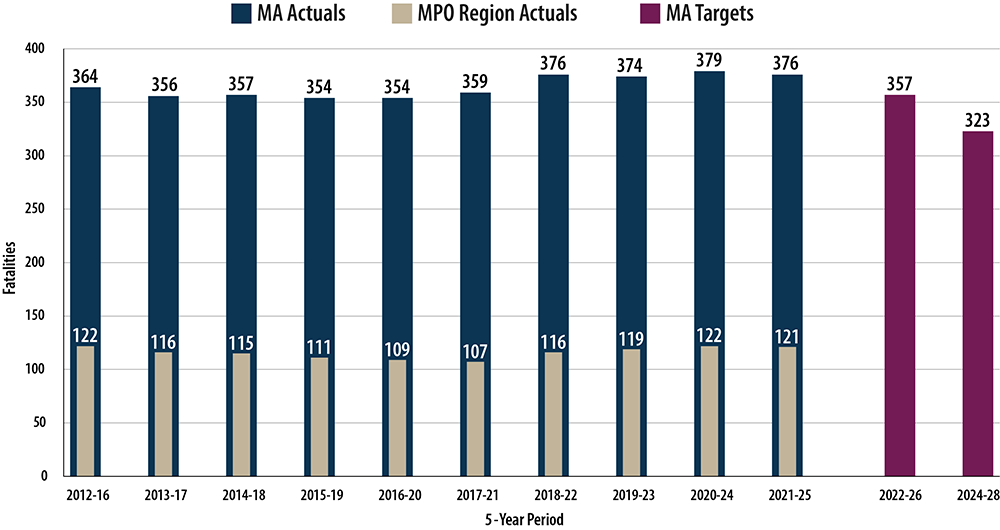
Note: The 2021-25 statewide figure uses a MassDOT forecast for Calendar Year 2025 because 2025 data was unavailable when MassDOT developed state-level targets. For up-to-date data please consult the MassDOT IMPACT Data Portal.
MA = Massachusetts. MPO = Metropolitan Planning Organization.
Sources: Federal Highway Administration, Commonwealth of Massachusetts, and Boston Region MPO Staff.
Figure 4-2
Fatality Rate per 100 Million VMT
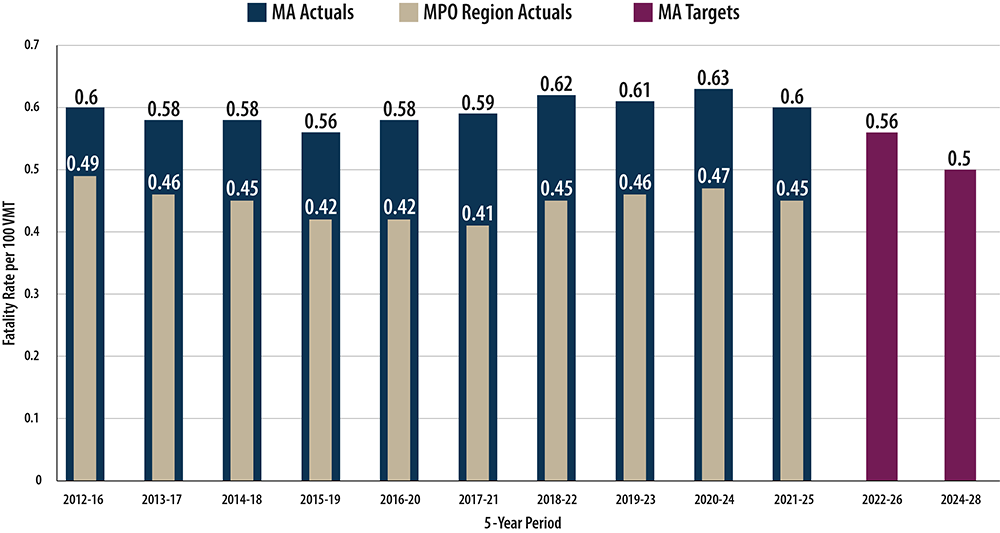
Note: The 2021-25 statewide figure uses a MassDOT forecast for Calendar Year 2025 because 2025 data was unavailable when MassDOT developed state-level targets. For up-to-date data please consult the MassDOT IMPACT Data Portal.
MA = Massachusetts. MPO = Metropolitan Planning Organization. VMT = vehicle-miles traveled.
Sources: Federal Highway Administration, Commonwealth of Massachusetts, and Boston Region MPO Staff.
Figure 4-3
Number of Serious Injuries
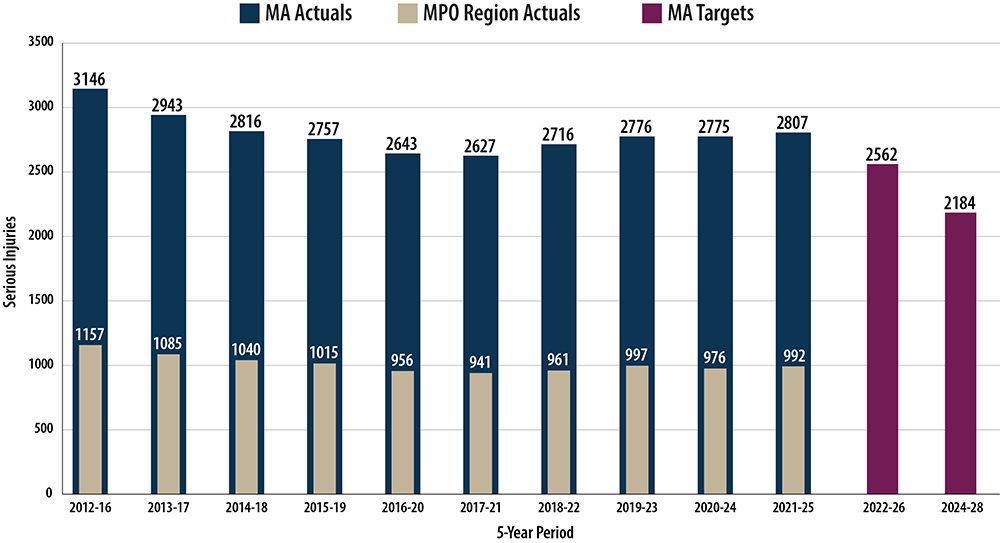
Note: The 2021-25 statewide figure uses a MassDOT forecast for Calendar Year 2025 because 2025 data was unavailable when MassDOT developed state-level targets. For up-to-date data please consult the MassDOT IMPACT Data Portal.
MA = Massachusetts. MPO = Metropolitan Planning Organization.
Sources: Federal Highway Administration, Commonwealth of Massachusetts, and Boston Region MPO Staff.
Figure 4-4
Serious Injury Rate per 100 Million VMT
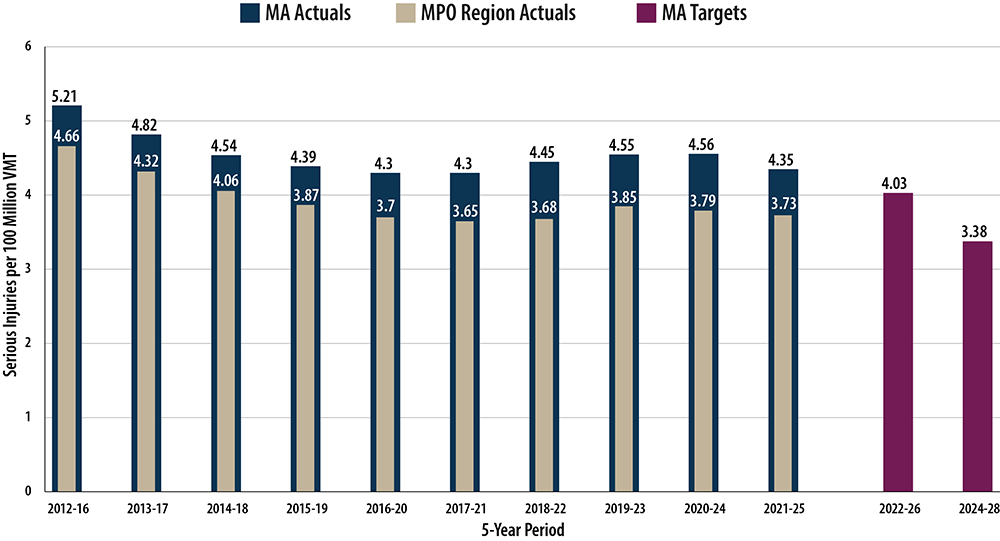
Note: The 2021-25 statewide figure uses a MassDOT forecast for Calendar Year 2025 because 2025 data was unavailable when MassDOT developed state-level targets. For up-to-date data please consult the MassDOT IMPACT Data Portal.
MA = Massachusetts. MPO = Metropolitan Planning Organization. VMT = vehicle-miles traveled.
Sources: Federal Highway Administration, Commonwealth of Massachusetts, and Boston Region MPO Staff.
Figure 4-5
Number of Nonmotorized Fatalities and Serious Injuries
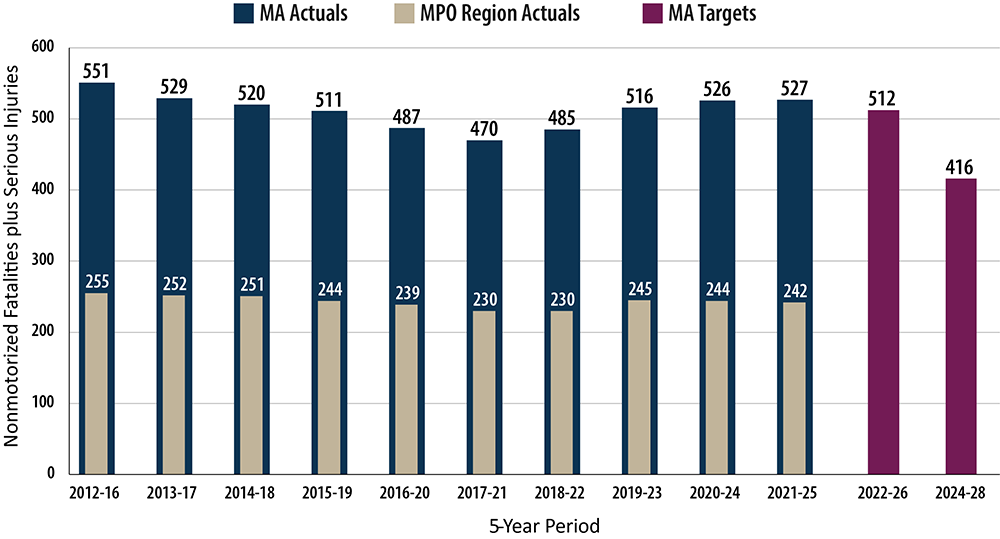
Note: The 2021-25 statewide figure uses a MassDOT forecast for Calendar Year 2025 because 2025 data was unavailable when MassDOT developed state-level targets. For up-to-date data please consult the MassDOT IMPACT Data Portal.
MA = Massachusetts. MPO = Metropolitan Planning Organization.
Sources: Federal Highway Administration, Commonwealth of Massachusetts, and Boston Region MPO Staff.
TIP Investment Relationships to Regional Planning Efforts and Performance Management
Table 4-6 contains project information related to regional planning efforts and performance measures. These relationships demonstrate how regionally prioritized projects support an array of goals.
Table 4-6
FFYs 2027–31 Regional Target Projects and Their Relationships to Plans and Performance Measures
| ID | Project Name | MPO Investment Program | Project Description | MPO Muncipalities | Programming Year (FFY) | Planning Relationships | Relationships to Performance Measures | ||||||
| 605168 | Hingham–Intersection Improvements at Route 3A/Summer Street Rotary | Complete Streets | Improve multimodal access between Hingham Center, residential areas, and Hingham Harbor and make safety improvements, including by establishing a small roundabout at the intersection of Route 3A and Summer Street. | Hingham | 2027 | This project location was studied in “Summer Street/George Washington Boulevard Subregional Priority Roadway Study in Hingham and Hull” (CTPS, 2016). | The project is expected to improve safety performance, including for bicyclists and pedestrians. It will improve more than a lane mile of substandard pavement on the NHS, and the geometric improvements included in the project are expected to help reduce delay and potentially PHED on the NHS. The project is expected to improve substandard sidewalks, add new sidewalks, and add bicycle accommodations, including a shared-use path. These features may support increases in non-SOV travel. The project is also expected to reduce CO2 and other transportation-related emissions. | ||||||
| 605857 | Norwood–Intersection Improvements at Route 1 and University Avenue/Everett Street | Intersection Improvements | Upgrade traffic signals and make associated geometric improvements at the intersection of Route 1, University Avenue, and Everett Street. Construct an additional travel lane in each direction on Route 1, lengthen left-turn lanes, upgrade pedestrian crossings and bicycle amenities, and rehabilitate sidewalks. | Norwood | 2029 | The Route 1 corridor in Norwood is identified as a priority bottleneck in the Destination 2040 Needs Assessment. This location was studied in “Route 1 at Everett Street and University Avenue” (CTPS, 2014). | The project area overlaps a 2017–19 all-mode HSIP crash cluster location and the project is expected to improve safety performance, including for bicyclists and pedestrians. It is expected to improve nearly three lane miles of pavement on the NHS. Signal and geometric improvements included in the project may improve reliability on unreliable NHS segments within the project area and potentially reduce PHED. The project will improve substandard sidewalks and add new sidewalks and bicycle accommodations, all of which may encourage non-SOV travel. It is expected to reduce CO2 and other transportation-related emissions. | ||||||
| 606453 | Boston–Improvements on Boylston Street | Complete Streets | Improve the roadway cross section, signals, and bicycle and pedestrian accommodations in the project corridor. | Boston | 2031 | N/A | The project is expected to improve safety performance, including for bicyclists and pedestrians. It will improve more than two lane miles of substandard NHS pavement, will address reliability needs on an unreliable NHS segment, and may also reduce PHED on that segment. It will improve substandard sidewalks and add bicycle lanes in the project corridor; these features are expected to increase non-SOV travel. The project is also expected to reduce CO2 and other transportation-related emissions. | ||||||
| 607981 | Somerville–McGrath Boulevard Reconstruction | Major Infrastructure: Roadway | Remove the existing McCarthy Viaduct and replace it with an at-grade urban boulevard. Rationalize intersections, improve signalization, and create off-street pedestrian and bicycle facilities. Improve bus operations by installing floating/in-lane bus stops, transit signal priority, and bus queue-jump lanes at key intersections. | Somerville | 2028–29 | This project is included in the Boston Region MPO's Long-Range Transportation Plan, Destination 2050. This project changes network capacity and is considered regionally significant for air quality modeling. | The project area overlaps a 2017–19 all-mode HSIP crash cluster location, a 2010–19 HSIP pedestrian crash cluster location, and a 2010–19 HSIP bicycle crash cluster location. It is expected to improve safety performance, including for bicyclists and pedestrians. It will improve one NHS bridge and improve more than four lane miles of substandard pavement on the NHS. The geometric and signal improvements included in the project may reduce PHED and improve reliability on this portion of the NHS network. The project will improve bus operations and amenities, reconstruct and reconfigure sidewalks, and add off-street bicycle and pedestrian facilities; these features are expected to increase non-SOV travel. It was analyzed as part of a set of recommended LRTP projects, and MPO staff estimate that this set will decrease CO2 emissions in the region compared to a no-build scenario. | ||||||
| 608067 | Woburn–Intersection Reconstruction at Route 3 (Cambridge Road) and Bedford Road and South Bedford Street | Intersection Improvements | Reconstruct the intersection and all traffic signal equipment. Enhance roadway geometry to provide exclusive turn lanes for intersection approaches. Reconstruct existing sidewalks, construct new sidewalks, and add bicycle lanes and ADA-compliant bus stops, where feasible. | Woburn | 2027 | N/A | The project is expected to improve safety performance, including for bicyclists and pedestrians. The project is expected to improve existing sidewalks and add new sidewalks at the intersection, as well as add new bike lanes; all of these features may encourage non-SOV travel. The geometric improvements included in the project are expected to help reduce delay and potentially PHED on nearby NHS routes. The project is expected to reduce CO2 and other transportation-related emissions. | ||||||
| 608158 | Westwood- Norwood- Reconstruction of Canton Street to University Drive | Complete Streets | The project will install new pedestrian sidewalks on the west side of the roadway and a shared-use path on the east side of the roadway. These facilities are being constructed where no dedicated facilities currently exist to improve multimodal accessibility to area residences, employment centers, and open space. Bridge N25032 will be replaced for improved multimodal access and freight rail clearance beneath. The project improves roadway geometry for all vehicles, including visibility improvements on five curves for stopping sight distance, the addition of truck apron turn lanes, and median installation. High-visibility crosswalks and rectangular rapid flashing beacons (RRFBs) will be added in seven locations. New medians will function as pedestrian refuges. New or relocated street lighting will be mounted on utility poles. Reflective signing and markers will be improved. | Westwood | 2029 | N/A | The project creates safe pedestrian and bicycle facilities along Canton Street, which lacks any facilities at the time of project programming. These multimodal facilities improve access to nearby transit facilities at the Route 128 / University Park MBTA and Amtrak station. | ||||||
| 609246 | Lynn– Reconstruction of Western Avenue | Complete Streets | Reconstruct Western Avenue between Centre Street and Eastern Avenue. Improve signal timing, intersection design, and bus stop locations. Implement bicycle and ADA-compliant pedestrian improvements. | Lynn | 2030-31 | N/A | The project area overlaps five 2017–19 all-mode HSIP crash cluster locations, two 2010–19 HSIP pedestrian crash cluster locations and one 2010–19 HSIP bicycle crash cluster location. The project is expected to improve safety performance, including for bicyclists and pedestrians, and it will improve nearly four lane miles of substandard pavement on the NHS. The signal improvements included in the project are expected reduce delay and may help reduce PHED and improve reliability on the NHS. It will reconstruct sidewalks and add bike lanes, TSP, and bus amenities; these features are expected to increase non-SOV travel. This project is also expected to reduce CO2 and other transportation-related emissions. | ||||||
| 609252 | Lynn–Rehabilitation of Essex Street | Complete Streets | Make key bicycle and pedestrian safety improvements and operational improvements, such as signal upgrades, in the project corridor. | Lynn | 2030 | N/A | The project area overlaps five 2017–19 all-mode HSIP crash cluster locations and three 2010–19 HSIP pedestrian crash cluster locations. The project is expected to improve safety performance, including for bicyclists and pedestrians. Planned improvements to signals and roadway geometry in the corridor may help improve reliability on nearby unreliable NHS segments and may also reduce PHED on those segments. It is expected to reconstruct substandard sidewalks and add bicycle lanes; these features are expected to increase non-SOV travel. This project is also expected to reduce CO2 and other transportation-related emissions. | ||||||
| 609257 | Everett– Rehabilitation of Beacham Street, from Route 99 to Chelsea City Line | Complete Streets | Reconstruct Beacham Street to reduce vehicular collisions and improve bicycle and pedestrian travel. | Everett | 2030 | N/A | This project is expected to improve transportation safety, including for bicyclists and pedestrians. It will improve substandard sidewalks and include a shared-use path—both features may encourage non-SOV travel and improve safety performance. The project is expected to reduce CO2 and other transportation-related emissions. | ||||||
| 609432 | Salem–Peabody- Boston Street Improvements | Complete Streets | Incorporate Complete Streets elements and a separated bicycle path into the corridor. Add a new signal at Boston Street and Aborn Street and upgrade existing signals at other intersections along the corridor. | Salem | 2027 | N/A | The project area overlaps a 2010–19 HSIP pedestrian crash cluster location, and the project is expected to improve safety performance, including for bicyclists and pedestrians. It is expected to improve more than a lane mile of substandard NHS pavement. The project includes signal and geometry improvements and is expected to reduce delay, which may reduce PHED and improve reliability on the NHS. It will implement sidewalks on both sides of the corridor and add separated bicycle facilities; these features are expected to increase non-SOV travel. This project is expected to reduce CO2 and other transportation-related emissions. | ||||||
| 610545 | Wakefield- Comprehensive Downtown Main Street Reconstruction | Complete Streets | Complete Streets enhancements to improve pedestrian and bicycle safety along a major local economic generator. Traffic signal upgrade at the intersection of Church and Salem Streets with geometry adjustments to improve turn radii and reduce emergency response times. Pedestrian signal upgrades, new crosswalks, pedestrian refuge islands, installation of a shared-use-path, and new pedestrian lighting. Partial closure of Common Street to thru-traffic to improve pedestrian accessibility for Upper and Lower Common open space. | Wakefield | 2031 | This project includes sections of the Mystic Highlands Greenway, a regional trail connection initiative. | This project implements Complete Streets enhancements and traffic-calming measures along a section of NHS roadway to complement investments in transit-oriented-development in Wakefield. These investments are also part of a larger regional investment in trails and bicycle paths for the Mystic Highlands Greenway, and the project provides for connectivity to the future Wakefield-Lynnfield Rail Trail. | ||||||
| 610662 | Woburn–Roadway and Intersection Improvements at Woburn Common, Route 38 (Main Street), Winn Street, Pleasant Street, and Montvale Avenue | Complete Streets | Improve safety and congestion within the Woburn Common area by making safety and operational improvements, reconfiguring the Woburn Common rotary, and reconstructing and realigning roadways. The project will also reconstruct sidewalks, add bike lanes, and upgrade or add signals in the area. | Woburn | 2031 | N/A | The project area overlaps a 2017–19 all-mode HSIP crash cluster location and a 2010–19 HSIP pedestrian crash cluster location. The project is expected to improve safety performance, including for bicyclists and pedestrians. It is expected to improve nearly two lane miles of substandard pavement on the NHS. Signal and geometric improvements included in the project may improve reliability on unreliable NHS segments within the project area and potentially reduce PHED. The project will reconstruct sidewalks to support pedestrian safety and mobility. It is also expected to include bicycle accommodations and to reduce CO2 and other transportation-related emissions. | ||||||
| 610823 | Quincy- Intersection Improvements at Willard Street and Ricciuti Drive | Intersection Improvements | This project will reconstruct the intersection of Willard Street and Ricciuti Drive near the Interstate 93 off-ramp to provide a signalized intersection and shared-use path for safer connectivity to Quincy Quarries and housing along Ricciuti Drive. The work will adjust intersection geometry, including moving the curb line, reconstructing the sidewalk, moving drainage structures, and updating ADA compliance for ramps in the area. | Quincy | 2027 | N/A | This project primarily focuses on improving safety for vulnerable users and mitigating hazards at locations near to limited-access highways. The project incorporates expansion of safe bicycle infrastructure near to nearby trails and greenways. | ||||||
| 610932 | Brookline–Rehabilitation of Washington Street | Complete Streets | Replace signals, reconstruct sidewalks and pavement, and provide protected bicycle facilities and dedicated bus pull-out spaces in the Washington Street corridor between Washington Square and Brookline Village. | Brookline | 2030 | N/A | The project area overlaps two 2010–19 HSIP bicycle crash cluster locations and a 2010–19 HSIP pedestrian crash cluster location. The project is expected to improve safety performance, including for bicyclists and pedestrians. It will improve substandard sidewalks, implement bicycle lanes, upgrade signals to include TSP, and add bus shelters to the corridor; these features are expected to increase non-SOV travel. The project is expected to reduce CO2 and other transportation-related emissions. | ||||||
| 611983 | Chelsea–Park and Pearl Street Reconstruction | Complete Streets | Improve safety and mobility on Park and Pearl Street by improving signals and roadway geometry, reconstructing sidewalks, and adding bicycle facilities. | Chelsea | 2030 | N/A | The project area overlaps a 2017–19 HSIP all-mode crash cluster location, a 2010–19 HSIP bicycle crash cluster location, and two 2010–19 HSIP pedestrian crash cluster locations. The project is expected to improve safety performance, including for bicyclists and pedestrians. The project will reconstruct sidewalks, improve bicycle amenities, and implement TSP; these features are expected to increase non-SOV travel. The project is expected to reduce CO2 and other transportation-related emissions. | ||||||
| 612534 | Melrose- Lebanon Street Improvement Project (Lynde Street to Malden City Line) | Complete Streets | This project will improve pedestrian and bicycle infrastructure on Lebanon Street from Lynde Street to the Malden city line. | Melrose | 2030 | N/A | This project will support a state of good repair along Lebanon Street in Melrose to ensure continued movement of people and freight between the two communities while also enhancing safety for all users. The project includes new shared-use paths and protected bicycle lanes that will support safety for vulnerable road users. | ||||||
| 612963 | Bellingham- Roadway Rehabilitation of Route 126 (Hartford Road), from 800 North of the I-495 NB Off Ramp to Medway Town Line, including B-06-017 | Complete Streets | The project includes roadway rehabilitation along 1.5 miles of Route 126, improved pedestrian and bicycle accommodations with full bilateral sidewalks and a shared-use path, and improvements to the bridge over Hopping Brook (B-06-017). An existing traffic signal at Maple Street will be upgraded and a new signal installed at Pearl Street. The project not only improves drainage throughout the project area but will incorporate improvements for better conveyance of Stall Brook under Route 126 for riverine flood mitigation. This project is funded across two federal fiscal years starting in FFY 2029. | Bellingham | 2031 | This project is consistent with a 2011 study and report titled "Route 126 Corridor: Transportation Improvement Study" that reviewed roadway conditions between Framingham, Ashland, Holliston, Medway, and Bellingham. | This project improves the condition of roadways and bridges in the Boston region while incorporating safe shared-use path connections near to areas frequented by vulnerable roadway users, including schoolchildren. The project upgrades existing safety infrastructure and installs a new signal. The project also incorporates improvements to resiliency by expanding culverts for riverine flood mitigation. | ||||||
| 612989 | Boston- Bridge Preservation, B-16-066 (38D), Cambridge Street over MBTA | Complete Streets | This project will replace the superstructure of a major bridge over the MBTA Orange Line, commuter rail, Amtrak lines, and Interstate 93. State-of-good-repair investments will be pursued to avoid closures and limit impacts to nearby projects (for example, projects on Mystic Avenue, Maffa Way, Rutherford Avenue, and McGrath Highway). The project will enhance multimodal accessibility for a key link to Sullivan Square MBTA station, including expanding bus facility access. | Boston | 2028 | This project is consistent with the City of Boston's Sullivan Square Design Project. This project is also listed in the Boston Region MPO's Long-Range Transportation Plan, Destination 2050. | This project replaces the deck and superstructure of an NHS bridge structure over MBTA, Amtrak, and freight rail and beneath Interstate 93. The new bridge will support a westbound bus lane to facilitate improved transit connectivity between Boston's Charlestown neighborhood and Somerville. | ||||||
| 613088 | Malden - Spot Pond Brook Greenway | Bicycle Network and Pedestrian Connections | The Spot Pond Brook Greenway is a proposed shared-use path connecting Malden's Oak Grove neighborhood with the Northern Strand Community Trail and Malden River via downtown Malden. The 1.1 mile, 11-foot-wide shared-use path will replace existing sidewalk infrastructure and narrow roadway widths to accommodate the new bicycle/pedestrian facility on existing right-of-way. The project will also install wayfinding signage on existing roadway facilities to connect the northern terminus of the path at Coytemore Lea Park with the Oak Grove MBTA station. | Malden | 2030 | This project includes sections of the Mystic Highlands Greenway, a regional trail connection initiative. | This project includes a 2017-19 bicycle HSIP crash cluster location and will improve the safety of bicyclists and pedestrians throughout the project area. The project will also improve connectivity to MBTA bus and rail transit facilities. | ||||||
| 613319 | Sudbury-Framingham-Bike Path Construction of Bruce Freeman Rail Trail, from the Sudbury Diamond Railroad Crossing to Eaton Road West | Bicycle Network and Pedestrian Connections | Phase 3 of the Bruce Freeman Rail Trail (BFRT) spans approximately 1.3 miles from Eaton Road W in Framingham to the Sudbury Diamond Railroad Crossing. The proposed trail will be a 10-foot paved shared-use path along the former railroad corridor with two-foot dense graded crushed stone shoulders. Sidewalks and pedestrian curb ramps at the at-grade intersection of the trail and Route 20 are proposed to be updated to create an ADA-compliant and accessible crossing at the existing signalized intersection of Nobscot Road and Route 20. A parking lot is also being proposed along Nobscot Road, approximately 550 feet south of Route 20. Other work includes fixing or replacing culverts and stream crossings where necessary and implementing safety fencing along the trail where necessary. This project is funded across two federal fiscal years starting in FFY 2029. | Sudbury | 2029 | N/A | This project will expand the regional trail network and create a linkage for further trail extensions into the City of Framingham, the first phase of which is planned for implementation in MassDOT's Statewide Highway Program. The trail will offer a safe pedestrian and bicycle facility through several communities and with connections to the MBTA commuter rail station at West Concord. | ||||||
| S12113 | Transit Transformation Set-Aside | Transit Transformation | The MPO’s Transit Transformation program was established in Destination 2050, the MPO’s current Long-Range Transportation Plan. This program will allocate a portion of the MPO’s Regional Target Highway funds to transit projects that advance the MPO’s goals in the region, including upgrades to stations and facilities and the purchase of vehicles for transit providers. | Regionwide | 2028-31 | Projects in the Transit Transformation program may address transit safety, the replacement of aging infrastructure, improving accessibility of transit systems, the procurement of low- or no-emission vehicles, and more. | |||||||
| S12820 | Bikeshare State of Good Repair Set-Aside | Bikeshare Support | This line item sets aside funding to support Bikeshare investments within the Community Connections program. Example uses of this set-aside include bikeshare system expansion as well as replacement and upgrades to existing stations. | Regionwide | 2028-31 | This funding implements a recommendation that will be made in the MPO's upcoming LRTP, Destination 2050, regarding the establishment of dedicated funding to support Bikeshare investment throughout the region. | This line item will ensure the maintenance and modernization of existing bikeshare infrastructure within the Boston region while providing additional funding resources for expansion into neighboring municipalities. | ||||||
| S12820 | Project Design Set-Aside | Multiple | This line item programs funding to be utilized in future TIPs for municipalities to conduct design work on projects. | Regionwide | 2028-31 | The Project Design program supports municipalities in designing a wide variety of TIP projects, including bicycle and pedestrian trails, intersection improvements, and Complete Streets projects. These projects may improve safety for all road users, reduce travel time, improve access to transit and key destinations, and support many other performance measures. | |||||||
| S12820 | Community Connections Set-Aside | Community Connections | The Community Connections program is the MPO’s funding program for first- and last-mile solutions, community transportation, and other small, nontraditional transportation projects such as those that update transit technology and improve bicycle and pedestrian facilities. The Community Connections program is one of the investment programs included in the MPO’s current Long-Range Transportation Plan, Destination 2050. | Regionwide | 2028-31 | The Community Connections program has recently funded new bicycle racks, bicycle shelters, and pedestrian safety improvements such as rectangular rapid flashing beacons. These improve vulnerable road user safety and encourage mode shift. | |||||||
| S12963 | Chelsea-Revere- Regional on Demand Microtransit Pilot Project | Community Connections | The Cities of Chelsea and Revere will implement a microtransit service that will provide regional, low-cost, on-demand transportation across a 6.5 square mile zone in Chelsea and Revere. The service will offer convenient pick-up and drop-off services that align with riders’ schedules, filling first- and last-mile gaps in the existing transit system and ensuring accessibility to critical destinations, such as grocery stores, healthcare facilities, places of employment, and educational institutions. The applicants estimate 58 passenger trips per day with electric vehicles. As a Microtransit Pilot Project, the project is proposed for funding across three years with $499,649 in FFY 2025, $450,278 in FFY 2026, and $463,807 in FFY 2027. | Chelsea, Revere | 2027 | N/A | This project provides new transit service to reduce transportation-related emissions by promoting shifts away from single-occupancy vehicles. | ||||||
| S13152 | MBTA- Better Bus Project - Operational Safety Improvements at Bus Stops | Transit Transformation | As part of the MBTA Better Bus Project, this project will make operational safety improvements at bus stops along bus Routes 714 and 716. The MBTA will build or improve bus stop curbs, sidewalks, signage, markings, and shelters, and improve accessibility and customer experience where conditions are unsafe, inaccessible, in poor state of operation or repair, or where bus stops do not exist at all. | Boston, Canton, Hingham, Hull, Milton | 2027 | This effort is included in the MBTA's Better Bus Project. More information can be found at: https://www.mbta.com/projects/better-bus-project | This project will improve facility conditions and safety along key regional bus routes that serve workforce commuters. These investments will alleviate congestion, improve economic vitality, and improve travel time reliability. | ||||||
| S13292 | MBTA - Operational Enhancement of Bus Routes 714 and 716 | Transit Transformation | This project will enable expanded service hours and frequency for MBTA bus Routes 714 and 716, serving the communities of Boston (Mattapan), Canton, Hingham, Hull, and Milton. Improvements include reduced headways, Sunday service for the Route 716 bus, and improved first-and-last-mile connections to commuter rail stations (Nantasket Junction, Canton Center, and Route 128) and state parks. | Boston, Canton, Hingham, Hull, Milton | 2027 | This effort is included in the MBTA's Better Bus Project. More information can be found at: https://www.mbta.com/projects/better-bus-project | This project will increase service frequencies for the Route 714 and 716 bus to reduce traffic congestion. This effort will also expand access to the Route 714 and 716 buses by supporting additional service hours and connections to regional rail facilities. | ||||||
| S13295 | Cambridge- New Bridge and Shared-Use Path Construction over Fitchburg Line at Danehy Park Connector [Design Only] | Bicycle Network and Pedestrian Connections | This project will design a new bridge carrying a shared-use path over the MBTA Fitchburg Line between New Street and Sherman Street. The path will connect to Danehy Park, Sherman Street, Alewife Station, and the North Cambridge residential neighborhoods. Construction of this project may commence as early as FFY 2031, and may be funded through a future TIP. | Cambridge | 2027 | N/A | This project will design improvements that will enhance safety, support economic development, and bolster intermodal connectivity. The bridge will connect the MBTA's Alewife Station and several housing developments to a park and a shopping center, improving access and connectivity in the area. | ||||||
| S13386 | Brookline- Bluebikes Expansion, 5 Stations | Bikeshare Support | This project includes five new Bluebikes stations in Brookline, each with 15 docks, as well as the purchasing of 40 classic bikes and three e-bikes. | Brookline | 2027 | This project invests in the expansion of the regional bikeshare network with the construction of five new stations in Brookline and the addition of new electric bicycles to the system. | |||||||
| S13394 | MBTA- Downtown Crossing Vertical Transportation Improvements | Transit Transformation | This project involves the design and construction of three new elevators to provide vertical transfers from the Red Line northbound to the Orange Line southbound platform, and from the Orange Line northbound to the Red Line southbound platform at Downtown Crossing. | Boston | 2027 | This project will improve accessibility to the MBTA's Red and Orange Lines and improve safety for users at the station. | |||||||
| S13396 | MBTA- Bus Priority and Accessibility Improvements | Transit Transformation | This project will fund ongoing construction of safety and accessibility improvements from among 87 high-priority bus stops that are in the design phase. Specific stops will be constructed based on progress in design, constructability, permitting, and coordination with municipalities, MassDOT, and the Department of Conservation and Recreation, which are partners and property owners for these bus stops. These stops were identified and prioritized through the Program for Accessible Transit Infrastructure (PATI). | Regionwide | 2028 | This project will improve accessibility to MBTA bus services and improve safety for users waiting at bus stops. | |||||||
| S13400 | MBTA- Locomotive Procurement | Transit Transformation | This project funds the procurement of new commuter rail locomotives to replace the oldest vehicles in the MBTA fleet. In alignment with Full T Ahead, commuter rail capital projects are focused on the near- and long-term actions that will get riders where they need to go reliably and efficiently. These capital projects lay the foundation for a modernized system carrying frequent and reliable all-day service. Replacing and overhauling the aging rail fleet is critical to Regional Rail service goals and advancing decarbonization on the system. | Regionwide | 2027 | This project will improve transit reliability by replacing vehicles that have exceeded their useful life benchmarks. If battery-electric vehicles are procured, the shift away from diesel vehicles will improve air quality as well. | |||||||
| S13406 | Revere- Revere Beach Connector | Bicycle Network and Pedestrian Connections | This project involves the design of a safe and accessible pedestrian and bike connection between the new Revere High School campus, Wonderland Park, and the surrounding neighborhoods. This project aims to evaluate a range of improvements, including enhanced sidewalk networks, shared-used paths, safer pedestrian crossings, potential grade-separated connections, and a crossing underneath the commuter rail tracks. Design funds are being requested to supplement the City of Revere’s “Reconnecting Communities” planning grant award from the US Department of Transportation. | Revere | 2027 | This project is part of a larger effort to connect the Northern Strand to Revere Beach, as well as an effort to develop a commuter rail station connecting to Wonderland Station. | The construction of this project would improve safety by giving pedestrians and other vulnerable road users a safer option to access Revere High School, Wonderland Station, and other key destinations. | ||||||
| S13409 | MAPC- Boston, Brookline, Cambridge, and Somerville Bluebikes Station Replacement | Bikeshare Support | This is a joint project between four municipalities to replace high-utility stations. The project includes 22 stations in Boston, four 19-dock stations in Brookline, 17 stations in Cambridge, and the replacement of 80 docks and 20 quad slabs in Somerville. | Boston, Brookline, Cambridge, Somerville, | 2027 | Replacing aging Bluebikes docks and slabs will extend the useful life of many high-ridership stations. | |||||||
| S13410 | Quincy- Bluebikes Expansion, 10 Stations | Bikeshare Support | This project includes ten new Bluebikes stations in Quincy, each with 10 or 15 docks. Many of the stations will service Red Line stations, high-ridership bus routes, schools, parks, libraries, and other community assets. | Quincy | 2027 | This project invests in the expansion of the regional bikeshare network with the construction of Quincy's first ten Bluebikes stations. | |||||||
| S13412 | CATA- Magnolia Shuttle | Transit Transformation | This funding would support a seasonal shuttle providing service between the Gloucester commuter rail station and Magnolia Village (and potentially Manchester commuter rail station, depending on timing and community feedback). The shuttle would initially run Saturdays, Sundays, and holidays from the third weekend in June through Labor Day Monday, from 9 AM to 5 PM. There is no service to Magnolia on Sundays and holidays; Saturday headways are 120 minutes (2 hours). Areas of interest along the route include Ravenswood Park, the Village of Magnolia, and Hammond Castle. | Gloucester, Manchester-by-the-Sea | 2027 | This shuttle would improve transit access to the neighborhoods of Magnolia and West Gloucester on summer weekends. | |||||||
| S13460 | MBTA- Symphony Station | Transit Transformation | This project will deliver four new accessible elevators, raised platforms for faster and easier boarding, accessible bathrooms, and improved wayfinding, lighting, and safety features at Symphony Station. Service will bypass the station for approximately 32 months. Several large cost drivers for this project have emerged during planning, including substantial utilities work and earthworks. | Boston | 2027-28 | This project will improve accessibility to the MBTA's Green Line and improve safety for users at the station. | |||||||
| S13498 | CATA- Access for All | Transit Transformation | CATA Access for All aims to sustain and provide support to several smaller programs at CATA. These programs are designed to enhance mobility and provide various services, including transportation for medical appointments, recreational activities, food delivery, and more for seniors, individuals with disabilities, and low-income individuals. The overall goal is to support CATA communities with improved accessibility to programs and mobility options. | Gloucester, Manchester-by-the-Sea, Rockport, Ipswich, Essex, Hamilton | 2027 | CATA's Access to All program will improve accessibility to public transit services, particularly for elderly and disabled users. | |||||||
| S13499 | CATA- Cape Ann Dialysis Transportation | Transit Transformation | The project will continue dialysis transportation services for elderly individuals and people with disabilities throughout CATA’s service area, ensuring greater mobility and access to health care for CATA communities. If staffing allows, CATA will provide a transfer to/from The RIDE (MBTA) for ADA customers. | Gloucester, Manchester-by-the-Sea, Rockport, Ipswich, Essex, Hamilton | 2027 | CATA's Dialysis Transportation program will improve accessibility to public transit services, particularly for elderly and disabled users. | |||||||
| Notes: HSIP cluster locations are identified by MassDOT. Substandard pavement and sidewalk designations are based on data provided by MassDOT and project proponents and on MPO assessments conducted for TIP evaluations. The estimated lane miles of substandard NHS pavement improved is based on MPO staff’s assessment of pavement condition in the project area and their assessment of the portion of the project on the NHS. The IRI thresholds used to classify pavement are based on the TIP criteria the MPO adopted in 2020: less than 95 is good, 95 to 170 is fair, and greater than 170 is poor. | |||||||||||||
| ADA = Americans with Disabilities Act. CATA = Cape Ann Transportation Authority. CO2 = carbon dioxide. CTPS = Central Transportation Planning Staff. FFY = federal fiscal year. HSIP = Highway Safety Improvement Program. IRI = International Roughness Index. LRTP = Long-Range Transportation Plan. MassDOT = Massachusetts Department of Transportation. MBTA = Massachusetts Bay Transportation Authority. MPO = metropolitan planning organization. N/A = not applicable. NB = northbound. NHS = National Highway System. PHED = peak hours of excessive delay. SOV = single-occupancy vehicle. TSP = transit signal priority. | |||||||||||||
| Source: Boston Region MPO staff. | |||||||||||||
Transit System Safety Performance Measures and Targets
The National Public Transportation Safety Plan details performance measures for which transit agencies subject to the PTASP rule must set targets. Transit agencies revisit their performance targets when updating their PTASPs each year. Required performance measures are shown in Table 4-7.7
Table 4-7
Federally Required Transit Performance Measures
Measure Category |
Measure |
Desired Direction |
Safety Events |
Total number of reportable safety events by mode |
Decrease |
Safety Events |
Rate of safety events per total VRM by mode |
Decrease |
Safety Events |
Collision Rate by mode (new) |
Decrease |
Safety Events |
Pedestrian Collision Rate by mode (new) |
Decrease |
Safety Events |
Vehicular Collision Rate by mode (new) |
Decrease |
Fatalities |
Total number of reportable fatalities by mode |
Decrease |
Fatalities |
Fatality rate per total VRM by mode |
Decrease |
Injuries |
Total number of reportable injuries by mode |
Decrease |
Injuries |
Injury rate per total VRM by mode |
Decrease |
Transit Worker Safety |
Transit Worker Fatality Rate by mode (new) |
Decrease |
Transit Worker Safety |
Transit Worker Injury Rate by mode (new) |
Decrease |
Transit Worker Safety |
Assaults on Transit Workers by mode (new) |
Decrease |
Transit Worker Safety |
Rate of Assaults on Transit Workers by mode (new) |
Decrease |
System Reliability |
Mean distance between major mechanical failures by mode |
Increase |
VRM = vehicle revenue-miles.
Source: Federal Transit Administration, “Safety Performance Targets Guide,” accessed February 4, 2025, https://www.transit.dot.gov/sites/fta.dot.gov/files/2024-11/SPTs-Guide-v3-11-06-2024.pdf.
The Boston Region MPO updated its set of transit safety performance targets on March 5, 2026.8 This update includes the MBTA’s, MWRTA’s, and CATA’s safety targets. Each agency’s targets are presented separately to reflect the local context, including the characteristics of the local operating environments and planned investments, policies, and safety-management activities.
MBTA Safety Targets
The MBTA sets targets for four modes: heavy rail (Red, Orange, and Blue Lines), light rail (Green Line and the Mattapan High Speed Line), bus, and The RIDE paratransit system. The MBTA’s commuter rail network and ferry service are not subject to these FTA requirements. For data display purposes in this chapter, the 14 measures are divided into three categories: fatalities and injuries, transit worker safety, and safety events and reliability.
Figure 4-6 shows the average number of fatalities, injuries, and safety events for CYs 2022-24 and targets for CY 2026. The MBTA has set a fatality target of zero fatalities for all modes and is committed to reducing the number of fatalities across its system to zero. The MBTA continues to invest in proactive solutions to achieve this goal. For injuries and safety events, the targets were calculated using a two percent decrease in the number of injuries and safety events. All rates are set per one million vehicle revenue-miles (VRM). Safety event, fatality, and injury targets are rounded to the nearest whole event.
Figure 4-6
MBTA Performance and Targets for Fatalities, Injury, and Safety Event Metrics
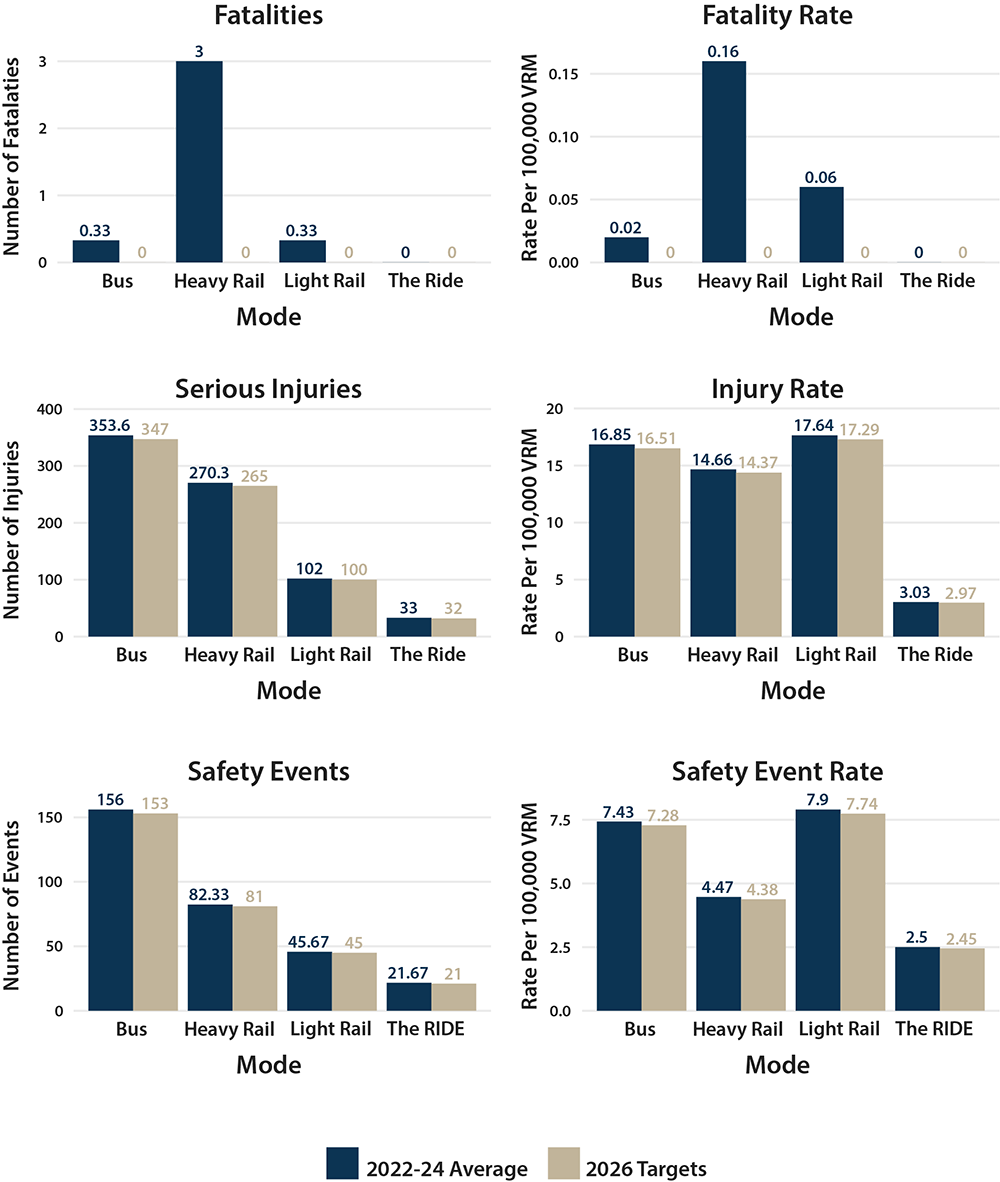
VRM = vehicle revenue-miles.
Source: MBTA.
Figure 4-7 shows the CY 2022–24 averages for transit worker safety reporting and targets for CY 2026. The MBTA has set a target of zero transit worker fatalities for all modes. For the transit worker injury and assault rates, the MBTA set a CY 2026 target for a two percent decrease from the 2022–24 average. The MBTA also used a two percent decrease from the 2022–24 average to develop the target for the number of assaults on transit workers; assault count targets are rounded to the nearest whole number.
Figure 4-7
MBTA Performance and Targets for Transit Worker Safety
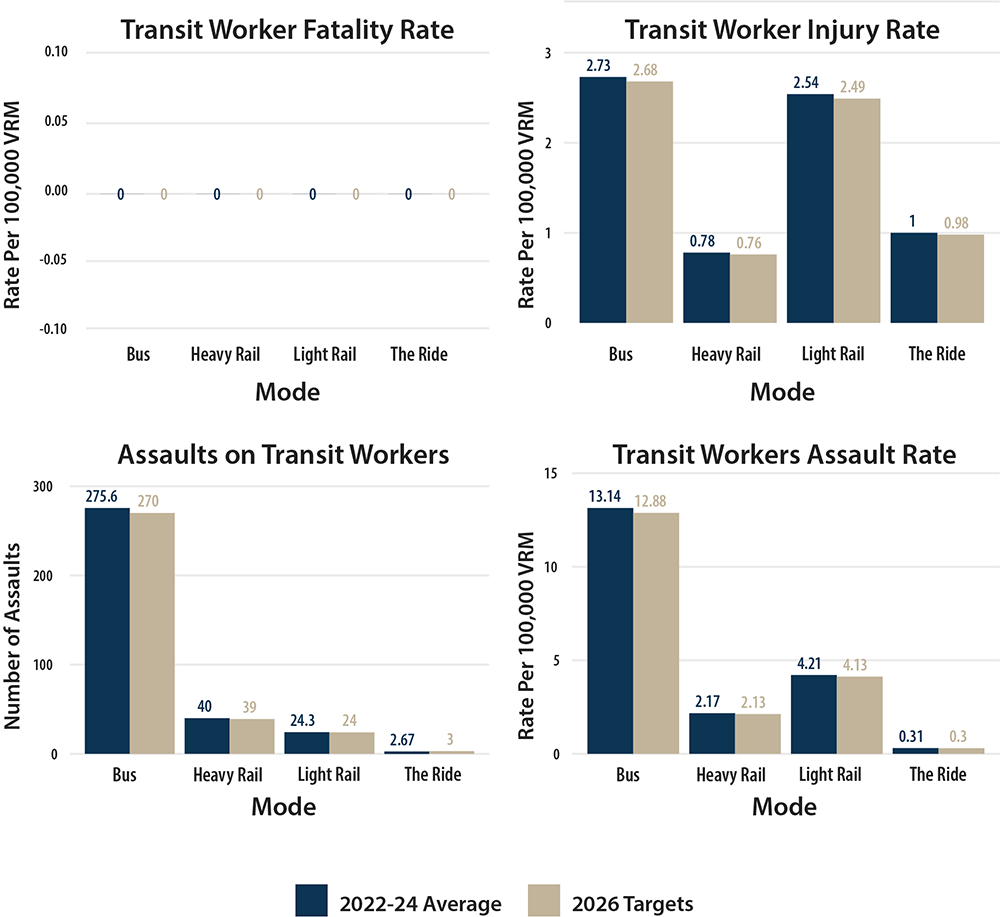
VRM = vehicle revenue-miles.
Source: MBTA.
The MBTA started reporting on collision targets in 2025. Figure 4-8 shows average CY 2022–24 performance and CY 2026 targets for collision metrics. The MBTA sets a target of a two percent decrease in collisions, pedestrian collisions, and vehicular collisions for light rail and bus. Heavy rail targets remain equal to the three-year average per VRM. All rates are calculated per one million VRM.
Figure 4-8
MBTA Performance and Targets for Collisions by Type
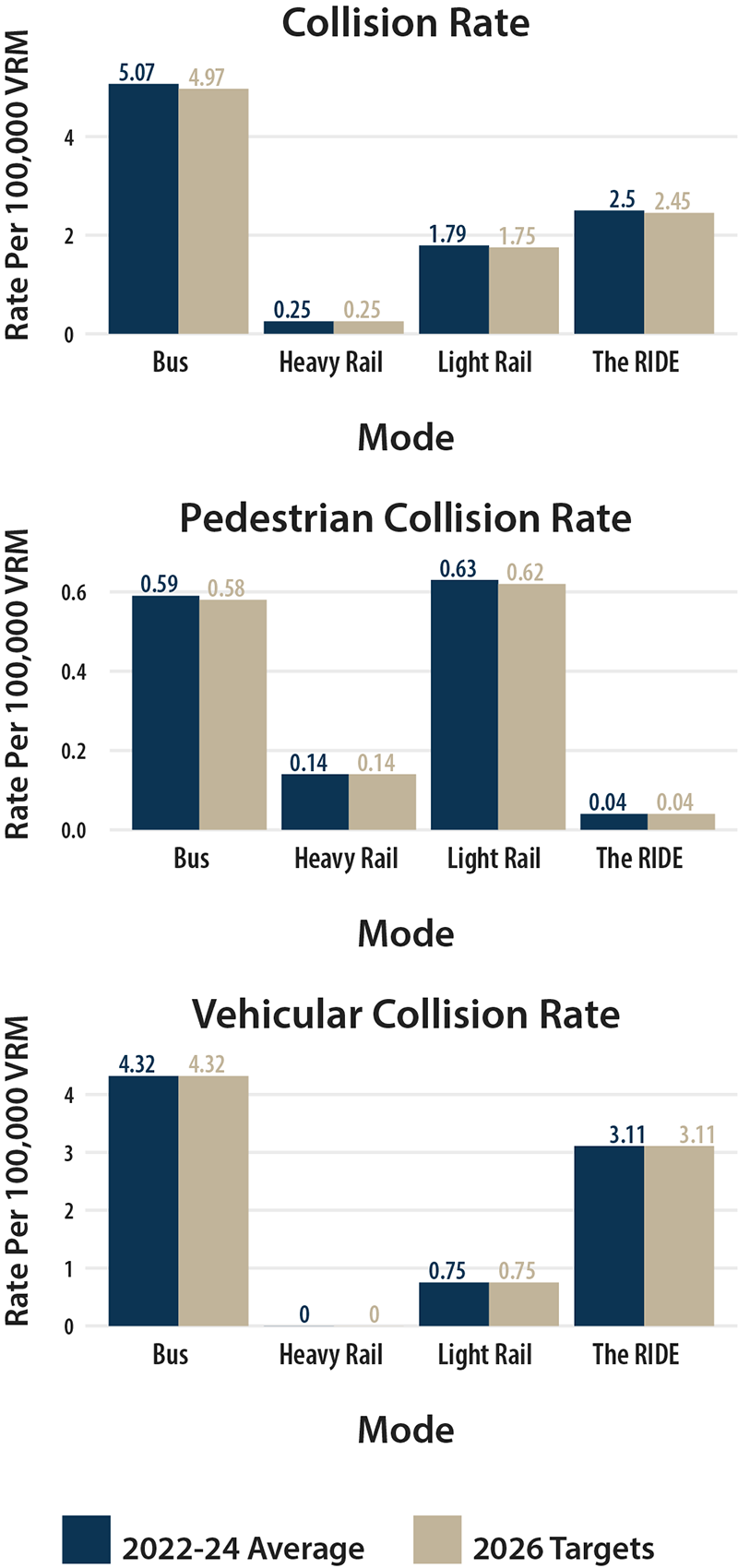
VRM = vehicle revenue-miles.
Source: MBTA.
System reliability is a measure of the average number of mechanical failures per VRM. The targets for system reliability are a measure of the mean number of miles between major mechanical failures by mode. The MBTA targets a two percent increase in this metric for all modes. Notably, this is the only transit safety target where the goal is to increase the metric value.
Figure 4-9
MBTA Performance and Targets for System Reliability
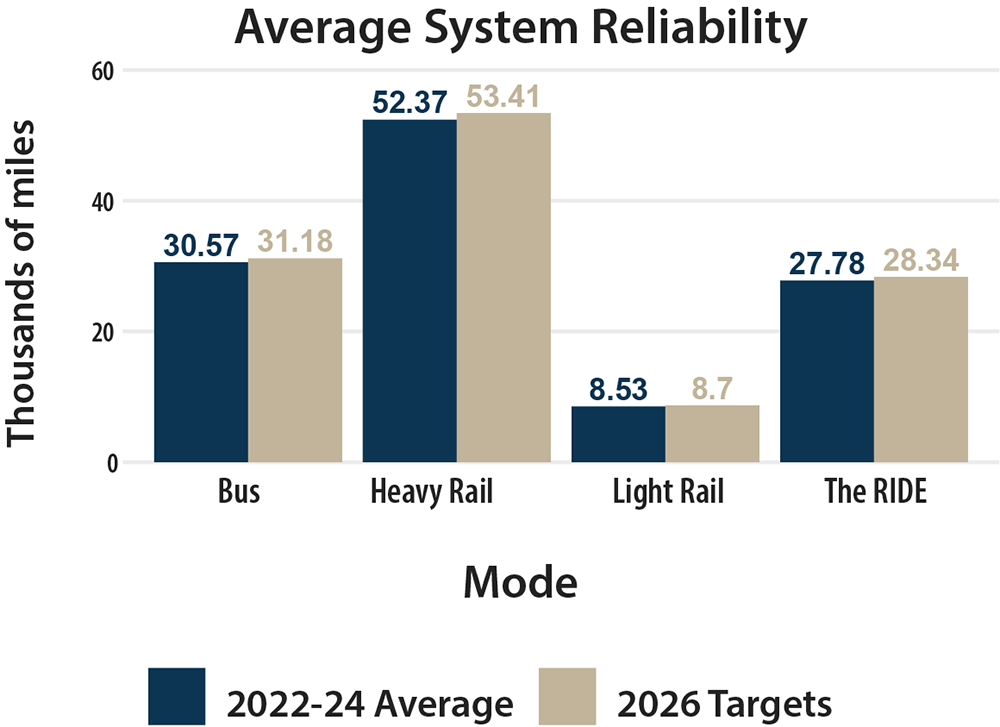
Source: MBTA.
Cape Ann Transportation Authority (CATA) Safety Targets
CATA monitors safety performance and sets targets for its fixed-route bus and demand response services. This chapter reports the 14 measures in three categories: safety events including fatalities and injuries, transit worker safety, and collision and reliability targets.
CATA’s CY 2026 safety and performance targets reflect modest improvements over its 2021–25 performance across most measures. With zero reported fatalities or serious injuries, CATA set a target of zero for both fixed-route service and demand response. As shown in Table 4-8 CATA set a target of one safety event per 100,000 VRM for both fixed-route demand and demand response service.
Table 4-8
CATA Performance (2021–25 Averages) and CY 2026 Targets for Fatalities, Injuries, and Safety Events
CATA MODE |
Fatalities |
Fatality Rate |
Injuries |
Injury Rate |
Safety Events |
Safety Event Rate |
2021–25 Performance |
||||||
Fixed-Route Demand |
0 |
0 |
0 |
0 |
2.2 |
0.80 |
Demand Response |
0 |
0 |
0 |
0 |
1 |
1.92 |
2026 Targets |
|
|
|
|
|
|
Fixed-Route Demand |
0 |
0 |
0 |
0 |
1 |
1 |
Demand Response |
0 |
0 |
0 |
0 |
1 |
2 |
Source: CATA and FTA Transit National Database.
Table 4-9 shows past performance for transit worker safety measures and targets for CY 2026. CATA has set targets of zero transit worker-related fatalities, injuries, and assaults for CY 2026.
Table 4-9
CATA Performance (2021–25 Averages) and CY 2026 Targets for Transit Worker Safety Targets
CATA MODE |
Transit Worker Fatality Rate |
Transit Worker Injury Rate |
Assaults on Transit Workers |
Assault on Transit Workers Rate |
2021–25 Performance |
||||
Fixed-Route Demand |
0 |
0 |
0 |
0 |
Demand Response |
0 |
0 |
0 |
0 |
2026 Targets |
|
|
|
|
Fixed-Route Demand |
0 |
0 |
0 |
0 |
Demand Response |
0 |
0 |
0 |
0 |
Source: CATA and FTA Transit National Database.
Table 4-10 shows past CATA performance for collision and reliability and CY 2026 targets. CATA set a target for no more than two collisions per 100,000 vehicle revenue-miles for both overall and vehicular collision rates. With no reportable pedestrian collisions from 2021 to 2025, CATA set a target of zero for the pedestrian-related safety measures. System reliability is a measure of the mean distance between major mechanical failures by mode. System reliability targets anticipate improvement for fixed-route service, while allowing for some regression in demand response performance.
Table 4-10
CATA Performance (2021–25 Averages) and CY 2026 Targets for Collision and Reliability Metrics
CATA MODE |
Collision Rate |
Pedestrian Collision Rate |
Vehicular Collision Rate |
Average System Reliability (miles) |
2021–25 Performance |
||||
Fixed-Route Demand |
2.14 |
0 |
2.14 |
112,694 |
Demand Response |
1 |
0 |
1 |
137,995 |
2026 Targets |
|
|
|
|
Fixed-Route Demand |
2 |
0 |
2 |
87,180 |
Demand Response |
2 |
0 |
2 |
118,351 |
Source: CATA and FTA Transit National Database.
MWRTA Safety Targets
MWRTA monitors safety performance and sets targets for its fixed-route bus and demand response services. For data display purposes in this chapter, the 14 measures are divided into three categories: safety events including fatalities and injuries, transit worker safety, and collisions and reliability. Having no reportable fatalities nor injuries from 2020 to 2024, MWRTA set CY 2025 targets of zero for all transit worker safety measures. MWRTA set more conservative targets to encourage the reporting of events.
Table 4-11 shows averages for safety events, fatalities, and injuries for CYs 2021-25 and targets for CY 2026; all rates are calculated per 100,000 VRM.
Table 4-11
MWRTA Performance (2021-25 Averages) and CY 2026 Targets for Fatalities, Injuries, and Safety Events
MWRTA MODE |
Fatalities |
Fatality Rate |
Injuries |
Injury Rate |
Safety Events |
Safety Event Rate |
2021–25 Performance |
||||||
Fixed-Route Demand |
0 |
0 |
1.2 |
0.11 |
1.4 |
0.14 |
Demand Response |
0 |
0 |
0 |
0 |
0.2 |
0.02 |
2026 Targets |
|
|
|
|
|
|
Fixed-Route Demand |
0 |
0 |
9 |
0.8 |
9 |
0.8 |
Demand Response |
0 |
0 |
7 |
0.7 |
7 |
0.7 |
Source: MWRTA and FTA Transit National Database.
Table 4-12 shows past performance for transit safety metrics and targets for CY 2026. All rates are calculated per 100,000 VRM.
Table 4-12
MWRTA Performance (2021–25 Averages) and CY 2026 Targets for Transit Worker Targets
MWRTA MODE |
Transit Worker Fatality Rate |
Transit Worker Injury Rate |
Assaults on Transit Workers |
Assault on Transit Workers Rate |
2021–25 Performance |
||||
Fixed-Route Demand |
0 |
0.02 |
0 |
0 |
Demand Response |
0 |
0 |
0 |
0 |
2026 Targets |
|
|
|
|
Fixed-Route Demand |
0 |
0.44 |
6 |
0.53 |
Demand Response |
0 |
0.44 |
5 |
0.5 |
Source: MWRTA and FTA Transit National Database.
Table 4-13 shows past performance for collision and reliability metrics and CY 2026 targets. System Reliability is a measure of mean distance between major mechanical failures by mode. . All rates are calculated per 100,000 VRM.
Table 4-13
MWRTA Performance (2021–25 Averages) and CY 2026 Targets for Collision and Reliability Metrics
MWRTA MODE |
Collision Rate |
Pedestrian Collision Rate |
Vehicular Collision Rate |
Average System Reliability (miles) |
2021–25 Performance |
||||
Fixed-Route Demand |
0.07 |
0 |
0.07 |
171,428 |
Demand Response |
0.02 |
0 |
0.02 |
112,346 |
2026 Targets |
|
|
|
|
Fixed-Route Demand |
0.53 |
0.08 |
0.44 |
75,000 |
Demand Response |
0.6 |
0.1 |
0.5 |
75,000 |
Source: MWRTA and FTA Transit National Database.
TIP Investments Supporting Transit Safety Performance
MassDOT and the transit agencies in the Boston region account for safety when selecting transit projects for capital investment programs, including the TIP. Safety is part of MassDOT’s Reliability priority area and investment programs are sized to support MBTA and RTA asset condition. Safety issues are also considered at the level of individual investments.
The MBTA’s planned capital investments are intended to improve safety outcomes, asset condition, and system reliability. The MBTA will use funding from the MPO’s Regional Target Program to improve accessibility and safety features at Symphony and Downtown Crossing Stations. CATA will continue to use its federal and state dollars to fund preventative maintenance activities, improve its administration and maintenance facility, and purchase new revenue vehicles to replace those that have reached the end of their useful life. Similarly, MWRTA will continue to invest in the modernization and expansion of its Blandin terminal facility and expansion of its vehicle fleet to include larger 29-foot, low-floor buses. Transit agency investments are also discussed in the Transit Asset Condition Performance section of this chapter and additional details about these investments are available in Chapter 3.
Future Activities to Improve and Monitor Safety Performance
In 2023, the MPO was awarded a federal Safe Streets and Roads for All discretionary grant of $2.1 million. The MPO used this grant money to create a Vision Zero Action Plan for the Boston region. This plan is one measure by which the MPO is committed to achieving zero roadway fatalities and serious injuries through an ambitious reduction of roadway hazards. More information on this Action Plan can be found on the Vision Zero page of the MPO’s website.
MPO staff are considering developing safety performance targets for the Boston region in alignment with the recommendations of the Vision Zero Action Plan. These targets would then be converted into the format required by FHWA on the five federally required performance metrics. The regional targets would supplement existing statewide targets.
Bridge and Pavement Performance Measures (PM2)
Relevant Goals, Policies, and Plans
The federally required bridge and pavement measures align with the MPO’s goal of mobility and reliability and monitor progress toward maintaining and modernizing the transportation system. The MPO seeks to address existing maintenance and state-of-good-repair needs for roads and sidewalks, upgrade infrastructure to better serve travelers, and prepare for future hazards.
Projects funded in the FFYs 2027–31 TIP support asset condition improvements, which complement MassDOT’s more extensive state-of-good-repair and modernization projects. MassDOT uses information from its asset management systems to guide decisions about asset maintenance and modernization to boost mobility and reliability and considers roadway investment priorities from its Transportation Asset Management Plan.9
Roadway Asset Condition Performance Measures and Targets
Bridge Condition Measures and Targets
To meet federal performance monitoring requirements, states and MPOs must track and set performance targets for the condition of bridges on the National Highway System. Bridge condition performance measures include the following:
- Percent of NHS bridges by deck area classified as in good condition
- Percent of NHS bridges by deck area classified as in poor condition
NHS bridge condition is classified based on the condition ratings of three bridge components: the deck, the superstructure, and substructure. The lowest rating of the three components determines the overall bridge condition. The measures express the share of NHS bridges in a certain condition by deck area, divided by the total deck area of NHS bridges in the MPO region or state.
Table 4-14 shows the performance baselines for NHS bridge condition in Massachusetts and the Boston region for 2022. MassDOT determined that there are 2,246 bridges in the Commonwealth, of which 844 are located in the Boston region. According to the 2022 baseline, 16.9 percent of bridges in Massachusetts were in good condition and 11.2 percent were in poor condition. In the Boston region, 15.7 percent were in good condition and 12.9 percent were in poor condition.
Table 4-14
NHS Bridge Condition 2022 Baselines for Massachusetts and the Boston Region
Geographic Area |
Total NHS Bridges |
Total NHS Bridge Deck Area |
Percent of NHS Bridge Deck Area in Good Condition |
Percent of NHS Bridge Deck Area in PoorCondition |
Massachusetts |
2,246 |
29,457,351
|
16.9% |
11.2% |
Boston Region |
844 |
13,916,199 |
15.7% |
12.9% |
1 Massachusetts baseline data is based on a MassDOT analysis conducted in 2022.
NHS = National Highway System.
Source: Massachusetts Department of Transportation.
States must set performance targets for NHS bridge and pavement condition measures at two-year and four-year intervals. Table 4-15 shows the baseline Massachusetts value calculated in 2022 and MassDOT’s current NHS bridge performance targets established in 2023. The two-year target reflects conditions as of the end of CY 2023, and the four-year target reflects conditions as of the end of CY 2025. These targets reflect the bridge condition MassDOT anticipated based on historic trends and planned bridge investments. As shown in the table, MassDOT anticipated that the share of NHS bridge deck area in good condition and poor condition would be nearly identical to the baseline.
Table 4-15
Massachusetts NHS Bridge Condition Targets
Federally Required Bridge Condition Performance Measure |
Baseline (CY 2022) |
Two-Year Target |
Four-Year Target |
Long Term Target |
Percent of NHS Bridges by deck area in good condition |
16% |
16% |
16% |
>18% |
Percent of NHS Bridges by deck area in poor condition |
12% |
16% |
12% |
< 10% |
CY = calendar year. NHS = National Highway System.
Sources: Massachusetts Department of Transportation and the Boston Region MPO staff.
The Boston Region MPO elected to support MassDOT’s four-year bridge performance targets in February 2023. This approach reflects the ways that each entity supports bridge improvements in the Boston region. The MPO’s Regional Target Program typically makes modest contributions to bridge improvements in the Boston region, while the MassDOT Bridge Program remains the region’s primary funding source for the replacement or rehabilitation of substandard bridges.
The MPO will adopt updated targets in FFY 2027. Updated statewide performance information and targets for bridge conditions are available in the 2025 MassDOT Annual Performance Tracker.10 Within the Boston area data from the 2024 MassDOT Bridges dataset shows that 14.9 percent of NHS bridge deck area is in poor condition, 71.9 percent is in fair condition, and 12.2 percent is in poor condition.
Pavement Condition Performance and Targets
As with NHS bridges, USDOT’s framework for performance management requires states and MPOs to monitor and set targets for the condition of pavement on NHS roadways. According to the 2024 Massachusetts Road Inventory, 10,455 lane-miles (about 14 percent of statewide lane mileage) are part of the NHS.11 This includes 3,186 lane-miles on the Interstate System and 7,259 lane miles of non-Interstate NHS roadways. All Interstate roadways in Massachusetts are owned by MassDOT.
Within the Boston region, 3,692 lane-miles (16 percent of all roadway lane miles) are part of the NHS. Of these, there are 1,160 lane-miles (37 percent) on the Interstate System and 2,532 non-Interstate NHS roadway lane-miles.
Federal NHS pavement performance measures include the following:
- Percent of pavements on the Interstate System in good condition
- Percent of pavements on the Interstate System in poor condition
- Percent of pavements on the non-Interstate NHS in good condition
- Percent of pavements on the non-Interstate NHS in poor condition
Interstate pavement is classified as in good or poor condition using the International Roughness Index (IRI) and one or more pavement distress metrics (cracking and/or rutting and faulting) depending on the pavement type (asphalt, jointed concrete, or continuous concrete). FHWA sets thresholds for each metric that determine whether the metric value is good, fair, or poor, along with thresholds that determine whether the pavement segment is in good or poor condition.
In 2023, MassDOT established performance targets for NHS pavement condition performance measures. The two-year target reflects target conditions as of the end of CY 2023, and the four-year target reflects target conditions as of the end of CY 2025. MPOs are required to set four-year Interstate and non-Interstate pavement condition performance targets and may choose to support the state targets or set their own targets. The Boston Region MPO elected to adopt MassDOT’s two-year and four-years targets on February 16, 2023.12
MassDOT’s approach when setting targets was to use past pavement indicators to identify trends and to set conservative targets. Table 4-16 shows MassDOT’s performance targets for these measures along with baseline data as of 2021.
Table 4-16
Massachusetts NHS Pavement Condition Targets
Federally Required Pavement Condition Performance Measure1 |
Baseline |
Two-Year Target |
Four-Year Target |
Percent of Interstate Highway System pavements that are in good condition2 |
72% |
70% |
70% |
Percent of Interstate Highway System pavements that are in poor condition |
0% |
2% |
2% |
Percent of non-Interstate NHS pavements that are in good condition |
33.9% |
30% |
30% |
Percent of non-Interstate NHS pavements that are in poor condition |
2.9% |
5% |
5% |
1 The 2021 values for pavement condition are as of January 1, 2021.
2 These values reflect the International Roughness Index (IRI) only.
CY = calendar year. NHS = National Highway System.
Source: Massachusetts Department of Transportation.
The 2024 MassDOT Pavement Inventory and MassDOT Performance Management Tracker include updated roadway pavement performance and targets. The tracker uses the Pavement Serviceability Index (PSI), which is a different index than IRI resulting in 2024 baseline values and targets that are not comparable to the targets presented above. The MPO will adopt updated targets based on IRI in FFY 2027 in line with federal reporting requirements.
MassDOT’s pavement-improvement programs, along with its other corridor and intersection improvement programs, provide most of the funding for pavement improvements in the Boston region. The MPO’s policy has been to not use Regional Target funds for projects that only resurface pavement. However, the MPO does fund roadway reconstruction projects that include pavement improvements in addition to other design elements. The MPO will collaborate with MassDOT to make progress towards these NHS pavement-condition targets.
TIP Investments Supporting Roadway Asset Condition
When prioritizing capital investments for the TIP, the MPO uses its project evaluation criteria to assess how well each project funded with Regional Target dollars may help maintain or prevent damage to the Boston region’s roadway infrastructure. The MPO’s criteria prioritize projects that improve poor condition bridges, pavement, sidewalks, and signals, and projects that improve the network’s ability to support emergency response, continue functioning during extreme weather events, enhance the natural environment, and improve regional coordination, among other resilience elements.
More information about the MPO’s current TIP criteria is available in Appendix A.
Future Activities to Improve and Monitor Transportation Assets
The MPO will continue to collaborate with MassDOT to monitor bridge and pavement performance and set targets in line with federally required timelines. Additionally, the MPO will aim to explore metrics for monitoring multimodal and non-single-occupancy-vehicle (non-SOV) infrastructure availability and quality in collaboration with the MPO’s Multimodal Mobility Infrastructure Program. The MPO will also collaborate with MassDOT to better estimate the impacts of TIP investments on federally required highway performance measures and other performance targets and measure.
Transit Asset Condition Performance
Relevant Goals, Policies, and Plans
Transit agencies must update performance targets for federally required Transit Asset Management (TAM) performance measures. These targets relate to transit rolling stock, nonrevenue service vehicles, facilities, and rail fixed-guideway infrastructure. They are developed based on the agencies’ most recent asset inventories and condition assessments, and capital investment and procurement expectations, which are informed by the agencies’ TAM plans. The MBTA, MWRTA, and CATA share their asset inventory and condition data and their performance targets with the Boston Region MPO so that the MPO can monitor and set TAM targets for the Boston region. The MPO revisits its targets in these performance areas each year when updating its TIP.
The following sections discuss the MPO’s current performance targets for each of the TAM performance measures. They reflect fiscal year (FY) 2026 targets: the MBTA’s targets are for state fiscal year (SFY) 2026 and CATA’s and MWRTA’s targets are for federal fiscal year (FFY) 2026. The MPO adopted these targets on March 19, 2026.13 The FY 2026 TAM targets described in the tables below may reflect changes in the overall number of assets in each transit category, past or planned asset replacement or repair, other factors depending on the asset type, or a combination of these factors.
TAM Condition Performance Measures and Targets
Rolling Stock and Equipment Vehicles
FTA’s TAM performance measure for evaluating whether rolling stock and equipment vehicles are in a state of good repair is the percentage of vehicles that meet or exceed their useful life benchmark (ULB). This measure uses vehicle age as a proxy for its state of good repair, and the goal is to bring this value as close to zero as possible. FTA defines ULB as “the expected lifecycle of a capital asset for a particular transit provider’s operating environment, or the acceptable period of use in service for a particular transit provider’s operating environment.”14
When setting targets, each agency has the discretion to use FTA-identified default ULBs for vehicles or to adjust ULBs with approval from the FTA.
- The MBTA has used FTA default ULBs for all vehicle types except for paratransit autos and vans, and some articulated buses, which are measured using MBTA-defined ULBs.
- The MWRTA uses FTA default ULBs for vans and equipment vehicles (excluding automobiles) and uses ULBs from the Massachusetts Department of Transportation’s Fully Accessible Vehicle Guide for its cutaway vehicles and automobiles.15
- CATA uses useful life criteria as defined in FTA Circular 5010.1F (Award Management Requirements) for ULB values for its vehicles.16
Table 4-17 describes past performance and the MPO’s FY 2026 targets for rolling stock. The MBTA, CATA, and MWRTA are improving performance for a variety of rolling-stock-vehicle classes. Transit agencies can make improvements on this measure by expanding their rolling-stock fleets or replacing vehicles within those fleets.
Table 4-17
FY 2025 Performance and FY 2026 Targets for Transit Rolling Stock
|
|
FY 2025 Performance |
FY 2026 Targets |
|
Agency |
Asset Type |
Percent of Vehicles |
Target Percent of Vehicles |
|
MBTA |
Articulated Buses |
21.05% |
21.05% |
|
MBTA |
Buses |
14.67% |
14.11% |
|
MBTA |
Light Rail (Passenger) |
38.17% |
38.17% |
|
MBTA |
Vintage Trolleys |
100% |
100% |
|
MBTA |
Heavy Rail (Passenger) |
41.74% |
37.94% |
|
MBTA |
Commuter Rail (Locomotive) |
21.11% |
21.11% |
|
MBTA |
Commuter Rail (Coach) |
6.31% |
16.89% |
|
MBTA |
Ferry Boats |
0% |
0% |
|
MBTA |
Paratransit (Automobiles) |
55% |
55% |
|
MBTA |
Paratransit (Vans) |
25.13% |
45.30% |
|
CATA |
Buses |
36% |
0% |
|
CATA |
Cutaway Vehicles |
29% |
7% |
|
MWRTA |
Automobiles |
100% |
100% |
|
MWRTA |
Cutaway Vehicles |
42.9% |
35% |
|
MWRTA |
Vans |
0% |
0% |
|
Note: The CATA and MWRTA figures follow the federal fiscal year of October 1 to September 30. The MBTA figures follow the state fiscal year of July 1 to June 30.
CATA = Cape Ann Transportation Authority. FY = fiscal year. MBTA = Massachusetts Bay Transportation Authority. MWRTA = MetroWest Regional Transit Authority. ULB = Useful Life Benchmark.
Source: CATA, MBTA, MWRTA, and Boston Region MPO staff.
The MBTA continues to implement several major revenue-vehicle capital programs in FY 2026, including the procurement of new locomotives. The procurement of new locomotives will be partially funded through the MPO’s Regional Target Program. The MWRTA and CATA did not meet their FY 2025 targets because replacement vehicles did not arrive as scheduled due to supply chain issues. Both transit agencies aim to procure new buses in FY 2026, and the MPO has programmed funds for MWRTA bus replacements.
Table 4-18 shows FY 2025 performance and the MPO’s FY 2026 targets for transit equipment vehicles. Transit agencies can make progress toward these targets by expanding their fleets or replacing vehicles within those fleets. The MBTA, CATA, and MWRTA continue to monitor equipment vehicle needs across the system by investing in the maintenance and replacement of nonrevenue equipment. The MBTA set lower targets for automobiles because the Transit Police are expected to scrap 52 vehicles and receive 31 new vehicles in FY 2026. Targets for the other two MBTA equipment categories are based on planned scrap lists. The MWRTA and CATA set their equipment target equal to their FY 2025 performance. Table 4-18 shows equipment targets for all agencies.
Table 4-18
FY 2025 Performance and FY 2026 Targets for Equipment
Agency |
Asset Type |
Percent of Vehicles |
Target Percent of Vehicles |
MBTA |
Automobiles |
63.27% |
19.35% |
MBTA |
Trucks and Other Rubber Tire Vehicles |
16.61% |
18.99% |
MBTA |
Steel Wheel Vehicles |
41.10% |
42.47% |
CATA |
All Equipment |
75% |
75% |
MWRTA |
All Equipment |
30% |
30% |
Note: CATA and MWRTA figures follow the federal fiscal year of October 1 to September 30. MBTA figures follow the state fiscal year of July 1 to June 30.
CATA = Cape Ann Transportation Authority. FY = fiscal year. MBTA = Massachusetts Bay Transportation Authority. MWRTA = MetroWest Regional Transit Authority. ULB = Useful Life Benchmark.
Source: CATA, MBTA, MWRTA, and Boston Region MPO staff.
Facilities
FTA assesses the condition of passenger stations, parking facilities, and administrative and maintenance facilities to determine if they are in a state of good repair by using the FTA Transit Economic Requirements Model (TERM) scale, which generates a composite rating based on assessments of facility components. The five-point FTA TERM scale defines a 3.0 – 3.9 rating for a transit facility as “moderately deteriorated or defective but has not exceeded useful life.”17 The MBTA, MWRTA, and CATA all set targets based on achieving a 3.0 rating or higher. The MBTA reports separate performance and target metrics for administrative/maintenance buildings and passenger/parking facilities.
Table 4-19 shows FY 2025 performance and the MPO’s FY 2026 targets for MBTA, MWRTA, and CATA facilities. MWRTA and CATA have just one facility each, and those facilities scored 3.0 or greater on the TERM scale. The MBTA set targets equal to its SFY 2025 performance for both types of facilities, as no facilities are predicted to receive a change in condition rating.
Table 4-19
FY 2025 Performance and FY 2026 Targets for Facilities
Agency |
Facility Type |
Percent of Facilities |
Target Percent of Facilities Rated Less Than 3.0 on the FTA’s TERM Scale |
MBTA |
Administrative/Maintenance |
2.18% |
2.18% |
MBTA |
Passenger/Parking |
19.05% |
19.05% |
CATA |
Administrative/Maintenance |
0% |
0% |
MWRTA |
Administrative/Maintenance |
0% |
0% |
Note: CATA and MWRTA figures follow the federal fiscal year of October 1 to September 30. MBTA figures follow the state fiscal year of July 1 to June 30.
CATA = Cape Ann Transportation Authority. FTA TERM = Federal Transit Administration’s Transit Economic Requirements Model. FY = fiscal year. MBTA = Massachusetts Bay Transportation Authority. MWRTA = MetroWest Regional Transit Authority.
Source: CATA, MBTA, MWRTA, and Boston Region MPO staff.
Rail Fixed-Guideway Infrastructure (MBTA Only)
Table 4-20 describes SFY 2025 performance and SFY 2026 targets for rail fixed-guideway condition. The MBTA is the only transit agency in the Boston region with track infrastructure. Rail fixed-guideway condition is measured by the percentage of track that is subject to performance or speed restrictions. The MBTA set targets in accordance with FTA’s performance management guidelines for infrastructure. The SFY 2026 performance targets were set at 4 or 4.5 percent for all modes based on anticipated conditions and currently programmed funding.
Table 4-20
SFY 2025 Performance and SFY 2026 MBTA Targets for Infrastructure (Fixed Guideway)
Asset Type |
Percent of Miles with Performance Restrictions – SFY 2025 Performance |
Target Percent of Miles with Performance Restrictions – SFY 2026 Targets |
Light Rail |
0.30% |
4.50% |
Heavy Rail |
2.18% |
4.50% |
Commuter Rail |
1.68% |
4.00% |
Note: For this performance measure, the term “miles” refers to “directional route miles,” which represents the miles managed and maintained by the MBTA with respect to each direction of travel (for example, northbound and southbound), and excludes nonrevenue tracks such as yards, turnarounds, and storage tracks. The baseline and target percentages represent the percentage of annual average revenue track miles with performance restrictions from the total revenue miles.
SFY = state fiscal year (July 1 to June 30).
Source: MBTA and Boston Region MPO staff.
TIP Investments Supporting Transit System Asset Condition
Many types of transit investments may affect the TAM vehicle, facility, and fixed-guideway performance measures described in the previous section because these investments may either improve or replace assets already included in transit agency inventories, or because they may expand those inventories. These investments may improve assets gradually over time by upgrading specific asset subsystems, or they may generate more dramatic changes in performance by overhauling or replacing assets.
The FFYs 2027–31 TIP includes a variety of transit infrastructure improvement initiatives, funded both by the MPO’s Regional Targets and dollars that the MBTA, MWRTA, and CATA program in coordination with MassDOT. Many of the MBTA and CATA investments appear in the priority investment lists these agencies include in their TAM plans.
Vehicles
During FFYs 2027 to 2031, the MBTA will be investing in vehicles to replace or expand its fleets through its Vehicles program. These procurements will support more efficient, reliable, and sustainable operations and include the following:
- Type 10 Green Line light-rail vehicles to replace existing Type 7 and Type 8 fleets
- Replacement and modernization of Orange and Red Line cars
- Buses, including hybrid and battery electric models, and supporting infrastructure
Meanwhile, CATA plans to purchase four low-floor buses to replace those that have reached the end of their useful life. The MPO has programmed funds for MWRTA to acquire three new 29-foot buses to replace cutaway vehicles that have reached the end of their useful life. Expected purchases include compressed-natural-gas-powered vehicles and electric vehicles. MWRTA will also continue pursuing opportunities to migrate its fleet to fully electric vehicles. Collectively, these investments will help improve the condition of the fleets and make progress with respect to the TAM rolling stock performance measure.
Equipment
While funding for equipment vehicles is not expressly part of the FFYs 2027–31 TIP, the MBTA continues to monitor needs for support vehicles across the system and invest in the maintenance and replacement of nonrevenue equipment. This includes the procurement of first response vehicles, service cars, service trucks, tow trucks, spot tampers, swing masters, crane cars, and other support vehicles. CATA and MWRTA will continuously evaluate their service fleets throughout the performance period.
Facilities
As part of the FFYs 2027-31 TIP, the MPO programmed funding for accessibility and safety improvements to Symphony Station. In recent TIPs, the MPO has funded accessibility improvements at the Natick Center and Wellesley Square commuter rail stations, Jackson Square Station, and the Nubian Square bus facility. While CATA’s and MWRTA’s administration and maintenance facilities are currently in a state of good repair and scored 3.0 or above on the FTA TERM scale, these agencies will continue to maintain and upgrade those facilities during FFYs 2027 to 2031. In FFYs 2027 and 2028, the MPO has programmed funding for an expansion of the MWRTA’s Blandin Hub to accommodate the growing fleet of compressed natural gas (CNG) buses.
Fixed-Guideway Infrastructure
The MBTA is making continued investments in track signals and systems during FFYs 2027 to 2031 to help reduce the need for performance restrictions on fixed guideways. The MBTA is currently undergoing an aggressive plan to improve track segments on heavy and light rail systems. Track segment improvements on heavy and light rail track will allow the MBTA to remove designated slow zone areas.
MPO Investment in Transit Asset Improvements
During the development of the FFYs 2027–31 TIP, the MPO formally solicited transit projects as candidates for funding. More information on funded transit projects is available in Chapter 3. The MPO will continue to work with the MBTA, CATA, and MWRTA to
- bring assets (including those covered by the TAM performance measures) into a state of good repair;
- modernize transit system assets;
- improve safety-critical, operations-critical, or climate-sensitive assets;
- incorporate resilience elements into transit projects; and
- improve pedestrian elements at transit stations.
Future Activities to Improve and Monitor Transit Assets
The MPO will continue to make investments to improve reliability of the public transit system in coordination with the MBTA, MWRTA, CATA, and other stakeholders. This work may include the following activities:
- Continue to implement the MPO’s TIP project selection criteria pertaining to public transit system preservation and modernization, and further integrate criteria into the MPO’s performance-monitoring activities.
- Continue to refine the MPO’s Transit Transformation investment program and identify links between this program and improvements in the condition of the region’s transit assets.
Reliability, Congestion, and Emissions Performance Measures (PM3)
Relevant Goals, Policies, and Plans
Reliability
The MPO aims to improve reliability of travel times in the Boston region. FHWA requires states and MPOs to monitor and set targets for the following reliability performance measures:
- Percent of the person-miles traveled on the Interstate System that are reliable (Level of Travel Time Ratio [LOTTR])18
- Percent of the person-miles traveled on the non-Interstate NHS that are reliable (LOTTR)
- Truck Travel Time Reliability Index (TTTR) Index which compares longer (95th percentile) truck travel times to average (50th percentile) truck travel times
Traffic Congestion
MassDOT and the Boston Region MPO examine traffic congestion using measures they must track to meet CMAQ requirements. CMAQ requirements help FHWA, states, and MPOs better understand the impacts of investments on traffic congestion relief. Performance measures related to traffic congestion apply to urbanized areas (UZAs) that contain geographic areas designated by the US Department of Environmental Protection (EPA) as nonattainment areas.
MPOs must set CMAQ traffic congestion targets if
- the region contains mainline highways on the NHS that cross part of a UZA with a population of more than one million; and
- the part of the MPO area that overlaps the UZA contains part of a nonattainment or maintenance area for relevant criteria pollutants.
The Boston Region MPO meets these respective criteria and, therefore, must set targets for traffic congestion performance measures for the Boston MA-NH UZA, which includes portions of seven MPO areas in eastern Massachusetts and one MPO in New Hampshire.
MPOs are required to set the peak hours of excessive delay (PHED) per capita targets for the UZA
PHED per capita is calculated using the formula below.

States and MPO must also monitor the share of travel using non-single-occupancy-vehicles (non-SOV) including public transit, carpool, and bicycles. Leveraging non-SOV modes of transportation reduces congestion and air pollution. Non-SOV travel is measured as part of the American Community Survey in five-year period estimates, which are updated each year.
Green House Gas Emissions and Air Quality
The MPO aims to support clean air and healthy communities in the Boston region by creating an environmentally friendly transportation system. It pursues this goal by investing in projects that reduce greenhouse gases (GHGs) and other pollutants generated by the transportation sector.
If climate trends continue as projected, the conditions in the Boston region will include a rise in sea level coupled with storm-induced flooding and warmer temperatures that would affect the region’s infrastructure, economy, human health, and natural resources. The Commonwealth of Massachusetts is responding to this challenge by taking action to reduce the GHGs produced in the state, including those generated by the transportation sector.
Massachusetts’ Global Warming Solutions Act (GWSA) requires reductions of GHGs by 2020 and further reductions by 2050, relative to 1990 baseline conditions. To meet GWSA requirements, the MPO works with MassDOT and other stakeholders to anticipate the GHG impacts of projects included in the TIP, specifically by examining increases or reductions in carbon dioxide (CO2).
More details on the MPO’s GHG tracking and evaluation processes are included in Appendix B. TIP projects may also help reduce other air pollutants and precursors, volatile organic compounds (VOCs), nitrogen oxides (NOx) and carbon monoxide (CO), by improving traffic flow and bicycle and pedestrian travel. Tracking the air quality benefits of transportation projects helps identify projects that may be eligible for CMAQ funds. These CMAQ-funded projects are described in the MPO’s CMAQ Performance plans and progress reports. The MPO expects its CMAQ-funded projects to support improvements to various emissions performance measures, reinforcing the connection between planning, investments, and expected performance outcomes. More detailed information about the region’s air quality status and related requirements is available in Chapter 5.
Performance Measures and Targets
Travel Time Reliability
The Boston Region MPO adopted the two-year and four-year statewide reliability, congestion, and emissions performance measure targets set by MassDOT in January 2023.19 MassDOT follows FHWA regulations in measuring Level of Travel Time Reliability (LOTTR) and Truck Travel Time Reliability (TTTR) in order to determine the predictability of travel times on the roadway network.
For LOTTR, the performance of all segments of the NHS are classified as reliable or unreliable based on a comparison between the 50th percentile travel time and the 80th percentile travel time. The proportion of reliable segments is reported. LOTTR baseline value for 2021 and targets are presented in Table 4-23.
Actual travel time reliability values for the Interstate Highway System and the non-Interstate NHS in Massachusetts in 2021 were better than the Commonwealth’s two-year and four-year targets, as shown Figures 4-10 and 4-11. These figures show the change in the percentage of person-miles on the Interstate Highway System and non-Interstate NHS, respectively, that were reliable for both Massachusetts and the Boston region between 2017 and 2021 and targets through 2025. The Commonwealth and MPO will adopt new targets and release new performance data in FFY 2027.
Figure 4-10
Performance Values and Targets for the Percent of Person-Miles that are Reliable on the Interstate Highway System
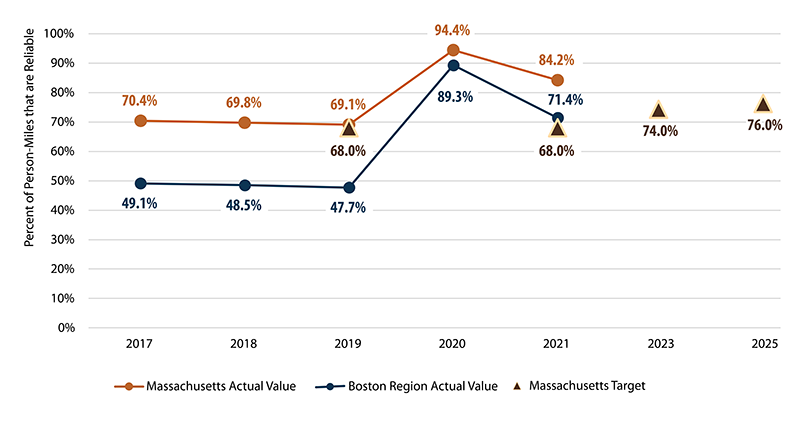
Note: The number of municipalities in the Boston Region MPO area decreased from 101 to 97 in 2018. This change may have affected 2017 values calculated using the Regional Integrated Transportation Information Systems (RITIS) platform in April 2022 as compared to baselines determined when targets were initially set in 2018.
Sources: National Performance Management Research Data Set, Massachusetts Department of Transportation, and the Boston Region MPO staff.
Figure 4-11
Performance Values and Targets for the Percent of Person-Miles that are Reliable on the Non-Interstate NHS
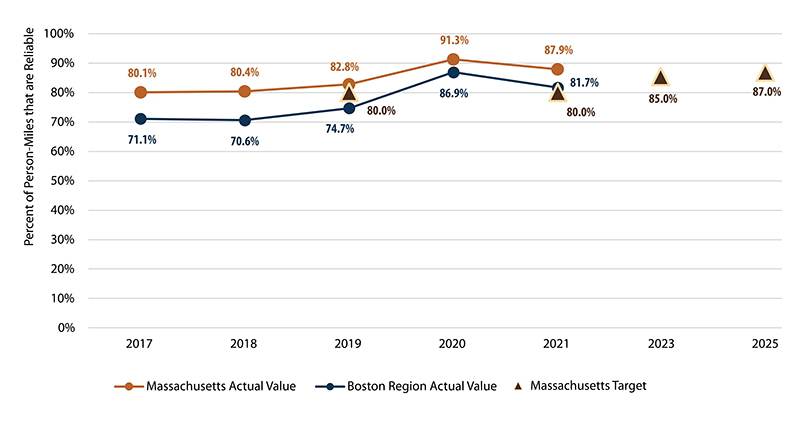
Note: The number of municipalities in the Boston Region MPO area decreased from 101 to 97 in 2018. This change may have affected 2017 values calculated using the Regional Integrated Transportation Information Systems (RITIS) platform in April 2022 as compared to baselines determined when targets were initially set in 2018.
Sources: National Performance Management Research Data Set, Massachusetts Department of Transportation, and the Boston Region MPO staff.
For TTTR, the ratio between the 50th percentile travel time and 90th percentile travel time for trucks along the Interstate System is reported. When setting TTTR targets MassDOT staff considered past travel time reliability measure values and uncertainty around future travel demand following the COVID-19 pandemic. As shown in Figure-4-12, the Boston region’s TTTR baseline value is higher than the statewide value indicating that truck travel times on the Boston region’s Interstate highway network have been generally less reliable than on Massachusetts’s full Interstate network.
TTTR Index values for the Interstate Highway System in Massachusetts were better than the Commonwealth’s two-year and four-year targets between 2017 and 2022, as shown in Figure 4-12. TTTR values improved for both Massachusetts and the Boston region in 2020, although reliability worsened for both geographies in 2021. Performance monitoring will enable the Commonwealth, the MPO, and other stakeholders to respond to post-pandemic changes in truck travel time reliability. The Commonwealth and MPO will adopt new targets and release new performance data in FFY 2027.
Figure 4-12
Performance Values and Targets for Truck Travel Time Reliability on the Interstate Highway System
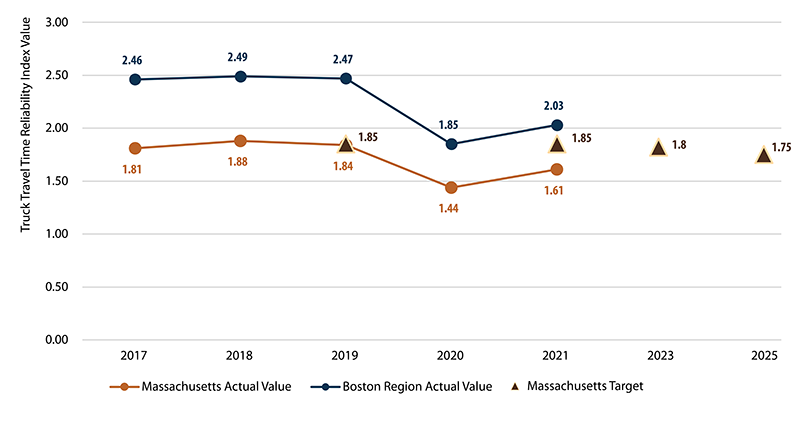
Note: The number of municipalities in the Boston Region MPO area decreased from 101 to 97 in 2018. This change may have affected 2017 values calculated using the Regional Integrated Transportation Information Systems (RITIS) platform in April 2022 as compared to baselines determined when targets were initially set in 2018.
Sources: National Performance Management Research Data Set, Massachusetts Department of Transportation, and the Boston Region MPO staff.
Congestion Mitigation
Congestion mitigation targets for the Boston MA-NH UZA were set through a collaborative process involving the MPO, MassDOT, and the New Hampshire Department of Transportation (NH DOT). Targets were developed for two metrics: annual hours of peak hour excessive delay (PHED) per capita, which estimates the excessive delay experienced by a UZA’s population from travel on the NHS during peak periods and the percent of non-SOV travel.
To develop the PHED targets, MassDOT and NH DOT created projected PHED per capita by using an initial trend line based on a 5 percent growth rate; this growth rate reflects half of the rate of increase in PHED per capita between 2018 and 2019 (prior to the COVID-19 pandemic). This 5 percent growth rate accounted for the fact that traffic had not yet returned to pre-pandemic levels. However, MassDOT and NH DOT acknowledged the large degree of uncertainty surrounding future demand for travel.
MassDOT and NH DOT proposed a target of 24 annual hours of PHED per capita for the end of CY 2023 and a target of 22 hours of PHED per capita for the end of CY 2025. However, travel during the baseline year (2021) was heavily influenced by the COVID-19 pandemic, and at the time targets were developed there was a high degree of uncertainty about post-pandemic travel patterns. These estimates assumed that strategies and policies would be implemented to mitigate growth in congestion during the four-year period. The Boston Region MPO board voted to adopt these targets in October 202220 .
Table 4-21 summarizes the proposed target values. In 2024, MPO staff estimated PHED values for 2022, and the value was 14.8 hours per capita, indicating that actual patterns for PHED are below targeted values. Updated baseline values and targets that account for post-pandemic travel patterns will be calculated in FFY 2027. The 14.8 value was published by the MPO in the Boston Region MPO Mid-Performance Period CMAQ Progress Report (2024).22
Table 4-21
Baseline Value and Targets for Annual Hours of Peak Hour Excessive Delay Per Capita in the Boston MA-NH UZA
Geographic Area |
2021 Measure Value (Baseline) |
Two-Year Target |
One-Year Value Calculated in 2024 |
Four-Year Target |
|
Boston Urbanized Area |
18.0 |
24.0 |
14.8 |
22.0 |
|
CY = calendar year. UZA = urbanized area.
Sources: National Performance Management Research Data Set, US Census Bureau, Federal Highway Administration, the Massachusetts Department of Transportation, the New Hampshire Department of Transportation, Cambridge Systematics, and the Boston Region MPO staff.
Performance targets for the non-SOV metrics were set through a collaboration between MassDOT, NH DOT, the Boston MPO, and the Northern Middlesex Council of Governments (NMCOG). In 2022, MassDOT, NH DOT, and the MPOs submitted a report on the first performance period (2018–21). In addition, the agencies submitted a CMAQ Performance Plan for the second performance period of 2022–25 and, as part of that effort, they set targets for 2023 and 2025.23
Due to the impacts of the COVID-19 pandemic on travel patterns, performance for 2021 exceeded the levels of the 2023 and 2025 targets for non-SOV travel. This resulted in the MPO board voting in 2024 to adjust the 2025 target to 42.6 percent. Table 4-23 shows the updated target for 2025 adopted in 2024 as well as the original 2023 target. Figure 4-13 shows performance through 2022, original targets for 2023 and 2025 set in 2022 and the revised targets set in 2024 (visualized as the forecast). For the forecast, the midpoint, lower bound, and upper bound are all shown.
Figure 4-13
Performance, Projections, and Initial Targets for the Percent of Non-SOV Travel in the Boston MA-NH UZA, submitted September 2024
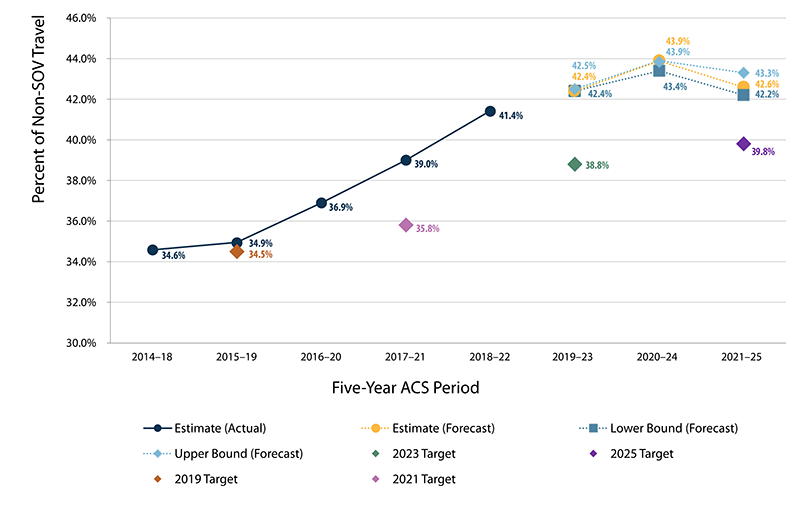
Non-SOV = non-single-occupancy vehicle, UZA = urbanized area
Source: Boston Region MPO and the American Community Survey (ACS).
The non-SOV targets will be updated in FFY 2027 in line with CMAQ reporting requirements.
Air Quality
In December 2023, MassDOT adopted a four-year GHG emissions target that aims to reduce carbon dioxide on the NHS in Massachusetts. The targets adopted by MassDOT are shown in Table 4-22.
Table 4-22
Statewide Baseline Value and Targets for GHG Emissions Reductions of CO2 on the NHS
Performance Measure |
CY 2022 Measure Value (Baseline) |
Four-Year Target |
Percent reduction in CO2 emissions on the NHS |
0 |
7.9 |
CY = calendar year. CO2 = carbon dioxide. GHG = greenhouse gas emissions. NHS = National Highway System
Source: MassDOT.
The federally required CMAQ emissions reduction measure represents the total emissions reduction for applicable pollutants and precursors for CMAQ-funded projects in locations designated as nonattainment or maintenanceareas because they do not meet the EPA standards for criteria air pollutants and precursors from mobile sources.24 MPOs establish a baseline value for emissions by identifying the emissions reductions for applicable pollutants and precursors that were associated with CMAQ-funded projects obligated for funding in nonattainment or maintenance areas.
Baseline values were calculated based on a review of projects completed between FFYs 2018 and 2021. The Boston Region MPO and MassDOT did not program any CMAQ-funded projects in maintenance or nonattainment areas in the TIP and State Transportation Improvement Program (STIP), respectively, between FFYs 2018 and 2021. Thus, the baseline amount of carbon monoxide reduced by CMAQ-funded projects for the 2018 to 2021 baseline period is zero kilograms per day as indicated in Table 4-23.
In 2022, MPO staff identified one project during the 2022 to 2025 performance period that met the CMAQ criteria: the NewMo Microtransit Service Expansion Project, which is funded through the MPO’s Community Connections program.25 The two-year and four-year forecasted emissions reductions are shown in Table 4-23. NewMo service was provided during FFYs 2022 and 2023. Based on a formula with factors for ridership of NewMo vehicles, carbon monoxide emissions were reduced by 0.053 kilograms per day during FFYs 2022 and 2023. Updated emissions reductions targets will be developed in FFY 2027 in line with federal reporting requirements.
Table 4-23 shows the 2021 baseline, two-year, and four-year targets for the Reliability, Congestion, and Emissions Performance Measures (PM3). TTTR and LOTTR metrics compare performance statewide to performance within the Boston region. Percent Non-SOV data is reported for the Boston UZA which includes portions of the Boston MPO, six additional MPOs in Massachusetts, and one in New Hampshire.
Table 4-23
PM3 Measures and Targets
| Measure |
Description |
2021 Measure |
Two-Year Target |
Four-Year Target |
|---|---|---|---|---|
Massachusetts—Interstate Highway System LOTTR |
Percent of person-miles on the |
84.2% |
74.0% |
76.0% |
Massachusetts—Non-Interstate NHS System LOTTR |
Percent of person-miles on the |
87.9% |
85.0% |
87.0% |
Boston Region—Interstate Highway System LOTTR1 |
Percent of person-miles on the |
71.4% |
N/A2 |
N/A2 |
Boston Region—Non-Interstate NHS System LOTTR1 |
Percent of person-miles on the |
81.7% |
N/A2 |
N/A2 |
Massachusetts—Interstate Highway System TTTR |
Truck Travel Time Reliability Index |
1.61 |
1.80 |
1.75 |
Boston Region—Interstate Highway System TTTR1 |
Truck Travel Time Reliability Index |
2.03 |
N/A2 |
N/A2 |
|
|
Baseline (CYs 2016–2020) |
Two-Year Target (CYs 2019–23) |
Four-Year Target (CYs 2021-25) |
Percent non-SOV (Boston UZA) |
Share of travel using non-single-occupancy-vehicles averaged across a four year period. |
36.9% |
38.8% |
42.6% |
|
|
Baseline (FYs 2018-2021) |
Two Year Target (FFYs 2022-23 |
Four Year Target (FFYs 2022-25) |
Emissions Reductions: CO |
Daily kilograms of carbon monoxide emissions reduction from CMAQ projects in Boston region nonattainment or maintenance areas |
0 |
0.354 |
0.354 |
Note: LOTTR targets reflect projected conditions as of the end of CY 2023, and the four-year target reflects conditions as of the end of CY 2025.
1 The baseline values for the Boston region that are shown in this table were calculated in 2022.
2 The N/A values indicate that the MPO adopted state, not regional targets.
CO = carbon monoxide. CY = calendar year. MPO = metropolitan planning organization. N/A = not applicable. NHS = National Highway System.
Sources: National Performance Management Research Data Set, Cambridge Systematics; US Census Bureau, American Community Survey Five-Year Estimates (Table DP03, “Selected Economic Characteristics”); the Massachusetts Department of Transportation; the New Hampshire Department of Transportation; and the Boston Region MPO staff.
TIP Projects Supporting Freight and Travel-Time Reliability Performance
The MPO seeks to make investments that help manage capacity on the transportation network and improve mobility options for travelers in a variety of ways, including the following:
- Providing alternatives to single-occupancy-vehicle (SOV) travel, such as by expanding transit service or adding new bicycle and pedestrian facilities
- Improving roadway design or adding capacity at bottleneck locations
- Implementing traffic and operational improvements along congested or unreliable corridors
When prioritizing projects for funding with Regional Target dollars, the MPO uses evaluation criteria to assess how well each project expands transportation options and mode choice and how it supports mobility. These sets of criteria include items that award points to projects that enhance bicycle and pedestrian accommodations and connections to transit, and that support truck movement. The MPO’s criteria prior to October 2020 granted points to projects that reduced vehicle congestion and delay for transit vehicles. In October 2020, the MPO adopted an updated set of project selection criteria that
- includes criteria tailored to each of the MPO’s investment programs;
- transitions from an emphasis on reducing vehicle congestion to supporting reliability, which is measured using travel-time information available in the Regional Integrated Transportation Information System (RITIS) platform; and
- awards points for reducing transit passenger delay, as opposed to transit vehicle delay.
The MPO’s Community Connections investment program, which funds first- and last-mile solutions, community transportation, and other related projects, has its own set of evaluation criteria. These criteria focus on connectivity to transit and key destinations and supporting shifts in travel to non-SOV modes.
By electing to support the Commonwealth’s targets for federally required reliability measures and agreeing to the Boston MA-NH UZA targets for the federally required annual hours of peak hour excessive delay (PHED) per capita and non-SOV travel measures, the MPO agrees to plan and program projects so that they contribute to achieving those targets. It can be challenging to anticipate how transportation projects may affect these performance measures, as they track outcomes that are not only affected by transportation investments but also traveler choices and demand, among other factors.
TIP Projects Supporting Congestion and Emissions Performance Measures
The MPO uses evaluation criteria to assess the projected transportation-related emissions from each project that is a candidate for Regional Target funding, both for CO2 and other air quality pollutants and precursors, among other environmental considerations. Transportation projects can support reductions in CO2, VOCs, NOx, and CO by improving traffic flow and providing alternatives to SOV travel, including bicycle, walking, and transit options.
MPO staff identified project-related metrics to determine how its Regional Target-funded roadway projects could improve the transportation system in ways that contribute to more reliable, less congested travel on the NHS or that encourage more non-SOV travel. The following project types are recognized:
- Projects that improve roadway geometry or signalization on the NHS, particularly on segments considered to be unreliable, might improve overall travel time reliability on that system.
- Projects that reduce vehicle hours of delay, particularly on the NHS, may also reduce annual hours of PHED per capita.
- Projects that add to the region’s sidewalk or bicycle and pedestrian facility networks, support access to transit, or provide new non-SOV options might encourage use of non-SOV modes. These projects also help to create connectivity in the bicycle and pedestrian networks identified in the Massachusetts Bicycle Transportation and Pedestrian Transportation Plans.
More information on GHG monitoring and evaluation, including the emissions-reduction benefits of funded projects, can be found in Appendix B.
MassDOT, MBTA, MWRTA, and CATA projects and programs also support improvements to air quality and the environment. The MBTA’s and MWRTA’s capital programs include capital investments in fleet electrification and electric-vehicle-charging facilities. Appendix B provides more detailed information and assessments of the GHG impacts of MassDOT, MBTA, CATA, and MWRTA projects and programs.
Future Activities to Improve and Monitor Reliability, Congestion, and Emissions Performance Measures
The CMAQ performance management requirements create frameworks that reinforce coordination between the MPO, MassDOT, and the region’s transit providers as they make investments to support clean air and sustainable communities. CMAQ performance metrics and targets will be updated in FFY 2027 in line with federal government requirements.
Future performance activities in this area may include the following:
- Improve methods for understanding how transportation projects may improve air quality and other environment-related outcomes.
- Continue to implement the MPO’s updated TIP project selection criteria pertaining to clean air and sustainable communities, and further integrate these criteria into the MPO’s performance-monitoring activities.
- Explore other performance measures related to air quality and the environment.
MassDOT, MBTA, MWRTA, and CATA projects, which are described in Chapter 3, also address capacity management and mobility in the Boston region and may also support improvements on federally required reliability, congestion, and non-SOV travel performance measures.
Access and Connectivity Performance
Relevant Goals, Policies, and Plans
The MPO’s access and connectivity goal includes providing transportation options and improving access to key destinations to support economic vitality and high quality of life. The MPO’s objectives in this area encompass providing people with access to jobs, affordable housing, essential services, and other key destinations. Accessibility also depends on providing transportation options, improving connectivity between modes and systems, and removing barriers to make it easy for people of all abilities to walk, bike, roll, use assistive mobility devices, or take transit.
Several different planning processes come together to address access and connectivity performance, issues, and needs. The MPO combines this planning work with ongoing system-level analyses that support its long-range planning. These analyses are documented in its LRTP Needs Assessment, which was released in July 2023. MassDOT conducts its own analyses of access and connectivity performance and needs, which it documents in modal plans such as its Bicycle Transportation Plan, Pedestrian Transportation Plan, and MassDOT Performance Management Tracker tool.26 Meanwhile, the MBTA tracks and analyzes metrics and uses these to support planning processes, such as its current long-term investment plan Focus40.27 The exchange and integration of these plans help agencies in the Boston region coordinate to improve access and connectivity across modes.
Access and Connectivity Performance Measures
Several federally required performance measures are related to access and connectivity, and those are discussed in the Reliability, Congestion, and Emissions Section of this chapter. The MPO published additional measures directly related to access and connectivity in the LRTP Needs Assessment.
The Needs Assessment includes a range of access and connectivity analyses focused on the availability of accessible transit, frequent transit, car share, bike share, and bicycle infrastructure, and travel patterns of transportation network companies (TNCs) provided by companies such as Lyft and Uber. Additionally, the Needs Assessment’s Access and Connectivity chapter features a Destination Access and Transportation Cost Analysis tool, which compares travel time, costs, and accessibility of types of locations in the region.
Future Activities to Improve and Monitor Access and Connectivity Performance
The MPO will continue to work with MassDOT, the MBTA, MWRTA, CATA,, other transit service providers, and other stakeholders in the region to improve access and connectivity performance. These activities may include the following:
- Continue to implement the MPO’s updated TIP project selection criteria pertaining to access and connectivity, and further integrate these criteria into the MPO’s performance-monitoring activities.
- Continue to seek out and improve data to help the MPO better analyze access and connectivity issues for all modes.
- Continue to refine the MPO’s Community Connections and Transit Transformation programs and strengthen links between these programs and the region’s performance in various access and connectivity areas.
- Explore ways to integrate the monitoring of federally required performance measures more fully into the MPO’s Congestion Management Process.
Resiliency Performance
Relevant Goals, Policies, and Plans
The MPO seeks to provide transportation that supports sustainable environments and enables communities in the region to adapt to, and withstand, the potential adverse impacts of severe weather events. There are several objectives that the MPO is working toward:
- Prioritizing investments that make the region’s infrastructure more adaptive and responsive to current and future climate hazards
- Making investments in disadvantaged communities and areas that bear disproportionate climate and environmental burdens
- Investing in transportation that improves emergency access and protects evacuation routes
- Using nature-based solutions that reduce negative impacts, such as runoff, and impacts to water sources, open space, and environmentally sensitive areas
MAPC’s regional plan, MetroCommon 2050, helps shape environmental planning efforts in the region and informs the MPO’s approach to setting risk mitigation objectives. The plan aims to reduce environmental harm in communities impacted by environmental burdens, boost emergency response contingencies, and invest in critical systems and infrastructure, including transportation. Similarly, the Commonwealth has several initiatives, toolkits, and emergency preparedness guidelines for protecting vulnerable populations and infrastructure. More specific to transportation, MassDOT’s Flood Risk Assessment identifies flood exposure to the in-state NHS roads and bridges, rail lines, MassDOT facilities, and public airports.
Resiliency Performance Measures
In the LRTP Needs Assessment, the MPO published several measures on Resiliency. The Needs Assessment contains data on flood risk to key infrastructure in the transportation system, including critical facilities and MBTA catchment areas, and to communities with limited transportation access. Additionally, the Needs Assessment shows risks related to heat impacts. The report also shows a survey of municipal efforts from the Commonwealth's Municipal Vulnerability Preparedness (MVP) program. All of this information contributes to planning for short-term and long-term risks to the region’s transportation system.
Future Activities to Improve and Monitor Resiliency Performance
The MPO has several avenues for assessing and mitigating the risk posed by severe weather events to transportation assets. The MPO considers risk and adaptive capacity when assessing projects for the TIP’s investment programs—Complete Streets, Intersection Improvements, Major Infrastructure, and Transit Transformation. The ongoing MPO programs, including the Transportation Impact Mitigation Program and Community Transportation Access Program, move risk mitigation and adaptation efforts forward on a rolling basis. Additionally, the MPO plans to use studies to identify vulnerable transportation assets, improve regional resilience coordination, and study travel patterns in relation to flooding and emergencies.
Performance Monitoring, Reporting, and Evaluation
The three key phases in the MPO’s PBPP process—planning, investing, and monitoring and evaluating—were discussed earlier in this chapter. Within this framework, the MPO’s TIP relates primarily to the first two phases, focusing on the relationship between the goals and objectives and performance requirements in the MPO’s planning framework and ways the MPO will invest its capital dollars in upcoming federal fiscal years. Other MPO activities relate more directly to the monitoring and evaluation phase of PBPP:
- The MPO’s current LRTP, Destination 2050, contains a Needs Assessment report that describes the MPO’s performance measures and targets as of July 2023. This report includes an assessment of the Boston region’s current performance with respect to baseline data and, where feasible, past performance targets.
- The MPO will also report on its progress through federally required performance plans and reports, such as its CMAQ performance plans and progress reports.
- The MPO also describes progress on its PBPP program web page. This page provides ongoing updates about the MPO’s target-setting activities for federally required performance measures, as well as a link to the MPO’s Performance Dashboard, which provides visualizations of the performance of the Boston region’s transportation system.
- The MPO supplements these monitoring and reporting activities with specific evaluation studies—such as TIP Before-and-After studies—that it conducts through its Unified Planning Work Program to better understand the outcomes of MPO investments.
The Commonwealth and the region’s transit agencies also have reporting and evaluation responsibilities. MassDOT and the Commonwealth’s Executive Office of Public Safety and Security report roadway safety target information annually to FHWA and the National Highway Traffic Safety Administration (NHTSA). MassDOT reports other statewide performance targets and related information to FHWA on a biennial basis via FHWA’s Performance Management Form. The MBTA, MWRTA, and CATA must report their asset inventory and condition data to the FTA’s National Transit Database (NTD) and provide information about the progress that has been made with respect to performance measures and targets as compared to previous reports. These transit agencies also regularly report data about safety outcomes to the NTD. Their annual reviews of their PTASPs and safety targets also create opportunities for them to evaluate their performance.
The MPO will continue to incorporate the results of these reports and evaluations in its planning and investment activities. These activities may include identifying new ways to bring information about performance into the MPO’s LRTP and TIP development processes, such as by updating project selection criteria or providing information through other means. This work would help the MPO develop scenarios to explore how various transportation investments made through the LRTP could support various goals and performance areas. Over time, activities like these will help ensure that the MPO’s investments are helping to meet its vision and goals for the region’s transportation system.
https://www.mass.gov/doc/massachusetts-shsp-2023/download
https://www.ctps.org/data/pdf/programs/performance/CY2023-Travel-Time-Reliability-Targets.pdf
https://www.bostonmpo.org/data/pdf/programs/performance/2022-CMAQ-Performance-Targets.pdf
https://www.ctps.org/data/calendar/pdfs/2022/2024-09-23-CMAQ-Mid-Performance-Period-Progress-Report.pdf
Chapter 5:
Community Impact and Title VI Performance Report
The Boston Region Metropolitan Planning Organization (MPO) monitors how its transportation investments impact communities throughout the Boston region to ensure they meet the needs of all residents. This chapter contains analyses that assess how impacts of MPO-funded projects in the FFYs 2027–31 Transportation Improvement Program (TIP) are distributed throughout the region’s communities, focusing on populations covered by Title VI of the Civil Rights Act of 1964 and other federal mandates (referred to as “nondiscrimination populations”). These analyses are guided by the MPO’s goal of ensuring that all people in the region benefit from the MPO’s transportation investments and that disparities in transportation outcomes are addressed.
Methodological Approach
The MPO assesses the impacts of MPO-funded projects, as a group, on residents of the Boston region, including nondiscrimination populations. Nondiscrimination populations are federally protected based on race, national origin, age, and disability, as well as low-income to promote investment in communities where historically there has been underinvestment:
- People who identify as a minority28
- People with low incomes29
- People with limited English proficiency (LEP)30
- Older adults (ages 75 and older)
- Youth (ages 17 and younger)
- People with disabilities
The analyses in this chapter show the extent to which MPO-funded projects meet the MPO’s goal of investing in transportation that meets the needs of all residents by assessing who is likely to benefit based on project, air quality, and destination access impacts. The analyses focus on a subset of MPO-funded projects (depending on data availability) as noted.
Geographical Analyses
The analyses in this section show the geographical distribution of MPO-funded projects in the FFYs 2027–31 TIP. It includes maps that show project locations and the demographics of the surrounding communities, as well as analyses that show the number of people served or impacted by these projects.
Demographics of the Boston Region
Figures 5-1 through 5-6 show the demographics of nondiscrimination populations within the Boston region overlaid with the MPO-funded projects programmed in the FFYs 2027–31 TIP.
Figure 5-1
Minority Population
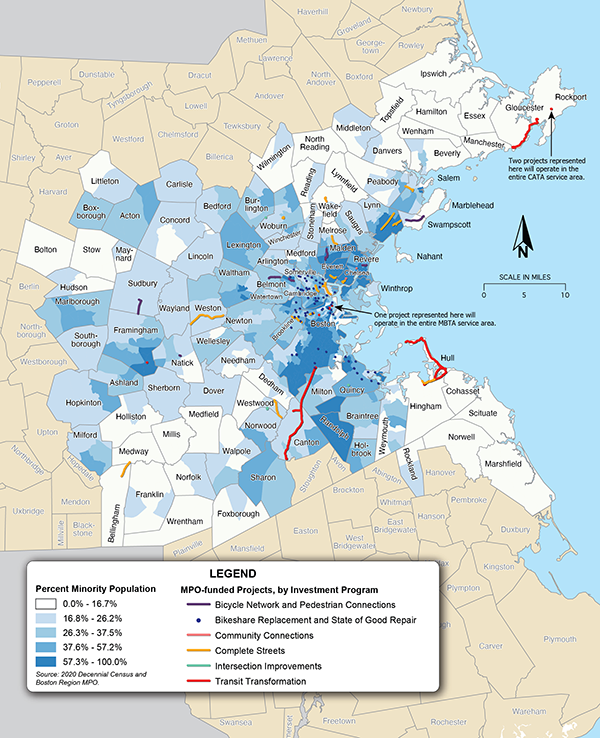
Figure 5-2
Low-income Population
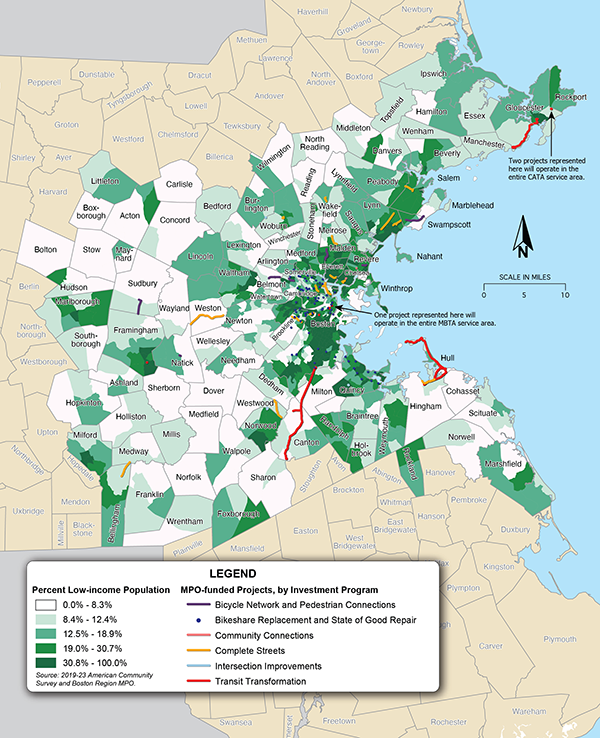
Figure 5-3
People with Limited English Proficiency
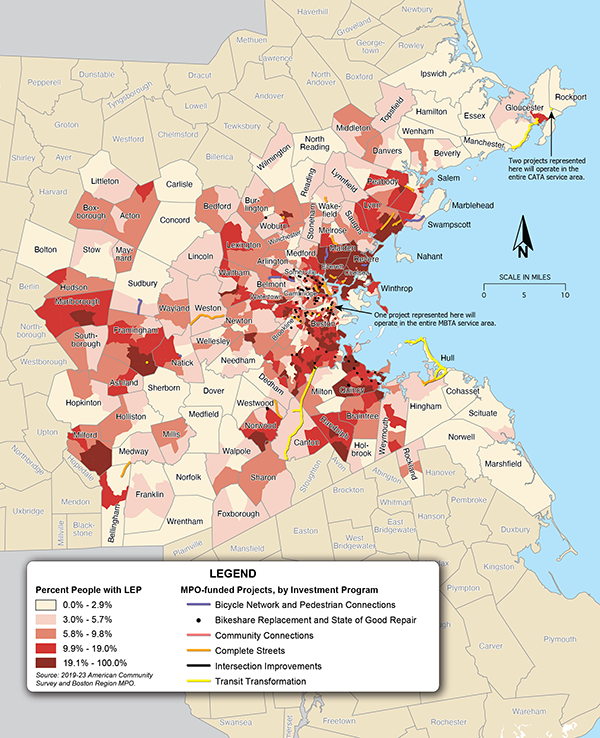
Figure 5-4
People with Disabilities
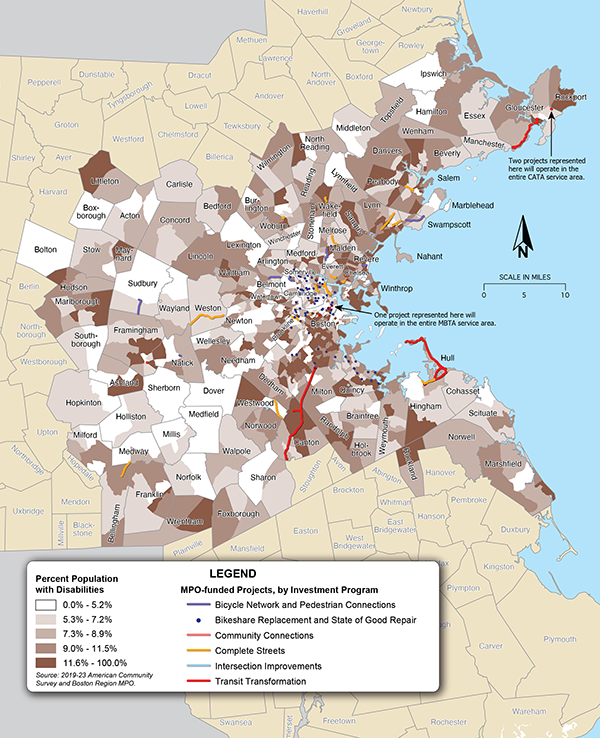
Figure 5-5
Older Adult Population
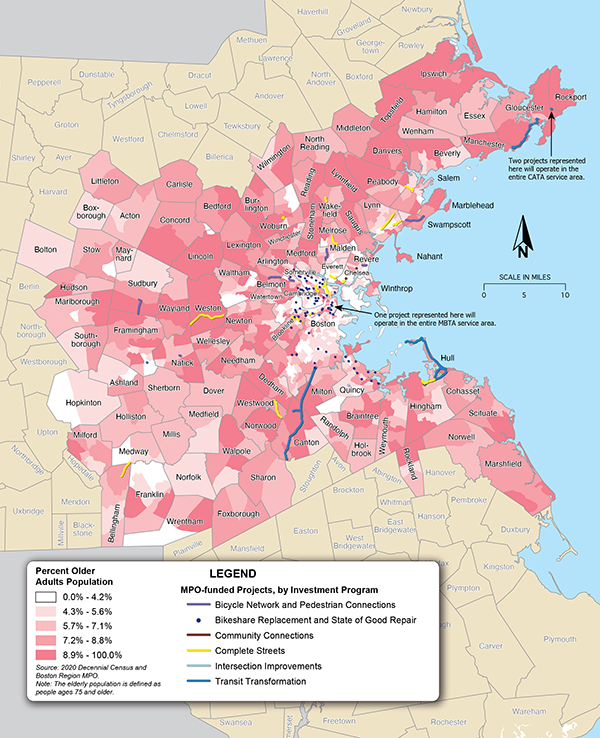
Figure 5-6
Youth Population
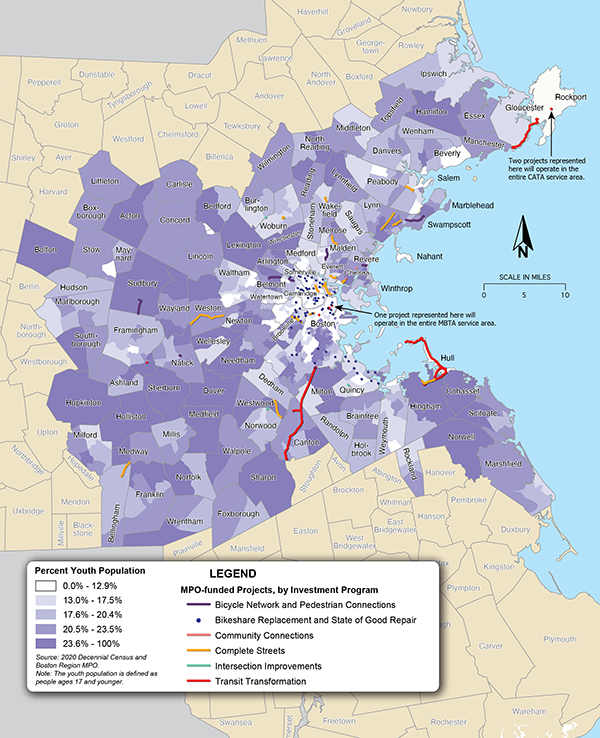
Populations Served or Impacted by MPO-Funded Projects
Table 5-1 shows the percent of each nondiscrimination population likely to be served or impacted by MPO-funded projects in the FFYs 2027–31 TIP, compared to the percent of the rest of the population. The projects included in the analysis did not include those that would be funded in the later years of the TIP through the Community Connections, Transit Transformation, Bikeshare State of Good Repair, and Project Design Programs’ set-asides since these funds are not yet committed. Projects that do not have a specific location (for example, locomotive procurement) were also excluded. People are considered to be served or impacted by a project if they live within one-half mile of the project location.
The analysis results show that the share of the minority population, low-income population, and people with limited English proficiency served or impacted by MPO-funded projects is greater than their share of the region’s population. This indicates that they are well-served by these projects. However, this is not the case for people with disabilities, older adults, and youth, as they make up smaller shares of the population served or impacted by MPO-funded projects than that of their share of the region’s populations.
Table 5-1
Populations Served or Impacted by the FFYs 2027–31 TIP
| Population Group | Regionwide Population | Percent of Regionwide Population | Population Served or Impacted | Percent of Population Served or Impacted |
| Race and ethnicity | blank | blank | blank | blank |
| Minority population | 1,223,835 | 36.5% | 341,292 | 40.1% |
| Nonminority population | 2,133,359 | 63.5% | 510,410 | 59.9% |
| Income | blank | blank | blank | blank |
| Low-income population | 613,863 | 19.1% | 197,942 | 24.8% |
| Non-low-income population | 2,606,823 | 80.9% | 600,878 | 75.2% |
| English language ability | blank | blank | blank | blank |
| People with limited English proficiency | 360,973 | 11.4% | 120,516 | 15.0% |
| English speakers | 2,800,806 | 88.6% | 683,237 | 85.0% |
| Disability status | blank | blank | blank | blank |
| People with disabilities | 341,581 | 10.3% | 84,410 | 10.2% |
| People without disabilities | 2,964,393 | 89.7% | 744,747 | 89.8% |
| Age | blank | blank | blank | blank |
| Older adults (ages 75 and older) | 234,814 | 7.0% | 55,837 | 6.6% |
| People under age 75 | 3,122,380 | 93.0% | 795,865 | 93.4% |
| Youth (ages 17 and younger) | 634,486 | 19.0% | 150,105 | 17.6% |
| Adults | 2,722,708 | 81.0% | 701,597 | 82.4% |
Source: Boston Region MPO and US Census Bureau.
Figure 5-7 shows the percentage of each nondiscrimination population likely to be served or impacted by projects in each of the FFYs 2027–31 TIP’s investment programs based on the percentage of the population residing in the project area. This analysis also excluded projects that would be funded through set-asides in the later years of the TIP and projects without a specific location. Minority populations, low-income populations, people with disabilities, youth, and people with limited English proficiency are most served by Community Connections projects. The older adult population is most served by Transit Transformation projects. Older adults are most served by Intersection Improvement Projects.
Figure 5-7
Percent of Nondiscrimination Populations Served or Impacted by MPO-funded Projects in the FFYs 2027–31 TIP by Investment Program
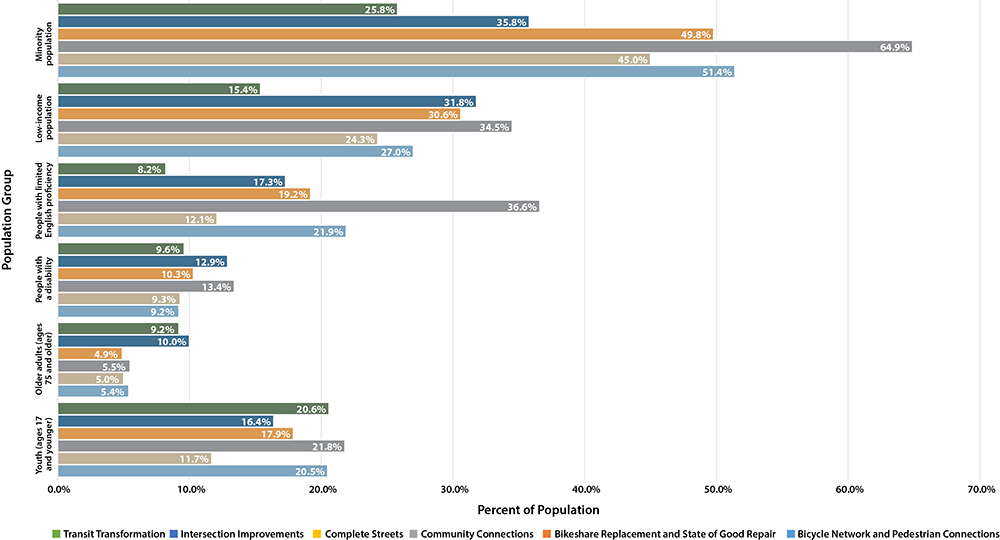
Sources: US Census Bureau and Boston Region MPO.
Funding Distribution Analysis
The MPO staff analyzed how MPO funds are distributed in the region based on the percentage of people living in project areas. The MPO has programmed approximately $764 million on the projects over which is has funding discretion in the FFYs 2027–31 TIP. Approximately $682 million was included in this analysis, about $100 million less than the total funding programmed as it does not include investment program set-asides not yet committed to specific projects without a specific location.
Table 5-2 shows the percentage of funding allocated in the FFYs 2027–31 TIP to MPO-funded projects, in the aggregate, among nondiscrimination populations compared to the rest of the region’s population. Funding allocation is based on the percentage of the population served or impacted by projects (see Table 5-1). Results show that the share of funding allocated to the minority population, low-income population, and people with limited English proficiency exceeds their percentage of the regionwide population. The percentage of funding allocated to people with disabilities, older adults, and youth, however, is less than the percentage of the region’s population.
Table 5-2
Funding Allocation by Population in the FFYs 2027–31 TIP
| Population | Percentage of Funding Allocated | Percentage of Regionwide Population |
| Race and ethnicity | blank | blank |
| Minority population | 39.0% | 36.5% |
| Nonminority population | 61.0% | 63.5% |
| Income | blank | blank |
| Low-income population | 25.0% | 19.1% |
| Non-low-income population | 75.0% | 80.9% |
| English language ability | blank | blank |
| People with limited English proficiency | 13.9% | 11.4% |
| English speakers | 86.1% | 88.6% |
| Disability status | blank | blank |
| People with disabilities | 10.1% | 10.3% |
| People without disabilities | 89.9 | 89.7% |
| Age | blank | blank |
| Older adults (ages 75 and older) | 6.5% | 7.0% |
| People under age 75 | 93.5% | 93.0% |
| Youth (ages 17 and younger) | 17.8% | 19.0% |
| Adults | 82.2% | 81.0% |
Sources: US Census Bureau and Boston Region MPO.
Figure 5-8 shows the change in the per capita allocation of MPO funds to nondiscrimination populations over the last three TIPs—the FFYs 2025–29, FFYs 2026–30, and FFYs 2027–31 TIPs. The results show that per capita funding has increased for all nondiscrimination populations except older adults, for whom it decreased slightly over last year’s TIP.
Figure 5-8
Change in Funding Per Capita Allocated by Nondiscrimination Populations over the Last Three TIPs
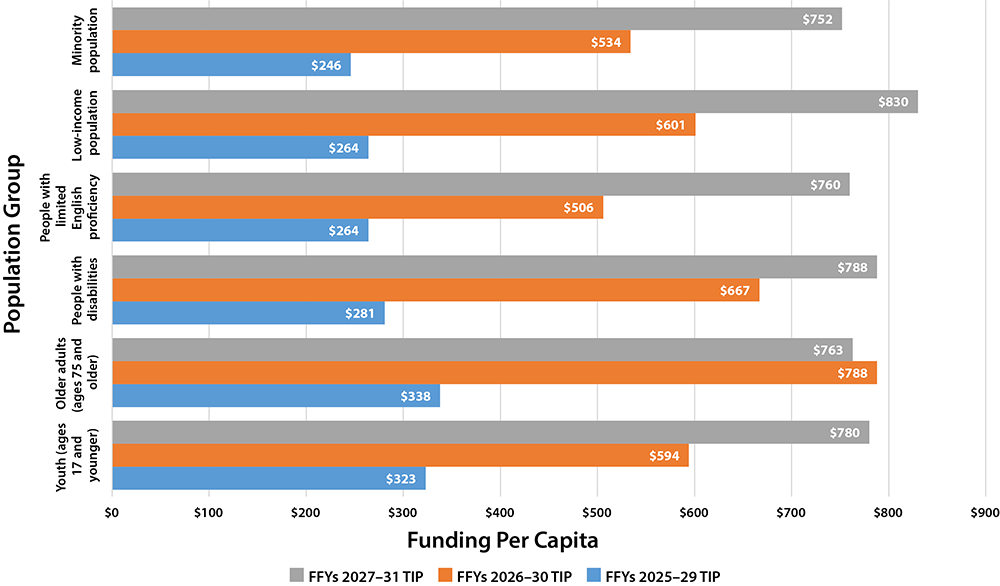
FFY = federal fiscal year. TIP = Transportation Improvement Program.
Sources: US Census Bureau and Boston Region MPO.
Transportation Emissions Impacts Analysis
The analyses described in this section assess air quality impacts using the MPO’s Congestion Mitigation and Air Quality (CMAQ) analyses. They do not include investment programs reserved in the later years of the TIP that are not yet committed to specific projects or projects without a specific location, as previously described. Also excluded are projects for which emissions impacts cannot be quantified; i.e., the CMAQ analysis indicates a qualitative decrease because the change in emissions cannot be quantified.
Table 5-3 shows the projected emissions reductions per 1,000 people that may result from MPO-funded projects in the FFYs 2027–31 TIP for nondiscrimination populations compared to the rest of the region’s population. Reductions are in kilograms and are the sum of carbon monoxide (CO), volatile organic compounds (VOC), and nitrogen oxides (NOx) emissions. The results show that the emissions reductions per 1,000 people for most nondiscrimination populations exceed that for the rest of the region’s population. The exception is older adults, who are expected to experience a 14.6 kilogram (kg) reduction in emissions, compared to a 15.1 kg reduction for people under age 75.
Table 5-3
Total Emission Reductions from the FFYs 2027–31 TIP
| Population | Total Change in Emissions (kg) | Change in Emissions Reduction per 1,000 People (kg) |
| Race and ethnicity | blank | blank |
| Minority population | -5,207.5 | -17.3 |
| Nonminority population | -6,218.9 | -13.6 |
| Income | blank | blank |
| Low-income population | -3,507.7 | -20.0 |
| Non-low-income population | -7,918.7 | -14.7 |
| English language ability | blank | blank |
| People with limited English proficiency | -1,783.4 | -16.2 |
| English speakers | -9,643.0 | -15.9 |
| Disability status | blank | blank |
| People with disabilities | -1,159.5 | -15.5 |
| People without disabilities | -10,266.9 | -15.4 |
| Age | blank | blank |
| Older adults (ages 75 and older) | -727.6 | -14.6 |
| People under age 75 | -10,698.7 | -15.1 |
| Youth (ages 17 and younger) | -2,096.9 | -15.3 |
| Adults | -9,329.5 | -15.0 |
kg = kilograms.
Source: US Census Bureau and Boston Region MPO’s Congestion Mitigation and Air Quality analyses.
Figure 5-9 shows how the emissions reduction per 1,000 people for nondiscrimination populations estimated to result from MPO-funded projects has changed over the past three TIPs. These changes are shown for each TIP and are not cumulative. The results show that emissions reductions are lower for this TIP compared to the FFYs 2026–30 TIP for all nondiscrimination populations except for people with limited English proficiency. Even though overall emissions reductions are favorable in this TIP for nondiscrimination populations compared to the rest of the region, this result may indicate that the types of projects being funded do not reduce emissions as much as those funded in earlier TIPs. It may also have to do with the types of projects that can be quantified with CMAQ analyses.
Figure 5-9
Emission Reductions per 1,000 People in the Past Three TIPs for Nondiscrimination Populations
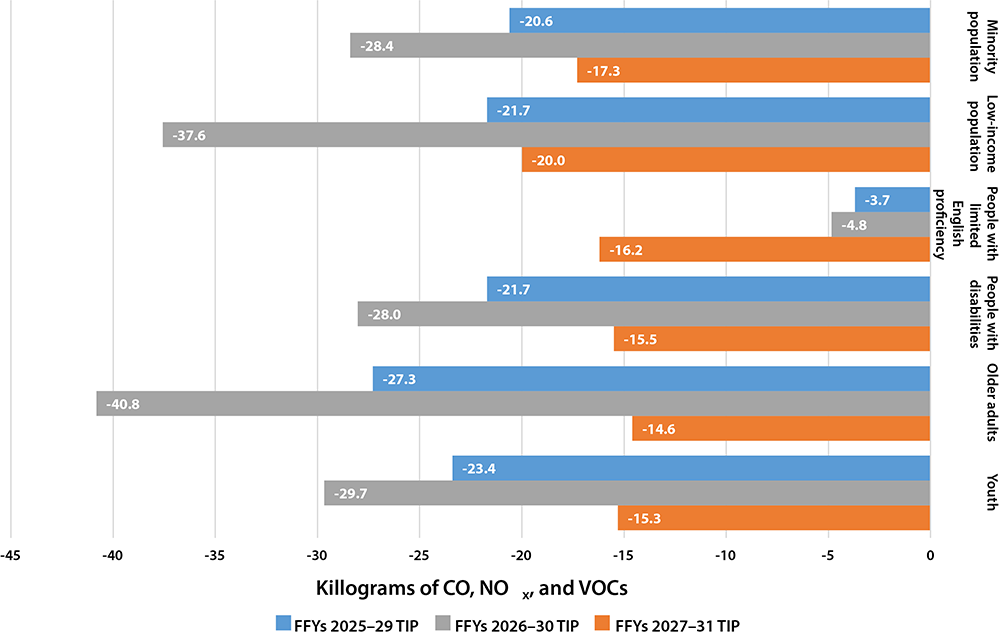
CO = carbon monoxide. FFY = federal fiscal year. NOx = nitrogen oxide. TIP = Transportation Improvement Program. VOC = volatile organic compounds.
Note: This analysis does not include projects for which a change in emissions could not be quantified.
Source: US Census Bureau and Boston Region MPO’s Congestion Mitigation and Air Quality analyses.
Destination Access and Travel Time Impacts
MPO staff used Conveyal, a destination access tool, to analyze changes in travel time and the number of various types of destinations people can reach within a given travel time. The analyses were conducted on all MPO-funded projects in the TIP that would directly change travel speeds and/or the ability of a person to reach a destination. Modeled projects include those within the Complete Streets, Intersection Improvement, Transit Transformation, Community Connections, and Bicycle Network and Pedestrian Connection Programs that include one or more of the following improvements:
- Addition of new transportation infrastructure (such as building a shared-use path) or service (such as a new bus route)
- Change in roadway geometry (such as the removal of a travel lane)
- Addition of traffic-calming elements (such as speed tables)
At this time, Bikeshare Expansion and Support projects cannot be modeled in Conveyal; MPO staff are continuing to work on developing a method to model them. Staff also continue to expand their understanding of the impacts of various project elements on travel speeds so that more projects can be included in future analyses.
Table 5-4 shows the change in the number of destinations that can be accessed within a given travel time—including access to jobs, healthcare, and parks and open space—expected due to the MPO-funded projects in the FFYs 2027–31 TIP. The analysis compared a no-build scenario, in which TIP projects are not built, to the TIP program scenario, in which all the TIP projects are built, to determine the change in the number of destinations that can be accessed by all people in the Boston region with implementation of the TIP program. The results show that the number of jobs that can be accessed within a 45-minute drive increased, while the number of parks and open space that can be accessed within a 45-minute drive and nonemergency healthcare facilities that can be accessed within a 25-minute transit trip both decreased.
Table 5-4
Change in the Average Number of Destinations Accessible per Person from the FFYs 2027–31 TIP
| Metric Destination | No-build Scenario | TIP Program Scenario | Percent Change |
| Parks and open space within a 45-minute drive trip1 | 10,047 | 10,020 | -0.26% |
| Jobs within a 45-minute transit trip2 | 179,399 | 179,407 | 0.004% |
| Nonemergency healthcare within a 25-minute transit trip3 | 3.77 | 3.76 | -0.09% |
1 Access to parks and open space is measured to points of access within a 45-minute drive trip.
2 Access to jobs is measured by the number of employment locations that can be accessed within a 45-minute transit trip.
3 Access to nonemergency healthcare facilities is measured by the number of facilities that can be accessed within a 25-minute transit trip.
TIP = Transportation Improvement Program.
Sources: Boston Region MPO, US Census Bureau, Conveyal, Massachusetts Department of Public Health Care Facility Licensure and Certification, and MassGIS.
Table 5-5 shows the change in travel times—transit travel time and drive travel time—expected due to the MPO-funded projects in the FFYs 2027–31 TIP. This analysis also compared the no-build scenario to the TIP program scenario to determine the TIP program’s impact on travel times. The results show that both transit and drive travel times would increase slightly.
Table 5-5
Change in Average Per Person Travel Times from the FFYs 2027–31 TIP
| Metric | No-build Scenario | TIP Program Scenario | Percent Change |
| Average travel time (minutes) by driving | 37.15 | 37.24 | 0.25% |
| Average travel time (minutes) by transit | 71.29 | 71.32 | 0.04% |
TIP = Transportation Improvement Program.
Sources: Boston Region MPO and Conveyal.
Future Activities
MPO staff will continue to research more sophisticated methods of identifying specific impacts of MPO-funded projects and evaluating, as a group, their impacts, with a focus on access to destinations. Staff are using the results of a recent study, Applying Conveyal to TIP Project Scoring, and conducting follow-up work to develop project evaluation criteria that can be used to assess how well projects provide access to various destinations. This new methodology may allow staff to understand how individual projects may affect nondiscrimination populations prior to the MPO selecting TIP projects for funding. In addition, that work will refine methods for modeling projects in Conveyal and support improved destination access and travel time analyses described in this chapter.
Notes
The following demographic data sources were used for the analyses reported in this chapter:
- Minority population: US Census Bureau; 2020 Decennial Census Redistricting Data (P.L. 94-171), Table P2: Hispanic or Latino, and Not Hispanic or Latino by Race; https://data.census.gov/table/DECENNIALPL2020.P2?q=P2:+HISPANIC+OR+LATINO,+AND+NOT+HISPANIC+OR+LATINO+BY+RACE.
- Low-income population: US Census Bureau; 2019–23 American Community Survey, Table C17002: Ratio of Income to Poverty Level in the Past 12 Months; https://data.census.gov/table/ACSDT5Y2023.C17002?q=c17002.
- People with limited English proficiency: US Census Bureau; 2019–23 American Community Survey, Table B16004: Age by Language Spoken at Home by Ability to Speak English for the Population 5 Years and Older; https://data.census.gov/table/ACSDT5Y2023.B16004?q=B16004:+Age+by+Language+Spoken+at+Home+by+Ability+to+Speak+English+for+the+Population+5+Years+and+Over.
- People with disabilities: US Census Bureau; 2019–23 American Community Survey, Table B18101: Sex by Age by Disability Status; https://data.census.gov/table/ACSDT5Y2023.B18101?q=B18101:+Sex+by+Age+by+Disability+Status.
- Older adult and youth populations: US Census Bureau; 2020 Decennial Census Redistricting Data (P.L. 94-171), Table P12: Sex by Age for Selected Categories; https://data.census.gov/table/DECENNIALCD1182020.P12?q=P12:+SEX+BY+AGE+FOR+SELECTED+AGE+CATEGORIES.
28 People who identify as a minority include those who identify as Hispanic or Latino/a/x and/or a race other than White.
29 A person is considered to have a low income if their annual family income is less than or equal to 200 percent of the poverty level for their family size.
30 People with limited English proficiency are those who speak English less than “very well.”
Appendix A:
Project Prioritization and Scoring
Eligibility for Regional Target Funding
As described in Chapter 2, the Transportation Improvement Program (TIP) development and project prioritization and funding process consists of numerous phases and is supported by several different funding sources. This appendix includes information about transportation projects that the Boston Region Metropolitan Planning Organization (MPO) considered for funding through the Highway Discretionary (Regional Target) Program in the federal fiscal years (FFYs) 2027–31 TIP. To be considered for funding by the MPO, a project must fulfill certain basic criteria. Projects evaluated through the MPO’s Bicycle Network and Pedestrian Connections, Complete Streets, and Intersection Improvements investment programs must meet these criteria:
- The Massachusetts Department of Transportation’s (MassDOT) Project Review Committee must have approved the project or must plan to review it.
- The project proponent must be a municipality or state agency.
- The project proponent must have submitted a pre-25 percent design to MassDOT, or the project must be at a later design stage.
For projects evaluated through the MPO’s Transit Transformation program, the following criteria apply:
- The project proponent must be a municipality, regional transit authority (RTA), or state agency.
- The RTA that serves the project area or would operate the facility must have approved the project or must plan to review it.
- The project proponent must identify the source of 20 percent matching funding for the project.
For projects evaluated through the MPO’s Community Connections program, the following criteria apply:
- The project proponent must submit a complete application for funding to MPO staff along with supporting documentation, such as geographic files depicting the project area and budgeting worksheets.
- The proponent must be a municipality, transportation management association (TMA), or RTA. Other entities, such as nonprofit organizations, may apply in partnership with a municipality, TMA, or RTA that has agreed to serve as a project proponent and fiscal manager.
- The proponent must demonstrate that the project will have a positive impact on air quality, as the Community Connections program is funded using federal Congestion Mitigation and Air Quality funds.
- The proponent must demonstrate readiness and institutional capacity to manage the project sustainably.
Evaluation Criteria
Once a proponent provides sufficient design documentation for a project and the municipality or state is actively prioritizing the project for funding, the project can be evaluated by MPO staff. The evaluation criteria used to score projects are based on the MPO’s goals and objectives. After the projects are evaluated, the scores are shared with project proponents, posted on the MPO’s website, and presented to the MPO board for review and discussion.
The scores for projects evaluated during development of the FFYs 2027–31 TIP for programming in the MPO’s Bicycle Network and Pedestrian Connections, Complete Streets, and Intersection Improvements programs are summarized in Table A-3. Scores for projects that applied for funding through the MPO’s Community Connections program during the FFYs 2027–31 TIP cycle are summarized in Table A-4.
Following the adoption of the Long-Range Transportation Plan, Destination 2050, in July 2023, the MPO revised the TIP evaluation criteria to better align with the MPO’s updated goals, objectives, and investment programs. These criteria were employed during the project selection process for the FFYs 2027–31 TIP. The final criteria were informed by robust public engagement conducted during the development of Destination 2050 and developed through an update process that engaged MPO members, staff, and external stakeholders. This update also created separate criteria for different project types within the Community Connections program given the diverse array of first- and last-mile projects that can be funded through the program.
The project selection criteria for each investment program are shown in separate tables in this appendix as follows: Bicycle Network and Pedestrian Connections (Table A-5); Complete Streets (Table A-6); Intersection Improvements (Table A-7); and Transit Transformation (Table A-8).
Community Connections project selection criteria are shown in separate tables in this appendix as follows: Bicycle Lanes (Table A-9); Bicycle Racks (Table A-10); Bikeshare Support (Table A-11); Microtransit Pilots (Table A-12); and Wayfinding Signage (Table A-13).
Other Considerations in Project Selection and Programming
More details about the MPO’s FFYs 2027–31 Regional Target projects are available in the funding tables included in Chapter 3. Performance-related information for these projects, including their relationships to the MPO’s Long-Range Transportation Plan, is included in Chapter 4. Information about greenhouse gas emissions for these projects is available in Appendix B.
TIP Programming Policies
TIP Project Cost Policy
In the spring of 2021, the MPO board voted to create an Ad Hoc Committee to explore the causes and consequences of cost increases for projects that the MPO funds and recommend possible policy changes to the full MPO board.
In September 2021, the MPO adopted a series of policies based on the findings and recommendations of the Ad Hoc Committee. These policies included requiring that projects be at the 25 percent design stage before they are funded on the TIP and the creation of a mechanism for the MPO board to request that projects be rescored when costs increase beyond a designated threshold. These thresholds are increases of $2,500,000 or 25 percent of project cost, whichever is triggered first.
More information on the 2021 TIP Project Cost Policies may be found on the MPO’s website (PDF)(HTML).
In summer 2025, MPO staff worked with the TIP Process, Engagement, and Readiness Committee to address needed improvements to the 2021 TIP Project Cost Policies. These improvements were adopted by the MPO in fall 2025, and were in effect beginning with the FFYs 2027–31 TIP.
Revised TIP Project Rescoring Policy
In October 2025, staff worked with the TIP Process, Engagement, and Readiness Committee to reinforce the rescoring policy set under the 2021 TIP Project Cost Policies. These improvements were in response to structural issues in implementing the policy that discouraged its enforcement. Despite numerous projects surpassing the cost thresholds set by the policy, the MPO board did not request rescoring or reconsideration of any project between the FFYs 2023–27 and FFYs 2026–30 TIPs.
The policy update focused on the creation of an automatically initiated rescoring framework for projects that were evaluated using outdated criteria that were based on a Long-Range Transportation Plan that is five or more years old. During development of the FFYs 2027–31 TIP, staff scored 13 funded projects that were either scored under the FFYs 2021–25 or earlier TIPs, or had never been previously scored. Cohorts for project scoring are outlined in Table A-1.
Table A-1
TIP Project Rescoring Cohorts
Rescoring Cohort |
Relevant TIPs |
Number of Projects |
TIP Cycle for Rescoring |
Cohort 1 (Complete) |
FFYs 2021–25 and older |
13 projects |
FFYs 2027–31 |
Cohort 2 |
FFYs 2022–26, 2023–27, 2024–28 |
11 projects |
FFYs 2029–33 |
Cohort 3 |
FFYs 2025–29, 2026–30, 2027–31, 2028–32 |
5 projects |
FFYs 2033–37 |
Automatic project rescoring for Cohort 2 will take place for the development of the FFYs 2029–33 TIP. The number of projects in Cohort 2 will decrease over time should projects successfully advertise or be removed from the TIP. The number of projects in Cohort 3 will increase over time should the MPO fund new projects through the FFYs 2028–32 TIP.
More information on the Revised TIP Project Rescoring Policy can be found on the MPO’s website (PDF)(HTML).
Revised TIP Project Readiness Requirements
Following adoption of the TIP Project Cost Policies in 2021, there was no mechanism in place to require that project proponents continue progressing designs past the 25 percent stage to retain TIP funding. Moreover, the 25 percent threshold only applied to new projects, allowing several TIP projects to remain on the TIP without 25 percent submissions—some through the FFYs 2026–30 TIP.
MassDOT’s adoption of a new Project Development and Design Guide in October 2023 shifted more components of project design to earlier, pre-25 percent stages. On average, this increased the time required for projects to reach 25 percent design but decreased the time required to attain later design stages. These process improvements, when combined with a minimum threshold of 25 percent design to receive TIP funding, had a net effect of reducing the eligibility for new projects to be funded through the TIP without effectively addressing the design risks of currently funded projects.
In response to these changes, the MPO adopted Revised Readiness Requirements in December 2025. These requirements established a minimum design requirement for a project to be funded in each programming year of the TIP, alongside two additional milestones (“Next Stage” and “Cost Estimate”) to provide a more objective basis for assessing project risk. These thresholds are listed in Table A-2.
Table A-2
Five Year Readiness Guidelines
|
Year 1 |
Year 2 |
Year 3 |
Year 4 |
Year 5 |
Minimum Requirement |
100% design submitted |
75% design approved or combined 75% / 100% |
25% DPH held |
25% design received with comments |
Pre-25% submission |
Next Stage |
PS&E within 9 months |
100% design within 6 months |
75% design within 6 months |
25% DPH scheduled |
25% submission within 3 months |
Cost Estimate |
New cost estimate |
Cost estimate less than 1.5 years old |
New cost estimate |
Cost estimate less than 1.5 years old |
New cost estimate |
DPH = Design Public Hearing. FFY = Federal Fiscal Year. PS&E = Plans, Specifications, and Estimates.
Any project that does not meet the minimum required design milestone for TIP programming, a pre-25 percent design submission, is not eligible for funding through the Regional Target Program of that TIP in accordance with this policy.
More information on the 2025 TIP Project Readiness Requirements can be found on the MPO’s website (PDF)(HTML).
The Universe of Projects
Starting with the FFYs 2027–31 TIP, the Universe of Projects is now maintained through an online TIP Project Dashboard. The dashboard provides project descriptions and information for both programmed and unprogrammed projects and a breakdown of funding by subregion.
Table A-3
FFYs 2027–31 TIP Project Evaluation Results:
Multiple MPO Investment Programs
| Bicycle Network and Pedestrian Connections Program | |||||||||||||||
| Proponent | Project Number | Project Name | Total Score | Total Base Score | Total Scaled Equity Score | Safety | Safety Equity Score | Mobility and Reliability | Mobility and Reliability Equity Score | Access and Connectivity | Access and Connectivity Equity Score | Resilience | Resilience Equity Score | Clean Air and Healthy Communities | Clean Air and Healthy Communities Equity Score |
| Concord | 612870 | Concord- Assabet River Multi-Use Trail and Bridge Construction | 59.9 | 55.5 | 4.4 | 14 | 3.5 | 11 | 2 | 12.5 | 1.5 | 11 | 2 | 7 | 2 |
| Revere | S13406 | Revere- Revere Beach Connector (Design Only) | 71.4 | 61 | 10.4 | 14 | 9 | 12 | 4 | 12 | 4 | 14 | 6 | 9 | 3 |
| Newton | 613594 | Needham-Newton- Bridge Replacement on Christina Street | 74 | 64 | 10 | 13 | 7 | 12 | 5 | 11 | 4 | 15 | 3 | 13 | 6 |
| Brookline | 613683 | Brookline- Pedestrian Bridge Replacement, B-27-017, Davis Path over MBTA | 73.65 | 66 | 7.65 | 14 | 6.75 | 11 | 2.625 | 13 | 3 | 15 | 3.75 | 13 | 3 |
| Cambridge | 613568 | Cambridge- New Bridge and Shared-Use Path Construction over Fitchburg Line at Danehy Park Connector | 85.3 | 73.5 | 11.8 | 14.5 | 7.5 | 15 | 6 | 13 | 5 | 17 | 6 | 14 | 5 |
| 100 | 80 | 20 | 16 | 15 | 17 | 16 | 16 | ||||||||
| Complete Streets Program | |||||||||||||||
| Proponent | Project Number | Project Name | Total Score | Total Base Score | Total Scaled Equity Score | Safety | Safety Equity Score | Mobility and Reliability | Mobility and Reliability Equity Score | Access and Connectivity | Access and Connectivity Equity Score | Resilience | Resilience Equity Score | Clean Air and Healthy Communities | Clean Air and Healthy Communities Equity Score |
| Malden | 613244 | Malden – Broadway Reconstruction Everett to Melrose City Line | 78 | 67 | 11 | 12.5 | 6 | 16.5 | 8.5 | 12 | 5 | 14 | 2 | 12 | 6 |
| Marblehead | 612947 | Marblehead- Village Street Bridge Replacement M-04-001 | 44.4 | 41 | 3.4 | 8 | 2 | 11 | 3.5 | 1 | 1 | 11 | 0.5 | 10 | 1.5 |
| Wakefield | 613145 | Wakefield- Comprehensive Downtown Improvements | 63.8 | 59 | 4.8 | 12 | 3 | 17 | 4 | 12 | 2.5 | 9 | 1 | 9 | 1.5 |
| Everett | 613585 | Chelsea- Everett- Reconstruction of Vine Street and Third Street, from Chelsea Street to MBTA Station | 67.1 | 59 | 8.1 | 14 | 6 | 12 | 5.25 | 12 | 3 | 12 | 2.25 | 9 | 3.75 |
| 100 | 80 | 20 | 16 | 19 | 15 | 14 | 16 | ||||||||
| Transit Transformation Program | |||||||||||||||
| Proponent | Project Number | Project Name | Total Score | Total Base Score | Total Scaled Equity Score | Safety | Safety Equity Score | Mobility and Reliability | Mobility and Reliability Equity Score | Access and Connectivity | Access and Connectivity Equity Score | Resilience | Resilience Equity Score | Clean Air and Healthy Communities | Clean Air and Healthy Communities Equity Score |
| CATA | S13388 | CATA Access for All | 39.8 | 35 | 4.8 | 0 | 0 | 10 | 5 | 8 | 2.5 | 8 | 0.5 | 9 | 4 |
| CATA | S13389 | Cape Ann Dialysis Transportation | 39.8 | 35 | 4.8 | 0 | 0 | 10 | 5 | 8 | 2.5 | 8 | 0.5 | 9 | 4 |
| MWRTA | S13390 | Procurement of 10 Compressed Natural Gas (CNG) Vehicles | 49.5 | 42 | 7.5 | 4 | 0 | 12 | 7.5 | 10 | 5.25 | 8 | 0.75 | 8 | 5.25 |
| MWRTA | S13391 | Construction of Vehicle Maintenance and Fueling Facility | 55.6 | 46 | 9.6 | 5 | 0.75 | 14 | 7.5 | 12 | 8.25 | 5 | 0.75 | 10 | 6.75 |
| MWRTA | S13392 | Procurement of Hydrogen Fuel Cell-Powered Transit Vehicles | 50.8 | 43 | 7.8 | 4 | 0 | 12 | 7.5 | 10 | 5.25 | 8 | 0.75 | 9 | 6 |
| MBTA | S13393 | Symphony Station | 50.6 | 41 | 9.6 | 8 | 2 | 11 | 10 | 9 | 5 | 7 | 2 | 6 | 5 |
| MBTA | S13394 | Downtown Crossing Vertical Transportation Improvements Phase 2 | 42.6 | 35 | 7.6 | 5 | 2 | 10 | 8 | 9 | 4 | 7 | 2 | 4 | 3 |
| MBTA | S13395 | Operational Enhancement of Bus Routes 714 and 716 | 34.8 | 31 | 3.8 | 3 | 1 | 10 | 5 | 7 | 1 | 7 | 1 | 4 | 1.5 |
| MBTA | S13396 | Bus Priority and Accessibility Improvements | 53.6 | 47 | 6.6 | 11 | 1 | 12 | 5 | 19 | 9 | 2 | 0 | 3 | 1.5 |
| MBTA | S13397 | Franklin Line Double Track Improvements - Phase 3 | 43.6 | 39 | 4.6 | 9 | 0.5 | 13 | 5 | 7 | 4 | 6 | 0.5 | 4 | 1.5 |
| MBTA | S13398 | Unit Substation Upgrade/Replacement | 45.4 | 40 | 5.4 | 10 | 1.5 | 11 | 5.25 | 6 | 2.25 | 6 | 0.75 | 7 | 3.75 |
| MBTA | S13399 | Haverhill Line Double Track Improvements | 43.8 | 39 | 4.8 | 10 | 1 | 12 | 5 | 7 | 4 | 6 | 0.5 | 4 | 1.5 |
| MBTA | S13400 | Locomotive Procurement | 41 | 35 | 6 | 6 | 1.5 | 12 | 7.5 | 6 | 2.25 | 6 | 0.75 | 5 | 3 |
| MBTA | S13401 | Better Bus Project - Operational Safety Improvements at Bus Stops | 44.6 | 39 | 5.6 | 10 | 1 | 12 | 4 | 11 | 7.5 | 3 | 0 | 3 | 1.5 |
| MBTA | S13402 | High Priority Stations Accessibility Improvements Program | 44.8 | 37 | 7.8 | 5 | 1.5 | 11 | 7.5 | 11 | 7.5 | 6 | 0.75 | 4 | 2.25 |
| MBTA | S13403 | Power Systems Reliability Program | 44.4 | 39 | 5.4 | 10 | 1.5 | 10 | 5.25 | 6 | 2.25 | 6 | 0.75 | 7 | 3.75 |
| MBTA | S13404 | Silver Line Tunnel Flood Mitigation | 47.8 | 44 | 3.8 | 11 | 1 | 11 | 4 | 5 | 1 | 13 | 1.5 | 4 | 2 |
| MBTA | S13405 | Blue Line Tunnel Airport Flood Mitigation | 51.6 | 44 | 7.6 | 11 | 2 | 11 | 8 | 5 | 2 | 13 | 3 | 4 | 4 |
| MBTA | S13420 | North Station Flooring Replacement | 38.1 | 33 | 5.1 | 7 | 1.5 | 8 | 3.75 | 9 | 4.5 | 7 | 1.5 | 2 | 1.5 |
| CATA | S13413 | Vehicle Replacement | 21.6 | 19 | 2.6 | 3 | 0.5 | 8 | 4 | 5 | 1 | 1 | 0 | 2 | 1 |
| CATA | S13412 | Magnolia Shuttle | 28.6 | 25 | 3.6 | 2 | 0 | 5 | 3.75 | 7 | 1.5 | 5 | 0 | 6 | 3.75 |
| 100 | 79 | 21 | 16 | 16 | 16 | 16 | 15 | ||||||||
| Abbreviations | ||||||||||||||||||
| CATA = Cape Ann Transportation Authority. CNG = Compressed Natural Gas. MBTA = Massachusetts Bay Transportation Authority. MWRTA = MetroWest Regional Transit Authority. N/A = not applicable. PRC = MassDOT's Project Review Committee. RRFB = Rapid Reflective Flashing Beacon. TBD = To be determined. | ||||||||||||||||||
| Metropolitan Area Planning Council (MAPC) Subregions: ICC = Inner Core Committee. MAGIC = Minuteman Advisory Group on Interlocal Coordination. MWRC = MetroWest Regional Collaborative. NSPC = North Suburban Planning Council. NSTF = North Shore Task Force. SSC = South Shore Coalition. SWAP = SouthWest Advisory Planning Committee. TRIC = Three Rivers Interlocal Council. | ||||||||||||||||||
Table A-4
FFYs 2027–31 TIP Project Evaluation Results:
Community Connections Program
| Community Connections Program | |||||||||
| Proponent | Project Name | Total Score | Connectivity | Regional and Interlocal Coordination | Plan Implementation | Transportation Equity | Climate Change Mitigation | Performance Management | |
| Malden | Malden Bicycle Rack Expansion | 78 | 16 | 8 | 8 | 20 | 18 | 8 | |
| Brookline | Brookline Bluebike Expansion | 76.5 | 15 | 8 | 16 | 13.5 | 16 | 8 | |
| Brookline | Brookline Bicycle Rack Expansion | 79.5 | 14 | 7 | 16 | 19.5 | 16 | 7 | |
| MAPC | Boston, Brookline, Cambridge, and Somerville Bluebikes Replacement of 60 Stations | 81 | 15 | 12 | 18 | 13 | 14 | 9 | |
| Quincy | Quincy Bluebikes Expansion, 10 Stations | 63 | 13 | 6 | 12 | 18 | 6 | 8 | |
| MAPC | Joint Municipality Bluebikes Expansion, 1500 ebikes, 25 classic bikes, 17 stations | 85 | 14 | 13 | 14 | 20 | 15 | 9 | |
| 18 | 16 | 18 | 20 | 18 | 10 | ||||
| Abbreviations | ||||||||||||||||||
| CATA = Cape Ann Transportation Authority. CNG = Compressed Natural Gas. MBTA = Massachusetts Bay Transportation Authority. MWRTA = MetroWest Regional Transit Authority. N/A = not applicable. PRC = MassDOT's Project Review Committee. RRFB = Rapid Reflective Flashing Beacon. TBD = To be determined. | ||||||||||||||||||
| Metropolitan Area Planning Council (MAPC) Subregions: ICC = Inner Core Committee. MAGIC = Minuteman Advisory Group on Interlocal Coordination. MWRC = MetroWest Regional Collaborative. NSPC = North Suburban Planning Council. NSTF = North Shore Task Force. SSC = South Shore Coalition. SWAP = SouthWest Advisory Planning Committee. TRIC = Three Rivers Interlocal Council. | ||||||||||||||||||
Table A-5
FFYs 2027–31 TIP Evaluation Criteria:
Bicycle Network and Pedestrian Connections Program
| Safety: Transportation by all modes will be safe. | Equity Multiplier? |
| The project design has a significant effect on improving safety for all users. Disqualifying - The project design does not improve safety for all users, or hinders user safety. 1 - The design of the project has a minor impact on improving safety for a limited number of potential facility users. 2 - The design of the project has a moderate effect on improving safety for all users of the facility, or improvements are primarily directed towards either pedestrians or micromobility, not both. 3 - The design of the project has a high effect on improving safety for all potential users of the facility, including the creation of entirely new facilities. | Yes |
| The project addresses a statewide Top 5% Bicycle Crash Cluster or Top 5% Pedestrian Crash Cluster. 0 - The project does not address a Top 5% Bicycle Crash Cluster or Top 5% Pedestrian Crash Cluster. 2 - The project addresses a Top 5% Bicycle Crash Cluster and/or a Top 5% Pedestrian Crash Cluster. | Yes |
| The proposed design provides for physical separation of facility users from other forms of traffic, and prevents obstruction. 0 - The proposed design either affords no physical separation for the facility, or the separation is horizontal and striped only. 1 - The proposed design has some physical separation for the facility in the form of a flexible barrier, but does not adequately prevent obstruction (ie: parking in bicycle lane). 2 - The proposed design affords full physical separation of the facility and its users from other forms of traffic, including vertical separation and fixed barriers. | Yes |
| Where vehicles and pedestrians or micromobility users share a facility, the project improves the safety of interactions between these users. 0 - The project does not take steps to reduce conflict and hazards between vulnerable users and vehicles. 1 - The project makes some steps towards reducing conflicts and hazards between vulnerable users and vehicles, such as flexible posts. 2 - The project reduces conflicts and hazards between vehicles and vulnerable users where they currently exist, or eliminates these hazards entirely. | |
| The project connects to existing pedestrian or micromobility facilities. 0 - The project does not connect to any current pedestrian or micromobility facilities, and the applicant does not provide any information as to how future connections may be made. 1 - The project does not connect to any current pedestrian or micromobility facilities, but the applicant describes how future connections will be made and any action to date towards those connections. 2 - The project connects to other micromobility or pedestrian facilities, including painted bike lanes or sidewalks. 3 - The project connects to safe micromobility and pedestrian facilities, or functions as an extension of an existing facility. | |
| The project improves safety and accessibility for people with disabilities. Disqualifying - The proposed project introduces potentially unsafe elements for people with disabilities. Alternatively, the project does not address identifiable issues with Americans with Disabilities Act Compliance in the Project Area. 0 - The project makes no significant improvements or creates incidental enhancements to safety for people with disabilities. 1 - The project makes minor improvements to safety for people with disabilities. 2 - The project makes significant improvements to safety for people with disabilities. | Yes |
| The project effectively addresses safety for transit operations and users. 0 - The project makes no significant improvements or creates incidental benefits to safety for transit operations or transit users. 1 - The project makes minor improvements to safety for transit operations or transit users. 2 - The project makes significant improvements to safety for transit operations or transit users. | |
| Mobility and Reliability | |
| The applicant thoroughly describes deficiencies in the current design of the corridor or intersection, and how the project addresses these deficiencies. 0 - The proposed project includes minor improvements to roadway mobility, or focuses primarily on the preservation of existing assets. 1 - The project primarily upgrades existing active transportation infrastructure within the current right of way and street footprint that addresses some of the deficiencies along the corridor. 2 - The project upgrades and modernizes infrastructure, including improvements that create active transportation connections where none currently exist. 3 - The project thoroughly addresses deficiencies in a corridor or network of assets to provide broader regional active transportation or intermodal connections. | |
| The project improves pedestrian safety near a high-utility corridor to promote walking. 0 - The project does not involve significant pedestrian safety improvements. 1 - The project improves pedestrian safety on a corridor with moderate utility. 2 - The project improves pedestrian safety on a high utility corridor. | Yes |
| The project improves safety near a high-utility corridor for other active transportation modes other than walking. 0 - The project does not involve significant safety improvements for other active transportation modes. 1 - The project improves active transportation safety for other active transportation modes on a corridor with moderate utility. 2 - The project improves active transportation safety for other active transportation modes on a high utility corridor. | |
| The applicant details how the facility may be maintained and upgraded throughout its useful life, including plans to ensure accessibility of the facility year round by users (ex: snow plowing, root management). 0 - The applicant does not describe their approach towards maintaining and supporting the asset. 1 - The applicant describes the process by which the asset may be maintained, and access supported. 2 - The applicant describes the process by which the asset may be maintained and access supported, and includes a plan for future improvements to the asset or along the network. | |
| The project improves travel time reliability by investing in measures that reduce dependence on single-occupancy-vehicle trips. 0 - The project does not improve travel time reliability, or does not significantly invest in non-SOV transportation modes. 1 - The project has some impact on travel time reliability through minor investments in non-SOV transportation modes. 2 - The project has some impact on travel time reliability through moderate investments in non-SOV transportation modes. 3 - The project has a significant impact on travel time reliability through rigorous investments in non-SOV transportation modes. | |
| The project invests in safe pedestrian facilities. 0 - The project does not invest in pedestrian facilities, or establishes facilities that are disconnected from other pedestrian infrastructure with no plans for connections. 1 - The project makes some investments in pedestrian facilities, such as beacons and sidewalks, but investments are limited to the immediate project area (ex: intersection). 2 - The project makes comprehensive investments in new and upgraded pedestrian facilities in the project area, and establishes safe connections to a greater pedestrian network. | Yes |
| The project includes complementary investments from bikeshare facilities. 0 - No bikeshare facilities are present along the route or near the asset. 1 - Bikeshare facilities are present along the route or near the asset. | Yes |
| Access and Connectivity | |
| The project serves sites targeted for future development (Up to 2 points). 0 - The project does not serve a site targeted for future development. 1 - The project serves a site for future development. 2 - The project serves a site targeted for future development that includes transit-supportive mixed-use or residential sites. | |
| The project serves sites included within a municipal Section 3A 'MBTA Communities' zoning district or other transit oriented development. (Up to 2 points). 0 - The project does not serve a TOD or MBTA Communities site. 1 - The project is near to or indirectly serves a TOD or MBTA Communities site. 2 - The project directly intersects with or serves a TOD or MBTA Communities site. | Yes |
| The project serves existing employment and population centers (Up to 3 points). 0 - The project does not serve an existing employment or population center. 1 - The project serves an existing employment or population center. 2 - The project serves an existing employment and population center. 3 - The project serves an existing employment and population center with significant affordable housing opportunities. | Yes |
| The project improves navigability at or along the work area through signage. 0 - No signage improvements are incorporated into the project. 1 - Signage improvements, which may include interpretive signage, are included in the proposed project. | |
| The project addresses safety concerns near to key public community assets. 0 - The project is not near to any key public community assets. 1 - The project addresses safety concerns near to one or more community assets. 2 - The project addresses safety concerns near key public community assets with a large population of vulnerable users, such as schools, libraries, or senior centers. | |
| The project is a product of or fulfills recommendations identified in a regional or statewide study. 0 - The project is not consistent with or the applicant does not cite a regional or statewide corridor study or Road Safety Audit. 1 - The project is thematically consistent with a regional or statewide study, such as a corridor study or Road Safety Audit. 2 - The project is explicitly called for in a regional or statewide study, such as a corridor study or Road Safety Audit. | |
| The project is listed in the Massachusetts Priority Trails Network. 0 - The project is not included in the MassDOT Priority Trails Network. 2 - The project is included in the MassDOT Priority Trails Network | |
| The project involves collaboration between multiple municipalities. 0 - Only one municipality is involved in the project. 1 - One or more municipalities are involved in the project. | |
| The asset can be safely accessed by non-SOV modes of transportation. 0 - Access to the asset is predominantly conducted by SOV modes. 1 - Access to the asset can be performed by walking, but facilities are either unsafe or are located in lower volume areas. 2 - Access to the asset can be performed by a variety of methods, including by transit. | |
| (Penalty) The project applicant is an MBTA Community not in compliance with Section 3A. 0 - The municipality is in compliance with or not subject to Section 3A. -5 - The municipality is not in compliance with Section 3A. | |
| Resilience | |
| The project reduces the risk of flooding in the project area through adaptation and resilience improvements. 0 - The project does not address flooding. 1 - The project reduces flood risk using structural adaptation/gray infrastructure. 2 - The project reduces flood risk using nature-based adaptation/green infrastructure, or a combination of green and gray infrastructure. | Yes |
| The project reduces the risk of extreme temperatures by reducing pavement cover, planting shade trees, providing shade structures, increasing green space, etc. 0 - The project does not address extreme temperatures. 1 - The project reduces extreme temperature risk using structural adaptation/gray infrastructure. 2 - The project reduces extreme temperature risk using nature-based adaptation/green infrastructure, or a combination of green and gray infrastructure. | Yes |
| The project implements recommendations or addresses needs identified in the respective municipality's Hazard Mitigation Plan, Municipal Vulnerability Plan, or Climate Adaptation Plan. 0 - The project does not address needs or recommendations. 2 - The project addresses needs or recommendations. | |
| The project improves stormwater infrastructure beyond MassDEP's MS4 standard. 0 - The project meets minimum standards. 1 - The project includes one design element to go above minimum stormwater improvement standards (adopts stormwater BMPs, prepares pollution and/or erosion prevention plan, adopts environmentally sensitive site design practices, is expected to remove high amounts of TSS, etc.). 2 - Project adopts more than one design element to go above minimum stormwater improvement standards. | |
| The project applicant demonstrates regional coordination or partnership on resilience improvements and project impacts with neighboring municipalities, environmental or EJ advocacy groups, local community organizations, regional or state agencies, etc. 0 - The applicant does not demonstrate regional coordination. 1 - The applicant demonstrates regional coordination with neighboring municipalities and/or regional or state agencies. 2 - The applicant demonstrates regional coordination with neighboring municipalities, regional or state agencies AND local community organizations/advocacy groups. | |
| The applicant details the expected useful life of the improvements, provides a plan for maintenance of resilience improvements, and/or references current and future climate conditions. 0 - Applicant does not reference current and future climate conditions and does not provide a plan for maintenance. 1 - Applicant references current and future climate conditions AND/OR provides a plan for maintenance. | |
| The project proposes improvements and reduces climate risk along evacuation routes and/or roadways that provide emergency access to critical facilities such as police stations, fire stations, and hospitals. 0 - The project does not propose improvements to an evacuation route or along roadways that provide emergency access to critical facilities. 1 - The project proposes improvements along an evacuation route OR along a roadway that provide emergency access to critical facilities. 2 - The project proposes improvements along an evacuation route AND along a roadway that provide emergency access to critical facilities. | |
| The project design is expected to address multiple hazards and/or provide multiple environmental benefits such as risk reduction, ecological restoration, aquatic connectivity, improved water quality, groundwater recharge, etc. 0 - Project design is not expected to address multiple hazards or provide multiple environmental benefits. 1 - Project design is expected to address multiple hazards or provide multiple environmental benefits. 2 - Project design is expected to address multiple hazards and provide multiple environmental benefits. | |
| (Penalty) The project is located in an existing or projected flood zone and/or the project site has flooded in the past and the applicant does not specify how the project will address flooding. 0 - Project is not located in an existing or projected flood zone and site has not flooded in the past OR project is located in a flood zone and the applicant specifies how the project will address flooding. -3 - Project is located in an existing or projected flood zone or site has flooded in the past and the project does not specify how it will address flooding. | Yes |
| (Penalty) The project is located in an area that is vulnerable to extreme heat and the applicant does not specify how the project will address heat. 0 - The project is not located in an area vulnerable to extreme heat OR project is located in a vulnerable area and the applicant specifies how the project will address heat. -3 - The project is located in an area vulnerable to extreme heat and the project does not specify how it will address heat. | Yes |
| Clean Air and Healthy Communities | |
| The project includes design elements aimed at reducing the amount of Single-Occupancy-Vehicle (SOV) trips (Up to 3 points). Disqualifying - The project does not provide effective reductions in the amount of Single Occupancy Vehicle trips 1 - The project provides some reductions in Single Occupancy Vehicle trips, but the extent is unclear or the primary usage of the facility will be for recreation. 2 - The project reduces Single Occupancy Vehicle trips to a moderate or greater extent, and includes viable non-recreational uses for the facility. 3 - The project not only includes reductions in Single Occupancy Vehicle trips by improving facilities for pedestrians and micromobility users, but complementing connections for other non-car modes such as transit or other trails.. | |
| The project reduces greenhouse gas emissions (Up to 3 points). 0 - The project does not support a reduction in greenhouse gas emissions. 1 - The project supports a reduction in greenhouse gas emissions primarily by reducing travel time delay. 3 - The project includes a variety of elements aimed at reducing emissions such as low or no emission mobility improvements, innovative technologies or methods, and travel demand management. | |
| The project is expected to have a positive impact on adjacent communities and natural areas through low impact design, pavement reduction, nature-based adaptation, and other improvements that protect air/water/soil quality, provide ecological restoration and functioning, improve aquatic connectivity, etc. -1 - The project is expected to have a negative impact on adjacent communities or natural areas. 0 - The project is not expected to impact adjacent communities or natural areas. 2 - The project is expected to have a positive impact on adjacent communities or natural areas. 3 - The project specifies native species for any added vegetation or green space. | Yes |
| The proposed project incorporates or will incorporate a meaningful community outreach and engagement process (Up to 3 points). 0 - The proposed project will incorporate all legally required community outreach and engagement necessary for the use of federal funding. 1 - The proposed project will incorporate additional community outreach and engagement as necessary, including public meetings within the served municipality or municipalities. 2 - The proposed project has already utilized community outreach and engagement, and the applicant will continue to engage stakeholders in the project process as it develops. 3 - The proposed project is the result of a rigorous community engagement process, and the proposed scope of work reflects the feedback or input received by the applicant from the community. The applicant will continue to engage stakeholders in the process, and the applicant has novel or innovative strategies to improve community engagement. | |
| The project effectively engages all community members in its outreach strategy and access for the service, specifically persons with disabilities or those with limited English proficiency (Up to 2 points). 0 - The project performs all legally required measures to ensure compliance with the Americans with Disabilities Act and Title VI of the Civil Rights Act. 1 - The applicant has identified a strategy to bring community members of all abilities and language proficiencies into the project outreach process and to ensure their access to services. 2 - The applicant has implemented an effective strategy to engage community members of all abilities and language proficiencies into the project engagement process and into offered services, while also identifying areas for potential improvement. | Yes |
| The project improves access to open space or sites for active recreation. 0 - The project does not improve access to open space or sites for active recreation. 2 - The project does improve access to open space or sites for active recreation. | Yes |
| BONUSES | |
| CAHQ: Pursuant to the improvement of the capacity of the transit asset or supportive facilities to capture/process/treat carbon emissions, the project utilizes nature-based solutions to improve air quality/treatment. | |
| CAHQ: Pursuant to the improvement of the capacity of the transit asset or supportive facilities to capture/process/treat contaminated water, the project utilizes nature-based solutions to improve water quality or treatment. | |
| Resilience: The project design is expected to address multiple hazards and/or provide multiple environmental benefits such as risk reduction, ecological restoration, aquatic connectivity, improved water quality, groundwater recharge, etc. 0 - Project design is not expected to address multiple hazards or provide multiple environmental benefits. 1 - Project design is expected to address multiple hazards OR provide multiple environmental benefits. 2 - Project design is expected to address multiple hazards AND provide multiple environmental benefits. | |
| Resilience: The project design includes provision of educational material for the public related to environmental improvements and aspects of the project/area. 0 - Project will not provide educational material. 1 - Project will provide educational material. | |
| Resilience: The primary purpose of the project is to improve resilience and reduce risk to climate hazards. 0 - The primary purpose of the project is not resilience. 1 - The primary purpose of the project is resilience. | |
| Resilience: The project proponents have used RMAT's Climate Resilience Design Standards Tool to demonstrate the value of resilience improvements in the project area. 0 - Proponents have not shared results from RMAT's Climate Resilience Design Standards Tool. 1 - Proponents have shared results from RMAT's Climate Resilience Design Standards Tool. |
Table A-6
FFYs 2027–31 TIP Evaluation Criteria:
Complete Streets Program
| Evaluation Criteria: Complete Streets Program | Equity Multiplier? |
| The project addresses a location with severe crashes. +2 EPDO value of 100 or more +1 EPDO value of less than 100 +0 No EPDO value" | Yes |
| The project addresses a location with a high frequency of crashes. +2 Crash rate between 0.78 or greater +1 Crash rate between 0.20 and 0.78 +0 Crash rate below 0.20 | Yes |
| The project addresses a statewide Top Crash Location. 0 - The project does not address a Top 200 Crash Cluster, Top 5% Intersection Crash Cluster, Top 5% Bicycle Crash Cluster, or Top 5% Pedestrian Crash Cluster. 1 - The project addresses one of the following: a Top 5% Intersection Crash Cluster, a Top 5% Bicycle Crash Cluster, or Top 5% Pedestrian Crash Cluster. 2 - The project addresses two of the following: a Top 5% Intersection Crash Cluster, a Top 5% Bicycle Crash Cluster, or a Top 5% Pedestrian Crash Cluster. 3 - The project addresses three or more Intersection, Bicycle, and/or Pedestrian Crash Clusters, or contains a Statewide Top 200 Crash Location. | |
| The project addresses a truck-related safety issue. 0 - The project does not directly address truck safety in the project area. 1 - The project directly addresses truck safety in the project area, including improving the safety of vulnerable users navigating in mixed traffic with trucks. | |
| The project effectively addresses safety for micromobility users. -2 - The project introduces potentially unsafe elements for micromobility users. 0 - The project makes no significant improvements or creates incidental benefits to safety for micromobility users. 1 - The project makes minor improvements to safety for micromobility users. 2 - The project makes significant improvements to safety for micromobility users. | |
| The project effectively addresses safety for pedestrians. - 2 - The project introduces potentially unsafe elements for pedestrians. 0 - The project makes no significant improvements or creates incidental benefits to safety for pedestrians. 1 - The project makes minor improvements to safety for pedestrians. 2 - The project makes significant improvements to safety for pedestrians. | Yes |
| The project effectively addresses safety for people with disabilities. - 5 - The proposed project introduces potentially unsafe elements for people with disabilities. Alternatively, the project does not address identifiable issues with Americans with Disabilities Act Compliance in the Project Area. 0 - The project makes no significant improvements or creates incidental enhancements to safety for persons with disabilities. 1 - The project makes minor improvements to safety for people with disabilities. 2 - The project makes significant improvements to safety for people with disabilities. | Yes |
| The project effectively addresses safety for transit operations and users. 0 - The project makes no significant improvements or creates incidental benefits to safety for transit operations or transit users. 1 - The project makes minor improvements to safety for transit operations or transit users. 2 - The project makes significant improvements to safety for transit operations or transit users. | |
| Mobility and Reliability | |
| The project improves pedestrian safety near a high-utility corridor to promote walking. 0 - The project does not involve significant pedestrian safety improvements. 1 - The project improves pedestrian safety on a corridor with moderate utility. 2 - The project improves pedestrian safety on a high utility corridor. | Yes |
| The project improves safety near a high-utility corridor for other active transportation modes other than walking. 0 - The project does not involve significant safety improvements for other active transportation modes. 1 - The project improves active transportation safety for other active transportation modes on a corridor with moderate utility. 2 - The project improves active transportation safety for other active transportation modes on a high utility corridor. | Yes |
| The applicant thoroughly describes deficiencies in the current design of the corridor or intersection, and how the project addresses these deficiencies. 0 - The proposed project includes minor improvements to roadway mobility, or focuses primarily on the preservation of existing assets. 1 - The project primarily upgrades existing infrastructure within the current right of way and street footprint that addresses some of the deficiencies along the corridor. 2 - The project focuses on upgrades and modernization of infrastructure, including improvements to accessibility by non-SOV modes, both within the current street footprint or beyond existing right of way. 3 - The project thoroughly addresses deficiencies in the design of the corridor or intersection, and also addresses potential deficiencies elsewhere on a corridor. | |
| The project addresses an unreliable corridor with significant travel time delay. 0 - The project does not address an unreliable corridor. 1 - The project improves the safety along an unreliable corridor, but the benefits of the improvements are difficult to quantify. 2 - The project significantly improves the safety of travel along an unreliable corridor. Travel time delay may be improved due to a reduced crash frequency. 3 - The project thoroughly improves the safety of travel along an unreliable corridor, and directly reduces travel time delay through the proposed street design. | |
| The project improves travel time reliability by investing in measures that reduce dependence on single-occupancy-vehicle trips. 0 - The project does not improve travel time reliability, or does not significantly invest in non-single occupancy vehicle transportation modes. 1 - The project has some impact on travel time reliability through minor investments in non-single occupancy vehicle transportation modes. 2 - The project has some impact on travel time reliability through moderate investments in non-single occupancy vehicle transportation modes. 3 - The project has a significant impact on travel time reliability through rigorous investments in non-single occupancy vehicle transportation modes. | |
| The project invests in safe pedestrian facilities. 0 - The project does not invest in pedestrian facilities, or establishes facilities that are disconnected from other pedestrian infrastructure with no plans for connections. 1 - The project makes some investments in pedestrian facilities, such as beacons and sidewalks, but investments are limited to the immediate project area (ex: intersection). 2 - The project makes comprehensive investments in new and upgraded pedestrian facilities in the project area, and establishes safe connections to a greater pedestrian network. | Yes |
| The project invests in safe micromobility facilities. 0 - The project does not invest in bicycle facilities, or proposed facilities do not offer significant levels of safety (ex: painted bicycle lanes with no separation). 2 - The project invests in safe bicycle facilities. | Yes |
| The project invests in safe transit facilities. 0 - The project does not invest in any transit facilities. 1 - The project makes some transit-supportive investments (ex: bumpouts near bus stops). 2 - The project directly invests in transit facilities (ex: transit signal priority). | Yes |
| Access and Connectivity | |
| The project serves sites targeted for future development (Up to 3 points). 0 - The project does not serve a site targeted for future development. 1 - The project serves a site for future development. 2 - The project serves a site targeted for future development that includes transit-supportive mixed-use or residential sites. 3 - The project serves a site or sites targeted for future development that include transit-supportive mixed-use or residential sites, and are included as part of compliance with Section 3A of the Massachusetts Zoning Act from the community in which it is located. | |
| The project serves existing employment and population centers (Up to 3 points). 0 - The project does not serve an existing employment or population center. 1 - The project serves an existing employment or population center. 2 - The project serves an existing employment and population center. 3 - The project serves an existing employment and population center with significant affordable housing opportunities. | Yes |
| The project addresses safety concerns near to key public community assets. 0 - The project is not near to any key public community assets. 1 - The project is near to one or more community assets. 2 - The project addresses safety concerns near key public community assets with a large population of vulnerable users, such as schools, libraries, or senior centers. | Yes |
| The project addresses safety concerns in multiple locations. 0 - Project improvements are concentrated at a specific site. 1 - The applicant details how the project is expected to have network improvements at other sites along the corridor. 2 - The project directly addresses multiple concerns at different locations. | |
| The project improves navigability at or along the work area through signage. 0 - No signage improves are incorporated into the project. 1 - Signage improvements, which may include interpretive signage, are included in the proposed project. | |
| The project is a product of or fulfills recommendations identified in a regional or statewide study. 0 - The project is not consistent with or the applicant does not cite a regional or statewide corridor study or Road Safety Audit. 1 - The project is thematically consistent with a regional or statewide study, such as a corridor study or Road Safety Audit. 2 - The project is explicitly called for in a regional or statewide study, such as a corridor study or Road Safety Audit. | |
| The project involves collaboration between multiple municipalities. 0 - Only one municipality is involved in the project. 1 - One or more municipalities are involved in the project. | |
| The project is near to or on a primary thoroughfare for regional freight travel. 0 - The project is not listed on a roadway with significant freight volumes. 1 - The project is on a roadway with significant freight volumes. | |
| (Penalty) The project applicant is an MBTA Community not in compliance with Section 3A. 0 - The municipality is in compliance with or not subject to Section 3A. -5 - The municipality is not in compliance with Section 3A. | |
| Resilience | |
| The project reduces the risk of flooding in the project area through adaptation and resilience improvements. 0 - The project does not address flooding. 1 - The project reduces flood risk using structural adaptation/grey infrastructure. 2 - The project reduces flood risk using nature-based adaptation/green infrastructure, or a combination of green and gray infrastructure. | Yes |
| The project reduces the risk of extreme temperatures by reducing pavement cover, planting shade trees, providing shade structures, increasing green space, etc. 0 - The project does not address extreme temperatures. 1 - The project reduces extreme temperature risk using structural adaptation/grey infrastructure. 2 - The project reduces extreme temperature risk using nature-based adaptation/green infrastructure, or a combination of green and gray infrastructure. | Yes |
| The project implements recommendations or addresses needs identified in the respective municipality's Hazard Mitigation Plan, Municipal Vulnerability Plan, or Climate Adaptation Plan. 0 - The project does not address needs or recommendations. 2 - The project addresses needs or recommendations. | |
| The project improves stormwater infrastructure beyond MassDEP's MS4 standard. 0 - The project meets minimum standards. 1 - The project includes one design element to go above minimum stormwater improvement standards (adopts stormwater BMPs, prepares pollution and/or erosion prevention plan, adopts environmentally sensitive site design practices, is expected to remove high amounts of TSS, etc.). 2 - Project adopts more than one design element to go above minimum stormwater improvement standards. | |
| The project applicant demonstrates regional coordination or partnership on resilience improvements and project impacts with neighboring municipalities, environmental or EJ advocacy groups, local community organizations, regional or state agencies, etc. 0 - The applicant does not demonstrate regional coordination. 1 - The applicant demonstrates regional coordination with neighboring municipalities and/or regional or state agencies. 2 - The applicant demonstrates regional coordination with neighboring municipalities, regional or state agencies AND local community organizations/advocacy groups. | |
| The applicant details the expected useful life of the improvements, provides a plan for maintenance of resilience improvements, and/or references current and future climate conditions. 0 - Applicant does not reference current and future climate conditions and does not provide a plan for maintenance. 1 - Applicant references current and future climate conditions OR provides a plan for maintenance. 2 - Applicant references current and future climate conditions AND provides a plan for maintenance. | |
| The project proposes improvements and reduces climate risk along evacuation routes and/or roadways that provide emergency access to critical facilities such as police stations, fire stations, and hospitals. 0 - The project does not propose improvements to an evacuation route or along roadways that provide emergency access to critical facilities. 1 - The project proposes improvements along an evacuation route OR along a roadway that provide emergency access to critical facilities. 2 - The project proposes improvements along an evacuation route AND along a roadway that provide emergency access to critical facilities. | |
| (Penalty) The project is located in an existing or projected flood zone and/or the project site has flooded in the past and the applicant does not specify how the project will address flooding. 0 - Project is not located in an existing or projected flood zone and site has not flooded in the past OR project is located in a flood zone and the applicant specifies how the project will address flooding. -3 - Project is located in an existing or projected flood zone or site has flooded in the past and the project does not specify how it will address flooding. | Yes |
| (Penalty) The project is located in an area that is vulnerable to extreme heat and the applicant does not specify how the project will address heat. 0 - The project is not located in an area vulnerable to extreme heat OR project is located in a vulnerable area and the applicant specifies how the project will address heat. -3 - The project is located in an area vulnerable to extreme heat and the project does not specify how it will address heat. | Yes |
| Clean Air and Healthy Communities | |
| The project includes design elements aimed at reducing the amount of Single-Occupancy-Vehicle (SOV) trips (Up to 3 points). 0 - The project does not support a reduction in single occupancy vehicle trips. 1 - The project provides indirect support to reductions in single occupancy vehicle trips through supportive infrastructure for transit or active transportation, such as signage, web applications, educational campaigns, or personnel improvements. 3 - The project supports a reduction in the amount of single occupancy vehicle trips by improving the condition or accessibility of existing transit or active transportation assets. | Yes |
| The project reduces greenhouse gas emissions (Up to 3 points). 0 - The project does not support a reduction in greenhouse gas emissions. 1 - The project supports a reduction in greenhouse gas emissions primarily by reducing travel time delay. 3 - The project includes a variety of elements aimed at reducing emissions such as low or no emission mobility improvements, innovative technologies or methods, and travel demand management. | |
| The project is expected to have a positive impact on adjacent communities and natural areas through low impact design, pavement reduction, nature-based adaptation, and other improvements that protect air/water/soil quality, provide ecological restoration and functioning, improve aquatic connectivity, etc. -3 - The project is expected to have a negative impact on adjacent communities or natural areas. 0 - The project is not expected to impact adjacent communities or natural areas. 2 - The project is expected to have a positive impact on adjacent communities or natural areas. 3 - The project is expected to have a positive impact AND specifies appropriate plant species for any added vegetation or green space (native species, flood/drought tolerant, diverse range of species, etc.). | Yes |
| The proposed project incorporates or will incorporate a meaningful community outreach and engagement process (Up to 3 points). 0 - The proposed project will incorporate all legally required community outreach and engagement necessary for the use of federal funding. 1 - The proposed project will incorporate additional community outreach and engagement as necessary, including public meetings within the served municipality or municipalities. 2 - The proposed project has already been subject to community outreach and engagement, and the applicant will continue to engage stakeholders in the project process as it develops. 3 - The proposed project is the result of a rigorous community engagement process, and the proposed scope of work reflects the feedback or input received by the applicant from the community. The applicant will continue to engage stakeholders in the process, and the applicant has novel or innovative strategies to improve community engagement. | |
| The project effectively engages all community members in its outreach strategy and access for the service, specifically people with disabilities or those with limited English proficiency (Up to 2 points). 0 - The project performs all legally required measures to ensure compliance with the Americans with Disabilities Act and Title VI of the Civil Rights Act. 1 - The applicant has identified a strategy to bring community members of all abilities and language proficiencies into the project outreach process and to ensure their access to services. 2 - The applicant has implemented an effective strategy to engage community members of all abilities and language proficiencies into the project outreach process and into offered services, while also identifying areas for potential improvement. | Yes |
| The project improves access to open space or sites for active recreation. 0 - The project does not improve access to open space or sites for active recreation. 2 - The project does improve access to open space or sites for active recreation. | |
| BONUSES | |
| CAHQ: Pursuant to the improvement of the capacity of the transit asset or supportive facilities to capture/process/treat carbon emissions, the project utilizes nature-based solutions to improve air quality/treatment. | |
| CAHQ: Pursuant to the improvement of the capacity of the transit asset or supportive facilities to capture/process/treat contaminated water, the project utilizes nature-based solutions to improve water quality or treatment. | |
| Resilience: The project design is expected to address multiple hazards and/or provide multiple environmental benefits such as risk reduction, ecological restoration, aquatic connectivity, improved water quality, groundwater recharge, etc. 0 - Project design is not expected to address multiple hazards or provide multiple environmental benefits. 1 - Project design is expected to address multiple hazards OR provide multiple environmental benefits. 2 - Project design is expected to address multiple hazards AND provide multiple environmental benefits. | |
| Resilience: The project design includes provision of educational material for the public related to environmental improvements and aspects of the project/area. 0 - Project will not provide educational material. 1 - Project will provide educational material. | |
| Resilience: The primary purpose of the project is to improve resilience and reduce risk to climate hazards. 0 - The primary purpose of the project is not resilience. 1 - The primary purpose of the project is resilience. | |
| Resilience: The project proponents have used RMAT's Climate Resilience Design Standards Tool to demonstrate the value of resilience improvements in the project area. 0 - Proponents have not shared results from RMAT's Climate Resilience Design Standards Tool. 1 - Proponents have shared results from RMAT's Climate Resilience Design Standards Tool. |
Table A-7
FFYs 2027–31 TIP Evaluation Criteria:
Intersection Improvements Program
| Evaluation Criteria: Intersection Improvements Program | Equity Multiplier? |
| The project addresses a location identified in the Boston Region MPO Regional Safety Action Plan. 0 - The project does not address locations in the Regional Safety Action Plan. 1 - The project is located on the high injury network (HIN), but is not directly identified in the Regional Safety Action Plan. 2 - The project is located on the high injury network (HIN) and is identified in the Regional Safety Action Plan. | |
| The project addresses a truck-related safety issue. 0 - The project does not directly address truck safety in the project area. 1 - The project directly addresses truck safety in the project area, including improving the safety of vulnerable users navigating in mixed traffic with trucks. | |
| The project makes comprehensive safety improvements for all road users. 0 - The project makes no significant improvements to safety for all road users. 1 - The project makes some minor improvements to safety for automobiles. 2 - The project makes some moderate improvements to safety, but these improvements are primarily directed for automobiles. 3 - The project makes some minor improvements to the safety of vulnerable roadway users and automobiles. 4 - The project makes some moderate improvements to the safety of vulnerable roadway users, but improvements are primarily directed at automobiles. 5 - The project makes comprehensive improvements for all roadway users, such that all users may navigate through the corridor safely, including the elimination of mixed traffic between vulnerable users and automobiles where practicable. | |
| The project effectively addresses safety for micromobility users. -2 - The project introduces potentially unsafe elements for micromobility users. 0 - The project makes no significant improvements or creates incidental benefits to safety for micromobility users. 1 - The project makes minor improvements to safety for micromobility users. 2 - The project makes significant improvements to safety for micromobility users. | |
| The project effectively addresses safety for pedestrians. - 2 - The project introduces potentially unsafe elements for pedestrians. 0 - The project makes no significant improvements or creates incidental benefits to safety for pedestrians. 1 - The project makes minor improvements to safety for pedestrians. 2 - The project makes significant improvements to safety for pedestrians. | Yes |
| The project effectively addresses safety for people with disabilities. - 5 - The proposed project introduces potentially unsafe elements for people with disabilities. Alternatively, the project does not address identifiable issues with Americans with Disabilities Act Compliance in the Project Area. 0 - The project makes no significant improvements or creates incidental enhancements to safety for persons with disabilities. 1 - The project makes minor improvements to safety for people with disabilities. 2 - The project makes significant improvements to safety for people with disabilities. | Yes |
| The project effectively addresses safety for transit operations and users. 0 - The project makes no significant improvements or creates incidental benefits to safety for transit operations or transit users. 1 - The project makes minor improvements to safety for transit operations or transit users. 2 - The project makes significant improvements to safety for transit operations or transit users. | |
| Mobility and Reliability | |
| The project improves pedestrian safety near a high-utility corridor to promote walking. 0 - The project does not involve significant pedestrian safety improvements. 1 - The project improves pedestrian safety on a corridor with moderate utility. 2 - The project improves pedestrian safety on a high utility corridor. | Yes |
| The project improves safety near a high-utility corridor for other active transportation modes other than walking. 0 - The project does not involve significant safety improvements for other active transportation modes. 1 - The project improves active transportation safety for other active transportation modes on a corridor with moderate utility. 2 - The project improves active transportation safety for other active transportation modes on a high utility corridor. | Yes |
| The applicant thoroughly describes deficiencies in the current design of the corridor or intersection with regard to safety, and how the project addresses these deficiencies. 0 - The proposed project has minor improvements to roadway safety, or focuses primarily on the preservation of existing assets. 1 - The project primarily upgrades existing infrastructure within the current right of way and street footprint that addresses some of the deficiencies along the corridor. 2 - The project focuses on upgrades and modernization of infrastructure, including improvements to accessibility by non-SOV modes, both within the current street footprint or beyond existing right of way. 3 - The project thoroughly addresses deficiencies in the design of the corridor or intersection, and also addresses potential deficiencies elsewhere on a corridor. | |
| The project addresses an unreliable corridor with significant travel time delay. 0 - The project does not address an unreliable corridor. 1 - The project improves the safety along an unreliable corridor, but the benefits of the improvements are difficult to quantify. 2 - The project significantly improves the safety of travel along an unreliable corridor. Travel time delay may be improved due to a reduced crash frequency. 3 - The project thoroughly improves the safety of travel along an unreliable corridor, and directly reduces travel time delay through the proposed street design. | |
| The project improves travel time reliability by investing in measures that reduce dependence on single-occupancy-vehicle trips. 0 - The project does not improve travel time reliability, or does not significantly invest in non-SOV transportation modes. 1 - The project has some impact on travel time reliability through minor investments in non-SOV transportation modes. 2 - The project has a significant impact on travel time reliability through rigorous investments in non-SOV transportation modes. | |
| The project invests in safe pedestrian facilities. 0 - The project does not invest in pedestrian facilities, or establishes facilities that are disconnected from other pedestrian infrastructure with no plans for connections. 1 - The project makes some investments in pedestrian facilities, such as beacons and sidewalks, but investments are limited to the immediate project area (ex: intersection). 2 - The project makes comprehensive investments in new and upgraded pedestrian facilities in the project area, and establishes safe connections to a greater pedestrian network. | Yes |
| The project invests in safe micromobility facilities. 0 - The project does not invest in bicycle facilities, or proposed facilities do not offer significant levels of safety (ex: painted bicycle lanes with no separation). 1 - The project invests in safe bicycle facilities. | Yes |
| The project invests in safe transit facilities. 0 - The project does not invest in any transit facilities. 1 - The project makes some transit-supportive investments (ex: bumpouts near bus stops). 2 - The project directly invests in transit facilities (ex: transit signal priority). | Yes |
| Access and Connectivity | |
| The project serves sites targeted for future development (Up to 3 points). 0 - The project does not serve a site targeted for future development. 1 - The project serves a site for future development. 2 - The project serves a site targeted for future development that includes mixed-use or residential sites. 3 - The project serves a site or sites targeted for future development that includes mixed-use or residential sites, and are included as part of compliance with Section 3A of the Massachusetts Zoning Act from the community in which it is located. | |
| The project serves existing employment and population centers (Up to 3 points). 0 - The project does not serve an existing employment or population center. 1 - The project serves an existing employment or population center. 2 - The project serves an existing employment and population center. 3 - The project serves an existing employment and population center, or a population center that has significant affordable housing opportunities. | Yes |
| The project addresses safety concerns in multiple locations. 0 - Project improvements are concentrated at a specific site. 1 - The applicant details how the project is expected to have network improvements at other sites along the corridor. 2 - The project directly addresses multiple concerns at different locations. | |
| The project addresses safety concerns near to key public community assets. 0 - The project is not near to any key public community assets. 1 - The project addresses safety concerns near key public community assets with a large population of vulnerable users, such as schools, libraries, or senior centers. | Yes |
| The project improves navigability at or along the work area. 0 - No signage improves are incorporated into the project. 1 - Signage improvements, which may include interpretive signage, are included in the proposed project. | |
| The project is a product of or fulfills recommendations identified in a regional or statewide study. 0 - The project is not consistent with or the applicant does not cite a regional or statewide corridor study or Road Safety Audit. 1 - The project is thematically consistent with a regional or statewide study, such as a corridor study or Road Safety Audit. 2 - The project is explicitly called for in a regional or statewide study, such as a corridor study or Road Safety Audit. | |
| The project involves collaboration between multiple municipalities. 0 - Only one municipality is involved in the project. 1 - One or more municipalities are involved in the project. | |
| The project is near to or on a primary thoroughfare for regional freight travel. 0 - The project is not listed on a roadway with significant freight volumes. 1 - The project is on a roadway with significant freight volumes. | |
| Resilience | |
| The project reduces the risk of flooding in the project area through adaptation and resilience improvements. 0 - The project does not address flooding. 1 - The project reduces flood risk using structural adaptation/grey infrastructure. 2 - The project reduces flood risk using nature-based adaptation/green infrastructure, or a combination of green and gray infrastructure. | Yes |
| The project reduces the risk of extreme heat by reducing pavement cover, planting shade trees, providing shade structures, increasing green space, etc. 0 - The project does not address extreme heat. 1 - The project reduces extreme heat risk using structural adaptation/grey infrastructure. 2 - The project reduces extreme heat risk using nature-based adaptation/green infrastructure, or a combination of green and gray infrastructure. | Yes |
| The project implements recommendations or addresses needs identified in the respective municipality's Hazard Mitigation Plan, Municipal Vulnerability Plan, or Climate Adaptation Plan. 0 - The project does not address needs or recommendations. 2 - The project addresses needs or recommendations. | |
| The project improves stormwater infrastructure beyond MassDEP's MS4 standard. 0 - The project meets minimum standards. 1 - The project includes one design element to go above minimum stormwater improvement standards (adopts stormwater BMPs, prepares pollution and/or erosion prevention plan, adopts environmentally sensitive site design practices, is expected to remove high amounts of TSS, etc.). 2 - Project adopts more than one design element to go above minimum stormwater improvement standards. | |
| The project applicant demonstrates regional coordination or partnership on resilience improvements and project impacts with neighboring municipalities, environmental or EJ advocacy groups, local community organizations, regional or state agencies, etc. 0 - The applicant does not demonstrate regional coordination. 1 - The applicant demonstrates regional coordination with neighboring municipalities and/or regional or state agencies. 2 - The applicant demonstrates regional coordination with neighboring municipalities, regional or state agencies AND local community organizations/advocacy groups. | |
| The applicant details the expected useful life of the improvements, provides a plan for maintenance of resilience improvements, and/or references current and future climate conditions. 0 - Applicant does not reference current and future climate conditions and does not provide a plan for maintenance. 1 - Applicant references current and future climate conditions AND/OR provides a plan for maintenance. | |
| The project proposes improvements and reduces climate risk along evacuation routes and/or roadways that provide emergency access to critical facilities such as police stations, fire stations, and hospitals. 0 - The project does not propose improvements to an evacuation route or along roadways that provide emergency access to critical facilities. 1 - The project proposes improvements along an evacuation route OR along a roadway that provide emergency access to critical facilities. | |
| (Penalty) The project is located in an existing or projected flood zone and/or the project site has flooded in the past and the applicant does not specify how the project will address flooding. 0 - Project is not located in an existing or projected flood zone and site has not flooded in the past OR project is located in a flood zone and the applicant specifies how the project will address flooding. -3 - Project is located in an existing or projected flood zone or site has flooded in the past and the project does not specify how it will address flooding. | Yes |
| (Penalty) The project is located in an area that is vulnerable to extreme heat and the applicant does not specify how the project will address heat. 0 - The project is not located in an area vulnerable to extreme heat OR project is located in a vulnerable area and the applicant specifies how the project will address heat. -3 - The project is located in an area vulnerable to extreme heat and the project does not specify how it will address heat. | Yes |
| Clean Air and Healthy Communities | |
| The project includes design elements aimed at reducing the amount of Single-Occupancy-Vehicle (SOV) trips (Up to 2 points). 0 - The project does not support a reduction in SOV trips. 1 - The project provides indirect support to reductions in SOV trips through supportive infrastructure for transit or active transportation, such as signage, web applications, educational campaigns, or personnel improvements. 2 - The project supports a reduction in the amount of SOV trips by improving the condition or accessibility of existing transit or active transportation assets. | Yes |
| The project includes design elements aimed at reducing greenhouse gas emissions (Up to 3 points). 0 - The project does not support a reduction in greenhouse gas emissions. 1 - The project supports a reduction in greenhouse gas emissions primarily by reducing travel time delay. 2 - The project includes a variety of elements aimed at reducing emissions such as low or no emission mobility improvements, innovative technologies or methods, and travel demand management. | |
| The project is expected to have a positive impact on adjacent communities and natural areas through low impact design, pavement reduction, nature-based adaptation, and other improvements that protect air/water/soil quality, provide ecological restoration and functioning, improve aquatic connectivity, etc. -3 - The project is expected to have a negative impact on adjacent communities or natural areas. 0 - The project is not expected to impact adjacent communities or natural areas. 2 - The project is expected to have a positive impact on adjacent communities or natural areas. 3 - The project is expected to have a positive impact AND specifies appropriate plant species for any added vegetation or green space (native species, flood/drought tolerant, diverse range of species, etc.). | Yes |
| The proposed project incorporates or will incorporate a meaningful community outreach and engagement process (Up to 3 points). 0 - The proposed project will incorporate all legally required community outreach and engagement necessary for the use of federal funding. 1 - The proposed project will incorporate additional community outreach and engagement as necessary, including public meetings within the served municipality or municipalities. 2 - The proposed project has already been subject to community outreach and engagement, and the applicant will continue to engage stakeholders in the project process as it develops. 3 - The proposed project is the result of a rigorous community engagement process, and the proposed scope of work reflects the feedback or input received by the applicant from the community. The applicant will continue to engage stakeholders in the process, and the applicant has novel or innovative strategies to improve community engagement. | |
| The project proposes design elements aimed at improving water quality and reducing pollutant runoff to adjacent water resources. (Up to 1 point). 0 - The project does not propose any measures that address water quality, or contaminants generated by the facility or along the transit route. 1 - The project directly improves water quality through technologies or strategies that improve treatment capacity or limit contamination, including investment in expanded stormwater treatment facilities or reductions in impervious surfaces. | |
| BONUSES | |
| CAHQ: Pursuant to the improvement of the capacity of the transit asset or supportive facilities to capture/process/treat carbon emissions, the project utilizes nature-based solutions to improve air quality/treatment. | |
| CAHQ: Pursuant to the improvement of the capacity of the transit asset or supportive facilities to capture/process/treat contaminated water, the project utilizes nature-based solutions to improve water quality or treatment. | |
| Resilience: The project design is expected to address multiple hazards and/or provide multiple environmental benefits such as risk reduction, ecological restoration, aquatic connectivity, improved water quality, groundwater recharge, etc. 0 - Project design is not expected to address multiple hazards or provide multiple environmental benefits. 1 - Project design is expected to address multiple hazards OR provide multiple environmental benefits. 2 - Project design is expected to address multiple hazards AND provide multiple environmental benefits. | |
| Resilience: The project design includes provision of educational material for the public related to environmental improvements and aspects of the project/area. 0 - Project will not provide educational material. 1 - Project will provide educational material. | |
| Resilience: The primary purpose of the project is to improve resilience and reduce risk to climate hazards. 0 - The primary purpose of the project is not resilience. 1 - The primary purpose of the project is resilience. | |
| Resilience: The project proponents have used RMAT's Climate Resilience Design Standards Tool to demonstrate the value of resilience improvements in the project area. 0 - Proponents have not shared results from RMAT's Climate Resilience Design Standards Tool. 1 - Proponents have shared results from RMAT's Climate Resilience Design Standards Tool. |
Table A-8
FFYs 2027–31 TIP Evaluation Criteria:
Transit Transformation Program
| Evaluation Criteria: Transit Transformation Program | Equity Multiplier? |
| The proposed project supports dedicated rights of way for transit, or mitigates interference from other facility users (Up to 2 Points). 0 - The project does not address any shared right of way 1 - The project makes minor improvements to safety on existing rights of way used by transit operators. 2 - The project makes significant improvements to safety on existing rights of way used by transit operators, or creates new dedicated right of way for transit vehicles. | |
| The proposed project improves system responsiveness during emergency events (Up to 2 Points). 0 - The proposed project does not improve emergency response times. 1 - The proposed project makes improvements to emergency response times within the facility 2 - The proposed project makes improvements to emergency response times within and beyond the facility | |
| Mobility and Reliability | |
| The project reduces transit passenger delay (Up to 5 points) | Yes |
| The project invests in new transit assets or expanded service (Up to 5 points) | Yes |
| The project performs state of good repair improvements that extend the useful life of the facility (Up to 2 points) 0 - The project does not incorporate state of good repair improvements for existing facilities. 1 - The project incorporates state of good repair improvements for existing facilities. 2 - The project incorporates state of good repair improvements for existing facilities, and the proposed mobilization and construction strategy avoids closures to transit facilities or disruptions to transit operations. | |
| The project improves conditions for personnel that support transit operations (Up to 2 points). 0 - The project does not directly incorporate improvements for personnel involved in transit operations. 1 - The project incorporates improvements for non-customer-facing transit operations personnel. 2 - The project incorporates improvements for customer-facing transit personnel. | |
| Access and Connectivity | |
| The project serves sites targeted for future development (Up to 3 points). -3 - The project does not serve a site targeted for future development due to noncompliance with Section 3A of the Massachusetts Zoning Act from the community in which it is located. 0 - The project does not serve a site targeted for future development. 1 - The project serves a site for future development. 2 - The project serves a site targeted for future development that includes transit-supportive mixed-use or residential sites. 3 - The project serves a site or sites targeted for future development that include transit-supportive mixed-use or residential sites, and are included as part of compliance with Section 3A of the Massachusetts Zoning Act from the community in which it is located. | |
| The project serves existing employment and population centers (Up to 3 points). 0 - The project does not serve an existing employment or population center. 1 - The project serves an existing employment or population center. 2 - The project serves an existing employment and population center. 3 - The project serves an existing employment and population center, or a population center that has significant affordable housing opportunities. | Yes |
| The project improves intermodal connections, and the ability of users to navigate those connections. 0 - The project does not improve intermodal connections. 2 - The project improves intermodal connections. | |
| The project invests in pedestrian connections to transit facilities or routes (Up to 3 points). -1 - The project does not invest in pedestrian connections to transit facilities, and no pedestrian connections are present. The applicant has sufficient jurisdiction or authority to provide such improvements. 0 - The project does not invest in pedestrian connections to transit facilities or routes, but connections to the facilities and routes exist and are in fair or better condition. Or, if a lack of connectivity exists, it is due to a lack of jurisdiction on the behalf of the applicant to improve. 1 - The project improves the condition of an existing pedestrian facility in the project area. 3 - The project adds a new, safe pedestrian connection for transit access in the project area. | Yes |
| The project invests in bicycle connections to transit facilities or routes (Up to 4 points). -1 - The project does not invest in bicycle connections to transit facilities, and no pedestrian connections are present. The applicant has sufficient jurisdiction or authority to provide such improvements. 0 - The project does not invest in bicycle connections to transit facilities or routes, but connections to the facilities and routes exist and are in fair or better condition. Or, if a lack of connectivity exists, it is due to a lack of jurisdiction on the behalf of the applicant to improve. 2 - The project improves the condition of an existing bicycle facility in the project area. 3 - The project improves the condition and user safety of an existing bicycle facility in the project area. 4 - The project adds a new, safe bicycle connection for transit access in the project area. | |
| The project improves ADA accessibility for transit facilities or routes (Up to 4 points). -2 - The project does not invest in ADA accessibility upgrades for a facility where deficiencies can be identified. 0 - The project does not invest in ADA accessibility upgrades for a facility or route. 2 - The project invests in ADA accessibility upgrades for a transit facility. 4 - The project invests in ADA accessibility upgrades for a transit facility and adjoining features, such as sidewalks or pathways. | Yes |
| Resilience | |
| The project reduces the risk of flooding in the project area through adaptation and resilience improvements. 0 - The project does not address flooding. 1 - The project reduces flood risk using structural adaptation/grey infrastructure. 2 - The project reduces flood risk using nature-based adaptation/green infrastructure, or a combination of green and gray infrastructure. 3 - The project adopts green infrastructure and specifies appropriate plant types for any added vegetation (native species, flood/drought tolerant, diverse range of species, etc.) | Yes |
| The project reduces the risk of extreme heat by reducing pavement cover, planting shade trees, providing shade structures, increasing green space, etc. 0 - The project does not address extreme heat. 1 - The project reduces extreme heat risk using structural adaptation/grey infrastructure. 2 - The project reduces extreme heat risk using nature-based adaptation/green infrastructure, or a combination of green and gray infrastructure. 3 - The project adopts green infrastructure and specifies appropriate plant types for any added vegetation (native species, flood/drought tolerant, diverse range of species, etc.) | Yes |
| The project implements recommendations or addresses needs identified in the respective municipality's Hazard Mitigation Plan, Municipal Vulnerability Plan, or Climate Adaptation Plan. 0 - The project does not address needs or recommendations. 2 - The project addresses needs or recommendations. | |
| The project improves stormwater infrastructure beyond MassDEP's MS4 standard. 0 - The project meets minimum standards. 1 - The project includes one design element to go above minimum stormwater improvement standards (adopts stormwater BMPs, prepares pollution and/or erosion prevention plan, adopts environmentally sensitive site design practices, is expected to remove high amounts of TSS, etc.). 2 - Project adopts more than one design element to go above minimum stormwater improvement standards. | |
| The project applicant demonstrates regional coordination or partnership on resilience improvements and project impacts with neighboring municipalities, environmental or EJ advocacy groups, local community organizations, regional or state agencies, etc. 0 - The applicant does not demonstrate regional coordination. 1 - The applicant demonstrates regional coordination with neighboring municipalities and/or regional or state agencies. 2 - The applicant demonstrates regional coordination with neighboring municipalities, regional or state agencies AND local community organizations/advocacy groups. | |
| The project addresses risk to rider health and safety posed by climate hazards. 0 - The project does not address risk to rider health and safety posed by climate hazards. 3 - The project proposes improvements that will reduce risk to rider health and safety posed by climate hazards. | |
| The applicant details the expected useful life of the improvements and provides a plan for maintenance of resilience improvements beyond the construction phase. 0 - The applicant does not provide a maintenance plan and/or clear information as to the expected useful life of the asset. 1 - The applicant does provide a maintenance plan and/or clear information as to the expected useful life of the asset. | Yes |
| (Penalty) The project is located in an existing or projected flood zone and/or the project site has flooded in the past and the applicant does not specify how the project will address flooding. 0 - Project is not located in an existing or projected flood zone and site has not flooded in the past OR project is located in a flood zone and the applicant specifies how the project will address flooding. -3 - Project is located in an existing or projected flood zone or site has flooded in the past and the project does not specify how it will address flooding. | Yes |
| (Penalty) The project is located in an area that is vulnerable to extreme heat and the applicant does not specify how the project will address heat. 0 - The project is not located in an area vulnerable to extreme heat OR project is located in a vulnerable area and the applicant specifies how the project will address heat. -3 - The project is located in an area vulnerable to extreme heat and the project does not specify how it will address heat. | Yes |
| Clean Air and Healthy Communities | |
| The project supports a reduction in the amount of Single-Occupancy-Vehicle (SOV) trips for a given area (Up to 3 points). 0 - The project does not support a reduction in SOV trips. 1 - The project provides indirect support to reductions in SOV trips through the implementation of transit-supportive infrastructure, such as signage, web applications, education campaigns, or personnel improvements. 2 - The project supports a reduction in the amount of SOV trips by improving the condition or accessibility of existing transit assets, or reliability of existing service. 3 - The project supports a reduction in the amount of SOV trips by improving the accessibility or capacity of existing transit assets, making investments that improve the frequency or capacity of service, or expand service area or hours of operation for transit. | Yes |
| The project directly supports a reduction in Greenhouse Gas Emissions from transit operations or facilities (Up to 3 points). 0 - The project does not support a reduction in Greenhouse Gas Emissions from transit operations or facilities, or the support is indirect. 1 - The project supports reductions in Greenhouse Gas Emissions from transit operations or facilities through an investment in low emission technologies. 2 - The project supports reductions in Greenhouse Gas Emissions from transit operations or facilities through investments in both low emission technologies and no emission technologies. 3 - The project invests exclusively in the adoption and installation of zero-emission technologies or facility electrification. | Yes |
| The project is expected to have a positive impact on adjacent communities and natural areas through low impact design, pavement reduction, nature-based adaptation, and other improvements that protect air/water/soil quality, provide ecological restoration and functioning, improve aquatic connectivity, etc. -1 - The project is expected to have a negative impact on adjacent communities or natural areas. 0 - The project is not expected to impact adjacent communities or natural areas. 2 - The project is expected to have a positive impact on adjacent communities or natural areas. 4 - The project specifies native species for any added vegetation or green space. | |
| The project proposes design elements aimed at removing air pollutants and improving air quality. (Up to 1 point). 0 - The project does not propose any measures that address air quality. 1 - The project proposes design elements that remove air pollutants and improve air quality. | |
| The project proposes design elements aimed at improving water quality and reducing pollutant runoff to adjacent water resources. (Up to 1 point). 0 - The project does not propose any measures that address water quality, or contaminants generated by the facility or along the transit route. 1 - The project directly improves water quality through technologies or strategies that improve treatment capacity or limit contamination, including investment in expanded stormwater treatment facilities or reductions in impervious surfaces. | |
| The proposed project incorporates or will incorporate a meaningful community outreach and engagement process (Up to 3 points). 0 - The proposed project will incorporate all legally required community outreach and engagement necessary for the use of federal funding. 1 - The proposed project will incorporate additional community outreach and engagement as necessary, including public meetings within the served municipality or municipalities. 2 - The proposed project has already been subject to community outreach and engagement, and the applicant will continue to engage stakeholders in the project process as it develops. 3 - The proposed project is the result of a rigorous community engagement process, and the proposed scope of work reflects the feedback or input received by the applicant from the community. The applicant will continue to engage stakeholders in the process, and the applicant has novel or innovative strategies to improve community engagement. | Yes |
| BONUSES | |
| CAHQ: Pursuant to the improvement of the capacity of the transit asset or supportive facilities to capture/process/treat carbon emissions, the project utilizes nature-based solutions to improve air quality/treatment. | |
| CAHQ: Pursuant to the improvement of the capacity of the transit asset or supportive facilities to capture/process/treat contaminated water, the project utilizes nature-based solutions to improve water quality or treatment. | |
| Resilience: The project design is expected to address multiple hazards and/or provide multiple environmental benefits such as risk reduction, ecological restoration, aquatic connectivity, improved water quality, groundwater recharge, etc. 0 - Project design is not expected to address multiple hazards or provide multiple environmental benefits. 1 - Project design is expected to address multiple hazards OR provide multiple environmental benefits. 2 - Project design is expected to address multiple hazards AND provide multiple environmental benefits. | |
| Resilience: The project design includes provision of educational material for the public related to environmental improvements and aspects of the project/area. 0 - Project will not provide educational material. 1 - Project will provide educational material. | |
| Resilience: The primary purpose of the project is to improve resilience and reduce risk to climate hazards. 0 - The primary purpose of the project is not resilience. 1 - The primary purpose of the project is resilience. | |
| Resilience: The project proponents have used RMAT's Climate Resilience Design Standards Tool to demonstrate the value of resilience improvements in the project area. 0 - Proponents have not shared results from RMAT's Climate Resilience Design Standards Tool. 1 - Proponents have shared results from RMAT's Climate Resilience Design Standards Tool. |
Table A-9
FFYs 2027–31 TIP Evaluation Criteria:
Community Connections–Bicycle Racks
| Connectivity: Improve first- and last-mile connections to key destinations. | Equity Multiplier? |
| Work locations for the project complement transit operating routes. | 0 - Proposed work locations are not near transit routes. 1 - Only one work location in the project is located near a transit route with limited accessibility or utility to and from that point. 2 - One work location in the project is located near a major transit route, but the location provides some utility to and from that point. Or, more than one work location is near a transit route, but the locations are not well connected to one another. 3 - The proposed work locations effectively mirror one or more transit routes, and improve accessibility to and from that route. |
| The work location or locations are safely accessible by walking. | 0 - Proposed work locations are not near safe pedestrian infrastructure, such as sidewalks and crosswalks. 1 - Less than half of proposed work locations are near safe pedestrian infrastructure. 2 - More than half of proposed work locations are near safe pedestrian infrastructure. 3 - All work locations are near safe, pedestrian-accessible sites that include signalized crosswalks and continuous sidewalks. |
| The work location or locations are near to safe bicycle-supportive infrastructure. | 0 - Proposed work locations are not near safe bicycle infrastructure. 1 - Most proposed work locations are near bicycle infrastructure that does not provide physical separation for users. 2 - Most proposed work locations are near bicycle infrastructure that provides some on-road separation for users. 3 - Most or all work locations are near bicycle infrastructure that provides full physical separation, including vertical or horizontal separation, for users. |
| Regional and Interlocal Coordination | |
| The project includes a substantial public engagement process. | 0 - The municipality or municipalities applying for the project are the primary stakeholders in the project development process. 1 - The municipality or municipalities have engaged their communities for the purpose of implementing the proposed improvements, specifically entities responsible for ensuring the continuing operations of the project (ROW, local operating costs, etc.) 2 - The municipality or municipalities have held public meetings on the proposed project, in addition to the above. 3 - The municipality or municipalities have engaged stakeholders in their communities for the purpose of soliciting feedback to improve the planning and prioritization of the project, in addition to the above. 4 - The project involves a rigorous public engagement process that addresses multiple public and private groups at the local level. The public engagement process specifically led to the identification of sites included in the project. |
| The project demonstrates collaboration between different components of the municipality for site prioritization. | 0 - The applicant is not working with other business units within the municipality as part of the project. 1 - The applicant has received support from elected officials within the municipality for the project beyond the budget process. 2 - In addition to the above, the selection of sites as part of the project was performed in consultation with other municipal units, including for example school committees, Councils on Aging, Parks Departments, etc. |
| The project demonstrates collaboration between multiple municipalities. | 0 - No direct support from other municipalities is provided. 1 - The applicant is a regional organization providing bicycle parking for one or more municipalities. 2 - The project involves collaboration between one or more municipalities. |
| The project demonstrates collaboration with other state or federal agencies. | 0 - The project does not involve any direct coordination with state or federal agencies in a manner unrelated to the TIP process. 1 - The project involves a state or federal facility, and support for the applicant to improve that facility has been provided by the facility owner. The owner is not otherwise involved in the project. 2 - The project is a direct partnership between a municipality and a state or federal agency, which may be demonstrated through providing bicycle racks at State/National Parks, publicly-accessible state/federal buildings (including universities), or other facilities. |
| Project demonstrates collaboration across multiple sectors | 0 - No direct support from private entities is listed. 2 - The project proponent coordinated with the private sector in the development of the project as part of selecting site areas. 4 - The project includes extensive support between the public and private sectors, including private funding contributions. |
| Project collaborators submit letters of support to MPO | 0 - The applicant has not attached letters of support. 2 - Letters of support are attached to demonstrate fulfillment of the above criteria. |
| Plan Implementation: Support local, regional, and statewide planning efforts. | |
| Project is included in local plans or studies | 0 - The project is not included in any local plans or studies. 2 - The project is thematically consistent with the contents of a local plan or study, but the applicant does not cite those documents. 4 - The project is thematically consistent with the contents of a local plan or study, and those documents are cited by the applicant. 6 - The project is explicitly called for in the contents of a local plan or study. |
| Project is included in regional plans or studies, including those created by the Boston Region MPO and Metropolitan Area Planning Council | 0 - The project is not included in any regional plans or studies. 2 - The project is thematically consistent with the contents of a regional plan or study, but the applicant does not cite those documents. 4 - The project is thematically consistent with the contents of a regional plan or study, and the applicant cites those documents. Alternatively, the applicant developed this project or identified the need being addressed by the project through direct consultation with MAPC or a similar body. 6 - The project is explicitly called for in the contents of a regional plan or study, or is located at a regionally significant junction for the Bluebikes network as identified by MAPC or a similar entity. |
| Project is included in statewide plans or studies | 0 - The project is not included in any statewide plans or studies. 2 - The project is included in a statewide planning document, but is not cited by the applicant. 4 - The project is included in a statewide planning document cited by the applicant. |
| Project acts as an 'anchor' for development of a sustainable bicycle network. | 0 - The project does not add racks to an area of at least low-moderate utility. 1 - The project expands into an area of low-moderate utility, or add racks where none currently exist to an area of low utility. 2 - The project expands into an area of moderate or greater utility. |
| Transportation Equity: Ensure that all people receive comparable benefits from, and are not disproportionately burdened by, MPO investments, regardless of race, color, national origin, age, income, ability, or sex. | |
| Project serves one or more transportation equity populations, as identified by the Boston Region MPO | Each population's index scores are based on the percent of the population group within the service area relative to the MPO regional average. For example, the higher percentage, the higher the index. Equity Score Look-up Table If the sum of the Indices Greater than… …And Less Than… The Project Score is… 0 1 0 0.99 6 3 5.99 11 6 10.99 16 9 15.99 21 12 20.99 27 18 |
| The project expands or maintains direct access to a safe bicycle facility. | 0 - Work locations for the project are not near to a safe bicycle facility. 1 - Work locations for the project are near to a safe bicycle facility. |
| The project serves a community with a low rate of automobile ownership. | 0 - The project does not install bicycle racks in an area with low rates of automobile ownership. 1 - The project installs bicycle racks in an area with a low rate of automobile ownership. |
| Climate Change Mitigation | |
| For new racks, does the project further promote mode shift? For repair/replacement projects, how many users utilize the facility? | 0 - The extent to which the project creates new trips is unclear or lacks sufficient supporting information. For rack repair/replacement projects, the applicant does not provide data for existing ridership at the involved stations. 2 - The project creates a moderate number of new trips that would otherwise be taken by an automobile. For rack repair/replacement projects, the stations being replaced are of moderate utility and consistent ridership levels. 3 - The project creates a large number of new trips that would otherwise be taken by an automobile, or increases the accessibility of an alternative transportation mode/route (ex: existing trails, routes parallel to transit operations). For rack repair/replacement projects, the stations being replaced are of significant utility with strong ridership levels, and are first priority investments. 4 - Pursuant to 3 above, but does so in area with disproportionate air quality burden. |
| Estimates for project demand are realistic and grounded in thorough analysis. | 0 - Future demand projections do not seem realistic, or the methodology as to how they were calculated is not explained. 2 - Future demand projections seem reasonable and support the above argument for substituting single occupancy vehicle trips. 4 - The applicant has provided realistic demand projections and accounted for possible variations in demand (seasonal variation, new enabling infrastructure, etc.) in their estimate. |
| The rack investment is complementary to an ongoing or planned surface transportation investment. | 0 - The investment does not complement any planned or nearby projects. 2 - The investment is somewhat related to a planned or nearby project, but the connection between the two is limited. 4 - The investment is related to a planned or nearby project that offers some bike-supportive infrastructure. 6 - The investment is directly and deliberately related to a planned or nearby project that offers safe and accessible bike-supportive infrastructure, such as a shared-use-path. |
| The rack investment reinforces access to an existing surface transportation facility. | 0 - The investment does not complement any nearby bicycle facilities. 2 - The investment complements an existing low to moderate utility link for biking. 4 - The investment complements an existing moderate to high utility link for biking, or a physically separated and safe pathway for all users (ex: shared use path, rail trail). |
| Performance Management | |
| The project application includes a budget worksheet that outlines the sources and uses of the project. | Disqualifying - No budget worksheet is attached. 0 - A budget sheet is included, but the costs associated are unrealistic. 3 - The budget sheet is attached, and the applicant describes the expenses, including the rationale behind the selected unit type. |
| The project proponent broadly outlines expected activities necessary for asset maintenance. | 0 - No description of maintenance activities are provided. 3 - An anticipated maintenance schedule is provided. |
| The estimates for the usage rates on the bicycle racks are sound. | 0 - The applicant does not describe how demand was estimated. 2 - The process for estimating demand for the bicycle racks is vague. 4 - The demand estimates for the bicycle racks are sound. |
Table A-10
FFYs 2027–31 TIP Evaluation Criteria:
Community Connections–Bikeshare Support
| Connectivity: Improve first- and last-mile connections to key destinations. | Equity Multiplier? |
| Work locations for the project complement transit operating routes. | 0 - Proposed work locations are not near transit routes. 1 - Only one work location in the project is located near a transit route with limited accessibility or utility to and from that point. 2 - One work location in the project is located near a major transit route, but the location provides some utility to and from that point. Or, more than one work location is near a transit route, but the locations are not well connected to one another. 3 - The proposed work locations effectively mirror one or more transit routes, and improve accessibility to and from that route. |
| The work location or locations are safely accessible by walking. | 0 - Proposed work locations are not near safe pedestrian infrastructure, such as sidewalks and crosswalks. 1 - Less than half of proposed work locations are near safe pedestrian infrastructure. 2 - More than half of proposed work locations are near safe pedestrian infrastructure. 3 - All work locations are near safe, pedestrian-accessible sites that include signalized crosswalks and continuous sidewalks. |
| The work location or locations are near to safe bicycle-supportive infrastructure. | 0 - Proposed work locations are not near safe bicycle infrastructure. 1 - Most proposed work locations are near bicycle infrastructure that does not provide physical separation for users. 2 - Most proposed work locations are near bicycle infrastructure that provides some on-road separation for users. 3 - Most or all work locations are near bicycle infrastructure that provides full physical separation, including vertical or horizontal separation, for users. |
| Regional and Interlocal Coordination | |
| Project demonstrates collaboration between multiple entities within the municipality or municipalities. | 0 - The municipality or municipalities applying for the project are the primary stakeholders in the project development process. 2 - The municipality or municipalities have engaged entities within their communities for the purpose of implementing the proposed improvements, specifically entities responsible for ensuring the continuing operations of the project (ROW, local operating costs, etc.) 3 - The project is a joint effort between one or more municipalities (minimum score for joint applications). 4 - The municipality or municipalities have engaged stakeholders in their communities for the purpose of soliciting feedback to improve the planning and prioritization of the project, in addition to securing any local support for ROW. 6 - The project involves a rigorous public engagement process that addresses multiple public and private groups at the local level, including direct involvement from community based organizations to help shape the scope of the project. |
| Project demonstrates collaboration between multiple municipalities. | 0 - No direct support from other municipalities is provided. 2 - The application refers to the Bluebikes Council as providing support, but there is no written documentation. 4 - The project has the written approval of the Bluebikes Council, or letters of support from neighboring communities, or involves work spread across multiple municipalities. |
| Project demonstrates collaboration across multiple sectors | 0 - No direct support from private entities is listed, or the applicant refers to private collaboration that is within the existing scope of the Bluebikes contract (ex: vendor, sponsorships) 2 - The project proponent coordinated with the private sector in the development of the project beyond the private stakeholders already involved in the Bluebikes contract. 4 - The project includes extensive cooperation with the private sector, including the direct contribution of local, private funding from local businesses, fundraising, etc. |
| Project collaborators submit letters of support to MPO | 0 - The applicant has not attached letters of support. 2 - Letters of support are attached to demonstrate fulfillment of the above criteria. |
| Plan Implementation: Support local, regional, and statewide planning efforts. | |
| Project is included in local plans or studies | 0 - The project is not included in any local plans or studies. 2 - The project is thematically consistent with the contents of a local plan or study, but the applicant does not cite those documents. 4 - The project is thematically consistent with the contents of a local plan or study, and those documents are cited by the applicant. 6 - The project is explicitly called for in the contents of a local plan or study. |
| Project is included in regional plans or studies, including those created by the Boston Region MPO and Metropolitan Area Planning Council | 0 - The project is not included in any regional plans or studies. 2 - The project is thematically consistent with the contents of a regional plan or study, but the applicant does not cite those documents. 4 - The project is thematically consistent with the contents of a regional plan or study, and the applicant cites those documents. Alternatively, the applicant developed this project or identified the need being addressed by the project through direct consultation with MAPC or a similar body. 6 - The project is explicitly called for in the contents of a regional plan or study, or is located at a regionally significant junction for the Bluebikes network as identified by MAPC or a similar entity. |
| Project is included in statewide plans or studies | 0 - The project is not included in any statewide plans or studies. 2 - The project is included in a statewide planning document, but is not cited by the applicant. 4 - The project is included in a statewide planning document cited by the applicant. |
| Project acts as an 'anchor' for development of a sustainable bikeshare network. | 0 - For expansion projects, the project does not expand into an area of at least low-moderate utility, or is located in an area saturated with bikeshare. For repair projects, the project does not address an asset nearing the end of its useful life in a priority location, or in a location of at least moderate utility. 1 - For expansion projects, the project expands into an area of low-moderate utility. For repair projects, the project addresses an asset nearing the end of its useful life in a location of at least moderate utility. 2 - For expansion projects, the project expands into an entirely new part of the Boston Region, or expands into an area ranging from moderate to high utility. Alternatively, the proposed expansion seeks to link together more 'disconnected' nexuses of stations back into the larger regional system For repair projects, the project addresses an asset nearing the end of its useful life in a high utility or critical area. |
| Transportation Equity: Ensure that all people receive comparable benefits from, and are not disproportionately burdened by, MPO investments, regardless of race, color, national origin, age, income, ability, or sex. | |
| Project serves one or more transportation equity populations, as identified by the Boston Region MPO | Each population's index scores are based on the percent of the population group within the service area relative to the MPO regional average. For example, the higher percentage, the higher the index. Equity Score Look-up Table If the sum of the Indices Greater than… …And Less Than… The Project Score is… 0 1 0 0.99 6 3 5.99 11 6 10.99 16 9 15.99 21 12 20.99 27 18 |
| The project expands or maintains direct access to a safe bicycle facility. The bikeshare model supports access to these facilities for individuals who do not own a private bicycle. | 0 - Work locations for the project are not near to a safe bicycle facility. 1 - Work locations for the project are near to a safe bicycle facility. |
| The project incorporates pedal-assist or fully electric bikes in an area with a high share of older adults. | 0 - The project does not incorporate any pedal-assist or fully electric bikes. 1 - The project incorporates pedal-assist or fully electric bikes. |
| Climate Change Mitigation | |
| For expansion projects, to what extent does the expanded service encourage new trips that would otherwise be taken by an automobile? For repair/replacement projects, how many trips does the existing service support? | 0 - The extent to which the project creates new trips is unclear or lacks sufficient supporting information. For station repair/replacement projects, the applicant does not provide data for existing ridership at the involved stations. 2 - The project creates a moderate number of new trips that would otherwise be taken by an automobile. For station repair/replacement projects, the stations being replaced are of moderate utility and consistent ridership levels. 3 - The project creates a large number of new trips that would otherwise be taken by an automobile, or increases the accessibility of an alternative transportation mode/route (ex: existing trails, routes parallel to transit operations). For station repair/replacement projects, the stations being replaced are of significant utility with strong ridership levels, and are first priority investments. 4 - The project performs all work necessary for 3 above, and does so in an area with disproportionate air quality burden. |
| Estimates for project demand are realistic and grounded in thorough analysis. | 0 - Future demand projections do not seem realistic, or the methodology as to how they were calculated is not explained. 2 - Future demand projections seem reasonable and support the above argument for substituting single occupancy vehicle trips. 4 - The applicant has provided realistic demand projections and accounted for possible variations in demand (seasonal variation, new enabling infrastructure, etc.) in their estimate. |
| The bikeshare investment is complementary to an ongoing or planned surface transportation investment. | 0 - The investment does not complement any planned or nearby projects. 2 - The investment is somewhat related to a planned or nearby project, but the connection between the two is limited. 4 - The investment is related to a planned or nearby project that offers some bike-supportive infrastructure. 6 - The investment is directly and deliberately related to a planned or nearby project that offers safe and accessible bike-supportive infrastructure, such as a shared-use-path. |
| The bikeshare investment expands access to an existing surface transportation facility. | 0 - The investment does not complement any nearby bicycle facilities. 1 - The investment complements an existing low to moderate utility link for biking. 2 - The investment complements an existing moderate to high utility link for biking, or a physically separated and safe pathway for all users (ex: shared use path, rail trail). |
| The investment incorporates improvements for bikeshare electrification. | 0 - The investment does not incorporate or support current and future electrification of the bikeshare facility (or facilities). 1 - The investment incorporates electrification of the bikeshare fleet, but not for the facility itself. 2 - The investment incorporates electrification for the bikeshare facility. |
| Performance Management | |
| The project proponent outlines expected sources of funding to support the costs of operation associated with the project. | -3 - No sources of potential operating costs are provided. 0 - Sources of funding for operating costs are indicated, but are vague. 2 - Sources of funding for operating costs are indicated and seem secure. 3 - The proponent identifies sources of funding for operating costs that are secure and innovative in some manner. |
| The project proponent outlines expected sources of funding to support the maintenance or replacement of the asset. In the case of Bikeshare projects seeking capital support for station repair or replacement, the project proponent outlines their plan for keeping the asset in a state of good repair. | 0 - The applicant does not describe the sources of funding necessary for long term maintenance of the asset, or describe any plan to maintain the asset. 1 - The applicant describes how they intend to maintain the asset, but does not indicate sources of funding for maintenance. Alternatively, the source of maintenance funding described is from other state or Boston Region MPO programs that have a local match requirement (which is not indicated). 2 - The applicant describes a plan to maintain the asset and identifies sources of funding to do so to some detail. 3 - The applicant thoroughly details a plan to maintain and continue to fund the maintenance of assets included in the proposed project. |
| Project application includes completed budget worksheet that demonstrates financial viability of project | Disqualifying - No budget worksheet is attached. 0 - The project application includes a budget worksheet, but it is missing information or does not demonstrate the financial viability of the project. 2 - The project application includes a complete budget worksheet, but some concerns around the financial viability and sustainability of the project remain. 4 - Pursuant to the above criteria, the budget worksheet demonstrates the near term and long term fiscal viability and sustainability of the project. |
Appendix B:
Introduction
This chapter documents the latest Transportation Improvement Program (TIP) air quality conformity determination for the 1997 Ozone National Ambient Air Quality Standards (NAAQS) and carbon monoxide (CO) NAAQS in the Boston Region Metropolitan Planning Organization (MPO) area. It covers the applicable conformity requirements according to the latest regulations, regional designation status, legal considerations, and federal guidance. This chapter also addresses the MPO’s work toward achieving greenhouse gas emissions reductions mandated by the Global Warming Solutions Act of 2008.
Air Quality Conformity
Legislative and Regulatory Background
The 1990 Clean Air Act Amendments (CAAA) require MPOs within nonattainment and maintenance areas to perform air quality conformity determinations prior to the approval of Long-Range Transportation Plans (LRTPs) and TIPs, and at such other times as required by regulation. CAAA Section 176(c) (Title 42, United States Code [USC], Section 7506 [c]) requires that federally funded or approved highway and transit activities are consistent with (“conform to”) the purpose of the State Implementation Plan (SIP). Conformity to the purpose of the SIP means that Federal Highway Administration (FHWA) and Federal Transit Administration (FTA) funding and approvals are given to highway and transit activities that
- will not cause or contribute to new air quality violations;
- worsen existing violations; or
- delay the timely attainment of the relevant NAAQS or any interim milestones (42 USC 7506[c][1]).
The United States Environmental Protection Agency’s (EPA) transportation conformity rules establish the criteria and procedures for determining whether metropolitan transportation plans, TIPs, and federally supported highway and transit projects conform to the SIP (Title 40, Code of Federal Regulations [CFR], Parts 51.390 and 93).
A nonattainment area is one that the EPA has designated as not meeting certain air quality standards. A maintenance area is a nonattainment area that now meets the standards and has been redesignated as maintaining the standard. A conformity determination is a demonstration that plans, programs, and projects are consistent with the SIP for attaining the air quality standards. The CAAA requirement to perform a conformity determination ensures that federal approval and funding go to transportation activities that are consistent with air quality goals.
Conformity in Massachusetts
The Commonwealth of Massachusetts was previously classified as a nonattainment area for ozone and was divided into two nonattainment areas. The Eastern Massachusetts Ozone Nonattainment Area included Barnstable, Bristol, Dukes, Essex, Middlesex, Nantucket, Norfolk, Plymouth, Suffolk, and Worcester Counties. The Western Massachusetts Ozone Nonattainment Area included Berkshire, Franklin, Hampden, and Hampshire Counties. With these classifications, the 1990 CAAA required the Commonwealth to reduce its emissions of volatile organic compounds (VOCs) and nitrogen oxides (NOx), the two major precursors to ozone formation, to attain the ozone standard.
The 1970 Clean Air Act defined a one-hour NAAQS for ground-level ozone. The 1990 CAAA further classified degrees of nonattainment of the one-hour standard based on the severity of the monitored levels of the pollutant. The Commonwealth of Massachusetts was classified as being in serious nonattainment of the one-hour ozone standard and was required to achieve attainment by 1999. The attainment date was later extended, first to 2003, and a second time to 2007.
In 1997, the EPA proposed a new eight-hour ozone standard that replaced the one-hour standard, effective June 15, 2005. Scientific research showed that ozone could affect human health at lower levels and over longer exposure times than one hour. The new standard was challenged in court, and after a lengthy legal battle the courts upheld it. The new standard was finalized in June 2004. The new eight-hour standard is 0.08 parts per million (ppm) averaged over eight hours, and this level is not to be exceeded more than once per year. With this new standard, nonattainment areas were again further classified based on the severity of the eight-hour values. Massachusetts was classified as being in moderate nonattainment for the eight-hour standard and again was separated into two nonattainment areas—Eastern Massachusetts and Western Massachusetts.
In March 2008, the EPA published revisions to the eight-hour ozone NAAQS, establishing a level of 0.075 ppm (Volume 73, Federal Register [FR], page 16438; March 27, 2008). In 2009, EPA announced it would reconsider this standard because it fell outside of the range recommended by the Clean Air Scientific Advisory Committee. However, EPA did not take final action on the reconsideration, keeping the standard as 0.075 ppm.
After reviewing data from Massachusetts monitoring stations, the EPA sent a letter on December 16, 2011, proposing that only Dukes County be designated as a nonattainment area for the new proposed 0.075 ppm ozone standard. The Commonwealth of Massachusetts concurred with these findings.
On May 21, 2012, the final rule (77 FR 30088) was published in the Federal Register. This rule defined the 2008 NAAQS as 0.075 ppm, the standard that was promulgated in March 2008. A second rule (77 FR 30160) published on May 21, 2012, revoked the 1997 ozone NAAQS effective one year after the July 20, 2012, effective date of the 2008 NAAQS.
Also, on May 21, 2012, the Federal Register published the air quality designation areas for the 2008 NAAQS. Dukes County was the only area in Massachusetts designated as a nonattainment area. All other Massachusetts counties were designated as attainment/unclassifiable for the 2008 standard.
On March 6, 2015, the EPA published the final rulemaking, “Implementation of the 2008 National Ambient Air Quality Standards (NAAQS) for Ozone: State Implementation Plan Requirements; Final Rule” (80 FR 12264), effective April 6, 2015. This rulemaking confirmed the removal of transportation conformity to the 1997 ozone NAAQS and the replacement with the 2008 ozone NAAQS, which actually set a stricter level of allowable ozone concentration than the 1997 standards and designated Massachusetts (except for Dukes County) as in attainment/unclassifiable.
However, on February 16, 2018, the United States Court of Appeals for the District of Columbia Circuit in South Coast Air Quality Management District v. EPA (“South Coast II,” 882 F.3d 1138) held that transportation conformity determinations must be made in areas that were designated either as nonattainment or maintenance areas for the 1997 ozone NAAQS and in attainment for the 2008 ozone NAAQS when the 1997 ozone NAAQS was revoked.
On November 29, 2018, the EPA issued Transportation Conformity Guidance for the South Coast II Court Decision (EPA-420-B-18-050, November 2018), which addressed how transportation conformity determinations could be made in these areas. According to the guidance, both Eastern and Western Massachusetts, along with several other areas across the country, were defined as orphan nonattainment areas—areas that were designated as nonattainment areas for the 1997 ozone NAAQS at the time of its revocation (80 FR 12264, March 6, 2015) and as attainment areas for the 2008 ozone NAAQS in EPA’s original designation rule for this NAAQS (77 FR 30160, May 21, 2012). As of February 16, 2019, conformity determinations are required in these areas.
Conformity Determination
Ozone
After February 16, 2019, as a result of the court ruling and the subsequent federal guidance, transportation conformity for the 1997 NAAQS now applies to both Massachusetts orphan areas. (This requirement is intended as an anti-backsliding measure.) Therefore, a conformity determination was made for the 1997 ozone NAAQS in all of the Massachusetts MPOs’ FFYs 2024–50 LRTPs. The latest conformity determination was finalized in July 2023, following all of the MPOs’ endorsements of their LRTPs, and approved by the Massachusetts Divisions of FHWA and FTA on October 13, 2023. This conformity determination continues to be valid for the Boston Region MPO’s FFYs 2027–31 TIP, and Massachusetts’ 2027–31 State Transportation Improvement Program, as each is developed from the conforming FFYs 2024–50 LRTPs.
The transportation conformity regulation in 40 CFR § 93.109 sets forth the criteria and procedures for determining conformity. The conformity criteria for TIPs and LRTPs include a demonstration of fiscal constraint (§ 93.108), a basis on the latest planning assumptions (§ 93.110), use of the latest emissions model (§ 93.111), consultation (§ 93.112), provision for the timely implementation of transportation control measures (TCMs) (§ 93.113[b] and [c]), and consistency with an emissions budget and/or interim emissions tests (§ 93.118 and/or § 93.119).
For the 1997 ozone NAAQS areas, transportation conformity for TIPs and LRTPs for the 1997 ozone NAAQS can be demonstrated without a regional emissions analysis, per 40 CFR § 93.109(c). This provision states that the regional emissions analysis requirement applies one year after the effective date of the EPA’s nonattainment designation for a NAAQS and until the effective date of revocation of such NAAQS for an area. The 1997 ozone NAAQS revocation was effective on April 6, 2015, and the court for South Coast II upheld the revocation. As no regional emission analysis is required for this conformity determination, there is no requirement to use the latest emissions model, budget, or interim emissions tests.
Therefore, transportation conformity for the 1997 ozone NAAQS for the Boston Region MPO’s FFYs 2027–31 TIP can be demonstrated by showing that the remaining requirements in 40 CFR § 93.109 have been met. The following requirements regarding the use of the latest planning assumptions, consultation, timely implementation of TCMs, and fiscal constraint are defined in Section 2.4 of that guidance and addressed in the following sections.
Latest Planning Assumptions
The requirement to use the latest planning assumptions in 40 CFR § 93.110 generally applies to regional emissions analyses. In the areas subject to the 1997 ozone NAAQS, this requirement applies to assumptions about TCMs in an approved SIP. (See the section titled Timely Implementation of Transportation Control Measures below).
Consultation
The consultation requirements in 40 CFR § 93.112 for interagency consultation and public consultation were addressed. Interagency consultation was conducted with FHWA, FTA, EPA Region 1, the Massachusetts Department of Environmental Protection (DEP), and the other Massachusetts MPOs on March 6, 2019, when the latest conformity-related court rulings and resulting federal guidance was discussed. Regular and recurring interagency consultations have been held on (at least) an annual schedule. The most recent conformity consultation was held on March 19, 2026. Ongoing consultation is conducted in accordance with the following items:
- The Commonwealth of Massachusetts’ Air Pollution Control Regulations 310 CMR 60.03, “Conformity to the State Implementation Plan of Transportation Plans, Programs, and Projects Developed, Funded, or Approved Under Title 23 USC or the Federal Transit Act”
- The Commonwealth of Massachusetts’ Memorandum of Understanding (MOU) between DEP, the Massachusetts Department of Transportation (MassDOT), and Massachusetts MPOs, and Regional Transit Authorities, titled “The Conduct of Air Quality Planning and Coordination for Transportation Conformity” (dated September 16, 2019)
Public consultation was conducted consistent with planning rule requirements in 23 CFR § 450. Title 23 CFR § 450.324 and 310 CMR 60.03(6)(h) requires that the development of the TIP, LRTP, and related certification documents provide an adequate opportunity for public review and comment. Section 450.316(b) also establishes the outline for MPOs’ public engagement programs.
The Boston Region MPO's current Public Engagement Plan was endorsed by the MPO board in October 2021 and amended in September 2022. The Public Engagement Plan ensures that the public will have access to the TIP and LRTP and all supporting documentation, and provides for public notification of the availability of the TIP and LRTP and the public's right to review and comment on the document. The Public Engagement Plan provides for a 21-day public review and comment period prior to the adoption of the TIP and a 30-day public review and comment period for the LRTP. The plan is available at https://www.bostonmpo.org/public-engagement.
The public comment period for this TIP, including this air quality conformity determination, will commence on or around May 8, 2026, and conclude 21 days later, on or around May 29, 2026. This will allow sufficient opportunity for the MPO board to review comments and make any revisions to the document. The Boston Region MPO is expected to endorse this TIP and air quality conformity determination on or around June 4, 2026. These procedures comply with the associated federal requirements.
Timely Implementation of Transportation Control Measures
Transportation control measures were required in the SIP in revisions submitted to EPA in 1979 and 1982. All of these TCMs have been accomplished through construction projects or through implementation of ongoing programs. All of the projects have been included in the Boston Region MPO's TIPs (present and past) as recommended projects or projects requiring further study.
Fiscal Constraint
Transportation conformity requirements in 40 CFR § 93.108 state that TIPs and LRTPs must be fiscally constrained so as to be consistent with the United States Department of Transportation’s metropolitan planning regulations (23 CFR part 450). The Boston Region MPO’s FFYs 2027–31 TIP is consistent with the required fiscal constraints, as demonstrated in this document.
Carbon Monoxide
On April 22, 2002, the EPA classified Waltham as being in attainment for CO emissions. Subsequently, an EPA-approved CO limited maintenance plan was set up through the Massachusetts SIP to ensure that emission levels did not increase. While the maintenance plan was in effect, past TIPs and LRTPs included an air quality conformity determination against a “budget test” (using “hot spot” analyses as needed at the project level) for Waltham. As of April 22, 2022, the 20-year maintenance period for this CO area expired and transportation conformity is no longer required for this pollutant in this municipality. This ruling is documented in a letter from EPA dated April 26, 2022.
Conformity with the State Implementation Plan
In summary and based on the entire process described above, the Boston Region MPO has prepared this conformity determination for the 1997 ozone NAAQS in accordance with EPA’s and the Commonwealth of Massachusetts’ latest conformity regulations and guidance. This conformity determination process demonstrates that the FFYs 2027–31 TIP meets the Clean Air Act and Transportation Conformity Rule requirements for the 1997 ozone NAAQS and has been prepared following all the guidelines and requirements of these rules during this period.
Therefore, the implementation of the Boston Region MPO’s FFYs 2027–31 TIP is consistent with the air quality goals of, and in conformity with, the Massachusetts SIP.
Greenhouse Gas Monitoring and Evaluation
The Global Warming Solutions Act of 2008 (GWSA) required statewide reductions in greenhouse gas (GHG) emissions of 25 percent below 1990 levels by the year 2020, and 80 percent below 1990 levels by 2050. As part of the GWSA, the Executive Office of Energy and Environmental Affairs (EEA) released the Massachusetts Clean Energy and Climate Plan for 2025 and 2030 (CECP) in June 2022, which outlines programs to attain GHG emissions reduction goals—including an 18 percent reduction attributed to the transportation sector by 2025 and a 34 percent reduction by 2030. EEA released an updated CECP in December 2022, which specified an emissions reduction target of 86 percent by 2050 for the transportation sector.
The Commonwealth’s 13 metropolitan planning organizations (MPOs) are integrally involved in achieving GHG emissions reductions mandated by the GWSA. MPOs work closely with the Massachusetts Department of Transportation (MassDOT) to develop common transportation goals, policies, and projects that will help to reduce GHG emissions levels statewide and meet the specific requirements of the GWSA and its requirements for the transportation sector, defined in state regulation 310 CMR 60.05. The purpose of this regulation is to assist the Commonwealth in achieving its adopted GHG emissions reduction goals by requiring the following:
- MassDOT must demonstrate that its GHG emissions reduction commitments and targets are being achieved.
- Each MPO must evaluate and track the GHG emissions and impacts of both its Long-Range Transportation Plan (LRTP) and Transportation Improvement Program (TIP).
- Each MPO, in consultation with MassDOT, must develop and use procedures to prioritize and select projects for its LRTP and TIP based on factors that include GHG emissions and impacts.
The Commonwealth’s MPOs are meeting the requirements of this regulation through the transportation goals and policies contained in their LRTPs, the major projects planned in their LRTPs, and the mix of new transportation projects that are programmed and implemented through their TIPs.
The GHG tracking and evaluation processes enable the MPOs and MassDOT to identify the anticipated GHG impacts of the planned and programmed projects, and to use GHG impacts as criteria to prioritize transportation projects. This approach is consistent with the GHG emissions reduction policies that promote healthy transportation modes through prioritizing and programming an appropriate balance of roadway, transit, bicycle, and pedestrian investments, as well as policies that support smart growth development patterns by creating a balanced multimodal transportation system.
Regional Tracking and Evaluating Long-Range Transportation Plans
MassDOT coordinated with the Boston Region MPO and other regional planning agencies to implement GHG tracking and to evaluate projects during the development of LRTPs starting in 2011. Working together, MassDOT and the MPOs have attained the following milestones:
- The MPOs completed modeling and developed long-range statewide projections for GHG emissions produced by the transportation sector. These results are in a supplement to the Boston Region MPO’s LRTP, Destination 2050. The Boston Region MPO’s travel demand model and the statewide travel demand model were used to project GHG emissions levels for 2019 No-Build (base conditions). These projections were developed as part of amendments to 310 CMR 60.05 (adopted in August 2017 by the Massachusetts Department of Environmental Protection) to demonstrate that aggregate transportation GHG emissions reported by MassDOT will meet established annual GHG emissions targets.
- All of the MPOs have discussed climate change, addressed GHG emissions reduction projections in their LRTPs, and prepared statements affirming their support for reducing GHG emissions as a regional goal.
Tracking and Evaluating Transportation Improvement Programs
In addition to monitoring the GHG impacts of larger-scale projects in the LRTP, it also is important to monitor and evaluate the GHG impacts of all transportation projects that are programmed in the TIP. The TIP includes both the larger, capacity-adding projects from the LRTP and smaller projects, which are not included in the LRTP but that may affect GHG emissions. The principal objective of this tracking is to enable the MPOs to evaluate the expected GHG impacts of different projects and to use this information as criteria to prioritize and program projects in future TIPs.
In order to monitor and evaluate the GHG impacts of TIP projects, MassDOT and the MPOs have developed approaches for identifying anticipated GHG emissions impacts of different types of projects. Since carbon dioxide (CO2) is the largest component of GHG emissions overall and is the focus of regulation 310 CMR 60.05, CO2 has been used to measure the GHG emissions impacts of transportation projects in the TIP and LRTP.
All TIP projects have been sorted into two categories for analysis: 1) projects with quantified CO2 impacts and 2) projects with assumed CO2 impacts. Projects with quantified impacts consist of capacity-adding projects from the LRTP and projects from the TIP that underwent a Congestion Mitigation and Air Quality Improvement (CMAQ) program spreadsheet analysis. Projects with assumed impacts are those that would be expected to produce a minor decrease or increase in emissions, and those that would be assumed to have no CO2 impact.
Travel Demand Model Analysis
Projects with quantified impacts include capacity-adding projects in the LRTP that were analyzed using the Boston Region MPO’s travel demand model set. No independent calculations were done for these projects during the development of the TIP.
Off-Model Analysis Methods
MassDOT’s Office of Transportation Planning provided spreadsheets that are used to determine a projects’ eligibility for funding through the CMAQ program. These spreadsheets contain emissions factors produced by the EPA’s MOtor Vehicle Emission Simulator (MOVES) model that are used to calculate emissions reduction as a result of mode shift to active or public transportation and/or reduction of single-occupancy vehicle trips. Typically, MPO staff uses data from projects’ functional design reports to conduct these calculations. Staff used these spreadsheets to calculate estimated projections of CO2 for each project, in compliance with GWSA regulations.
These estimates are shown in Tables B-1 and B-2. A note of “to be determined” is shown for those projects for which a functional design report was not yet available. Table B-3 summarizes the GHG impact analyses of highway projects completed or expected to be completed before FFY 2027. Table B-4 summarizes the GHG impact analyses of transit projects completed or expected to be completed before FFY 2027. A project is considered completed when the construction contract has been awarded.
Table B-1
Greenhouse Gas Regional Highway Project Tracking: FFYs 2027–31 Programmed Projects
| MassDot Project ID | MassDOT Project Description | GHG Analysis Type | GHG Impact Description | GHG CO2 Impact (kg/yr) | Additional Information | |||
| Federal Fiscal Year 2027 | ||||||||
| 605168 | HINGHAM- IMPROVEMENTS ON ROUTE 3A, FROM OTIS STREET/COLE ROAD INCLUDING SUMMER STREET AND ROTARY, ROCKLAND STREET TO GEORGE WASHINGTON BOULEVARD | Quantified | Quantified Decrease in Emissions from Complete Streets Project | 284,736 | ||||
| 606901 | BOSTON- BRIDGE REPLACEMENT, B-16-109, RIVER STREET BRIDGE OVER MBTA/AMTRAK | Qualitative | No assumed impact/negligible impact on emissions | 0 | ||||
| 607977 | HOPKINTON- WESTBOROUGH- RECONSTRUCTION OF I-90/I-495 INTERCHANGE | Quantified | RTP project included in the statewide model | 0 | ||||
| 608067 | WOBURN- BURLINGTON- INTERSECTION RECONSTRUCTION AT ROUTE 3 (CAMBRIDGE ROAD) & BEDFORD ROAD AND SOUTH BEDFORD STREET | Quantified | Quantified Decrease in Emissions from Traffic Operational Improvement | 168,263 | ||||
| 609204 | BELMONT- COMMUNITY PATH, BELMONT COMPONENT OF THE MCRT (PHASE I) | Qualitative | No assumed impact/negligible impact on emissions | 0 | TBD | |||
| 609437 | SALEM- PEABODY- BOSTON STREET IMPROVEMENTS | Quantified | Quantified Decrease in Emissions from Complete Streets Project | 1,758 | ||||
| 609532 | CHELSEA- TARGETED SAFETY IMPROVEMENTS AND RELATED WORK ON BROADWAY, FROM WILLIAMS STREET TO CITY HALL AVENUE | Qualitative | Qualitative Decrease in Emissions | 0 | Qualitative decrease from safety improvements. | |||
| 610680 | NATICK- LAKE COCHITUATE PATH | Quantified | Quantified Decrease in Emissions from Bicycle and Pedestrian Infrastructure | 2,625 | ||||
| 610823 | QUINCY- INTERSECTION IMPROVEMENTS AT WILLARD STREET AND RICCIUTI DRIVE | Quantified | Quantified Decrease in Emissions from Traffic Operational Improvement | 288,401 | ||||
| 611954 | BOSTON- GUIDE AND TRAFFIC SIGN REPLACEMENT ON I-90/I-93 WITHIN CENTRAL ARTERY/TUNNEL SYSTEM | Qualitative | No assumed impact/negligible impact on emissions | 0 | ||||
| 611974 | MEDFORD- INTERSECTION IMPROVEMENTS AT MAIN STREET/SOUTH STREET, MAIN STREET/MYSTIC VALLEY PARKWAY RAMPS AND MAIN STREET/MYSTIC AVENUE | Quantified | Quantified Decrease in Emissions from Traffic Operational Improvement | 389,745 | ||||
| 612076 | TOPSFIELD- BRIDGE REPLACEMENT, T-06-013, PERKINS ROW OVER MILE BROOK | Qualitative | No assumed impact/negligible impact on emissions | 0 | ||||
| 612100 | REVERE- IMPROVEMENTS AT BEACHMONT VETERANS ELEMENTARY (SRTS) | Qualitative | Qualitative Decrease in Emissions | 0 | Qualitative decrease from Safe Routes to School improvements. | |||
| 612816 | BROOKLINE- IMPROVEMENTS AT WILLIAM H. LINCOLN SCHOOL (SRTS) | Qualitative | Qualitative Decrease in Emissions | 0 | Qualitative decrease from Safe Routes to School improvements. | |||
| 613318 | BURLINGTON- WOBURN- INTERSTATE PAVEMENT PRESERVATION AND RELATED WORK ON I-95 | Qualitative | Qualitative Decrease in Emissions | 0 | Qualitative decrease from pavement resurfacing. | |||
| 613343 | FOXBOROUGH - INTERSTATE PAVEMENT PRESERVATION AND RELATED WORK ON I-95 | Qualitative | Qualitative Decrease in Emissions | 0 | Qualitative decrease from pavement resurfacing. | |||
| 613921 | BOSTON- BRIDGE DECK PRESERVATION OF B-16-259 AND B-16-260 ON I-93 | Qualitative | No assumed impact/negligible impact on emissions | 0 | ||||
| 614227 | MEDFIELD- SIDEWALK REPLACEMENT AND INFRASTRUCTURE IMPROVEMENTS ON PLEASANT STREET | Qualitative | Qualitative Decrease in Emissions | 0 | Not enough information yet for a quantitative analysis. Qualitative decrease from pedestrian improvements. | |||
| 616290 | LINCOLN TO ARLINGTON- GUIDE AND TRAFFIC SIGN REPLACEMENT ON A SECTION OF ROUTE 2 | No assumed impact/negligible impact on emissions | 0 | |||||
| 616325 | DANVERS- BEVERLY- PAVEMENT PRESERVATION ON SR128 (MM 42.09-47.14) | No assumed impact/negligible impact on emissions | 0 | |||||
| S12963 | CHELSEA-REVERE- REGIONAL ON-DEMAND MICROTRANSIT PILOT PROJECT | Quantified | Quantified Decrease in Emissions from New/Additional Transit Service | 4,055 | Estimated 58 passenger trips per day, vendor would use electric vehicles. | |||
| S13386 | BROOKLINE- BLUEBIKES EXPANSION, 5 STATIONS | Quantified | Quantified Decrease in Emissions from Bicycle and Pedestrian Infrastructure | 2,967 | ||||
| S13395 | MBTA- OPERATIONAL ENHANCEMENT OF BUS ROUTES 714 AND 716 | Quantified | Quantified Decrease in Emissions from New/Additional Transit Service | 41,045 | ||||
| S13400 | MBTA- LOCOMOTIVE PROCUREMENT | Not Applicable | No assumed impact/negligible impact on emissions | 0 | ||||
| S13401 | MBTA- BETTER BUS PROJECT, OPERATIONAL SAFETY IMPROVEMENTS AT BUS STOPS | Quantified | Quantified Decrease in Emissions from New/Additional Transit Service | 182,747 | ||||
| S13406 | REVERE- REVERE BEACH CONNECTOR (DESIGN ONLY) | Not Applicable | No assumed impact/negligible impact on emissions | 0 | ||||
| S13410 | QUINCY- BLUEBIKES EXPANSION, 10 STATIONS | Quantified | Quantified Decrease in Emissions from Bicycle and Pedestrian Infrastructure | 7,934 | ||||
| S13412 | CATA- MAGNOLIA SHUTTLE | Not Applicable | No assumed impact/negligible impact on emissions | 0 | ||||
| S13414 | Framingham - Bruce Freeman Rail Trail (Federal Earmark for Design - MA292) | Not Applicable | No assumed impact/negligible impact on emissions | 0 | ||||
| S13415 | Belmont Community Path Phase II - Federal Earmark for Design (MA293) | Not Applicable | No assumed impact/negligible impact on emissions | 0 | ||||
| S13416 | Hull - Nantasket Beach Two-Way Traffic Flow Conversion - Federal Earmark for Design (MA294) | Not Applicable | No assumed impact/negligible impact on emissions | 0 | ||||
| S13418 | Wakefield - Main Street Corridor Improvement Project (Federal Earmark for Design - MA 297) | Not Applicable | No assumed impact/negligible impact on emissions | 0 | ||||
| S13447 | MAPC and City of Boston- LEVERAGING INNOVATIVE NETWORKS TO KEEP URBAN PATHWAYS UNCONGESTED (LINKUP) IN GREATER BOSTON (FFY 2024 Congestion Relief Program) | Not Applicable | No assumed impact/negligible impact on emissions | 0 | ||||
| S13463 | Quincy - Reconstruction of Traffic Signals at Sea Street and Coddington Street Along Southern Artery (Design Earmark - MA295) | Not Applicable | No assumed impact/negligible impact on emissions | 0 | ||||
| S13497 | MAPC- BOSTON, BROOKLINE, CAMBRIDGE, AND SOMERVILLE BLUEBIKES REPLACEMENT OF 60 STATIONS | Not Applicable | No assumed impact/negligible impact on emissions | 0 | ||||
| S13498 | CATA- ACCESS FOR ALL | Qualitative | No assumed impact/negligible impact on emissions | 0 | ||||
| S13499 | CATA- CAPE ANN DIALYSIS TRANSPORTATION | Qualitative | No assumed impact/negligible impact on emissions | 0 | ||||
| S13500 | CAMBRIDGE- NEW BRIDGE AND SHARED-USE PATH CONSTRUCTION OVER FITCHBURG LINE AT DANEHY PARK CONNECTOR (DESIGN ONLY) | Not Applicable | No assumed impact/negligible impact on emissions | 0 | ||||
| Federal Fiscal Year 2028 | ||||||||
| 604564 | MAYNARD- BRIDGE REPLACEMENT, M-10-004, ROUTE 62 (MAIN STREET) OVER THE ASSABET RIVER | Qualitative | No assumed impact/negligible impact on emissions | 0 | ||||
| 606728 | BOSTON- BRIDGE REPLACEMENT B-16-365, STORROW DRIVE OVER BOWKER RAMPS (PHASE 2) | Qualitative | No assumed impact/negligible impact on emissions | 0 | ||||
| 608952 | CHELSEA- BRIDGE SUPERSTRUCTURE REPLACEMENT C-09-013, WASHINGTON AVENUE, CARTER STREET & COUNTY ROAD/ROUTE 1 | Qualitative | No assumed impact/negligible impact on emissions | 0 | ||||
| 609467 | HAMILTON- IPSWICH- BRIDGE REPLACEMENT, H-03-002=I-01-006, WINTHROP STREET OVER IPSWICH RIVER | Qualitative | No assumed impact/negligible impact on emissions | 0 | ||||
| 610660 | SUDBURY- WAYLAND- MASS CENTRAL RAIL TRAIL (MCRT) | Qualitative | No assumed impact/negligible impact on emissions | 0 | TBD | |||
| 610676 | WRENTHAM- INTERSECTION IMPROVEMENTS ON ROUTE 1A AT NORTH AND WINTER STREET | Quantified | Quantified Decrease in Emissions from Traffic Operational Improvement | 105,187 | ||||
| 610782 | DANVERS- MIDDLETON- BRIDGE REPLACEMENT, D-03-009=M-20-005, ANDOVER STREET (SR 114) OVER IPSWICH RIVER | Qualitative | No assumed impact/negligible impact on emissions | 0 | ||||
| 612028 | STONEHAM- BRIDGE REPLACEMENT, S-27-006 (2L2), (ST 28) FELLSWAY WEST OVER I-93 | Qualitative | No assumed impact/negligible impact on emissions | 0 | ||||
| 612173 | BELLINGHAM- BRIDGE REPLACEMENT, B-06-022, MAPLE STREET OVER I-495 | Qualitative | No assumed impact/negligible impact on emissions | 0 | ||||
| 612178 | NATICK- BRIDGE REPLACEMENT, N-03-010, SPEEN STREET OVER RR MBTA/CSX | Qualitative | No assumed impact/negligible impact on emissions | 0 | ||||
| 612182 | NEWTON- BRIDGE REPLACEMENT, N-12-040, BOYLSTON STREET OVER GREEN LINE D | Qualitative | No assumed impact/negligible impact on emissions | 0 | ||||
| 612523 | REVERE- STATE ROAD BEACHMONT CONNECTOR | Qualitative | No assumed impact/negligible impact on emissions | 0 | TBD | |||
| 612804 | DEDHAM- IMPROVEMENTS AT AVERY ELEMENTARY (SRTS) | Qualitative | Qualitative Decrease in Emissions | 0 | Qualitative decrease from Safe Routes to School improvements. | |||
| 612884 | CHELSEA- IMPROVEMENTS AT MARY C. BURKE ELEMENTARY (SRTS) | Qualitative | Qualitative Decrease in Emissions | 0 | Qualitative decrease from Safe Routes to School improvements. | |||
| 612889 | SHARON- COTTAGE STREET SCHOOL IMPROVEMENTS (SRTS) | Qualitative | Qualitative Decrease in Emissions | 0 | Qualitative decrease from Safe Routes to School improvements. | |||
| 612894 | FRAMINGHAM- IMPROVEMENTS AT HARMONY GROVE ELEMENTARY SCHOOL (SRTS) | Qualitative | Qualitative Decrease in Emissions | 0 | Qualitative decrease from Safe Routes to School improvements. | |||
| 612989 | BOSTON- BRIDGE PRESERVATION, B-16-066 (38D), CAMBRIDGE STREET OVER MBTA | Qualitative | No assumed impact/negligible impact on emissions | 0 | ||||
| 613082 | MEDFORD- WELLINGTON GREENWAY CONSTRUCTION (PHASE IV) | Qualitative | No assumed impact/negligible impact on emissions | 0 | TBD | |||
| 613099 | BOSTON- SLOPE STABILIZATION AND RELATED WORK ON I-93 | Qualitative | No assumed impact/negligible impact on emissions | 0 | ||||
| 613121 | EVERETT- TARGETED MULTI-MODAL AND SAFETY IMPROVEMENTS ON ROUTE 16 (DESIGN ONLY) | Not Applicable | No assumed impact/negligible impact on emissions | 0 | ||||
| 613356 | SHARON- INTERSTATE PAVEMENT PRESERVATION AND RELATED WORK ON I-95 | Qualitative | Qualitative Decrease in Emissions | 0 | Qualitative decrease from pavement resurfacing. | |||
| 613388 | FRANKLIN- MEDWAY- MILFORD- INTERSTATE PAVEMENT PRESERVATION AND RELATED WORK ON I-495 (MM 44.5-50.5) | Not Applicable | No assumed impact/negligible impact on emissions | 0 | ||||
| 616313 | FRANKLIN- PAVEMENT PRESERVATION ON I-495 (MM 42.5-44.5) | No assumed impact/negligible impact on emissions | 0 | |||||
| S13391 | MWRTA- CONSTRUCTION OF VEHICLE MAINTENANCE AND FUELING FACILITY | Qualitative | Qualitative Decrease in Emissions | 0 | Decrease from construction of facility to support deployment of low emission vehicles. | |||
| S13396 | MBTA- BUS PRIORITY AND ACCESSIBILITY IMPROVEMENTS | Qualitative | Qualitative Decrease in Emissions | 0 | Decrease from traffic operational improvements at various locations. Sites to be identified as design advances. | |||
| S13460 | MBTA- SYMPHONY STATION ACCESSIBILITY IMPROVEMENTS | Qualitative | Qualitative Decrease in Emissions | 0 | Decrease in emissions from new accessible elevators, raised platforms for faster boarding, accessible bathrooms, improved station flow. | |||
| S13501 | NATICK- COCHITUATE RAIL TRAIL EXTENSION (MBTA STATION TO MAIN STREET) (DESIGN ONLY) | Not Applicable | No assumed impact/negligible impact on emissions | 0 | ||||
| Federal Fiscal Year 2029 | ||||||||
| 605857 | NORWOOD- INTERSECTION IMPROVEMENTS AND RELATED WORK AT ROUTE 1 & UNIVERSITY AVENUE/EVERETT STREET | Quantified | Quantified Decrease in Emissions from Traffic Operational Improvement | 1,092,131 | ||||
| 606449 | CAMBRIDGE- BRIDGE REPLACEMENT, C-01-008, FIRST STREET AND C-01-040, LAND BOULEVARD OVER BROAD CANAL | Qualitative | No assumed impact/negligible impact on emissions | 0 | ||||
| 607684 | BRAINTREE- BRIDGE REPLACEMENT, B-21-017, WASHINGTON STREET (ST 37) OVER MBTA/CSX RAILROAD | Qualitative | No assumed impact/negligible impact on emissions | 0 | ||||
| 607981 | SOMERVILLE- MCGRATH BOULEVARD CONSTRUCTION | Quantified | Quantified Decrease in Emissions from Complete Streets Project | 136,345 | ||||
| 608052 | NORWOOD- INTERSECTION & SIGNAL IMPROVEMENTS AT US 1 (PROVIDENCE HIGHWAY) & MORSE STREET | Qualitative | Qualitative Decrease in Emissions | 0 | Not enough information yet for a quantitative analysis. Qualitative decrease from traffic improvements. | |||
| 608158 | WESTWOOD- NORWOOD- RECONSTRUCTION OF CANTON STREET TO UNIVERSITY DRIVE | Quantified | Quantified Decrease in Emissions from Complete Streets Project | 5,693 | ||||
| 608954 | WESTON- RECONSTRUCTION ON ROUTE 30 | Quantified | Quantified Decrease in Emissions from Complete Streets Project | 922 | ||||
| 610543 | REVERE- MALDEN- IMPROVEMENTS AT ROUTE 1 (NB) (PHASE 1) | Qualitative | Qualitative Decrease in Emissions | 0 | Qualitative decrease from pavement resurfacing. | |||
| 610666 | SWAMPSCOTT- RAIL TRAIL CONSTRUCTION | Quantified | Quantified Decrease in Emissions from Bicycle and Pedestrian Infrastructure | 138,430 | ||||
| 612027 | IPSWICH- RESURFACING OF ROUTE 1A | No assumed impact/negligible impact on emissions | 0 | |||||
| 612196 | BRAINTREE- BRIDGE REPLACEMENT, B-21-067, JW MAHER HIGHWAY OVER MONATIQUOT RIVER | Qualitative | No assumed impact/negligible impact on emissions | 0 | ||||
| 612499 | MEDFORD- SOUTH MEDFORD CONNECTOR BIKE PATH | Qualitative | No assumed impact/negligible impact on emissions | 0 | TBD | |||
| 612599 | LYNN- TARGETED SAFETY AND MULTIMODAL IMPROVEMENTS (PLAYBOOK PRIORITY CORRIDORS) | Qualitative | Qualitative Decrease in Emissions | 0 | Qualitative decrease from safety improvements. | |||
| 612616 | MILTON- INTERSECTION IMPROVEMENTS AT ROUTE 138 AND BRADLEE ROAD | Qualitative | No assumed impact/negligible impact on emissions | 0 | ||||
| 612990 | SALEM- RECONSTRUCTION OF BRIDGE STREET (ROUTE 107), FROM FLINT STREET TO 150 FEET WEST OF WASHINGTON STREET | Qualitative | Qualitative Decrease in Emissions | 0 | Not enough information yet for a quantitative analysis. Qualitative decrease from Complete Streets improvements. | |||
| 613124 | BOSTON- DECK/SUPERSTRUCTURE REPLACEMENT, B-16-054 (4T2), BEACON STREET OVER I-90 (STRUCTURE 50, MILE 132.2) | Qualitative | No assumed impact/negligible impact on emissions | 0 | ||||
| 613125 | BOSTON- DECK/SUPERSTRUCTURE REPLACEMENT OF BRIDGE B-16-051 (4T5), MASS AVENUE OVER I-90 & MBTA (STRUCTURE 54, MILE 132.84) | Qualitative | No assumed impact/negligible impact on emissions | 0 | ||||
| 613154 | WELLESLEY- DRAINAGE IMPROVEMENTS ALONG ROUTE 9 AND CULVERT REPLACEMENTS OVER BOULDER BROOK FOR FLOOD MITIGATION | Qualitative | No assumed impact/negligible impact on emissions | 0 | ||||
| 613166 | ACTON- SAFETY IMPROVEMENTS AT ROUTE 2A/119 (GREAT ROAD) | Qualitative | Qualitative Decrease in Emissions | 0 | Qualitative decrease from safety improvements | |||
| 613319 | SUDBURY- FRAMINGHAM- BIKE PATH CONSTRUCTION OF BRUCE FREEMAN RAIL TRAIL, FROM THE SUDBURY DIAMOND RAILROAD CROSSING TO EATON ROAD WEST | Quantified | Quantified Decrease in Emissions from Bicycle and Pedestrian Infrastructure | 18,348 | CMAQ consultation 2/20/2024 | |||
| 613468 | NEWTON- IMPROVEMENTS AT PARKER STREET FOR THE OAK HILL MIDDLE SCHOOL (SRTS) | Qualitative | Qualitative Decrease in Emissions | 0 | Qualitative decrease from Safe Routes to School improvements. | |||
| 613477 | HOLLISTON- LINDEN STREET IMPROVEMENTS AT ROBERT ADAMS MIDDLE SCHOOL (SRTS) | Qualitative | Qualitative Decrease in Emissions | 0 | Qualitative decrease from Safe Routes to School improvements. | |||
| 613564 | READING- OAKLAND ROAD AT READING MEMORIAL HIGH SCHOOL AND COOLIDGE MIDDLE SCHOOL (SRTS) | Qualitative | Qualitative Decrease in Emissions | 0 | Qualitative decrease from Safe Routes to School improvements. | |||
| 613640 | NATICK- RESURFACING AND RELATED WORK ON ROUTE 9 | No assumed impact/negligible impact on emissions | 0 | |||||
| 613882 | DISTRICT 4- ACCESSIBILITY IMPROVEMENTS AT MULTIPLE LOCATIONS (SOUTHERN PROJECT) | Qualitative | Qualitative Decrease in Emissions | 0 | Qualitative decrease from accessibility improvements. | |||
| 614264 | LEXINGTON- BURLINGTON- PAVEMENT PRESERVATION ON I-95 (MILE 44.9-51.5) | No assumed impact/negligible impact on emissions | 0 | |||||
| 614266 | WELLESLEY- NEWTON- WESTON PAVEMENT PRESERVATION ON I-95 (MILE 37.2-40.8) | Not Applicable | No assumed impact/negligible impact on emissions | 0 | ||||
| Federal Fiscal Year 2030 | ||||||||
| 608498 | QUINCY- BRAINTREE- RECONSTRUCTION AND RELATED WORK ON ROUTE 53 | Qualitative | Qualitative Decrease in Emissions | 0 | Qualitative decrease from pavement resurfacing. | |||
| 609252 | LYNN- REHABILITATION OF ESSEX STREET | Quantified | Quantified Decrease in Emissions from Complete Streets Project | 411,006 | Consultation Committee 3/03/2019 | |||
| 609257 | EVERETT- RECONSTRUCTION OF BEACHAM STREET | Quantified | Quantified Decrease in Emissions from Complete Streets Project | 9,708 | ||||
| 610650 | BOSTON- SAFETY IMPROVEMENTS ON GALLIVAN BOULEVARD (ROUTE 203), FROM WASHINGTON STREET TO GRANITE AVENUE | Qualitative | Qualitative Decrease in Emissions | 0 | Qualitative decrease from safety improvements | |||
| 610665 | STONEHAM- INTERSECTION IMPROVEMENTS AT ROUTE 28 (MAIN STREET), NORTH BORDER ROAD AND SOUTH STREET | Qualitative | Qualitative Decrease in Emissions | 0 | Not enough information yet for a quantitative analysis. Qualitative decrease from traffic improvements. | |||
| 610932 | BROOKLINE- REHABILITATION OF WASHINGTON STREET | Quantified | Quantified Decrease in Emissions from Complete Streets Project | 36,431 | ||||
| 611983 | CHELSEA- PARK STREET & PEARL STREET RECONSTRUCTION | Quantified | Quantified Decrease in Emissions from Complete Streets Project | 10,214 | ||||
| 611997 | NEWTON- HORACE MANN ELEMENTARY SCHOOL IMPROVEMENTS (SRTS) | Qualitative | Qualitative Decrease in Emissions | 0 | Qualitative decrease from Safe Routes to School improvements. | |||
| 612001 | MEDFORD- MILTON FULLER ROBERTS ELEMENTARY SCHOOL (SRTS) | Qualitative | Qualitative Decrease in Emissions | 0 | Qualitative decrease from Safe Routes to School improvements. | |||
| 612534 | MELROSE- LEBANON STREET IMPROVEMENT PROJECT | Quantified | Quantified Decrease in Emissions from Bicycle and Pedestrian Infrastructure | 8,907 | ||||
| 612607 | DANVERS- RAIL TRAIL WEST EXTENSION (PHASE 3) | Qualitative | No assumed impact/negligible impact on emissions | 0 | TBD | |||
| 612613 | NEWTON- INTERSECTION IMPROVEMENTS AT ROUTE 16 AND QUINOBEQUIN ROAD | Qualitative | Qualitative Decrease in Emissions | 0 | Not enough information yet for a quantitative analysis. Qualitative decrease from traffic improvements. | |||
| 613088 | MALDEN- SPOT POND BROOK GREENWAY | Quantified | Quantified Decrease in Emissions from Bicycle and Pedestrian Infrastructure | 77,012 | ||||
| 613639 | FRAMINGHAM- RESURFACING AND RELATED WORK ON ROUTE 9 | No assumed impact/negligible impact on emissions | 0 | |||||
| 613654 | FRAMINGHAM- BIKE PATH CONSTRUCTION OF BRUCE FREEMAN RAIL TRAIL, FROM EATON ROAD WEST TO FROST STREET | Qualitative | No assumed impact/negligible impact on emissions | 0 | TBD | |||
| 613730 | EVERETT- DARTMOUTH STREET/HARVEY STREET IMPROVEMENTS (SRTS) | Not Applicable | No assumed impact/negligible impact on emissions | 0 | ||||
| 616341 | WRENTHAM- PAVEMENT PRESERVATION ON SR1A (MM 11.35-13.55) | No assumed impact/negligible impact on emissions | 0 | |||||
| Federal Fiscal Year 2031 | ||||||||
| 605276 | BEVERLY- SALEM- BRIDGE REPLACEMENT, B-11-005=S-01-013, KERNWOOD AVENUE OVER DANVERS RIVER AND B-11-001, BRIDGE STREET OVER BASS RIVER (HALL-WHITAKER DRAWBRIDGE) | Qualitative | No assumed impact/negligible impact on emissions | 0 | ||||
| 606226 | BOSTON- RECONSTRUCTION OF RUTHERFORD AVENUE, FROM CITY SQUARE TO SULLIVAN SQUARE | Quantified | RTP project included in the statewide model | 0 | ||||
| 606453 | BOSTON- IMPROVEMENTS ON BOYLSTON STREET, FROM INTERSECTION OF BROOKLINE AVENUE & PARK DRIVE TO IPSWICH STREET | Quantified | Quantified Decrease in Emissions from Complete Streets Project | 527,474 | ||||
| 607748 | ACTON- INTERSECTION & SIGNAL IMPROVEMENTS ON SR 2 & SR 111 (MASSACHUSETTS AVENUE) AT PIPER ROAD & TAYLOR ROAD | Qualitative | Qualitative Decrease in Emissions | 0 | Qualitative decrease from safety improvements. | |||
| 608396 | LYNN- REVERE- BRIDGE RECONSTRUCTION, L-18-015=R-05-008, ROUTE 1A OVER SAUGUS RIVER | Qualitative | No assumed impact/negligible impact on emissions | 0 | ||||
| 608397 | GLOUCESTER- BRIDGE RECONSTRUCTION, G-05-002, WESTERN AVENUE OVER BLYNMAN CANAL | Qualitative | No assumed impact/negligible impact on emissions | 0 | ||||
| 609246 | LYNN- REHABILITATION OF WESTERN AVENUE (ROUTE 107) | Quantified | Quantified Decrease in Emissions from Complete Streets Project | 902,708 | Funding programmed in 2027 and 2028. | |||
| 609527 | READING- STONEHAM- WAKEFIELD- IMPROVEMENTS ON I-95 (NB), FROM I-93 TO NORTH AVENUE | Qualitative | Qualitative Decrease in Emissions | 0 | Qualitative decrease from pavement resurfacing. | |||
| 610545 | WAKEFIELD- MAIN STREET RECONSTRUCTION | Quantified | Quantified Decrease in Emissions from Complete Streets Project | 3,506 | Consultation committee: 03/13/2023 | |||
| 610662 | WOBURN- ROADWAY AND INTERSECTION IMPROVEMENTS AT WOBURN COMMON, ROUTE 38 (MAIN STREET), WINN STREET, PLEASANT STREET AND MONTVALE AVENUE | Quantified | Quantified Decrease in Emissions from Traffic Operational Improvement | 736,275 | ||||
| 610675 | CHELSEA- RECONSTRUCTION OF SPRUCE STREET, FROM EVERETT AVENUE TO WILLIAMS STREET | Qualitative | Qualitative Decrease in Emissions | 0 | Not enough information yet for a quantitative analysis. Qualitative decrease from Complete Streets improvements. | |||
| 611987 | CAMBRIDGE- BRIDGE REPLACEMENT, C-01-026, MEMORIAL DRIVE OVER BROOKLINE STREET | Qualitative | No assumed impact/negligible impact on emissions | 0 | ||||
| 612046 | GLOUCESTER- RESURFACING ON ROUTE 128 | No assumed impact/negligible impact on emissions | 0 | |||||
| 612496 | SOMERVILLE- BRIDGE PRESERVATION, S-17-031, I-93 (NB & SB) FROM ROUTE 28 TO TEMPLE STREET (PHASE 2) | Qualitative | No assumed impact/negligible impact on emissions | 0 | ||||
| 612519 | BOSTON- BRIDGE REPLACEMENT, B-16-165, BLUE HILL AVENUE OVER RAILROAD | Qualitative | No assumed impact/negligible impact on emissions | 0 | ||||
| 612615 | CANTON- MILTON- ROADWAY RECONSTRUCTION ON ROUTE 138, FROM ROYALL STREET TO DOLLAR LANE | Qualitative | Qualitative Decrease in Emissions | 0 | Not enough information yet for a quantitative analysis. Qualitative decrease from Complete Streets improvements. | |||
| 612634 | SOMERVILLE- BRIDGE REPLACEMENT, S-17-024, ROUTE 28/MCGRATH HWY OVER SOMERVILLE AVE EXT & MBTA | Qualitative | No assumed impact/negligible impact on emissions | 0 | ||||
| 612963 | BELLINGHAM- ROADWAY REHABILITATION OF ROUTE 126 (HARTFORD ROAD), FROM 800 NORTH OF THE I-495 NB OFF RAMP TO MEDWAY TL, INCLUDING B-06-017 | Quantified | Quantified Decrease in Emissions from Complete Streets Project | 2,558 | ||||
| 613130 | BOSTON- BRIDGE REPLACEMENT, B-16-033, MORRISSEY BOULEVARD OVER DORCHESTER BAY | Qualitative | No assumed impact/negligible impact on emissions | 0 | ||||
| 613282 | BOSTON- DEDHAM- INTERSECTION IMPROVEMENTS AT VFW PARKWAY AND SPRING STREET | Qualitative | Qualitative Decrease in Emissions | 0 | Qualitative decrease from safety improvements. | |||
| 614238 | LYNN- IMPROVEMENTS AT BRICKETT ELEMENTARY SCHOOL (SRTS) | Not Applicable | No assumed impact/negligible impact on emissions | 0 | ||||
| S12113 | BOSTON REGION - TRANSIT TRANSFORMATION PROGRAM | Qualitative | No assumed impact/negligible impact on emissions | 0 | ||||
| S12124 | BOSTON REGION - COMMUNITY CONNECTIONS PROGRAM | Qualitative | No assumed impact/negligible impact on emissions | 0 | Impact on emissions will be calculated specific projects chosen for funding through this program | |||
| S12820 | BOSTON REGION - BIKESHARE SUPPORT SET ASIDE | Qualitative | No assumed impact/negligible impact on emissions | 0 | ||||
| S13145 | BOSTON REGION PROJECT DESIGN SET-ASIDE | Not Applicable | No assumed impact/negligible impact on emissions | 0 | ||||
Table B-2
Greenhouse Gas Regional Transit Project Tracking: FFYs 2027–31 Programmed Projects
| MassDot Project ID | MassDOT Project Description | GHG Analysis Type | GHG Impact Description | GHG CO2 Impact (kg/yr) | Additional Information | |||
| Federal Fiscal Year 2027 | ||||||||
| Cape Ann Transportation Authority | ||||||||
| RTD0010579 | CATA - -Preventive Maintenance | Qualitative | No assumed impact/negligible impact on emissions | 0 | ||||
| RTD0010583 | CATA - -buy misc small capital | Qualitative | No assumed impact/negligible impact on emissions | 0 | ||||
| MetroWest Regional Transit Authority | ||||||||
| MWRTA011707 | METROWEST RTA- BLANDIN HUB OPERATIONS AND MAINTENANCE EXPANSION - CONSTRUCTION | Qualitative | No assumed impact/negligible impact on emissions | 0 | ||||
| MWRTA011948 | METROWEST RTA- ACQUIRE HEAVY DUTY 30 FOOT REVENUE VEHICLE | Qualitative | Qualitative Decrease in Emissions | 0 | Qualitative decrease from fuel-efficient bus procurement | |||
| RTD0011137 | MetroWest RTA - ACQUIRE REVENUE REPLACEMENT VEHICLES CUTAWAYS TYPE D CNG Consider For Statewide 5339 Funds | Qualitative | Qualitative Decrease in Emissions | 0 | Not enough information yet for a quantitative analysis. Qualitative decrease from assumed procurement of more efficient vehicles. | |||
| RTD0011195 | MetroWest Regional Transit Authority - OPERATING ASSISTANCE NON FIXED ROUTE ADA PARA SERV | Qualitative | No assumed impact/negligible impact on emissions | 0 | ||||
| RTD0011196 | MetroWest RTA - TERMINAL, INTERMODAL (TRANSIT) - BLANDIN/FCRS | Qualitative | No assumed impact/negligible impact on emissions | 0 | ||||
| RTD0011197 | MetroWest Regional Transit Authority - TECHNOLOGY SUPPORT/CAPITAL OUTREACH | Qualitative | No assumed impact/negligible impact on emissions | 0 | ||||
| RTD0011198 | MetroWest RTA - ACQUISITION OF BUS SUPPORT EQUIP/FACILITIES | Qualitative | No assumed impact/negligible impact on emissions | 0 | ||||
| RTD0011267 | MetroWest RTA - Fleet and Facility Carbon Reduction and Electrification | Qualitative | Qualitative Decrease in Emissions | 0 | Qualitative decrease from carbon reduction and electrification of fleet and facility | |||
| Massachusetts Bay Transportation Authority | ||||||||
| MBTA053 | 5307 Bridge & Tunnel Program | Qualitative | No assumed impact/negligible impact on emissions | 0 | ||||
| MBTA054 | Revenue Vehicle Program | Qualitative | Qualitative Decrease in Emissions | 0 | Not enough information yet for a quantitative analysis. Qualitative decrease from assumed procurement of more efficient vehicles. | |||
| MBTA055 | 5307 Signals/Systems Upgrade Program | Qualitative | No assumed impact/negligible impact on emissions | 0 | ||||
| MBTA056 | Stations and Facilities Program | Qualitative | No assumed impact/negligible impact on emissions | 0 | ||||
| MBTA057 | 5337 Bridge & Tunnel Program | Qualitative | No assumed impact/negligible impact on emissions | 0 | ||||
| MBTA058 | Revenue Vehicle Program | Qualitative | Qualitative Decrease in Emissions | 0 | Not enough information yet for a quantitative analysis. Qualitative decrease from assumed procurement of more efficient vehicles. | |||
| MBTA059 | 5337 Signals/Systems Upgrade Program | Qualitative | No assumed impact/negligible impact on emissions | 0 | ||||
| MBTA060 | Stations and Facilities Program | Qualitative | No assumed impact/negligible impact on emissions | 0 | ||||
| MBTA061 | 5339 Bus Program | Qualitative | No assumed impact/negligible impact on emissions | 0 | ||||
| MBTA063 | RRIF/TIFIA Financing Program | Qualitative | No assumed impact/negligible impact on emissions | 0 | ||||
| MassDOT | ||||||||
| RTD0010035 | MASSDOT - STATEWIDE -RTA FACILITY AND SYSTEM MODERNIZATION | No assumed impact/negligible impact on emissions | 0 | |||||
| RTD0010037 | MASSDOT - STATEWIDE - RTA PLANNING ASSISTANCE | No assumed impact/negligible impact on emissions | 0 | |||||
| RTD0011143 | MASSDOT - STATEWIDE -RTA TECHNICAL ASSISTANCE | No assumed impact/negligible impact on emissions | 0 | |||||
| RTD0011147 | 5311 RURAL OPERATING ASSISTANCE | No assumed impact/negligible impact on emissions | 0 | |||||
| RTD0011148 | MASSDOT - STATEWIDE - BUS AND BUS FACILITIES | No assumed impact/negligible impact on emissions | 0 | |||||
| RTD0011149 | MASSDOT - STATEWIDE -MOBILITY ASSISTANCE PROGRAM | No assumed impact/negligible impact on emissions | 0 | |||||
| RTD012034 | TMA Grant Program | No assumed impact/negligible impact on emissions | 0 | |||||
| Federal Fiscal Year 2028 | ||||||||
| Cape Ann Transportation Authority | ||||||||
| CATA012144 | CATA--fare collection equipment | Qualitative | No assumed impact/negligible impact on emissions | 0 | ||||
| RTD0010579 | CATA - -Preventive Maintenance | Qualitative | No assumed impact/negligible impact on emissions | 0 | ||||
| RTD0010583 | CATA - -buy misc small capital | Qualitative | No assumed impact/negligible impact on emissions | 0 | ||||
| RTD0010591 | CATA - -Revenue Vehicle Replacement. | Qualitative | Qualitative Decrease in Emissions | 0 | Not enough information yet for a quantitative analysis. Qualitative decrease from assumed procurement of more efficient vehicles. | |||
| MetroWest Regional Transit Authority | ||||||||
| MWRTA011705 | METROWEST RTA - PASSENGER TRANSFER STATION | Qualitative | No assumed impact/negligible impact on emissions | 0 | ||||
| MWRTA011706 | METROWEST RTA- Vehicle Maintenance Facility/Hydrogen Fuel Generation and Dispensing Depot | Qualitative | No assumed impact/negligible impact on emissions | 0 | ||||
| MWRTA011707 | METROWEST RTA- BLANDIN HUB OPERATIONS AND MAINTENANCE EXPANSION - CONSTRUCTION | Qualitative | No assumed impact/negligible impact on emissions | 0 | ||||
| MWRTA011948 | METROWEST RTA- ACQUIRE HEAVY DUTY 30 FOOT REVENUE VEHICLE | Qualitative | Qualitative Decrease in Emissions | 0 | Qualitative decrease from fuel-efficient bus procurement | |||
| RTD0011137 | MetroWest RTA - ACQUIRE REVENUE REPLACEMENT VEHICLES CUTAWAYS TYPE D CNG Consider For Statewide 5339 Funds | Qualitative | Qualitative Decrease in Emissions | 0 | Not enough information yet for a quantitative analysis. Qualitative decrease from assumed procurement of more efficient vehicles. | |||
| RTD0011195 | MetroWest Regional Transit Authority - OPERATING ASSISTANCE NON FIXED ROUTE ADA PARA SERV | Qualitative | No assumed impact/negligible impact on emissions | 0 | ||||
| RTD0011196 | MetroWest RTA - TERMINAL, INTERMODAL (TRANSIT) - BLANDIN/FCRS | Qualitative | No assumed impact/negligible impact on emissions | 0 | ||||
| RTD0011197 | MetroWest Regional Transit Authority - TECHNOLOGY SUPPORT/CAPITAL OUTREACH | Qualitative | No assumed impact/negligible impact on emissions | 0 | ||||
| RTD0011198 | MetroWest RTA - ACQUISITION OF BUS SUPPORT EQUIP/FACILITIES | Qualitative | No assumed impact/negligible impact on emissions | 0 | ||||
| RTD0011267 | MetroWest RTA - Fleet and Facility Carbon Reduction and Electrification | Qualitative | Qualitative Decrease in Emissions | 0 | Qualitative decrease from carbon reduction and electrification of fleet and facility | |||
| Massachusetts Bay Transportation Authority | ||||||||
| MBTA011475 | 5307 Bridge & Tunnel Program | Qualitative | No assumed impact/negligible impact on emissions | 0 | ||||
| MBTA011476 | 5307 Revenue Vehicle Program | Qualitative | Qualitative Decrease in Emissions | 0 | Not enough information yet for a quantitative analysis. Qualitative decrease from assumed procurement of more efficient vehicles. | |||
| MBTA011478 | 5307 Signals/Systems Upgrade Program | Qualitative | No assumed impact/negligible impact on emissions | 0 | ||||
| MBTA011481 | 5337 Bridge & Tunnel Program | Qualitative | No assumed impact/negligible impact on emissions | 0 | ||||
| MBTA011484 | 5307 Stations and Facilities Program | Qualitative | No assumed impact/negligible impact on emissions | 0 | ||||
| MBTA011486 | 5337 Revenue Vehicle Program | Qualitative | Qualitative Decrease in Emissions | 0 | Not enough information yet for a quantitative analysis. Qualitative decrease from assumed procurement of more efficient vehicles. | |||
| MBTA011487 | 5337 Signals/Systems Upgrade Program | Qualitative | No assumed impact/negligible impact on emissions | 0 | ||||
| MBTA011488 | 5337 Stations and Facilities Program | Qualitative | No assumed impact/negligible impact on emissions | 0 | ||||
| MBTA011489 | 5339 Bus Program | Qualitative | No assumed impact/negligible impact on emissions | 0 | ||||
| MBTA011490 | RRIF/TIFIA Financing Program | Qualitative | No assumed impact/negligible impact on emissions | 0 | ||||
| MassDOT | ||||||||
| RTD0010035 | MASSDOT - STATEWIDE -RTA FACILITY AND SYSTEM MODERNIZATION | No assumed impact/negligible impact on emissions | 0 | |||||
| RTD0010037 | MASSDOT - STATEWIDE - RTA PLANNING ASSISTANCE | No assumed impact/negligible impact on emissions | 0 | |||||
| RTD0011143 | MASSDOT - STATEWIDE -RTA TECHNICAL ASSISTANCE | No assumed impact/negligible impact on emissions | 0 | |||||
| RTD0011147 | 5311 RURAL OPERATING ASSISTANCE | No assumed impact/negligible impact on emissions | 0 | |||||
| RTD0011148 | MASSDOT - STATEWIDE - BUS AND BUS FACILITIES | No assumed impact/negligible impact on emissions | 0 | |||||
| RTD0011149 | MASSDOT - STATEWIDE -MOBILITY ASSISTANCE PROGRAM | No assumed impact/negligible impact on emissions | 0 | |||||
| RTD012034 | TMA Grant Program | No assumed impact/negligible impact on emissions | 0 | |||||
| Federal Fiscal Year 2029 | ||||||||
| Cape Ann Transportation Authority | ||||||||
| RTD0010579 | CATA - -Preventive Maintenance | Qualitative | No assumed impact/negligible impact on emissions | 0 | ||||
| RTD0010583 | CATA - -buy misc small capital | Qualitative | No assumed impact/negligible impact on emissions | 0 | ||||
| MetroWest Regional Transit Authority | ||||||||
| MWRTA011705 | METROWEST RTA - PASSENGER TRANSFER STATION | Qualitative | No assumed impact/negligible impact on emissions | 0 | ||||
| MWRTA011706 | METROWEST RTA- Vehicle Maintenance Facility/Hydrogen Fuel Generation and Dispensing Depot | Qualitative | No assumed impact/negligible impact on emissions | 0 | ||||
| MWRTA011707 | METROWEST RTA- BLANDIN HUB OPERATIONS AND MAINTENANCE EXPANSION - CONSTRUCTION | Qualitative | No assumed impact/negligible impact on emissions | 0 | ||||
| MWRTA011948 | METROWEST RTA- ACQUIRE HEAVY DUTY 30 FOOT REVENUE VEHICLE | Qualitative | Qualitative Decrease in Emissions | 0 | Qualitative decrease from fuel-efficient bus procurement | |||
| RTD0011137 | MetroWest RTA - ACQUIRE REVENUE REPLACEMENT VEHICLES CUTAWAYS TYPE D CNG Consider For Statewide 5339 Funds | Qualitative | Qualitative Decrease in Emissions | 0 | Not enough information yet for a quantitative analysis. Qualitative decrease from assumed procurement of more efficient vehicles. | |||
| RTD0011195 | MetroWest Regional Transit Authority - OPERATING ASSISTANCE NON FIXED ROUTE ADA PARA SERV | Qualitative | No assumed impact/negligible impact on emissions | 0 | ||||
| RTD0011196 | MetroWest RTA - TERMINAL, INTERMODAL (TRANSIT) - BLANDIN/FCRS | Qualitative | No assumed impact/negligible impact on emissions | 0 | ||||
| RTD0011197 | MetroWest Regional Transit Authority - TECHNOLOGY SUPPORT/CAPITAL OUTREACH | Qualitative | No assumed impact/negligible impact on emissions | 0 | ||||
| RTD0011198 | MetroWest RTA - ACQUISITION OF BUS SUPPORT EQUIP/FACILITIES | Qualitative | No assumed impact/negligible impact on emissions | 0 | ||||
| RTD0011267 | MetroWest RTA - Fleet and Facility Carbon Reduction and Electrification | Qualitative | Qualitative Decrease in Emissions | 0 | Qualitative decrease from carbon reduction and electrification of fleet and facility | |||
| Massachusetts Bay Transportation Authority | ||||||||
| MBTA011826 | 5307 Bridge & Tunnel Program | Qualitative | No assumed impact/negligible impact on emissions | 0 | ||||
| MBTA011827 | 5307 Revenue Vehicle Program | Qualitative | Qualitative Decrease in Emissions | 0 | Not enough information yet for a quantitative analysis. Qualitative decrease from assumed procurement of more efficient vehicles. | |||
| MBTA011828 | 5307 Signals/Systems Upgrade Program | Qualitative | No assumed impact/negligible impact on emissions | 0 | ||||
| MBTA011829 | 5307 Stations and Facilities Program | Qualitative | No assumed impact/negligible impact on emissions | 0 | ||||
| MBTA011830 | 5337 Bridge & Tunnel Program | Qualitative | No assumed impact/negligible impact on emissions | 0 | ||||
| MBTA011831 | 5337 Revenue Vehicle Program | Qualitative | Qualitative Decrease in Emissions | 0 | Not enough information yet for a quantitative analysis. Qualitative decrease from assumed procurement of more efficient vehicles. | |||
| MBTA011832 | 5337 Signals/Systems Upgrade Program | Qualitative | No assumed impact/negligible impact on emissions | 0 | ||||
| MBTA011834 | 5339 Bus Program | Qualitative | No assumed impact/negligible impact on emissions | 0 | ||||
| MBTA011836 | 5337 Stations and Facilities Program | Qualitative | No assumed impact/negligible impact on emissions | 0 | ||||
| MBTA011837 | RRIF/TIFIA Financing Program | Qualitative | No assumed impact/negligible impact on emissions | 0 | ||||
| MassDOT | ||||||||
| RTD0010035 | MASSDOT - STATEWIDE -RTA FACILITY AND SYSTEM MODERNIZATION | No assumed impact/negligible impact on emissions | 0 | |||||
| RTD0010037 | MASSDOT - STATEWIDE - RTA PLANNING ASSISTANCE | No assumed impact/negligible impact on emissions | 0 | |||||
| RTD0011143 | MASSDOT - STATEWIDE -RTA TECHNICAL ASSISTANCE | No assumed impact/negligible impact on emissions | 0 | |||||
| RTD0011147 | 5311 RURAL OPERATING ASSISTANCE | No assumed impact/negligible impact on emissions | 0 | |||||
| RTD0011148 | MASSDOT - STATEWIDE - BUS AND BUS FACILITIES | No assumed impact/negligible impact on emissions | 0 | |||||
| RTD0011149 | MASSDOT - STATEWIDE -MOBILITY ASSISTANCE PROGRAM | No assumed impact/negligible impact on emissions | 0 | |||||
| RTD012034 | TMA Grant Program | No assumed impact/negligible impact on emissions | 0 | |||||
| Federal Fiscal Year 2030 | ||||||||
| Cape Ann Transportation Authority | ||||||||
| CATA011695 | CATA - APC, AVL | Qualitative | No assumed impact/negligible impact on emissions | 0 | ||||
| RTD0010579 | CATA - -Preventive Maintenance | Qualitative | No assumed impact/negligible impact on emissions | 0 | ||||
| RTD0010583 | CATA - -buy misc small capital | Qualitative | No assumed impact/negligible impact on emissions | 0 | ||||
| MetroWest Regional Transit Authority | ||||||||
| MWRTA011706 | METROWEST RTA- Vehicle Maintenance Facility/Hydrogen Fuel Generation and Dispensing Depot | Qualitative | No assumed impact/negligible impact on emissions | 0 | ||||
| MWRTA011948 | METROWEST RTA- ACQUIRE HEAVY DUTY 30 FOOT REVENUE VEHICLE | Qualitative | Qualitative Decrease in Emissions | 0 | Qualitative decrease from fuel-efficient bus procurement | |||
| MWRTA011964 | MetroWest RTA - Hydrogen Vehicle Procurement | Qualitative | Qualitative Decrease in Emissions | 0 | Qualitative decrease from fuel-efficient bus procurement | |||
| RTD0011137 | MetroWest RTA - ACQUIRE REVENUE REPLACEMENT VEHICLES CUTAWAYS TYPE D CNG Consider For Statewide 5339 Funds | Qualitative | Qualitative Decrease in Emissions | 0 | Not enough information yet for a quantitative analysis. Qualitative decrease from assumed procurement of more efficient vehicles. | |||
| RTD0011195 | MetroWest Regional Transit Authority - OPERATING ASSISTANCE NON FIXED ROUTE ADA PARA SERV | Qualitative | No assumed impact/negligible impact on emissions | 0 | ||||
| RTD0011196 | MetroWest RTA - TERMINAL, INTERMODAL (TRANSIT) - BLANDIN/FCRS | Qualitative | No assumed impact/negligible impact on emissions | 0 | ||||
| RTD0011197 | MetroWest Regional Transit Authority - TECHNOLOGY SUPPORT/CAPITAL OUTREACH | Qualitative | No assumed impact/negligible impact on emissions | 0 | ||||
| RTD0011198 | MetroWest RTA - ACQUISITION OF BUS SUPPORT EQUIP/FACILITIES | Qualitative | No assumed impact/negligible impact on emissions | 0 | ||||
| RTD0011267 | MetroWest RTA - Fleet and Facility Carbon Reduction and Electrification | Qualitative | Qualitative Decrease in Emissions | 0 | Qualitative decrease from carbon reduction and electrification of fleet and facility | |||
| Massachusetts Bay Transportation Authority | ||||||||
| MBTA012045 | 5307 Bridge & Tunnel Program | Qualitative | No assumed impact/negligible impact on emissions | 0 | ||||
| MBTA012046 | 5307 Revenue Vehicle Program | Qualitative | Qualitative Decrease in Emissions | 0 | Not enough information yet for a quantitative analysis. Qualitative decrease from assumed procurement of more efficient vehicles. | |||
| MBTA012047 | 5307 Signals/Systems Upgrade Program | Not Applicable | No assumed impact/negligible impact on emissions | 0 | ||||
| MBTA012048 | 5307 Stations and Facilities Program | Not Applicable | No assumed impact/negligible impact on emissions | 0 | ||||
| MBTA012049 | 5337 Bridge & Tunnel Program | Not Applicable | No assumed impact/negligible impact on emissions | 0 | ||||
| MBTA012050 | 5337 Revenue Vehicle Program | Qualitative | Qualitative Decrease in Emissions | 0 | Not enough information yet for a quantitative analysis. Qualitative decrease from assumed procurement of more efficient vehicles. | |||
| MBTA012051 | 5337 Signals/Systems Upgrade Program | Not Applicable | No assumed impact/negligible impact on emissions | 0 | ||||
| MBTA012052 | 5337 Stations and Facilities Program | Not Applicable | No assumed impact/negligible impact on emissions | 0 | ||||
| MBTA012053 | 5339 Bus Program | Not Applicable | No assumed impact/negligible impact on emissions | 0 | ||||
| MBTA012054 | RRIF/TIFIA Financing Program (Potential) | Not Applicable | No assumed impact/negligible impact on emissions | 0 | ||||
| MassDOT | ||||||||
| RTD0010035 | MASSDOT - STATEWIDE -RTA FACILITY AND SYSTEM MODERNIZATION | No assumed impact/negligible impact on emissions | 0 | |||||
| RTD0010037 | MASSDOT - STATEWIDE - RTA PLANNING ASSISTANCE | No assumed impact/negligible impact on emissions | 0 | |||||
| RTD0011143 | MASSDOT - STATEWIDE -RTA TECHNICAL ASSISTANCE | No assumed impact/negligible impact on emissions | 0 | |||||
| RTD0011147 | 5311 RURAL OPERATING ASSISTANCE | No assumed impact/negligible impact on emissions | 0 | |||||
| RTD0011148 | MASSDOT - STATEWIDE - BUS AND BUS FACILITIES | No assumed impact/negligible impact on emissions | 0 | |||||
| RTD0011149 | MASSDOT - STATEWIDE -MOBILITY ASSISTANCE PROGRAM | No assumed impact/negligible impact on emissions | 0 | |||||
| RTD012034 | TMA Grant Program | No assumed impact/negligible impact on emissions | 0 | |||||
| Federal Fiscal Year 2031 | ||||||||
| Cape Ann Transportation Authority | ||||||||
| RTD0010579 | CATA - -Preventive Maintenance | Qualitative | No assumed impact/negligible impact on emissions | 0 | ||||
| RTD0010583 | CATA - -buy misc small capital | Qualitative | No assumed impact/negligible impact on emissions | 0 | ||||
| MetroWest Regional Transit Authority | ||||||||
| MWRTA011706 | METROWEST RTA- Vehicle Maintenance Facility/Hydrogen Fuel Generation and Dispensing Depot | Qualitative | No assumed impact/negligible impact on emissions | 0 | ||||
| MWRTA011948 | METROWEST RTA- ACQUIRE HEAVY DUTY 30 FOOT REVENUE VEHICLE | Qualitative | Qualitative Decrease in Emissions | 0 | Qualitative decrease from fuel-efficient bus procurement | |||
| RTD0011137 | MetroWest RTA - ACQUIRE REVENUE REPLACEMENT VEHICLES CUTAWAYS TYPE D CNG Consider For Statewide 5339 Funds | Qualitative | Qualitative Decrease in Emissions | 0 | Not enough information yet for a quantitative analysis. Qualitative decrease from assumed procurement of more efficient vehicles. | |||
| RTD0011195 | MetroWest Regional Transit Authority - OPERATING ASSISTANCE NON FIXED ROUTE ADA PARA SERV | Qualitative | No assumed impact/negligible impact on emissions | 0 | ||||
| RTD0011196 | MetroWest RTA - TERMINAL, INTERMODAL (TRANSIT) - BLANDIN/FCRS | Qualitative | No assumed impact/negligible impact on emissions | 0 | ||||
| RTD0011197 | MetroWest Regional Transit Authority - TECHNOLOGY SUPPORT/CAPITAL OUTREACH | Qualitative | No assumed impact/negligible impact on emissions | 0 | ||||
| RTD0011198 | MetroWest RTA - ACQUISITION OF BUS SUPPORT EQUIP/FACILITIES | Qualitative | No assumed impact/negligible impact on emissions | 0 | ||||
| RTD0011267 | MetroWest RTA - Fleet and Facility Carbon Reduction and Electrification | Qualitative | Qualitative Decrease in Emissions | 0 | Qualitative decrease from carbon reduction and electrification of fleet and facility | |||
| Massachusetts Bay Transportation Authority | ||||||||
| MBTA012281 | 5307 Bridge & Tunnel Program | Not Applicable | No assumed impact/negligible impact on emissions | 0 | ||||
| MBTA012282 | 5307 Revenue Vehicle Program | Qualitative | Qualitative Decrease in Emissions | 0 | Not enough information yet for a quantitative analysis. Qualitative decrease from assumed procurement of more efficient vehicles. | |||
| MBTA012283 | 5307 Signals/Systems Upgrade Program | Not Applicable | No assumed impact/negligible impact on emissions | 0 | ||||
| MBTA012284 | 5307 Stations and Facilities Program | Not Applicable | No assumed impact/negligible impact on emissions | 0 | ||||
| MBTA012285 | 5337 Bridge & Tunnel Program | Not Applicable | No assumed impact/negligible impact on emissions | 0 | ||||
| MBTA012286 | 5337 Revenue Vehicle Program | Qualitative | Qualitative Decrease in Emissions | 0 | Not enough information yet for a quantitative analysis. Qualitative decrease from assumed procurement of more efficient vehicles. | |||
| MBTA012287 | 5337 Signals/Systems Upgrade Program | Not Applicable | No assumed impact/negligible impact on emissions | 0 | ||||
| MBTA012288 | 5339 Bus Program | Not Applicable | No assumed impact/negligible impact on emissions | 0 | ||||
| MBTA012289 | RRIF/TIFIA Financing Program | Not Applicable | No assumed impact/negligible impact on emissions | 0 | ||||
| MassDOT | ||||||||
| RTD0010035 | MASSDOT - STATEWIDE -RTA FACILITY AND SYSTEM MODERNIZATION | No assumed impact/negligible impact on emissions | 0 | |||||
| RTD0010037 | MASSDOT - STATEWIDE - RTA PLANNING ASSISTANCE | No assumed impact/negligible impact on emissions | 0 | |||||
| RTD0011143 | MASSDOT - STATEWIDE -RTA TECHNICAL ASSISTANCE | No assumed impact/negligible impact on emissions | 0 | |||||
| RTD0011147 | 5311 RURAL OPERATING ASSISTANCE | No assumed impact/negligible impact on emissions | 0 | |||||
| RTD0011148 | MASSDOT - STATEWIDE - BUS AND BUS FACILITIES | No assumed impact/negligible impact on emissions | 0 | |||||
| RTD0011149 | MASSDOT - STATEWIDE -MOBILITY ASSISTANCE PROGRAM | No assumed impact/negligible impact on emissions | 0 | |||||
| RTD012034 | TMA Grant Program | No assumed impact/negligible impact on emissions | 0 | |||||
Table B-3
Greenhouse Gas Regional Highway Project Tracking: Completed Projects
| Project ID | Project Name | GHG Analysis Type | GHG Impact Description | GHG CO2 Impact (kg/yr) | Additional Information |
| 607342 | Milton- Intersection Improvements at Route 28 (Randolph Avenue) & Chickatawbut Road | Quantified | Quantified Decrease in Emissions from Traffic Operational Improvement | 1148458.52 | |
| 607420 | Natick- Superstructure Replacement, N-03-012, Boden Lane over CSX/MBTA | Qualitative | No assumed impact/negligible impact on emissions | 0 | |
| 607977 | Hopkinton- Westborough- Reconstruction of I-90/I-495 Interchange | Quantified | RTP project included in the statewide model | 0 | |
| 608940 | Weston- Intersection Improvements Boston Post Road (Route 20) at Wellesley Street | Quantified | Quantified Decrease in Emissions from Traffic Operational Improvement | 818732.6491 | |
| 609204 | Belmont- Community Path, Belmont Component of the MCRT (Phase I) | Quantified | Quantified Decrease in Emissions from Bicycle and Pedestrian Infrastructure | 26347 | |
| 609388 | Wenham- Safety Improvements on Route 1A | Qualitative | Qualitative Decrease in Emissions | 0 | Qualitative decrease from safety improvements. |
| 609399 | Randolph- Resurfacing and Related Work on Route 28 | Qualitative | Qualitative Decrease in Emissions | 0 | Qualitative decrease from pavement resurfacing. |
| 609531 | Arlington- Stratton School Improvements (SRTS) | Qualitative | Qualitative Decrease in Emissions | 0 | |
| 610537 | Boston- Ellis Elementary Traffic Calming (SRTS) | Qualitative | Qualitative Decrease in Emissions | 0 | Qualitative decrease from Safe Routes to School improvements. |
| 610544 | Peabody- Multi-Use Path Construction of Independence Greenway at I-95 and Route 1 | Quantified | Quantified Decrease in Emissions from Bicycle and Pedestrian Infrastructure | 24423 | Consultation Committee: 03/04/2020 |
| 611940 | Somerville- Bridge Replacement, S-17-016 (3Gf), Webster Avenue over MBTA and BMRR | Qualitative | No assumed impact/negligible impact on emissions | 0 | |
| 611974 | Medford- Intersection Improvements at Main Street/South Street, Main Street/Mystic Valley Parkway Ramps and Main Street/Mystic Avenue | Quantified | Quantified Decrease in Emissions from Traffic Operational Improvement | 389744.7512 | |
| 611982 | Medford- Shared Use Path Connection at the Route 28/Wellington Underpass | Quantified | Quantified Decrease in Emissions from Bicycle and Pedestrian Infrastructure | 4308.78 | |
| 612050 | Braintree- Weymouth- Resurfacing and Related Work on Route 3 | Qualitative | Qualitative Decrease in Emissions | 0 | Qualitative decrease from pavement resurfacing. |
| 612184 | Revere- Bridge Replacement, R-05-015, Revere Beach Parkway over Broadway | Qualitative | No assumed impact/negligible impact on emissions | 0 | |
| 613163 | Lynnfield- Peabody- Rail Trail Construction, from Ford Avenue to Nichols Lane (Phase 1) | Quantified | Quantified Decrease in Emissions from Bicycle and Pedestrian Infrastructure | 2748.23 | |
| 613383 | Lynnfield- Wakefield- Interstate Pavement Preservation and Related Work on I-95 | Qualitative | Qualitative Decrease in Emissions | 0 | Qualitative decrease from pavement resurfacing. |
| 613727 | Braintree- Reconstruction of Allen Street (MA285) | Not Applicable | No assumed impact/negligible impact on emissions | 0 | |
| 613921 | Boston- Bridge Deck Preservation of B-16-259 and B-16-260 on I-93 | Qualitative | No assumed impact/negligible impact on emissions | 0 | |
| 613994 | Burlington to Reading- Guide and Traffic Sign Replacement on a Section of I-95/128 | Qualitative | No assumed impact/negligible impact on emissions | 0 | |
| 614226 | Sherborn- Reconstruction of Route 27 and Route 16 (Design Only) | Not Applicable | No assumed impact/negligible impact on emissions | 0 | |
| 614244 | Holliston- Improvements at the Intersection of Route 16 (Washington Street) and Whitney Street and Approaches (Design Only) | Not Applicable | No assumed impact/negligible impact on emissions | 0 | |
| S12807 | MWRTA Catchconnect Microtransit Expansion Phase 2 | Quantified | Quantified Decrease in Emissions from New/Additional Transit Service | 102845.14 | The project adds complementary transit service to existing MWRTA bus connections in Framingham and Natick, and extends service hours for the existing CatchConnect service. Funding programmed in 2024, 2025, and 2026. Consultation Committee: 03/13/2023 |
| S12963 | Chelsea-Revere- Regional On-Demand Microtransit Pilot Project | Quantified | Quantified Decrease in Emissions from New/Additional Transit Service | 4054.53 | Estimated 58 passenger trips per day, vendor would use electric vehicles. |
| S12970 | CATA– Vehicle Replacement (4 Vehicles) | Quantified | Quantified Decrease in Emissions from Bus Replacement | 5.657 | Bus replacement of four vehicles past their useful life. Corresponds with RTD0010591 in CATA's program. |
| S12971 | MWRTA– Blandin Hub Redesign Initiative | Qualitative | Qualitative Decrease in Emissions | 0 | Qualitative decrease due to increased public transit accessibility. |
| S13048 | Hudson- Bike Path Construction of Mass Central Rail Trail, from Felton Street to Priest Street (Design Only) | Not Applicable | No assumed impact/negligible impact on emissions | 0 | Design funding. |
| S13129 | Salem- Broad Street and Dalton Parkway Corridor Project (Design Only) | Not Applicable | No assumed impact/negligible impact on emissions | 0 | |
| S13146 | Lexington- Design of Safety Improvements at the Interstate 95 and Route 4/225 Interchange | Not Applicable | No assumed impact/negligible impact on emissions | 0 | |
| S13147 | Framingham- Preliminary Design of Intersection Improvements at Route 126/135/MBTA & CSX Railroad | Not Applicable | No assumed impact/negligible impact on emissions | 0 | |
| S13152 | Better Bus Project - Operational Safety Improvements at Bus Stops | Qualitative | Qualitative Decrease in Emissions | 0 | Qualitative decrease resulting from transit operating safety improvements. Quantitative approach may follow with additional information from MBTA. |
| S13153 | MBTA- Bus Priority and Accessibility Improvements | Qualitative | Qualitative Decrease in Emissions | 0 | Decrease in emissions from bus accessibility improvements that will increase access to MBTA services. |
| S13179 | Brookline- Bluebikes Expansion, 3 Stations and 20 Electric Bikes | Quantified | Quantified Decrease in Emissions from Bicycle and Pedestrian Infrastructure | 689.95 | Quantified decrease from new investments in bikeshare assets. |
| S13180 | Boston- Bluebikes Station Replacement, 20 Stations | Qualitative | Qualitative Decrease in Emissions | 0 | Qualitative decrease from bike sharing replacement |
| S13181 | Somerville- Bluebikes Station Replacement, 5 Stations | Qualitative | Qualitative Decrease in Emissions | 0 | Qualitative decrease from bike share replacement. |
| S13182 | Cambridge- Bluebikes Station Replacement, 7 Stations | Qualitative | Qualitative Decrease in Emissions | 0 | Qualitative decrease from bike share replacement. |
| S13183 | Newton- Installation of 67 Bike Racks, 2 Shelters, and 12 RRFBs | Qualitative | Qualitative Decrease in Emissions | 0 | Qualitative reduction in GHG emissions from active transportation investments (bicycle assets, vulnerable user safety) |
| S13184 | Marblehead- Installation of 22 Bike Racks | Qualitative | Qualitative Decrease in Emissions | 0 | Decrease in emissions from installation of small bicycle infrastructure assets. |
| S13194 | Chelsea- Bluebikes Expansion, 3 12-Dock Stations, 36 Classic Bikes | Quantified | Quantified Decrease in Emissions from Bicycle and Pedestrian Infrastructure | 2138.85 | Quantified decrease from installation of new bikeshare assets. |
| S13291 | Ctps- Procurement and Installation of Six Air Quality Sensors for Ghg Monitoring (Performance Based Planning Program) | Not Applicable | No assumed impact/negligible impact on emissions | 0 | |
| S13292 | MBTA- Operational Enhancement of Bus Routes 714 and 716 | Quantified | Quantified Decrease in Emissions from New/Additional Transit Service | 188594.08 | |
| S13293 | Acton- Reconstruction of Route 2A/119 (Great Road), from Davis Road to Harris Street [Design Only] | Not Applicable | No assumed impact/negligible impact on emissions | 0 | |
| S13294 | Malden- Improvements on Eastern Avenue (Route 60), from Franklin Street to Lynn Street (Design Only) | Not Applicable | No assumed impact/negligible impact on emissions | 0 | |
| S13295 | Cambridge- New Bridge and Shared-Use Path Construction over Fitchburg Line at Danehy Park Connector (Design Only) | Not Applicable | No assumed impact/negligible impact on emissions | 0 | |
| S13301 | MBTA- Fairmount Line Decarbonization (Flex to FTA) | Qualitative | No assumed impact/negligible impact on emissions | 0 | Deacarbonization project by definition should result in GHG reduction. |
| S13323 | Belmont Community Path (Federal Earmark for Design) | Not Applicable | No assumed impact/negligible impact on emissions | 0 | |
| S13325 | Lynn: Lynn Safe Streets Projects (SS4A) | Not Applicable | No assumed impact/negligible impact on emissions | 0 | |
| S13326 | Peabody: Lynnfield Street Corridor Safety Demonstration Project (SS4A) | Not Applicable | No assumed impact/negligible impact on emissions | 0 | |
| S13335 | Quincy SS4A - Pedestrian Crossing Safety Improvements In Senior and School Zones Demonstration Program | Not Applicable | No assumed impact/negligible impact on emissions | 0 | |
| S13336 | Watertown SS4A - Watertown Safe Streets Initiative | Not Applicable | No assumed impact/negligible impact on emissions | 0 | |
| S13340 | Needham SS4A - Great Plain Avenue Multimodal Corridor Demonstration Project | Not Applicable | No assumed impact/negligible impact on emissions | 0 | |
| S13341 | PPPP - Prioritization Improvement Program for the Greater Boston Region | Not Applicable | No assumed impact/negligible impact on emissions | 0 | |
| S13344 | Boston - Safety at Nine Key Intersections (SS4A Implementation Grant) | Not Applicable | No assumed impact/negligible impact on emissions | 0 | |
| S13345 | Somerville - Quick Build Protected Bike Lanes Pilot (FY 2023 SS4A Supp/Demo Grant) | Not Applicable | No assumed impact/negligible impact on emissions | 0 | |
| S13346 | Boston - New Traffic Signal Operations (FY 23 SS4A Implementation Grant) | Not Applicable | No assumed impact/negligible impact on emissions | 0 | |
| S13347 | Everett - Planning and Demonstration Activities (FY 2023 SS4A Demonstration Grant) | Not Applicable | No assumed impact/negligible impact on emissions | 0 | |
| S13363 | MAPC- Leveraging Innovative Networks to Keep Urban Pathways Uncongested (Linkup) In Greater Boston (FFY 2024 Crf) | Not Applicable | No assumed impact/negligible impact on emissions | 0 | |
| S13374 | MWRTA- Blandin Hub Redesign Initiative | Qualitative | Qualitative Decrease in Emissions | 0 | Design of modernized transit facility including passenger facility upgrades |
| S13375 | MWRTA- Procurement of Nine 29-Foot Buses (CNG) | Qualitative | Qualitative Decrease in Emissions | 0 | Qualitative improvement from procurement of new low emission fleet vehicles. |
| S13377 | Quincy - Reconstruction of Traffic Signals at Sea Street and Coddington Street Along Southern Artery (Design Earmark - MA295) | Qualitative | No assumed impact/negligible impact on emissions | 0 | |
| S13381 | Cambridge - Neighborhood Electric Vehicle Charging Infrastructure for Cambridge Residents (Federal Earmark, Demo ID MA 287) | Qualitative | Qualitative Decrease in Emissions | 0 | |
| S13382 | Arlington- Mystic River Path to Minuteman Bikeway Connection Design (Federal Earmark MA 284) | Qualitative | No assumed impact/negligible impact on emissions | 0 | |
| S13383 | Medfield - Reconstruction of the West Street / Route 27 Intersection (Federal Earmark for Design - MA280) | Qualitative | No assumed impact/negligible impact on emissions | 0 | |
| S13388 | CATA- Access for All | Qualitative | No assumed impact/negligible impact on emissions | 0 | |
| S13389 | CATA- Cape Ann Dialysis Transportation | Qualitative | No assumed impact/negligible impact on emissions | 0 | |
| S13390 | MWRTA- Procurement of 10 Compressed Natural Gas (CNG) Vehicles | Qualitative | Quantified Decrease in Emissions from Bus Replacement | 0 | |
| S13394 | MBTA- Downtown Crossing Vertical Transportation Improvements Phase 2 | Qualitative | Quantified Decrease in Emissions from New/Additional Transit Service | 0 | |
| S13407 | Framingham - Chris Walsh Memorial Trail (Federal Earmark for Design - MA 283) | Not Applicable | No assumed impact/negligible impact on emissions | 0 | |
| S13411 | MAPC- Joint Municipality Bluebikes Expansion, 1500 Ebikes, 25 Classic Bikes, 17 Stations | Quantified | Quantified Decrease in Emissions from Bicycle and Pedestrian Infrastructure | 105217.43 | |
| S13464 | Marblehead Border to Boston Trail Engineering & Design | Not Applicable | No assumed impact/negligible impact on emissions | 0 |
Table B-4
Greenhouse Gas Regional Transit Project Tracking: Completed Projects
| Project ID | RTA | Project Name | GHG Analysis Type | GHG Impact Description | GHG CO2 Impact (kg/yr) | Additional Information |
| MBTA012042 | Massachusetts Bay Transportation Authority | Green Line CIG-Core Capacity (Proposed Funding) | Qualitative | No assumed impact/negligible impact on emissions | 0 | |
| MBTA012043 | Massachusetts Bay Transportation Authority | North Station Draw 1 Bridge Repl. (FFY26 MEGA) | Qualitative | No assumed impact/negligible impact on emissions | 0 | Bridge replacement, no impact |
| MBTA012044 | Massachusetts Bay Transportation Authority | Fairmount Line Decarbonization (CRP) | Qualitative | Qualitative Decrease in Emissions | 0 | Procurement of electric vehicles, not enough details |
| MBTA012118 | Massachusetts Bay Transportation Authority | Attleboro Station Improvements (GATRA) | Qualitative | Qualitative Decrease in Emissions | 0 | Decrease from station accessibility improvements |
| MBTA012119 | Massachusetts Bay Transportation Authority | RRIF Financing - PTC/ATC/Fiber | Qualitative | No assumed impact/negligible impact on emissions | 0 | |
| MBTA012120 | Massachusetts Bay Transportation Authority | Lynnway Multimodal Corridor (RAISE) | Qualitative | Qualitative Decrease in Emissions | 0 | Qualitative decrease due to expanded transit service, details not yet known |
| MBTA012121 | Massachusetts Bay Transportation Authority | Lower Broadway Everett Corridor (RAISE) | Qualitative | Qualitative Decrease in Emissions | 0 | Qualitative decrease due to expanded transit service, details not yet known |
| MBTA012122 | Massachusetts Bay Transportation Authority | Quincy Squantum Point Park Ferry Pier (Ferry) | Qualitative | Qualitative Decrease in Emissions | 0 | Decrease from station accessibility improvements |
| MBTA012123 | Massachusetts Bay Transportation Authority | JFK/UMass Station Improvement - Planning (RCP) | Qualitative | No assumed impact/negligible impact on emissions | 0 | |
| MBTA012124 | Massachusetts Bay Transportation Authority | Lynn Broad Street Corridor TSP (CPF) | Qualitative | Qualitative Decrease in Emissions | 0 | Should be quantitative, not yet enough information, decrease from transit signal priority |
| MBTA012125 | Massachusetts Bay Transportation Authority | Procurement of 40ft BEBs (CRP) | Qualitative | Qualitative Decrease in Emissions | 0 | Procurement of sustainable fuel buses |
| MBTA012126 | Massachusetts Bay Transportation Authority | Quincy Bus Maintenance Facility (CRP) | Qualitative | No assumed impact/negligible impact on emissions | 0 | |
| MBTA012127 | Massachusetts Bay Transportation Authority | Systemwide Flood Mitigation (PROTECT) | Qualitative | No assumed impact/negligible impact on emissions | 0 | Resilience improvements, no impact |
| MBTA012128 | Massachusetts Bay Transportation Authority | Lynn Station Improvements (STP) | Qualitative | Qualitative Decrease in Emissions | 0 | Decrease from station accessibility improvements |
| MBTA012129 | Massachusetts Bay Transportation Authority | Columbus Ave. Bus Lane Ph. II (CMAQ) | Qualitative | Qualitative Decrease in Emissions | 0 | Qualitative decrease due to expanded transit service, details not yet known |
| MBTA012130 | Massachusetts Bay Transportation Authority | Lynn Broad Street Corridor TSP (CMAQ) | Qualitative | Qualitative Decrease in Emissions | 0 | Decrease due to transit signal priority, not enough information yet |
| MBTA012131 | Massachusetts Bay Transportation Authority | Jackson Sq. Station Access Impr. (CMAQ) | Qualitative | Qualitative Decrease in Emissions | 0 | Decrease from station accessibility improvements |
| MBTA012132 | Massachusetts Bay Transportation Authority | Rail Transformation - Early Action CMAQ) | Qualitative | Qualitative Decrease in Emissions | 0 | Decrease from actions supporting more frequent transit service |
| MBTA012133 | Massachusetts Bay Transportation Authority | Central Station Accessibility Project (CMAQ) | Qualitative | Qualitative Decrease in Emissions | 0 | Decrease due to station accessibility improvements |
| MBTA012134 | Massachusetts Bay Transportation Authority | Nubian Square Bus Circulation Improv. (CMAQ) | Qualitative | No assumed impact/negligible impact on emissions | 0 | |
| MBTA012135 | Massachusetts Bay Transportation Authority | Pedal & Park System Modernization (CMAQ) | Qualitative | Qualitative Decrease in Emissions | 0 | Decrease due to installation of bicycle racks |
| MBTA012136 | Massachusetts Bay Transportation Authority | Bus Priority and Accessibility - PATI (CMAQ) | Qualitative | Qualitative Decrease in Emissions | 0 | Decrease due to transit accessibility improvements |
| MBTA012137 | Massachusetts Bay Transportation Authority | MBTA Catamaran Overhaul (CMAQ, FBP) | Qualitative | No assumed impact/negligible impact on emissions | 0 | |
| MBTA012138 | Massachusetts Bay Transportation Authority | Natick Center Station Accessibility (CMAQ) | Qualitative | Qualitative Decrease in Emissions | 0 | Decrease due to station accessibility improvements |
| MBTA012139 | Massachusetts Bay Transportation Authority | Wellesley Station Upgrades (CMAQ) | Qualitative | Qualitative Decrease in Emissions | 0 | Decrease due to station accessibility improvements |
| MBTA012140 | Massachusetts Bay Transportation Authority | Railroad Crossing Elimination Program (FRA) | Qualitative | No assumed impact/negligible impact on emissions | 0 | |
| MBTA012141 | Massachusetts Bay Transportation Authority | 714/716 Bus Route Extension (CMAQ) | Qualitative | Qualitative Decrease in Emissions | 0 | Quantitative, covered by line item in the Regional Target Program (S13292) |
| MBTA012142 | Massachusetts Bay Transportation Authority | South Salem Station - Planning (RAISE) | Qualitative | No assumed impact/negligible impact on emissions | 0 | Planning only |
| MBTA012143 | Massachusetts Bay Transportation Authority | Wellesley Commuter Rail ADA Compliance (CPF) | Qualitative | Qualitative Decrease in Emissions | 0 | Decrease from station accessibility improvements |
| MBTA012240 | Massachusetts Bay Transportation Authority | Mystic Valley Elder Services - Mobility Assistance | Qualitative | Qualitative Decrease in Emissions | 0 | Additional transit service, not yet enough information for quantified calculations |
| MBTA012270 | Massachusetts Bay Transportation Authority | City of Boston - Buy Replacement Vans (2) Type A | Qualitative | No assumed impact/negligible impact on emissions | 0 | Need more information on vehicle type |
| MBTA012271 | Massachusetts Bay Transportation Authority | Milton COA - Buy Replacement Van (1) Type Cb | Qualitative | No assumed impact/negligible impact on emissions | 0 | Need more information on vehicle type |
| MBTA012272 | Massachusetts Bay Transportation Authority | Watertown Department of Senior Services - Buy Replacement Van (1) Type Cb | Qualitative | No assumed impact/negligible impact on emissions | 0 | Need more information on vehicle type |
| MBTA012273 | Massachusetts Bay Transportation Authority | S.C.M. COMMUNITY TRANSPORTATIO Inc. - Buy Replacement Vans (2) Type E | Qualitative | No assumed impact/negligible impact on emissions | 0 | Need more information on vehicle type |
| MBTA012274 | Massachusetts Bay Transportation Authority | Town of Bedford - Buy Van (1) Type A | Qualitative | No assumed impact/negligible impact on emissions | 0 | Need more information on vehicle type |
| MBTA012279 | Massachusetts Bay Transportation Authority | 40Ft Enhanced Electric Hybrid Bus | Qualitative | Qualitative Decrease in Emissions | 0 | Procurement of sustainable fuel vehicle |
| MBTA012280 | Massachusetts Bay Transportation Authority | Mobileye Shield+ Collision Avoidance Phase 2 | Qualitative | No assumed impact/negligible impact on emissions | 0 | |
| MBTA012293 | Massachusetts Bay Transportation Authority | Downtown Crossing Vertical Transportation Improvements Phase 2 (CMAQ) | Qualitative | Qualitative Decrease in Emissions | 0 | Decrease from station accessibility improvements |
| MBTA041 | Massachusetts Bay Transportation Authority | 5307 Revenue Vehicle Program | Quantified | Quantified Decrease in Emissions from Bus Replacement | 4,386,686 | |
| MBTA042 | Massachusetts Bay Transportation Authority | 5307 Signals/Systems Upgrade Program | Qualitative | No assumed impact/negligible impact on emissions | 0 | |
| MBTA043 | Massachusetts Bay Transportation Authority | 5307 Stations and Facilities Program | Qualitative | No assumed impact/negligible impact on emissions | 0 | |
| MBTA044 | Massachusetts Bay Transportation Authority | 5337 Bridge & Tunnel Program | Qualitative | No assumed impact/negligible impact on emissions | 0 | |
| MBTA045 | Massachusetts Bay Transportation Authority | 5337 Revenue Vehicle Program | Quantified | Quantified Decrease in Emissions from Bus Replacement | 4,386,686 | |
| MBTA046 | Massachusetts Bay Transportation Authority | 5337 Signals/Systems Upgrade Program | Qualitative | No assumed impact/negligible impact on emissions | 0 | |
| MBTA047 | Massachusetts Bay Transportation Authority | 5337 Stations and Facilities Program | Qualitative | No assumed impact/negligible impact on emissions | 0 | |
| MBTA048 | Massachusetts Bay Transportation Authority | 5339 Bus Program | Qualitative | No assumed impact/negligible impact on emissions | 0 | |
| MBTA050 | Massachusetts Bay Transportation Authority | RRIF/TIFIA Financing Program | Qualitative | No assumed impact/negligible impact on emissions | 0 | |
| CATA011694 | Cape Ann Transportation Authority | CATA - Rehab/renovation of existing facility | Qualitative | No assumed impact/negligible impact on emissions | 0 | |
| CATA011695 | Cape Ann Transportation Authority | CATA - APC, AVL | Qualitative | No assumed impact/negligible impact on emissions | 0 | |
| RTD0010579 | Cape Ann Transportation Authority | CATA - -Preventive Maintenance | Qualitative | No assumed impact/negligible impact on emissions | 0 | |
| RTD0010583 | Cape Ann Transportation Authority | CATA - -buy misc small capital | Qualitative | No assumed impact/negligible impact on emissions | 0 | |
| RTD0010591 | Cape Ann Transportation Authority | CATA - -Revenue Vehicle Replacement. | Quantified | Quantified Decrease in Emissions from Bus Replacement | 5.657 | |
| T00073 | Cape Ann Transportation Authority | CATA-Rehab/Renovation Administration & Operations Facility | Qualitative | No assumed impact/negligible impact on emissions | 0 | |
| MWRTA011707 | MetroWest Regional Transit Authority | METROWEST RTA- BLANDIN HUB OPERATIONS AND MAINTENANCE EXPANSION - CONSTRUCTION | Qualitative | No assumed impact/negligible impact on emissions | 0 | |
| MWRTA011815 | MetroWest Regional Transit Authority | MetroWest RTA - BLANDIN HUB OPERATIONS AND MAINTENANCE EXPANSION - DESIGN | Qualitative | No assumed impact/negligible impact on emissions | 0 | |
| MWRTA011948 | MetroWest Regional Transit Authority | METROWEST RTA- ACQUIRE HEAVY DUTY 30 FOOT REVENUE VEHICLE | Qualitative | Qualitative Decrease in Emissions | 0 | |
| MWRTA012255 | MetroWest Regional Transit Authority | MWRTA - Buy Replacement Vans (4) TYPE E | Qualitative | No assumed impact/negligible impact on emissions | 0 | Need more information on vehicle type |
| MWRTA012256 | MetroWest Regional Transit Authority | MWRTA - Buy Replacement Vans (8) TYPE E2a | Qualitative | No assumed impact/negligible impact on emissions | 0 | Need more information on vehicle type |
| RTD0011117 | MetroWest Regional Transit Authority | MetroWest RTA - TERMINAL, INTERMODAL (TRANSIT) - BLANDIN | Qualitative | No assumed impact/negligible impact on emissions | 0 | |
| RTD0011118 | MetroWest Regional Transit Authority | MetroWest RTA - TECHNOLOGY SUPPORT/CAPITAL OUTREACH | Qualitative | No assumed impact/negligible impact on emissions | 0 | |
| RTD0011119 | MetroWest Regional Transit Authority | MetroWest RTA - ACQUISITION OF BUS SUPPORT EQUIP/FACILITIES | Qualitative | No assumed impact/negligible impact on emissions | 0 | |
| RTD0011137 | MetroWest Regional Transit Authority | MetroWest RTA - ACQUIRE REVENUE REPLACEMENT VEHICLES CUTAWAYS TYPE D CNG Consider For Statewide 5339 Funds | Quantified | Quantified Decrease in Emissions from Bus Replacement | 432335.305 | |
| RTD0011195 | MetroWest Regional Transit Authority | MetroWest RTA - OPERATING ASSISTANCE NON FIXED ROUTE ADA PARA SERV | Qualitative | No assumed impact/negligible impact on emissions | 0 |
Appendix C:
Public Engagement and Public Comments
Public Engagement
In the course of developing the Transportation Improvement Program (TIP), the staff of the Boston Region Metropolitan Planning Organization (MPO) regularly engages with municipalities, community-based organizations, and the general public to provide information and solicit feedback around milestones and key decision points. MPO staff publishes materials and information used by the MPO board for decision-making via the TIP development web page, bostonmpo.org/tip-dev, and shares updates via email and social media communication channels. This process affords interested stakeholders and members of the public opportunities to provide input to the MPO board during the development of the TIP and prior to the release of the draft TIP for the official public review period. This appendix documents the input received during the development of the Federal Fiscal Years (FFYs) 2027–31 TIP and comments received during the public review period.
MPO staff initiated public engagement activities for the FFYs 2027–31 TIP in October 2025. Staff held and participated in a variety of events, including MPO board and committee meetings, public information sessions and workshops, in-person pop-up engagement activities, and meetings with municipalities and organizations. Staff made particular efforts to encourage community-based organizations and members of the public to advocate for their communities’ priorities by providing feedback to the MPO about proposed TIP projects and engaging directly with municipalities and project proponents to support project development.
The following are highlights from public engagement during the development of the FFYs 2027–31 TIP:
- Staff launched a new Virtual TIP Project Dashboard to support understanding and awareness of roadway projects funded in the Boston region.
- Staff attended several in-person events, including farmers' markets and open streets events, throughout the year to engage members of the public directly, discuss local priorities, and share information about current and proposed TIP projects.
- Staff provided information and facilitated discussions with the Community Advisory Council about the TIP development process, including the Advisory Council's role and new project readiness guidelines.
- Throughout the TIP development process, MPO staff connected with municipal stakeholders in each of the Boston region’s eight subregions by attending subregional group meetings hosted by the Metropolitan Area Planning Council (MAPC) to discuss the TIP. Staff attended meetings of other locally and regionally focused transportation stakeholder groups to discuss the TIP. These events offered municipal and elected officials and other interested stakeholders the opportunity to directly engage with staff to ask questions, voice concerns, provide suggestions, and propose new projects for funding.
- Staff facilitated discussions about the TIP and solicited feedback from MPO board members, project proponents, members of the public, and other interested stakeholders at meetings of the TIP Process, Engagement, and Readiness Committee throughout the development of the FFYs 2027–31 TIP. Staff continued and broadened the availability of TIP Office Hours to support this effort.
- MPO staff hosted three virtual public subregional TIP Readiness meetings in January 2026. These meetings provided opportunities for municipalities with projects currently programmed for funding to provide direct updates about the status of their projects and for other interested stakeholders to learn about projects and participate in TIP development.
In addition to the specific meetings and engagement activities listed above, staff held numerous one-on-one and small group meetings with municipal stakeholders and community-based organizations to share detailed information about the TIP development process, solicit input and discuss priorities, and provide opportunities for deeper engagement on specific projects currently programmed on the TIP or proposed for funding in future years. These conversations also helped inform the development of additional engagement materials, strategies, and activities to effectively address local needs expressed by stakeholders.
Moreover, the MPO board held a series of discussions at its regular meetings as the TIP was developed in stages that focused on project solicitation, project evaluation, and programming of funds. Staff informed the public at each stage via its standard communication channels (email, social media, and the MPO website) and solicited public comment at each meeting. Staff regularly shared comment letters and emails received from members of the public, municipal and elected officials, advocates, and other stakeholders with the MPO board during meetings to help inform TIP planning and programming decisions.
Public Comments Received During TIP Development
During in-person engagement events conducted during the development of the FFYs 2027–31 TIP, staff collected information about public priorities for project funding and for transportation infrastructure improvements in general.
The MPO received a number of specific oral and written comments while developing the draft TIP. These comments are summarized in Table C-1.
Table C-1
Public Comments Received During the Development of The FFYs 2027-31 TIP
| Project | Name | Municipality/ Affiliation | Support/Oppose/Request/Concern | Comment |
| 610666 - SWAMPSCOTT- RAIL TRAIL CONSTRUCTION | Emily Andreano | Swampscott | Support | I am writing in support of completion of the Swampscott Rail Trail. I have lived in Swampscott for 20 years and have also lived in Marblehead, where the entire trail was completed a number of years ago, running from the Salem line to the Swampscott line. Salem’s trail is heavily used by Salem State University students who live nearby or in one of the on-campus dorms, and Lynn’s trail is used by commuters to Boston. Swampscott’s trail is right in between, and is partially completed. I am so grateful that Swampscott Town Meeting members have consistently supported creation of the Rail Trail. I am asking the Metropolitan Planning Organization to continue its support of the Swampscott Rail Trail by including this project (#610666) for funding in 2029 or even sooner if possible. Use of the trail has grown following completion of the first two sections. Many residents, including me have contributed to “Friends of the Swampscott Rail Trail” enabling the group to make a donation toward design and engineering work. Volunteers can regularly be seen picking up litter, planting shrubbery and flowers. As a former rail bed, the Rail Trail in particular is prone to having invasive plant species, because nothing was ever deliberately planted on the train tracks. The Friends of the Swampscott Rail Trail has worked with the Swampscott Conservancy identifying and removing invasive plants and replacing them with native species. The aim of this effort is to complete this recreational trail while adding more native trees and plants than have ever existed along this beautiful pathway. Our Rail Trail is prominently featured as one of the “Green Corridors” in Swampscott. I look forward to seeing the trail completed and thank you in advance for your support for this project! |
| 610666 - SWAMPSCOTT- RAIL TRAIL CONSTRUCTION | Irene and Jonathan Leamon | Swampscott | Support | Letter in concern about the Swampscott Rail Trail (Project #610666) |
| 610666 - SWAMPSCOTT- RAIL TRAIL CONSTRUCTION | Jennifer Honig and Christopher Muntiu | Swampscott | Support | In anticipation of your upcoming March meetings on MPO funding, I want to register my and my husband's strong support for the Swampscott Rail Trail. The trail is essential to addressing traffic problems in town which are potentially dangerous to walkers and bicyclists, including commuters to our schools. There are narrow sidewalks and many walkers and bikers who have to enter the streets to maneuver. We desperately need the trail to provide a safe path for travel, and a recreational asset to our small town. I know there are people who challenge the trail for all sorts of questionable reasons. But, the fact is that the vast majority of townspeople are eagerly and sometimes impatiently waiting for the remainder of the trail to be created. We love the small new segment but we want to be able to travel through our town, not just to Marblehead's trail!. Please make all efforts to expedite our funding. |
| 610666 - SWAMPSCOTT- RAIL TRAIL CONSTRUCTION | Suzanne Wright | Swampscott | Support | I am writing in support of completion of the Swampscott Rail Trail. I have lived in Swampscott for more than 30 years and have always been an active community volunteer, the Rail Trail was the first project I became involved with, in 1995(!). I envisioned walking my children, safely, surrounded by nature, to Marblehead, to their grandparent’s home. Parents are dead, children have grown and flown and still no completed rail trail through Swampscott. I am grateful that Swampscott Town Meeting members (including myself) have consistently supported creation of the Rail Trail. We are asking for the Metropolitan Planning Organization’s continued support of the Swampscott Rail Trail and the inclusion of this project (#610666) for funding in FY29 or sooner if feasible. As a runner, bike, rider and dog walker, the trails in surrounding communities have been important to my health and wellness. I regularly bike the Northern Strand Trail and the Danvers and Topsfield trails. It has been a blessing to experience life along the trails and to commute almost all the way to Boston, quickly, quietly and safely. I absolutely love the little portion we have completed in Swampscott and eagerly await more! It is not just me waiting, as Chair of the School Building Committee, one promise I made to my community was safe routes to school. The Rail Trail runs through the middle of our small town, connecting the three neighborhoods where our elementary schools were once located, before they were consolidated in 2024. The proposed trail would run close to Swampscott High School, behind Swampscott Middle School and to the new Swampscott Elementary School. Families, students and teachers will have a protected, safe, and stress free way to travel to school (we bus less than 10% of elementary school children). Residents will experience less congestion and stress commuting through town. We need the MPO’s support to get the Swampscott Rail Trail built. Our community needs and desperately wants the trail. I respectfully ask the MPO to continue to support our project Thank you in advance for your support, we look forward to seeing the trail completed! |
| 610666 - SWAMPSCOTT- RAIL TRAIL CONSTRUCTION | Jenny Galacar | Swampscott | Support | I’m writing to ask that you please keep the Rail Trail project in the TIP and not remove the $9.8 million allocated for construction. The pedestrian bridge over Paradise Road alone would make a huge safety difference for our kids and families. This project has strong community support and has already faced multiple delays. Please allow it to move forward as planned. |
| 610666 - SWAMPSCOTT- RAIL TRAIL CONSTRUCTION | Maura Carroll | Swampscott | Oppose | It has come to my attention that our state rep, Jenny Armini was made aware of the proposal to drop the Swampscott Rail Trail from this coming year’s TIP, and that she has possibly contacted the MPO to challenge this. I am hearing this third-party, so I cannot confirm its validity. If this is the case, I find this disconcerting after all the work the MPO has done to calculate the readiness of a project. As you know, I’ve joined many meetings over the years, and am impressed by the dedication to a fair process shown by both MPO and MassDOT. As you may recall from my letters in prior years, I feel this project was ill conceived and poorly planned since its inception back in the late 90s. Each year I have sent a letter to MPO outlining my concerns and I plan to do so again this year. I think I have mentioned that I am one of 30 land owners from Humphrey Street to Marblehead that have had our deeds corrected by National Grid, which show we do indeed own this land. Under the design plan, the town would be forced to take this by eminent domain, which is no small nor inexpensive feat. I certainly appreciate the work you and your team have done and your willingness to answer any questions I have had in the past. It’s always been very helpful. If you could, please let me know the status of this project at your earliest convenience I would greatly appreciate it. I intend to tune in to tomorrow’s meeting as I have been these past few meetings. |
| 610666 - SWAMPSCOTT- RAIL TRAIL CONSTRUCTION | Dan Albert | Marblehead | Support | I was alerted today that the BRMPO Board may decide to remove the project from the TIP at a meeting on March 19. As a member of the BRMPO Vision Zero Task Force and resident of Marblehead, I am writing with surprise and confusion having heard that this project might somehow be defunded. It is integral to the Marblehead Rail Trail and the Northern Strand Rail Trail. Without it, Marblehead vulnerable road users are cut off from the city of Boston. As there is still no agenda posted for the 3/19 Meeting, I am at a loss as to the details, so will leave it there: fund the project. |
| 610666 - SWAMPSCOTT- RAIL TRAIL CONSTRUCTION | Deb Newman | Swampscott | Support | I'm a frequent user of the Swampscott and Marblehead Rail Trails, and I've been hoping to bike beyond those this summer. I'm more than disappointed by the news that the Rail Trail has been targeted as a funding cut. So many municipalities have invested time, money, work, and advocacy to get their parts of the trail built. It's shocking that this project will become a failure and lead to dead ends. Losing the opportunity to expand open space that can be used and appreciated by many diverse people of all ages is a crime. Please, what can be done to retain the funding? |
| 610666 - SWAMPSCOTT- RAIL TRAIL CONSTRUCTION | Elliot Rushton | Beverly | Support | I am an avid cyclist who makes terrific use of projects like the upcoming Swampscott Rail Trail. I was looking forward to having more safe routes between my home in Beverly and Boston. So much progress has already been made, and I am hoping that efforts like that will not be wasted. Please do what you can to keep the project on the TIP. This supports not only recreational cyclists like me, but also commuters I know who would now be able to ride from points more north, keeping our cars off the road, getting exercise, and enjoying more of the beautiful North Shore. |
| 610666 - SWAMPSCOTT- RAIL TRAIL CONSTRUCTION | Joan Honig | Swampscott | Support | I seek your support for the timely construction of the Swampscott Rail Trail, keeping the project on the TIP. The Trail will benefit local families, seniors, and commuters and open up new green space for the community. Delaying or removing funding would significantly harm a broadly supported community project. |
| 610666 - SWAMPSCOTT- RAIL TRAIL CONSTRUCTION | Kevin Young | Rockport | Support | While I’m not a resident of Swampscott, I’m very familiar with the trails that connect Marblehead to Swampscott. Last year, a good friend and I did a 100 mile walk from Cape Ann through Swampscott, up to Newburyport and back to my home town of Rockport. The Swampscott Rails to Trail was an important part of this walk, as were the trails in many of the towns we passed through. I fully support the timely construction of the Swampscott Rails Tail and keeping the project on the TIP. The trail will benefit local families, Seniors (of which I’m one), as well as commuters and open new green space for the community at large. Delaying or removing funding would harm a broadly supported community project, at a time when creating safe trails for everyone is critical to supporting the health and enjoyment of the public. I sincerely request you work to maintain this timely funding. |
| 610666 - SWAMPSCOTT- RAIL TRAIL CONSTRUCTION | Molly Conner | Swampscott | Support | I am writing in response to hearing that our future state funding for the continued effort to get our beloved rail trail might be cut. Please help by keeping the project on the TIP. The rail trail will benefit so many families, commuters, and nature lovers. A fantastic opportunity to breathe in fresh air! Delaying or removing funding would harm a broadly supported community project. Please help us! |
| 610666 - SWAMPSCOTT- RAIL TRAIL CONSTRUCTION | Richard Simmons and Carol Roberts | Lynnfield | Support | I am writing to voice my disappointment with the decision to drop the funding for the Swampscott Rail Trail. There has been so much time and effort put into this endeavor. To drop the funding at this time flies in the face of reason and is an affront to all of us who have set aside time promoting its construction. Rail Trails tend to connect a community, bringing individuals together, and providing citizens with a venue for exercise and relaxation. Bicycle trails also provide a safer option for commuters to bicycle to work. The trails tend to remove bicyclists from busy streets, that are cluttered with drivers whose attention is not always focused on safety as much as centered on their cell phones. Rail trails also connect communities. The proposed trail in Swampscott will not only service people from the local community but will also be used by people from Marblehead, Lynn and Salem and beyond. Delaying funding will literally take the wind out of the hard work that has gone into promoting trails, getting them designed and partially built. Please reconsider this ill conceived decision to remove funding for this trail. |
| 610666 - SWAMPSCOTT- RAIL TRAIL CONSTRUCTION | Anthony John Bonner | Marblehead | Support | I would like to add my support to the timely construction of the Swampscott rail trail. A few years ago, I even made a film about it, that I understand was influential in getting the first part of the construction done. Many people dismiss such projects because they question their use as a means of getting from a to b, but really, it's better to look at them as ribbon parks, multi-use amenities for school walkers, dog walkers, joggers, moms with prams, ramblers, myriad exercisers, as well as bikes etc. Please consider NOT vetoing this project that many people have already contributed financially to, as well as backed in other ways. |
| 610666 - SWAMPSCOTT- RAIL TRAIL CONSTRUCTION | Gail Smith | Gloucester | Support | Please keep the Swampscott Rail Trail improvement project on the Transportation Improvement Project list. I have been looking forward to its completion for many years and am disappointed that it may removed from the list. It has broad community support and and will improve many lives in this area by offering more outdoor recreation area. |
| 610666 - SWAMPSCOTT- RAIL TRAIL CONSTRUCTION | Roberta Sherman | Lynn | Support | I recently received the extremely disappointing news that the funding for the Swampscott and Marblehead rail trails is on the chopping block to be removed from the state’s Transportation Improvement Project (TIP) list. The rail trail became one of my favorite places to walk last summer and fall. It was heartening to see so many other people enjoying it as well, some with their entire families (dogs included). So much time and thousands of grant and donated money has already been spent on design and engineering over the last four years but there's so much more work to be done to complete this project. I hope there is something that can be done to retain the funding. |
| 610666 - SWAMPSCOTT- RAIL TRAIL CONSTRUCTION | Shelley Sloboder | Gloucester | Support | I'm a frequent user of the Swampscott and Marblehead Rail Trails, and I've been hoping to bike beyond those this summer. I'm very disappointed by the news that the Rail Trail has been targeted as a funding cut. I travel to use these trails and it's often with a group of friends. Then we further support the community by getting a bite to eat locally. So many municipalities have invested time, money, work, and advocacy to get their parts of the trail built. It's shocking that this project will become a failure. The project expands green space and offers recreation for Marblehead and Swampscott and beyond. It's an extremely valuable community resource. Please retain the funding! |
| 610666 - SWAMPSCOTT- RAIL TRAIL CONSTRUCTION | Toni Bandrowicz | Swampscott | Support | Letter in concern about the Swampscott Rail Trail (Project #610666) |
| 610666 - SWAMPSCOTT- RAIL TRAIL CONSTRUCTION | "Edward ""Ted"" Dooley" | Swampscott | Support | I am writing to express my support for the timely construction of the Swampscott Rail Trail and to urge the MPO to keep the project on the Transportation Improvement Program (TIP) as scheduled. The construction of the Swampscott Rail Trail has long been identified as one of the community’s top priorities and remains a central goal of the Town of Swampscott’s Master Plan. The project enjoys broad support from residents, community organizations, and local officials. To date, approximately $1 million in local and community funding has already been invested in the planning, design, engineering, and easement work needed to advance the project—including $850,000 authorized by Town Meeting and $150,000 contributed by the Friends of the Swampscott Rail Trail. Removing or delaying the project at this stage would risk wasting these substantial investments and undermining years of community planning and commitment. Delaying or removing funding would harm a broadly supported community initiative that has been years in the making. I respectfully urge the MPO to maintain the project’s funding and timeline so the Town of Swampscott can move forward on this important community and regional priority. Thank you for your consideration. |
| 610666 - SWAMPSCOTT- RAIL TRAIL CONSTRUCTION | Loyce and Peter Lawlor | Swampscott | Support | As Swampscott residents, my husband and I are reaching out to voice our strong support for the long-planned Rail Trail to remain on the state’s Transportation Improvement Project (TIP) list for funding. Delaying or removing funding would harm a broadly supported community project. So long in the planning, this two-mile community path located on a former rail corridor, will run the length of Swampscott and link neighborhoods, schools, parks, and the MBTA Commuter Rail Station. The proposed rail trail’s off-road access and connection to three schools, including a new 900 student district wide K-4 grade school, will also provide parents and students a safe active transit solution that would reduce air pollution, encourage fitness and healthy lifestyle. The Swampscott Rail Trail will provide much needed open space in Town and will fill a recognized critical gap in the regional trail network. Constructing this gap will meet goals established by the Metropolitan Area Planning Council as well as add additional off-road mileage to the East Coast Greenway and the Border to Boston Trail. In closing, we hope that the Boston Region Metropolitan Planning Organization will keep this multi-beneficial project at the forefront for funding. |
| 610666 - SWAMPSCOTT- RAIL TRAIL CONSTRUCTION | Nick Connors | Swampscott | Support | Letter in concern about the Swampscott Rail Trail (Project #610666) |
| 610666 - SWAMPSCOTT- RAIL TRAIL CONSTRUCTION | Rick Smyers | Marblehead | Support | I am writing to express my concern regarding the potential removal of the Swampscott Rail Trail project from the Transportation Improvement Program (TIP) list. This project is a vital link in the North Shore’s transportation network. With the near completion of the Northern Strand Community Trail, the planned bike/pedestrian bridge over the Mystic River, and ongoing trail upgrades in Salem and Peabody, it is crucial that the Swampscott and Marblehead segments are finished. These "missing links" are essential to the integrity of the overall trail system; completing them would significantly enhance the value of the entire regional network. Bike and pedestrian infrastructure on the North Shore has been underfunded for decades. It is long past time to prioritize investment in these essential car-free modes of transportation. |
| 610666 - SWAMPSCOTT- RAIL TRAIL CONSTRUCTION | Steven Fafel | Swampscott | Support | I am kindly writing to request that you continue the funding for the Swampscott Rail Trail. This trail runs very close to my home and near the middle school and the new elementary school. This trail would not only provide for the continuation of the wonderful trail from Salem and Marblehead into Swampscott, but would also be a safe alternative for students in our community to safely get to school. Thank you for your consideration. |
| 610666 - SWAMPSCOTT- RAIL TRAIL CONSTRUCTION | Toni Bandrowicz | Swampscott | Support | I am writing on behalf of the Swampscott Conservancy, a 501(c)(3) nonprofit dedicated to the protection and enhancement of natural resources on the Northshore, to strongly urge the Boston Region Metropolitan Planning Organization to keep Swampscott’s Rail Trail project on the state’s Transportation Improvement Project (TIP) list for funding. So long in the planning, this two-mile community path located on a former rail corridor will run the length of Swampscott and link neighborhoods, schools, parks, and the MBTA Commuter Rail station. Given the state’s interest and recent efforts in encouraging sustainability and improved access to public transportation, Swampscott’s Rail Trail, by linking a large part of the town to the commuter rail, will help the state meet its objectives in this regard. The proposed rail trail’s off-road access and connection to three schools, including a new 900 student district wide K-4 grade school, will also provide parents and students a safe active transit solution that would reduce air pollution, encourage fitness and healthy lifestyle. By getting people out of their cars and starting to bike and walk more, trails like Swampscott’s will help fight climate change in a meaningful way given that the transportation sector generates the largest share of greenhouse gas emissions. Thus, Swampscott Rail Trail also supports the state’s interest and efforts, through policy initiatives and legislation, to combat climate change, in particular the new bill that would push the state’s transportation system to reduce vehicle miles traveled. The rail trail will provide non-polluting forms of transportation, such as cycling and walking, and so help decrease the amount of carbon dioxide and other global warming gases emitted into the atmosphere. Even though the fuel efficiency of our cars may be improving in recent years, it’s negated by the fact that we’re driving more. To drive less, we need safe alternatives for cycling and walking. Providing these alternatives will be an important part of managing climate change. The Swampscott Rail Trail will provide much needed open space in Town and will fill a recognized critical gap in the regional trail network. Constructing this gap will meet goals established by the Metropolitan Area Planning Council as well as add additional off-road mileage to the East Coast Greenway and the Border to Boston Trail. The Swampscott Conservancy actively collaborates with Town of Swampscott committees, boards, commissions, and departments, as well as other non-profit entities, to maintain and improve public open spaces. We intend to work with the Town in designing and providing native plants along the trail. Such plantings have multiple benefits. They create a low maintenance border, saving costs for ongoing upkeep of the trail. Native plantings also provide sources of food for insects (butterflies, honeybees, etc.) and animals (birds, chipmunks, and other small warm-blooded animals) that live in the area and forage these plants. Such plantings also provide opportunities for education regarding native planting, which is particularly important during our era of climate change. And, of course, such vegetation provides evidence of the beauty that exists in nature in New England. We hope that the Boston Region Metropolitan Planning Organization will keep this multi-beneficial project on the TIP list for funding. |
| 610666 - SWAMPSCOTT- RAIL TRAIL CONSTRUCTION | Annie Harris | Essex | Support | Letter in concern about the Swampscott Rail Trail (Project #610666) |
| 610666 - SWAMPSCOTT- RAIL TRAIL CONSTRUCTION | David Westcott | Swampscott | Support | I commute to Boston via bicycle during the warmer months. Completing the Swampscott Rail Trail would help me and many others safely navigate this commute. It would also benefit folks commuting to the Swampscott Commuter Rail Station (which I also do), connect the neighborhoods like Salem, Peabody, Marblehead and Lynn for kids and bicyclists of all ages. I know by completing the project it would have a very beneficial effect on the town forever. |
| 610666 - SWAMPSCOTT- RAIL TRAIL CONSTRUCTION | Matt Burdge | Swampscott | Support | I would encourage you to proceed with efforts to revitalize the Swampscott rail trail. Substantial amount of planning work have already been completed, and would serve as a pedestrian byway for the region, connecting Marblehead Swampscott all the way through Lynn. As a local resident, I would find this very appealing. I have read there have been questions as to whether to continue with this project, change is hard, and hard for some to see the benefits this would provide. |
| 610666 - SWAMPSCOTT- RAIL TRAIL CONSTRUCTION | Susan Namet | Swampscott | Support | The citizens of Swampscott have waited patiently for the completion of a Rail Trail in our community. Not often a project comes along that benefits all, from babies to our many seniors. It has been proven that a connection with the natural world plays a major role in humankind’s’ mental, emotional and spiritual well being. Please keep our Rail Trail Project #(610666) on TIP’s list for funding. |
| 610666 - SWAMPSCOTT- RAIL TRAIL CONSTRUCTION | Tara Gallagher | Swampscott | Support | I write in strong support of timely construction of the Swampscott Rail Trail and to ask you to keep the project on the TIP. The Trail will benefit local families, kids going to school, seniors, and commuters and open up new green space for the community in addition to relieving roadway congestion, reducing greenhouse gas emissions, and promoting mental and physical well-being. Delaying or removing funding for this project would harm a broadly supported community project. The Swampscott Rail Trail is the weak link in an already mostly completed system that runs along the North Shore. I used to ride from my office next to the Salem Rail Trail from Salem, into Marblehead and then to the spot where the Swampscott Trail should continue where I would just turn around and go back.. It minimizes the value of these other rail trails not to be able to have one longer, continuous system, I would have ridden to work from my home near the Swampscott Train Station to Salem State's Central Campus every day had the trail been available. Please retain the funding and allow this trail to be built. Thank you for your consideration. |
| 610666 - SWAMPSCOTT- RAIL TRAIL CONSTRUCTION | Vance Perry | Swampscott | Support | I am writing to express my strong support for the Swampscott Branch of the rail trail project. When completed, this trail will be a tremendous upgrade to the region’s transportation network and recreational infrastructure. The vision of being able to bike safely from Salem, Peabody, and Marblehead all the way into Boston on a connected rail trail is incredibly exciting. Projects like this promote healthy transportation, reduce traffic congestion, and create meaningful connections between our communities. It would be very disappointing if funding for this project does not move forward. The Swampscott Branch represents an important step toward a safer, more accessible regional trail network, and I hope it receives the support needed to become a reality. Thank you for your consideration. |
| 610666 - SWAMPSCOTT- RAIL TRAIL CONSTRUCTION | Maura Carroll | Swampscott | Oppose | Letter in concern about the Swampscott Rail Trail (Project #610666) |
| 610666 - SWAMPSCOTT- RAIL TRAIL CONSTRUCTION | Michael Cardinali | Swampscott | Support | I am writing to express my strong support for keeping the Rail Trail project on the State Transportation Improvement Program and moving it forward without delay. After years of planning, collaboration, and public engagement, this project is ready to deliver meaningful benefits to our community. The Rail Trail represents far more than a path. It will provide a safer way for people of all ages to get around town. It strengthens connections between neighborhoods, expands access to outdoor recreation, and reduces traffic by offering a practical alternative to driving. As someone who regularly uses the Marblehead Rail Trail for running and walking with my family, I’ve long looked forward to this extension and the improvements it will bring. Connecting our communities through a continuous, safe, and accessible trail network is an investment in our health, mobility and overall quality of life. Delaying or removing TIP funding at this stage would jeopardize a broadly supported, once-in-a-generation project. I urge you to maintain funding and allow this important project to move forward as planned. Thank you for your consideration. |
| 610666 - SWAMPSCOTT- RAIL TRAIL CONSTRUCTION | Terry G Lorber | Swampscott | Support | I support the Swampscott Rail Trail, as a property owner, volunteer, and town meeting member. My family moved to Swampscott in 2009, around the time of the first public votes approving this project. It's time to get this done! The loss of state funding will greatly harm this project and delay the possibility of connecting Lynn to Salem through Swampscott and the existing Marblehead trail. The Northern Strand project has created much excitement and increasing access for bike and foot traffic along this beautiful corridor should be a priority. |
| 610666 - SWAMPSCOTT- RAIL TRAIL CONSTRUCTION | Amanda Boyd | Swampscott | Support | Please ensure the Swampscott rail trail is fully funded for expansion. This rail trail is essential for a safe place for kids to ride bikes and walk, for runners to enjoy a shaded and car free place to run, and for members of the community to enjoy nature and get to places in Swampscott and Marblehead. We are so grateful that it exists and have been looking forward to its expansion so it can be closer to our house. It encourages good health and fitness, places for humans and animals to connect with nature, and a vital pathway for all to enjoy. It also allows seniors a safe place to get out and even a way for commuters to get to school and work. Please ensure the project moves forward and gets the necessary funding to continue. |
| 610666 - SWAMPSCOTT- RAIL TRAIL CONSTRUCTION | Brian Barrows | Somerville | Support | I hope you will join me in supporting the timely funding and construction of the Swampscott Rail Trail. The Swampscott trail provides an important link from Boston to Salem and beyond as part of the Border-to-Boston and East Coast Greenway trail systems. As a regular user of the Northern Strand trail, I know from experience that the there is no obvious safe route to continue north beyond Lynn. This gap in the system worsens road traffic, restricts access to recreation, and endangers the local community. Delaying or removing funding would harm a project that the overall community supports and wants to use as soon as possible. |
| 610666 - SWAMPSCOTT- RAIL TRAIL CONSTRUCTION | Brian McDonald | Malden | Support | I’m writing in support of the Swampscott Rail Trail and asking you to move it forward without further delay. This project has broad community backing: kids biking to school, seniors, runners, cyclists. It fills a real gap in the regional trail network connecting Boston to Salem as part of the Border-to-Boston and East Coast Greenway systems, and the Northern Strand from Everett to Lynn and Nahant doesn’t reach its potential without it. It’s been almost ten years. The funding should be there. Let’s get it built. |
| 610666 - SWAMPSCOTT- RAIL TRAIL CONSTRUCTION | Carrie and Erik Sylven | Swampscott | Support | As a Swampscott resident I am writing in strong support of the timely construction of the Rail Trail, keeping the project on the TIP. The Trail will benefit local families, seniors, and commuters. I commute to Boston for work 3-4 days a week and feel strongly that a rail trail would assist in avoiding traffic and dangerous intersections for both pedestrians, cyclists and motorists. Delaying or removing funding would harm this broadly supported community project. I hope you’ll consider this in your decision-making. |
| 610666 - SWAMPSCOTT- RAIL TRAIL CONSTRUCTION | Charmaine Champagne | Swampscott | Support | I support timely construction of the Rail Trail, keeping the project on the TIP. The Trail will benefit local families, seniors, and commuters. Delaying or removing funding would harm a broadly supported community project. |
| 610666 - SWAMPSCOTT- RAIL TRAIL CONSTRUCTION | Daniel Fava | Swampscott | Support | I write to you as a Swampscott resident asking you to please continue to support the timely funding, design, and 2029 construction of the Swampscott Rail Trail #610666 within the TIP. The rail trail is supported by the greater community at large and should remain on the Transportation Improvement Program as scheduled. Swampscott has local elections coming up on April 28, 2026 and hopefully any potential risk to having this project funded in 2029 as planned has been a much needed inspiration to get things moving with the town's elected Select Board. I hope this project will be designed, funded, and built as scheduled in 2029 so we can finally begin using this vital connection to local schools and the commuter rail. Without this crucial Swampscott connection between Lynn/Nahant and Marblehead/Salem, the highly debated Northern Strand Bike-to-the-Sea trail sections in Lynn and Nahant will not reach their full potential. This rail trail is needed promptly to provide a safe route to school for children who can walk or bike, which will reduce automobile traffic and pollution from parent drop-offs and lessen the risk of children getting hit by cars on main roads. Swampscott's children, seniors, dog-owners, walkers, local running clubs (Marathon Sports, Notch, Wicked, etc.), and cyclists have been anticipating this project for over a decade. Will another generation of children be denied the opportunity to use this trail to get to school safely? Shouldn't cyclists be able to safely commute south towards Boston and the Northern Strand Bike-to-the-Sea trail from points north in Salem, Marblehead, and Swampscott safely using rail trails? Delaying or removing funding would harm a project that the overall community supports and wants to use as soon as possible. I hope the Boston Region MPO TIP and Swampscott's Select Board can work together to keep the project's funding, design, and construction on track for 2029 (or sooner!). Thank you. |
| 610666 - SWAMPSCOTT- RAIL TRAIL CONSTRUCTION | Drew Deppen | Swampscott | Support | I am writing to express my support of the Swampscott rail trail. It recently came to my attention that the funding is in jeopardy and I am writing to see what can be done to rectify this situation. The Swampscott rail trail has been held up and blocked for random reasons for years, and this is really disturbing to me. The town voted in support of the rail trail years ago. The trail would allow students to travel to and from school in a much more safe fashion. It would also allow for the active community members the ability to walk, run, and cycle off the streets of the town and enjoy a more peaceful environment. It would be a huge addition to the town and improve the quality of life and build equity for the community. Please do not allow the funding to expire. Thank you for your time and consideration. |
| 610666 - SWAMPSCOTT- RAIL TRAIL CONSTRUCTION | Dustin Doss | Melrose | Support | I'm a resident of Melrose, and a frequent user of the Northern Strand trail. It's not hard to see that I'm not alone in this -- any day you'll see pedestrians and cyclists, children and families, using this trail for recreation, exercise, commuting to work, and to get to stores and restaurants. But it's also pretty obvious that the trail isn't perfect, especially as it abruptly ends in Lynn, with little connection to other nearby trail routes. The Swampscott rail trail project would be a huge boon to all of the towns and residents along the entire northern strand. It's currently slated for construction in 2029, and I'm writing in because I've heard that there is discussion of a delay. I'm asking clearly: please do not delay funding for this project any longer than it has been already. The investment-to-benefit here is cheap and will pay off for a long time, and delays tend to compound. This is a very popular project and me and the other users of the trail want to see it done as soon as possible. |
| 610666 - SWAMPSCOTT- RAIL TRAIL CONSTRUCTION | Jace LeBlanc | Swampscott | Support | I'm writing today in support of the completion of the Swampscott Rail Trail Project. I've seen reports that there is a possibility of further delay, and I'd like to see those involved with planning this project to leverage your mandate and authority to move forward to complete this leg of the Northern Strand. It connects communities and provides opportunity for those of all walks of life to enjoy being outdoors and traveling/commuting/exercising in a space that is mercifully not designed with vehicular traffic as the primary force on infrastructure. |
| 610666 - SWAMPSCOTT- RAIL TRAIL CONSTRUCTION | John Buchholz | Malden | Support | I hope you will join me in supporting the timely funding and construction of the Swampscott Rail Trail. The rail trail is supported by the greater community, and I hope this project will be built as soon as possible. Please do not further delay this vital connection to local schools and the commuter rail. The Swampscott rail trail provides an important link from Boston to Salem and beyond as part of the Border-to-Boston and East Coast Greenway trail systems. Without this link, the Northern Strand trail from Everett to Lynn and Nahant will not be fully utilized. Local children, seniors, dog-owners, walkers, running clubs, and cyclists have been anticipating this project for almost a decade. Will another generation of children be denied the opportunity to use this trail to get to school safely? Delaying or removing funding would harm a project that the overall community supports and wants to use as soon as possible. |
| 610666 - SWAMPSCOTT- RAIL TRAIL CONSTRUCTION | Kyle Bouchard | Westford | Support | I’m writing to express my support of the subject project. Massachusetts is leading New England in so many facets of society, and has shown such great advancement in fighting car-dependency. This project will support an important link from Boston to Salem and beyond as part of the Border-to-Boston and East Coast Greenway trail systems. Getting pedestrians and cyclists off the streets and supporting exercise for people across age demographics is vital to the health of our communities. I’ve spent years riding similar trails across the state. Whenever I bring along friends from out of state they’re always blown away by the volume at which these spaces are used-rain or shine. They often remark how desperately they wish they’re towns had similar infrastructure. Thank you for your time and I hope you put your support behind this effort. |
| 610666 - SWAMPSCOTT- RAIL TRAIL CONSTRUCTION | Layne Jacobs | Beverly | Support | I hope you will support the timely funding and construction of the Swampscott Rail Trail. The rail trail is supported by the greater community, and I hope this project will be built as soon as possible. The Swampscott rail trail provides an important link from Boston to Salem. Without this link, the Northern Strand trail will not be fully utilized. I and many other north shore residents have been anticipating this project for almost a decade. Delaying or removing funding would harm a project that the overall community supports and wants to use as soon as possible. |
| 610666 - SWAMPSCOTT- RAIL TRAIL CONSTRUCTION | Mark Degatano | Swampscott | Support | Please continue to fund, without delay, the Swampscott Rail Trail Project, #610666. My wife and I use the trail often, and wish it continued through Swampscott as it was planned. Furthermore, if the trail continued as intended to the Swampscott Elementary and Middle Schools, then families and school children could more easily and safely get to and from school. On the Marblehead end of the trail, many school children use it to get to and from their schools. Why is Swampscott left out? |
| 610666 - SWAMPSCOTT- RAIL TRAIL CONSTRUCTION | Michael Gilmore | Swampscott | Support | I am writing to express my strongest possible support for the Swampscott Rail Trail Project. I am a Swampscott resident and greatly appreciate what rail trails contribute to the quality of life for the residents of communities fortunate enough to host them. These are financially highly tractable opportunities to add tremendous value for families, those with pets, and those who simply want a few minutes to casually reflect away from the hustle and bustle of urban life. The trails branching in both directions from Alewife, the trail that connects Ayers to Nashua and others across the state are exactly what makes Massachusetts and the Boston area in particular such a special and nationally unique place to live. Please help put people first in supporting this initiative in every way possible. |
| 610666 - SWAMPSCOTT- RAIL TRAIL CONSTRUCTION | Mitchell DiPanni | Arlington | Support | I hope you will join me in supporting the timely funding and construction of the Swampscott Rail Trail. The rail trail is supported by the greater community, and I hope this project will be built as soon as possible. Please do not further delay this vital connection to local schools and the commuter rail. The Swampscott rail trail provides an important link from Boston to Salem and beyond as part of the Border-to-Boston and East Coast Greenway trail systems. Without this link, the Northern Strand trail from Everett to Lynn and Nahant will not be fully utilized. Local children, seniors, dog-owners, walkers, running clubs, and cyclists have been anticipating this project for almost a decade. Will another generation of children be denied the opportunity to use this trail to get to school safely? Delaying or removing funding would harm a project that the overall community supports and wants to use as soon as possible. Thanks for your consideration and support. |
| 610666 - SWAMPSCOTT- RAIL TRAIL CONSTRUCTION | Sam Ellington | Boston | Support | Please fund this. This area is incredible for biking and that has positive cascading effects on the entire region. Don’t listen to NIMBYs. |
| 610666 - SWAMPSCOTT- RAIL TRAIL CONSTRUCTION | Trevyn Langsford | Boston | Support | I’m writing in support of the funding and construction of the Swampscott Rail Trail. This project has the potential to be an asset to both the local community and the broader metro area. Studies have shown, time and time again, that rail trails bring economic, safety, and health benefits to the communities they run though. Whether giving children a safe place way to get to school, providing a comfortable place for active recreation, or encouraging bicycle tourism from being a part of Border-to-Boston and East Coast Greenway trail systems, the Swampscott Rail Trail would fulfill needs that so often go unaddressed. Please make the decision on 3/19 to move forward with the project. We’ve been waiting for it since 2017. |
| 610666 - SWAMPSCOTT- RAIL TRAIL CONSTRUCTION | Tyler Nelson | Salem | Support | I heard that there will be an upcoming decision on the timeline for the Swampscott rail trail, and that this email address is where I should write to express support for the project. I hope the trail can be completed as soon as possible with no further delay. It would be a valuable resource not only for Swampscott itself but also for the entire region, connecting communities and enhancing opportunities for safe, healthy transportation. As a Salem resident, I experience firsthand the benefits of the Salem-Marblehead rail trail and the Northern Strand trail. The Swampscott rail trail would link these routes, making the whole system better and safer. There are so many advantages of having an off-road multi-use path stretching all the way from Salem to Boston, for everything from recreation to commuting to economic development and more. The sooner this vision can be realized the better for Massachusetts—and really beyond, as the trail will be a key link in the entire East Coast Greenway. |
| 610666 - SWAMPSCOTT- RAIL TRAIL CONSTRUCTION | Andrea Rovaldi | Swampscott | Support | Our family is writing to ask you to please keep the Swampscott Rail Trail project on the TIP without any postponement. Many in town and our family are eagerly awaiting the completion of this Trail. |
| 610666 - SWAMPSCOTT- RAIL TRAIL CONSTRUCTION | Christopher Yip | Boston | Support | I hope you will join me in supporting the timely funding and construction of the Swampscott Rail Trail. The rail trail is supported by the greater community, and I hope this project will be built as soon as possible. Please do not further delay this vital connection to local schools and the commuter rail. The Swampscott rail trail provides an important link from Boston to Salem and beyond as part of the Border-to-Boston and East Coast Greenway trail systems. Without this link, the Northern Strand trail from Everett to Lynn and Nahant will not be fully utilized. As a cyclist, I hope that this will be constructed, as it will allow me to more easily and safely access biking along the North Shore from Boston. Delaying or removing funding would harm a project that the overall community supports and wants to use as soon as possible. |
| 610666 - SWAMPSCOTT- RAIL TRAIL CONSTRUCTION | David Bronstein | Newton | Support | I hope you will join me in supporting the timely funding and construction of the Swampscott Rail Trail. The rail trail is supported by the greater community, and I hope this project will be built as soon as possible. Over the years I have lived in Arlington along the Minuteman Rail Trail, and in Wayland near the MCRT. The arguments and discussions are always the same in that a vociferous few are concerned on the impacts of the trail on there proximity. Yet in every case when the trails get built, they quickly become huge asset to the local community and the broader population at large. The MCRT through Weston took nearly 25 years to finally get built. Let's not let this happen to the Swampscott Trail. Please do not further delay this vital connection to local schools and the commuter rail. The Swampscott rail trail provides an important link from Boston to Salem and beyond as part of the Border-to-Boston and East Coast Greenway trail systems. Delaying or removing funding would harm a project that the overall community supports and wants to use as soon as possible. |
| 610666 - SWAMPSCOTT- RAIL TRAIL CONSTRUCTION | Ed Robinson | Swampscott | Support | I'm a Swampscott resident and want very much for Swampscott to be part of the Rail Trail. Not having the necessary funding for completion will not only negatively effect Swampscott, but the value of the network as a whole--the more connections, the greater the value overall, as I'm sure you realize. |
| 610666 - SWAMPSCOTT- RAIL TRAIL CONSTRUCTION | Erin Ryan | Swampscott | Support | I am writing to urge you to please keep the Swampscott Rail Trail project on the TIP without any postponement. The project will improve quality of life for all residents, improve non-engine transportation throughout the community, including providing a safe way for many students to travel to and from school. As a Swampscott resident who has driven to both Salem and Marblehead rail trails and cycles to Nahant with my young children, I look forward to the day when my family can hop on our own in town trail to bring us to any of these communities to enjoy their vibrant town offerings and our own growing towns shops and restaurants. I recall being very excited about this project when I first moved to Swampscott over ten years ago, and am hopeful that we do not need to delay the project any longer. I along with many in town are eagerly awaiting the completion of this Trail. |
| 610666 - SWAMPSCOTT- RAIL TRAIL CONSTRUCTION | Frances Freiman | Swampscott | Support | Please keep the Swampscott Rail Trail project on the TIP without any postponement. Many in town are eagerly awaiting the completion of this Trail. |
| 610666 - SWAMPSCOTT- RAIL TRAIL CONSTRUCTION | Jason O'Sullivan | Swampscott | Support | Please keep the Swampscott Rail Trail project on the TIP without any postponement. Many in town are eagerly awaiting the completion of this Trail. |
| 610666 - SWAMPSCOTT- RAIL TRAIL CONSTRUCTION | Matt Weinberg | Swampscott | Support | Please keep the Swampscott Rail Trail project on the TIP without any postponement. Many in town are eagerly awaiting the completion of this Trail. |
| 610666 - SWAMPSCOTT- RAIL TRAIL CONSTRUCTION | Abby Muti | Swampscott | Support | I am weighting to urge you to please keep the Swampscott Rail Trail project on the TIP without any postponement. When we moved to Swampscott 6 years ago one of the elements we loved was the idea of having a completely rail trail that we could run on, ride bikes on and a way for my children to get safely to school. Many others in town are eagerly awaiting the completion of this Trail. |
| 610666 - SWAMPSCOTT- RAIL TRAIL CONSTRUCTION | Andrea Rossi | Swampscott | Support | I’m writing to support keeping the Swampscott Rail Trail project on the TIP and moving forward with the funding that was already approved. This project will be a real benefit to the community, providing a safe path for walking and biking and improving connections for residents of all ages. As a Swampscott parent, I’ve seen firsthand how limited safe biking options are—last summer, my son broke his arm riding on a sidewalk after hitting a tree root. A dedicated trail would provide a much safer place for kids and families to ride. This project has strong local support, and delaying or removing funding now would be a setback for the community. Thank you for your consideration. |
| 610666 - SWAMPSCOTT- RAIL TRAIL CONSTRUCTION | Ashley Grullemans | Swampscott | Support | I’m writing to express my support of the Swampscott Rail Trail Project and to urge those on the MPO to keep it on the TIP. The Trail will benefit local families, seniors, and commuters, improving quality of life for the community and reducing vehicle traffic in a congested area. Delaying or removing funding would harm a broadly supported community project that took years to set in motion. |
| 610666 - SWAMPSCOTT- RAIL TRAIL CONSTRUCTION | Beth Isler | Swampscott | Support | I am writing to show my support for the Swampscott Rail Trail and to ask that it remain on the TIP without postponement. My family and I are excited for the completion of the trail, especially as it will connect our neighborhood to my daughter's elementary school and this will serve as an important safe route to school. |
| 610666 - SWAMPSCOTT- RAIL TRAIL CONSTRUCTION | Beth Whittam | Swampscott | Support | It's come to my attention that the Swampscott Rail Trail Project (#610666) is suddenly in jeopardy. As a new resident of Swampscott who values public use spaces, I sincerely ask: Please keep the Swampscott Rail Trail project on the TIP without any postponement. There are many in this town who are eagerly awaiting the completion of this project, and I know it will benefit people of all ages and encourage an active, healthy lifestyle for our residents. Thank you for consideration and for fighting for our town's rail trail, public health, and the common good. |
| 610666 - SWAMPSCOTT- RAIL TRAIL CONSTRUCTION | Craig Della Penna | Florence | Support | Letter in concern about the Swampscott Rail Trail (Project #610666) |
| 610666 - SWAMPSCOTT- RAIL TRAIL CONSTRUCTION | Dan Whittam | Swampscott | Support | It's come to my attention that the Swampscott Rail Trail Project (#610666) is suddenly in jeopardy. As someone who has nearly been killed by cars many times while riding my bike, I sincerely ask: Please keep the Swampscott Rail Trail project on the TIP without any postponement. There are many in this town who are eagerly awaiting the completion of this project, and I know it will benefit people of all ages and encourage an active, healthy lifestyle for our residents. Thank you for consideration and for fighting for our town's rail trail, public health, and the common good. |
| 610666 - SWAMPSCOTT- RAIL TRAIL CONSTRUCTION | Elisabeth Knudsen | Swampscott | Support | I am writing to request that you keep the Swampscott Rail Trail Project (#610666) on the TIP without any postponement. The rail trail will provide easily accessible and safe access for residents to be physically active The rail trail will provide a safe route for children to walk to the elementary and middle schools, which has the added benefit of decreasing traffic congestion around those schools, which is a huge issue Connect Swampscott to Marblehead and Salem via the existing rail trail, strengthening the local economy Enhance the quality of life, foster community pride and preserve valuable outdoor space in a small town that does not have a lot of open space. It's extremely important to me that we do everything in our power to keep this project moving forward. Thank you for your consideration. |
| 610666 - SWAMPSCOTT- RAIL TRAIL CONSTRUCTION | Erin Pierce | Swampscott | Support | I am a resident of Swampscott and a board member of the Friends of the Swampscott Rail Trail. I would like you to support the continued funding of the rail trail by keeping it on the TIP. I got involved in the rail trail project when I moved to Swampscott about 4 years ago. The trail crosses my street, Walker Road, a few houses down from where I live. Once completed, my kids will be able to take the trail to the middle and elementary school without having to cross any roads, and almost all the way to the high school. It would really make me feel better as a parent knowing they have a safe path to take. And it will keep me from having driving them to and from school daily. Nearly everyone I have talked to in town is in favor of completing the trail. I often work on the completed section that connects to Marblehead. I volunteer to maintain the plantings along the trail and to keep it clean. I am constantly engaging with people who use the trail as I’m working, and they tell me they wish it would go all the way through town. Many of them say the same thing: “When is the trail going to be finished? Sometime in my lifetime I hope!?” The Friends of the Rail Trail have put in countless hours trying to make this happen. The people of the town have overwhelmingly supported this project through their votes and donations. Please help us make the completed trail a reality and vote to keep Swampscott on the TIP. |
| 610666 - SWAMPSCOTT- RAIL TRAIL CONSTRUCTION | Frances Weiner | Lynn | Support | Letter in concern about the Swampscott Rail Trail (Project #610666) |
| 610666 - SWAMPSCOTT- RAIL TRAIL CONSTRUCTION | Iris Goldy | Swampscott | Support | Please keep the Swampscott Rail Trail project on the TIP without any postponement. Many in town are eagerly awaiting the completion of this Trail. It has been years since the citizens of Swampscott overwhelmingly voted in favor of having a Rail Trail. Please do not cause further delay. |
| 610666 - SWAMPSCOTT- RAIL TRAIL CONSTRUCTION | Joseph Palone | Swampscott | Support | Please keep the Swampscott Rail Trail project on the TIP without any postponement. Many in town, including my young family, are eagerly awaiting the completion of this Trail. It will add safety to our recreational options and has been long-awaited. |
| 610666 - SWAMPSCOTT- RAIL TRAIL CONSTRUCTION | Justin Thompson and Ryan Graf | Swampscott | Support | Please work to keep the Swampscott Rail Trail project on the Transportation Improvement Plan without any postponement. I, among many others, are eager to see this trail completed and connected to other hub spots - not just for recreation, but also for a practical alternative to driving and to provide kids in the area the level of autonomy (kids should be able to safely bike or walk to school in a town our size without needing their parents zooming them around and idling in a drop-off/pickup line). |
| 610666 - SWAMPSCOTT- RAIL TRAIL CONSTRUCTION | Kaitlyn Krauskopf | Swampscott | Support | I am writing today as a concerned citizen of Swampscott to let you know that I wholeheartedly support the timely construction of the Swampscott Rail Trail and keeping the TIP project on time. I fondly remember voting in favor of this wonderful community trail just a few short weeks after moving to Swampscott in 2017, and for many years I have been looking forward to seeing it come to fruition. I live not even one block away from what is to hopefully become the final section of the proposed trail, and I can't tell you how excited my two little boys are to ride their bikes down it when it is finished. Walker Road (where we live) is an extremely busy street with cars that often go dangerously over the speed limit, so having a safer place for my boys to walk and bike is incredibly important to me. I have also been looking forward to walking our beloved family dog down the trail for years, as well. Delaying this trail and/or taking away its funding is going to be harmful for a very highly-supported community project and will be such a serious disappointment to so many folks in Swampscott, including my family and me. Please please please do not revoke funding for this wonderful project, and keep it moving forward on schedule. Thank you so much for your time and consideration, |
| 610666 - SWAMPSCOTT- RAIL TRAIL CONSTRUCTION | Katie Hurley | Swampscott | Support | I am writing in hope of continued support of the timely construction of the Rail Trail. This project would greatly benefit the community, especially students, since a large number of students walk/bike to schools. Delaying or removing funding would harm a broadly supported community project. |
| 610666 - SWAMPSCOTT- RAIL TRAIL CONSTRUCTION | Kendra Browne | Swampscott | Support | It has been brought to our attention that the Swampscott rail trail may lose its funding and halt/end the continuation of this for our community. It is vital we get this completed to the safety of our children. Currently, we have to cross a state highway, which is a death trap. Allowing us to complete this will allow safe commutes for adults and children together, as well as encouraging families to get outside and exercise. It has passed years ago, before my youngest was born. He is now 5 an we have to travel somewhere to ride bikes because our streets are not safe. Please consider in moving this project along as fast as possible for our community! |
| 610666 - SWAMPSCOTT- RAIL TRAIL CONSTRUCTION | Kristin Saccoccio | Swampscott | Support | I would like to express my strong concern over possible funding cuts/delays for the Swampscott Rail Trail. As the town becomes more congested due to the development of several large apartment complexes over the past several years, the need for the trail has become even more vital for our community. The trail will provide a safe alternative to cars on what are becoming very congested roads in our small town. |
| 610666 - SWAMPSCOTT- RAIL TRAIL CONSTRUCTION | Leah A Bartlett | Swampscott | Support | I’m writing to support keeping the Swampscott Rail Trail project on the TIP and moving forward with the funding that was already approved. The trail is widely supported by the community. In the past there was a town vote and the trail and the majority of the town voted yes. We continue to get support through monetary donations from community members. It would make a safer path for kids to get to both sides of town, especially getting to school without crossing major roads. It will reduce traffic and make fewer cars on the roads, esp at school pick up and drop off. It is good for all community members and makes us a healthier town. We are one of the only towns on the north shore without a rail trail. Other towns have benefitted greatly and this will help us connect with them. As someone who has a yard that will but up to the trail, I could not be happier to support something so beneficial for our town and our children’s safety. I appreciate you taking this into serious consideration. |
| 610666 - SWAMPSCOTT- RAIL TRAIL CONSTRUCTION | MIchael Ragozin | Swampscott | Support | Please keep the Swampscott Rail Trail project on the TIP without any postponement. Many in town are eagerly awaiting the completion of this Trail. In particular, school children need safe bike access throughout the town. Whether commuting to school or simply getting around the in the summer, the streets and sidewalks range from not ideal to unsafe for children. The rail trail is the solution for youth bike transportation in Swampscott. Further, with the Swampscott Rail Trail connection to the Marblehead trail (which connects to the Salem Trail), this will provide youth and adults with safe bike access through multiple towns on Boston's North Shore. |
| 610666 - SWAMPSCOTT- RAIL TRAIL CONSTRUCTION | Nelson Knudsen | Swampscott | Support | Please keep the Swampscott Rail Trail project on the TIP without any postponement. The proposed rail trail project will have an incredible generational impact on Swampscott and surrounding communities. The trail will serve as a new artery of car-free transit for our community directly linking all three public schools (elementary through high school) with other parts of town. The link to the Marblehead and Salem trails will connect us with neighboring towns. The trail will greatly reduce traffic during school times. It will provide a great recreational activity for all members of our community and utilize important open space. It will also connect our busy commuter rail transit station to the rest of town. I personally cant wait to ride though town on the trail with my children to the elementary school. Please don't delay the project any longer. |
| 610666 - SWAMPSCOTT- RAIL TRAIL CONSTRUCTION | Nichole Millea | Swampscott | Support | I’m reaching out today to share my strong support for the timely construction of the Rail Trail and to urge you to keep the project on the TIP. I truly believe this trail, will be a wonderful resource for our local families, seniors, and commuters alike. Delaying the project or removing funding would be a real loss for a community effort that has such broad support. I appreciate you taking this into serious consideration. |
| 610666 - SWAMPSCOTT- RAIL TRAIL CONSTRUCTION | P. Douglas Burgess | Swampscott | Support | I am writing in support of the Swampscott Rail Trail Transportation Improvement Program (TIP). The Swampscott Rail Trail is part of the East Coast Greenway, a 3,000 mile biking/walking trail from Maine to Florida which is 65% complete or under construction. Rail trails have proven to be very popular places for citizens to hike, bike, walk dogs, enjoy the outdoors. They also provide unique, cost-effective facilities for handicapped citizens to enjoy the outdoors. Please keep the Swampscott Rail Trail project on the TIP without postponement. Many in town are eagerly awaiting the completion of this important project. |
| 610666 - SWAMPSCOTT- RAIL TRAIL CONSTRUCTION | Randall Hughes | Swampscott | Support | I am writing to express my strong support for the timely completion of the Swampscott Rail Trail, and keeping the project on the TIP. The Swampscott community has demonstrated a broad base of support for this project, which will benefit local families and seniors, and open up needed green space in the community. The delay or removal of funding will jeopardize the many hours of planning, town discussions, and fundraising that has already gone on for this valuable project. |
| 610666 - SWAMPSCOTT- RAIL TRAIL CONSTRUCTION | Richard Gilberg | Swampscott | Support | Please keep Swampscott Rail Trail on the TIP Program. I have been waiting over 20 years to do something with this unused land. I grew up living adjacent to it, even remember the running train passing when I was 5 years old. Bicyclists and walkers would greatly enjoy it, every other city and town in the country seem to have made the conversion. Why not Swampscott? Please help us. |
| 610666 - SWAMPSCOTT- RAIL TRAIL CONSTRUCTION | Thomas Whittam | Swampscott | Support | It's come to my attention that the Swampscott Rail Trail Project (#610666) is suddenly in jeopardy. As a new resident of Swampscott who values public use spaces, I sincerely ask: Please keep the Swampscott Rail Trail project on the TIP without any postponement. There are many in this town who are eagerly awaiting the completion of this project, and I know it will benefit people of all ages and encourage an active, healthy lifestyle for our residents. Thank you for consideration and for fighting for our town's rail trail, public health, and the common good. |
| 610666 - SWAMPSCOTT- RAIL TRAIL CONSTRUCTION | Adam Leamon | Marblehead | Support | Just writing to voice support for the rail trail project. We live in Marblehead and have young kids and the rail trail is how our kids are able to get around Marblehead and Swampscott in a safe and efficient way. It’s an incredible resource to the community and would be a shame to let it become a failed or incomplete project. |
| 610666 - SWAMPSCOTT- RAIL TRAIL CONSTRUCTION | Brittany Brady | Somerville | Support | Please keep the Swampscott Rail Trail project on the TIP without any postponement. Many in town are eagerly awaiting the completion of this Trail. We often take our niece and nephew there on the weekends when we visit them, and it has been such a treasured place! |
| 610666 - SWAMPSCOTT- RAIL TRAIL CONSTRUCTION | Cliff Charney | Swampscott | Support | Please keep the Swampscott Rail Trail project on the Transportation Improvement Project ("TIP") without any postponement. Many in town including me are eagerly awaiting the completion of this trail. Thank you very much. |
| 610666 - SWAMPSCOTT- RAIL TRAIL CONSTRUCTION | Don Whittam | Swampscott | Support | It's come to my attention that the Swampscott Rail Trail Project (#610666) is suddenly in jeopardy. As a new resident of Swampscott who values public use spaces, I sincerely ask: Please keep the Swampscott Rail Trail project on the TIP without any postponement. There are many in this town who are eagerly awaiting the completion of this project, and I know it will benefit people of all ages and encourage an active, healthy lifestyle for our residents. Thank you for consideration and for fighting for our town's rail trail, public health, and the common good. |
| 610666 - SWAMPSCOTT- RAIL TRAIL CONSTRUCTION | Emily Paskewicz | Maine | Support | Letter in concern about the Swampscott Rail Trail (Project #610666) |
| 610666 - SWAMPSCOTT- RAIL TRAIL CONSTRUCTION | Joseph Singer | Swampscott | Support | We are writing in support of funding for the Rail Trail Project. As a Massachusetts family from Swampscott with two small children who love to bike, we are anxiously awaiting the completion of this project. We believe projects like this offer great exercise while fostering community and a commitment to sustainable travel for the North Shore. Please keep the Swampscott Rail Trail project on the TIP without any postponement. Many in town eagerly await the completion of this trail. |
| 610666 - SWAMPSCOTT- RAIL TRAIL CONSTRUCTION | Kathleen MacNichol | Georgetown | Support | This email is in reference to the Swampscott Rail Trail Project (#610666). I am asking you to help keep the Swampscott Rail Trail project going forward without any postponement. This project is eagerly awaited by the residents of Swampscott and the surrounding towns. My grandchildren live in Swampscott and as an occasional caretaker, I would love to see this project completed to help enhance our lives. Thank you for your assistance. |
| 610666 - SWAMPSCOTT- RAIL TRAIL CONSTRUCTION | Ken MacNichol | Georgetown | Support | Please keep the Swampscott Rail Trail project on the TIP without any postponement. Many in town are eagerly awaiting the completion of this Trail. |
| 610666 - SWAMPSCOTT- RAIL TRAIL CONSTRUCTION | Kenneth Macnichol | Lynn | Support | Please keep the Swampscott Rail Trail project on the TIP without any postponement. Many are eagerly awaiting the completion of this Trail. |
| 610666 - SWAMPSCOTT- RAIL TRAIL CONSTRUCTION | Kevin MacNichol | Swampscott | Support | Please keep the Swampscott Rail Trail project on the TIP without any postponement. Many in town are eagerly awaiting the completion of this Trail. My family is counting on this, please help us improve our community! |
| 610666 - SWAMPSCOTT- RAIL TRAIL CONSTRUCTION | Kyle MacNichol | Somerville | Support | Please keep the Swampscott Rail Trail project on the TIP without any postponement. Many in town are eagerly awaiting the completion of this Trail. This is a huge benefit to the community and it would be a great disservice for any delays or incompletions. Kids in the town and families need this to spend time outdoors and exercise Thanks for your help. |
| 610666 - SWAMPSCOTT- RAIL TRAIL CONSTRUCTION | Leah and Albert Gallo | Swampscott | Support | We are writing this letter in support of the completion of the Swampscott Rail Trail. We have lived in Swampscott for more than 70 years, and we look forward to the improvement of the landscape of our beautiful town the Rail Trail will bring. We are grateful to the Swampscott Town Meeting Members who have supported the creation of the Rail Trail and anxiously await the completion. |
| 610666 - SWAMPSCOTT- RAIL TRAIL CONSTRUCTION | Liana Feldman | Swampscott | Support | It's come to my attention that the Swampscott Rail Trail Project (#610666) is suddenly in jeopardy. As a new resident of Swampscott who values public use spaces, I sincerely ask: Please keep the Swampscott Rail Trail project on the TIP without any postponement. There are many in this town who are eagerly awaiting the completion of this project, and I know it will benefit people of all ages and encourage an active, healthy lifestyle for our residents. Thank you for consideration and for fighting for our town's rail trail, public health, and the common good. |
| 610666 - SWAMPSCOTT- RAIL TRAIL CONSTRUCTION | Loretta Connolly | Swampscott | Support | Please keep the Swampscott Rail Trail project on the TIP without any postponement. I use the Rail Trail and am grateful I can ride without the fear of traffic. Many in town are eagerly awaiting the completion of this Trail. |
| 610666 - SWAMPSCOTT- RAIL TRAIL CONSTRUCTION | Stephen Young | Swampscott | Support | Letter in concern about the Swampscott Rail Trail (Project #610666) |
| 610666 - SWAMPSCOTT- RAIL TRAIL CONSTRUCTION | Tim Burke | Swampscott | Support | It's come to my attention that the Swampscott Rail Trail Project (#610666) is suddenly in jeopardy. As a new resident of Swampscott who values public use spaces, I sincerely ask: Please keep the Swampscott Rail Trail project on the TIP without any postponement. There are many in this town who are eagerly awaiting the completion of this project, and I know it will benefit people of all ages and encourage an active, healthy lifestyle for our residents. Thank you for consideration and for fighting for our town's rail trail, public health, and the common good. |
| 610666 - SWAMPSCOTT- RAIL TRAIL CONSTRUCTION | Alexis Runstadler | Swampscott | Support | Letter in concern about the Swampscott Rail Trail (Project #610666) |
| 610666 - SWAMPSCOTT- RAIL TRAIL CONSTRUCTION | Debbie Boggs | Swampscott | Support | I am writing to voice my strong support for the funding of the Swampscott Rail Trail (SRT) by the State Transportation Improvement Program (TIP). The Rail Trail has had the enthusiastic support of the Swampscott Town Meeting (of which I have been an elected member for over 35 years) since 2002. Town Meeting has consistently voted in support of the trail, recognizing the enormous benefit the trail will confer on local families, commuters and seniors. Parenthetically, I would say, my support for the trail began when I was the mother of a young student, with whom I rode bicycles regularly--now I am a senior citizen who looks forward to long and lovely walks on the trail; it has been THAT long in the making! My young student is now well into her 30's, lives in Swampscott and runs marathons-the trail is ideal for her training. Additionally, the value the trail will have to the many town residents using the Commuter Rail is very significant. Countless residents have been involved over the years in the exhaustive effort to advance the trail to the point where it is now. The volunteer hours which have been devoted to this project since 2000 must total well into the tens of thousands. The hope for the completion of this project is very strong and the anticipation of the same is very high. Funding by TIP is critical to the successful advancement of this project. The completed portions of the trail are lovely and very popular with North Shore locals (and others), but we very much need TIP funding to complete the remainder of the trail. I respectfully urge TIP please to provide such funding. |
| 610666 - SWAMPSCOTT- RAIL TRAIL CONSTRUCTION | Grace Whittam | Swampscott | Support | It's come to my attention that the Swampscott Rail Trail Project (#610666) is suddenly in jeopardy. As a new resident of Swampscott who values public use spaces, I sincerely ask: Please keep the Swampscott Rail Trail project on the TIP without any postponement. There are many in this town who are eagerly awaiting the completion of this project, and I know it will benefit people of all ages and encourage an active, healthy lifestyle for our residents. Thank you for consideration and for fighting for our town's rail trail, public health, and the common good. |
| 610666 - SWAMPSCOTT- RAIL TRAIL CONSTRUCTION | Jason Calichman | Swampscott | Support | Letter in concern about the Swampscott Rail Trail (Project #610666) |
| 610666 - SWAMPSCOTT- RAIL TRAIL CONSTRUCTION | Lauren Shrestha | Swampscott | Support | I am writing to express my strong support for maintaining construction funding for the Swampscott Rail Trail through the State Transportation Improvement Program (TIP). As Chair of the Swampscott Commission on Disability and a mom of three autistic boys who thrive when they have access to safe, accessible outdoor spaces, I see firsthand how critical projects like this are. The Rail Trail will provide an inclusive, predictable, and safe environment for individuals with disabilities, as well as families, seniors, and commuters across our community. After years of planning and broad community support, this project represents more than just infrastructure - it is an investment in accessibility, equity, and public health. Delaying or removing funding at this stage would significantly impact those who rely on safe, sensory-friendly outdoor spaces and would undermine the progress already made. I respectfully urge you to keep the Swampscott Rail Trail on track and fully funded in the TIP. Thank you for your time and consideration. |
| 610666 - SWAMPSCOTT- RAIL TRAIL CONSTRUCTION | Michael Proscia | Salem | Support | I am writing to you to support the Swampscott Rail Trail project and keeping it in the TIP without postponement. We called Swampscott home for 6 years and we still visit the town regularly. As chair of the Swampscott Planning Board, I worked to ensure new developments in town were bicycle friendly. The Swampscott Rail Trail project is the key missing piece to the puzzle to stitch together our coastal town. It will be the backbone of active transportation, connecting all of the town's schools (High School, Middle School, and Elementary School) and nearly all of the town's neighborhoods. I fully support this project and hope that you will consider keeping the Swampscott Rail Trail Project on the TIP without any postponement. I know many others in town are eagerly awaiting the completion of this trail, and soon! Thank you for your time and attention. |
| 610666 - SWAMPSCOTT- RAIL TRAIL CONSTRUCTION | Nancy Schultz | Swampscott | Support | Citizens of Swampscott are learning that after years of planning, collaboration, and community support, the Swampscott Rail Trail is facing a serious threat: its construction funding through the State Transportation Improvement Program (TIP) is suddenly in jeopardy. As a citizen of Swampscott I find this alarming and very disappointing. The Rail Trail would provide a safer way for people to get around town, improve connections between neighborhoods, and remove cars from the road. Losing this funding would mean significant delays and the potential loss of a once‑in‑a‑generation investment. I urge you to: Keep the Swampscott Rail Trail project on the TIP without any postponement. Swampscott citizens are eagerly awaiting the completion of this Trail. Please--do not endanger this crucial community project! We ask for your continued support to keep the Rail Trail moving forward! |
| 610666 - SWAMPSCOTT- RAIL TRAIL CONSTRUCTION | Paula Claridge | Swampscott | Support | I'm writing to express my support for the Swampscott Rail Trail and to urge to you to please keep the Swampscott Rail Trail project on the TIP without any postponement. I, along with many others in town, eagerly await the completion of this Trail. I use the completed portion to walk and bike to Marblehead and connect to their portion of the rail trail. I also commute to Boston using the MBTA commuter rail. The completion of that portion of the rail trail will make the walk to the commuter rail station safer and more direct. The completion of the Swampscott Rail Trail will allow myself and other community members, and especially children, to safely get from one end of town to the other by not having to interact with vehicular traffic. I hope you continue supporting the completion of this highly desired community asset. |
| 610666 - SWAMPSCOTT- RAIL TRAIL CONSTRUCTION | Richard Frenkel | Swampscott | Support | Way back when I moved to Swampscott I learned about the Marblehead Rail Trail and would bike through Swampscott to reach it with whichever of my kids was of bike seat age. I joined a group of fellow Swampscotters to push for the creation of a connecting path through Swampscott. After all, the rail line that the Marblehead trail follows also ran through Swampscott. Town meeting voted over 2/3 for our proposal back then, and did so several times. My kids are now in their mid-to-late thirties, and we have about 2 blocks of trail. Needless to say, I want to see the trail finally completed. I don't know much about how funding works for projects like this. It might be possible to reduce costs by using stone dust as in Marblehead, for example. But I know a lot of work has gone into planning and a lot more work and time would probably have to go into modifying those plans. The Swampscott trail would very effectively tie the town together: it runs by the middle school and ends near the high school. It would provide a safe pedestrian corridor over busy 1A. I really would like to see it funded. In short I strongly support funding of the Swampscott Rail Trail by the State Transportation Improvement Program. |
| 610666 - SWAMPSCOTT- RAIL TRAIL CONSTRUCTION | Tania Lillak | Swampscott | Support | Letter in concern about the Swampscott Rail Trail (Project #610666) |
| 610666 - SWAMPSCOTT- RAIL TRAIL CONSTRUCTION | Aaron Berdofe | Swampscott | Support | I am writing to express my strong support for the Town of Swampscott's request for funding of the Swampscott Rail Trail via the State Transportation Improvement Program. When I moved to Swampscott in 2018, the idea of the rail trail was finally beginning to come into reality for the town and as a new parent, this was a selling point on choosing the town to live in; knowing this would be coming along. We currently have just a tease of the rail trail completed and it's honestly saddening to watch the project being stalled knowing we have an army of volunteers in town willing to care for and maintain it as they currently already do for this little stretch. A few years back I was asked by a town employee to take some drone video of the anticipated route of the trail which I obliged and if nothing else, I would really like your assistance in finally being able to take the "after" shots once it is completed. Extolling the general virtues of a rail trail seems superfluous, so specifically to Swampscott this will help us: Create a safe transportation route for non-motorists through a good portion of town of which we currently have none. My children (5 and 8 shortly) have nowhere to bike around safely except for on our short dead end street and we are lucky to have that here. Serve as a route to school for many students. The site of our recently completed new elementary school was chosen in part due to its proximity to this rail trail route. Serve as a route to the commuter rail station. Help get us so much closer to connecting to the Northern Strand Trail. Improve our access to the deficit of open space we currently have. I know public comment generally only engages those highly motivated for or against something, but this really is a project in town that enjoys widespread support amongst the general public, even amongst those directly abutting the proposed project. Being a town of only 3 square miles carries both its benefits (we only need 2 miles of trail!) and curses (that's ~90% of the way from Marblehead to Lynn: imagine the scope of a project like that in a larger town) and at this point this funding is crucial to helping us getting it completed in a timeframe that my children will be able to use it before they are adults. With that, I respectfully ask that this project be selected for funding. |
| 610666 - SWAMPSCOTT- RAIL TRAIL CONSTRUCTION | Anne M. Potts | Swampscott | Support | I am writing today in support for funding the Swampscott Rail Trail by the State Transportation Improvement Program. I am a town meeting member in Swampscott. I am an active person and part of an active family. I regularly ride the trails we have available to us starting near the Swampscott/Marblehead line and extending into Salem. I am desperate for easier access to these trails and the safety they provide to me and my fellow riders. Drivers everywhere are either less cognizant or disinterested in following bike-related traffic laws and I and my fellow local riders can report close calls we’re glad to have survived. I would welcome a confident way to ride from my neighborhood to the train station and to more comfortably extend my travels to Salem. One aspect of life in our small town is that we have a number of beautiful beaches and natural access points. Our layout, including a beautiful but winding historic zone designed by Frederick Law Olmstead, precludes safe bike travel across town to the shoreline. With the rail trail in place, a number of neighborhoods would have easier, safer and car-free access to the beaches and open spaces that make our town a beautiful place to live. I urge you to support this funding to advance us to completing the Swampscott Rail Trail. |
| 610666 - SWAMPSCOTT- RAIL TRAIL CONSTRUCTION | Anne-Marie Hakstian | Swampscott | Support | I am writing to voice my strong support for the funding of the Swampscott Rail Trail (SRT) by the State Transportation Improvement Program (TIP). The Rail Trail has had the enthusiastic support of the Swampscott Town Meeting. Town Meeting has consistently voted in support of the trail, recognizing the enormous benefit the trail will confer on local families, commuters and seniors. Countless residents have been involved over the years in the exhaustive effort to advance the trail to the point where it is now. The volunteer hours which have been devoted to this project over the years must total well into the tens of thousands. The desire for the completion of this project is very strong and the anticipation of the same is very high. Funding by TIP is critical to the successful completion of this project. We are so close to the finish line, however, we are not there yet and we need TIP funding to make this project a reality. I respectfully urge you please to provide such funding. |
| 610666 - SWAMPSCOTT- RAIL TRAIL CONSTRUCTION | Braxton Haake | Salem | Support | I hope you will join me in supporting the timely funding and construction of the Swampscott Rail Trail. The rail trail is supported by the greater community, and I hope this project will be built as soon as possible. The Swampscott rail trail provides an important link from Boston to Salem and beyond as part of the Border-to-Boston and East Coast Greenway trail systems. Without this link, the Northern Strand trail from Everett to Lynn and Nahant will not be fully utilized. As a Salem resident, walker, and cyclist, I am excited to have a trail connection to the Northern Strand and to Boston. |
| 610666 - SWAMPSCOTT- RAIL TRAIL CONSTRUCTION | Brendan Crighton | Swampscott | Support | Letter in concern about the Swampscott Rail Trail (Project #610666) |
| 610666 - SWAMPSCOTT- RAIL TRAIL CONSTRUCTION | Chelsea Longin | Swampscott | Support | Please keep the Swampscott Rail Trail project on the TIP without any postponement. Many in town are eagerly awaiting the completion of this Trail. |
| 610666 - SWAMPSCOTT- RAIL TRAIL CONSTRUCTION | Eli Cleveland | Swampscott | Support | I am writing to voice my support and desire to see the Swampscott Rail Trail come to fruition. My family moved here in 2017 and we were delighted to learn about the plan for the trail. We have two children who absolutely LOVE to ride their bikes, but we live on Walker Road which is an extraordinarily busy cut-through. Our oldest child just started kindergarten at the new elementary school and we would love to ride our bikes for drop-off and pick-up. Unfortunately, we are too close for the bus and too far for the kids to get there in a reasonable time. The rail trail is planned to cross Walker Road about 100 feet from our house. It also passes very near the new elementary school and the middle school. It would be such a delight to have a safe and direct route to-and-from school for the kids in our neighborhood. I admit that I have not kept a close eye on the project. I check for updates once or twice a year and it seemed that we were going to receive funding for this coming year. I am now being told that the funding may be directed elsewhere. Please let me know if there is anything we can do to keep the funding on track and get this project completed! |
| 610666 - SWAMPSCOTT- RAIL TRAIL CONSTRUCTION | Elizabeth A. Smith | Swampscott | Support | I am writing to voice my strong support for the funding of the Swampscott Rail Trail (SRT) by the State Transportation Improvement Program (TIP). The Rail Trail has had the enthusiastic support of the Swampscott Town Meeting (of which I have been an elected member for over 30 years) since 2002. Town Meeting has consistently voted in support of the trail, recognizing the enormous benefit the trail will confer on local families. I used to live in Groton, MA, and frequently enjoyed the rail trail there. I would love to see Swampscott and area residents have the same ability to enjoy the benefits of a rail trail. Countless residents have been involved over the years in the exhaustive effort to advance the trail to the point where it is now. The volunteer hours which have been devoted to this project over the years must total well into the tens of thousands. The desire for the completion of this project is very strong and the anticipation of the same is very high. Funding by TIP is critical to the successful completion of this project. We are so close to the finish line, however, we are not there yet and we need TIP funding to make this project a reality. I respectfully urge you please to provide such funding. |
| 610666 - SWAMPSCOTT- RAIL TRAIL CONSTRUCTION | Emily Westhoven | Swampscott | Support | I am writing to express my strong support for keeping the Swampscott Rail Trail on the Transportation Improvement Program (TIP) list currently under consideration and being voted on today! As a longtime Swampscott resident, and someone with roots in Europe where biking and walking is a widely supported and an integrated part of daily life, my family and I have been eagerly anticipating the completion of this trail! We see it as a transformative and important project for our community, and one where Swampscott can also lead the way: The proposed trail is ideally situated within a populated area and would provide a safe, accessible space for both walking and biking! Importantly, it would create a perfect connection between the train station and local schools, improving safety and mobility for students, commuters, and families alike while reducing car traffic. I strongly urge you to ensure that the Swampscott Rail Trail remains on the TIP list. Eliminating funding would jeopardize a broadly supported project that our community has been expecting and looking forward to for many years. |
| 610666 - SWAMPSCOTT- RAIL TRAIL CONSTRUCTION | Galen Mook | Boston | Support | Letter in concern about the Swampscott Rail Trail (Project #610666) |
| 610666 - SWAMPSCOTT- RAIL TRAIL CONSTRUCTION | Geralyn Falco | Swampscott | Support | I have just heard that Swampscott Rail Trail project is proposed to be removed from the state’s Transportation Improvement Project (TIP) list, eliminating the $9.8 million programmed for construction of the remainder of the trail and wasting the tens of thousands of grant and donated dollars (not to mention time) that has been spent on design and engineering over the last four years to keep us moving along the TIP process. As a resident of Swampscott and avid cyclist, I support timely construction of the Swampscott Rail Trail, keeping the project on the TIP. The Trail will benefit local families, seniors, and commuters, getting cars off the road. I will allow school children to walk to school on off-street pathway (similar to the path in neighboring Marblehead). In addition, delaying or removing funding would harm a broadly supported community project. We have been waiting for years for this money to continue construction on this rail trail and I find it disheartening to hear that it may never come to be in our town. |
| 610666 - SWAMPSCOTT- RAIL TRAIL CONSTRUCTION | Heidi Whear | Swampscott | Support | The Swampscott for All Ages Committee is writing to express our strong support for the timely construction of the Swampscott Rail Trail and to urge that the project remain on the region’s Transportation Improvement Program (TIP). The Swampscott Rail Trail represents a broadly supported community investment that will benefit residents of all ages. When completed, the trail will provide a safe, accessible corridor for walking, biking and mobility devices. It will serve families seeking safe recreation, older adults who value accessible outdoor spaces, and commuters looking for healthier and more sustainable transportation options. Over the past several years, substantial time, effort and financial resources have been invested to advance this project through design and engineering. Tens of thousands of dollars in grants and donations, along with significant volunteer and municipal effort, have helped bring the project to this point in the TIP process. Removing the project now and eliminating the $9.8 million programmed for construction would undermine those investments and delay a project that has strong community support. For these reasons, the Swampscott for All Ages Committee respectfully urges the Boston Region Metropolitan Planning Organization to keep the Swampscott Rail Trail on the TIP and support its timely construction. Thank you for your consideration and for your continued work to advance transportation projects that improve the health, mobility and quality of life for communities across the region. |
| 610666 - SWAMPSCOTT- RAIL TRAIL CONSTRUCTION | Jim and Trudi Olivetti | Swampscott | Support | This email is sent to you in support of the continued funding of the Swampscott Rail Trail. My wife and I, both retired senior citizens, make regular use of the Marblehead rail trail and the connecting portion of the trail that has been extended into Swampscott for walking and bike riding. Further development into Swampscott of the trail will allow us to start at our Swampscott home and continue through Marblehead into Salem without having to walk and/or ride on busy Swampscott streets. Funding by TIP is essential to the completion of the final sections of the Swampscott Rail Trail. Please lend your support on our behalf to provide TIP funding for this effort. |
| 610666 - SWAMPSCOTT- RAIL TRAIL CONSTRUCTION | Kathy Anamisis | Swampscott | Support | Please keep the Swampscott Rail Trail project on the state’s Transportation Improvement Project (TIP) list for funding. The Trail will benefit local families, seniors, and commuters and open up new green space for the community. Delaying or removing funding would harm a broadly supported community project. |
| 610666 - SWAMPSCOTT- RAIL TRAIL CONSTRUCTION | Kelsey Henry | Swampscott | Support | I am a resident of Swampscott and a mom of 3 little kids who all love to ride their bikes. We have been patiently (some days impatiently!) waiting for work to continue on our rail trail for several years. Completing the rail trail will provide my kids a safe and fully protected path to ride their bikes back and forth to school, back and forth to downtown where they can buy ice cream at Popo's and candy at Richdale's, and back and forth to friends' houses. To be able to do these things safely and independently is so important. It doesn't matter what improvements are made to our roadways and intersections, nothing would make them as safe as fully protected paths far from cars. Everyone is driving bigger and bigger cars, many of which tower over my kids and completely block visibility drivers' visibility. These giant SUVs and trucks crowd the roads and never provide a safe berth when passing people on bikes. We love to take family bike rides but roads are just not safe anymore. We need this rail trail! Thank you for your time and consideration. Please support our rail trail funding! |
| 610666 - SWAMPSCOTT- RAIL TRAIL CONSTRUCTION | Kevin Shields | Swampscott | Support | I am writing as a member of the Swampscott Disability Commission and wish to endorse the request for funding to allow those less abled to use the trail. |
| 610666 - SWAMPSCOTT- RAIL TRAIL CONSTRUCTION | Lucy Emple | Swampscott | Support | I am a long time resident of Swampscott, writing to ask for your support in funding for the long dreamed of Rail Trail in our town. For at least 30 years many volunteer efforts and hours have gone into trying to move this great idea forward. A rail trail would be a wonderful asset for people of all ages and abilities within the town, and it would connect us for walking and biking to nearby communities. The benefits are indisputable, and I am very hopeful that the State Transportation Improvement Program will help to bring this project to fruition. |
| 610666 - SWAMPSCOTT- RAIL TRAIL CONSTRUCTION | Maggie Barmack | Swampscott | Support | Letter in concern about the Swampscott Rail Trail (Project #610666) |
| 610666 - SWAMPSCOTT- RAIL TRAIL CONSTRUCTION | Martha Dansdill | Swampscott | Support | I want to express my enthusiastic support for funding the Swampscott Rail Trail. This project, so far, has provided immeasurable enjoyment for residents - walking, biking, strolling etc., and more importantly allows for a safe, green, non-polluting way to get around. Expanding the Trail will allow car-free access to our elementary and middle schools and also ease in accessing our downtown, local retail district and the Newburyport/Rockport T stop in Swampscott. Financial support will reflect an investment in a 21st century lifestyle! Over the years I have been a team volunteer on the Trail, improving the corridor by clearing out much invasive vegetation and planting natives. I have seen first-hand the steady stream of folks using the Trail and it’s clear there is broad support. Even abutters who have spoken out against the trail utilize the pathway. Our Town responded favorably to Governor Healey’s MBTA Communities Zoning Act overwhelmingly supporting the State’s vision for development and walkability to public transportation. Funding the Swampscott Trail will continue this forwarding-thinking vision by creating a convenient segment near the Swampscott Train station. Please keep the funding on the docket. |
| 610666 - SWAMPSCOTT- RAIL TRAIL CONSTRUCTION | Michelle Graham | Swampscott | Support | Please keep the Swampscott Rail Trail project on the TIP without any postponement. Many in town are eagerly awaiting the completion of this Trail. I moved to Swampscott 8 years ago, and have been looking forward to the day the Trail is completed since we got here. We enjoy the Trail in other towns, and really hope to have ours completed as soon as possible. The Trail would provide a safer way for people to get around town, improve connections between neighborhoods, and remove cars from the road. Losing this funding would mean significant delays and the potential loss of a once‑in‑a‑generation investment. Please help us build our Trail! |
| 610666 - SWAMPSCOTT- RAIL TRAIL CONSTRUCTION | Shauna Guidici | Swampscott | Support | We have been waiting nearly a decade for the rail trail to be apart of our community here in Swampscott. My daughter was two then when it was being discussed. So many other Massachusetts residents benefit from riding their bikes in their communities-why can't we? My daughter will be entering an age when she no longer wants to ride bikes. It's not safe to ride in the streets here! Please help make this dream a reality! |
| 610666 - SWAMPSCOTT- RAIL TRAIL CONSTRUCTION | Suzie Cheatham | Swampscott | Support | Please keep the Swampscott Rail Trail project on the TIP without any postponement. Many in town are eagerly awaiting the completion of this Trail. |
| 610666 - SWAMPSCOTT- RAIL TRAIL CONSTRUCTION | Trevor Henry | Swampscott | Support | I am writing to express my strong support for the Swampscott Rail Trail Project (#610666) and to urge the Boston Region Metropolitan Planning Organization to maintain its funding in the Transportation Improvement Program. As a Swampscott resident and a member of the town’s Master Plan Committee, I have seen firsthand the importance of this project to our community’s long-term vision. The rail trail represents a critical investment in safe, accessible, and sustainable transportation infrastructure. It will provide meaningful connections between neighborhoods and North Shore towns, support active transportation, and enhance public health and environmental outcomes. It is also important to note that while a vocal minority has expressed opposition, multiple town votes, planning processes, and community surveys have consistently demonstrated that the rail trail is a top priority for Swampscott residents. The project reflects years of community engagement and a clear, data-informed mandate for investment in this type of infrastructure. Beyond its transportation benefits, the rail trail is an important community asset that aligns with Swampscott’s goals around livability, economic vitality, and climate resilience. Projects like this are essential to building a more connected and equitable region. Given the significant planning, community engagement, and local support that have gone into this effort, removing the project from the TIP at this stage would represent a major setback. I respectfully urge the MPO to retain funding and allow this important project to move forward. Thank you for your consideration and for your continued leadership in advancing transportation investments across the region. |
| S12983 - SHERBORN - RECONSTRUCTION OF ROUTE 27 AND ROUTE 16 | Heidi Doyle | Sherborn | Support | This is a comment for TIP Amendment Three: Project S12983 Sherborn- Reconstruction of Route 27 and Route 16 (Design Only). Sherborn faces significant challenges at this heavy commuter route balancing traffic flow, safety and residents' desire to maintain the historic small town feel. Traffic is only expected to increase with the addition of 300+ dwelling units at the Medfield State Hospital property, right by the town line on Route 27 in the next 3 years. Sherborn, a town of @4500 residents, does not have the staff or funds to design/improve these intersection conditions. Improvements in this area will yield regional benefits the many residents of surrounding towns that commute through Sherborn to reach the Mass Pike, Commuter Stations and other Greater Boston locations. Project costs have increased rapidly- increasing the funds would allow all parties to get the maximum benefits from redesigning this area. Thank you for your vote to support this increase at last week's meeting. We are ready to get to work and look forward to improving this commuter route. |
Summary of Public Engagement and Public Comments Received During the Public Review Period for the Draft FFYs 2027–31 TIP
MPO staff conducted a 21-day public review period for the draft FFYs 2027–31 TIP between May 8 and May 29, 2026. During this time, staff solicited comments via email and social media communication channels and at meetings and in-person events. Staff attended four in-person public engagement events during the public review period, engaging with approximately 400 individuals in total. During the public review period, the MPO received 11 written comments and letters and one petition. These comments are summarized in Table C-2.
Table C-2
Public Comments Received during the Public Review Period for the Draft FFYs 2027-31 TIP
[Information about engagement conducted during the public review period and comments received will be included in the final version of the document when it is posted to the MPO’s website following a vote for endorsement.]
Source: Boston Region MPO staff.
Appendix D:
Geographic Distribution of TIP Funding
Overview of contents
Appendix D provides information about the geographic distribution of federal highway funding in the Boston region in the Federal Fiscal Years (FFYs) 2027–31 Transportation Improvement Program (TIP) as well as for all years since 2011. It includes the distribution of the Boston Region MPO’s Regional Target Program funding (the MPO’s discretionary funding) and funding for projects and programs prioritized by the Massachusetts Department of Transportation. Funding amounts shown include the state’s matching funds that leverage the available federal funds.
Figures D-1 through D-4 summarize the distribution of the MPO’s Regional Target Program funding and all federal highway funding by subregion. Funding is shown for the time period covered by this TIP (FFYs 2027–31) and a longer time period (FFYs 2011–31). Table D-1 shows the breakdown of this data for each municipality in the Boston region for FFYs 2027–31.
Purpose
The analysis presented here provides details about how the MPO has allocated its federal transportation highway dollars across its geographic region by showing which municipalities and areas of the Boston region have received highway funding for the construction of transportation projects. These data were first compiled for FFYs 2008–13 in response to the Boston Region MPO’s 2014 Certification Review by the Federal Highway Administration and Federal Transit Administration.
Figure D-1
Distribution of Regional Target Funding by Subregion (FFYs 2027–31)
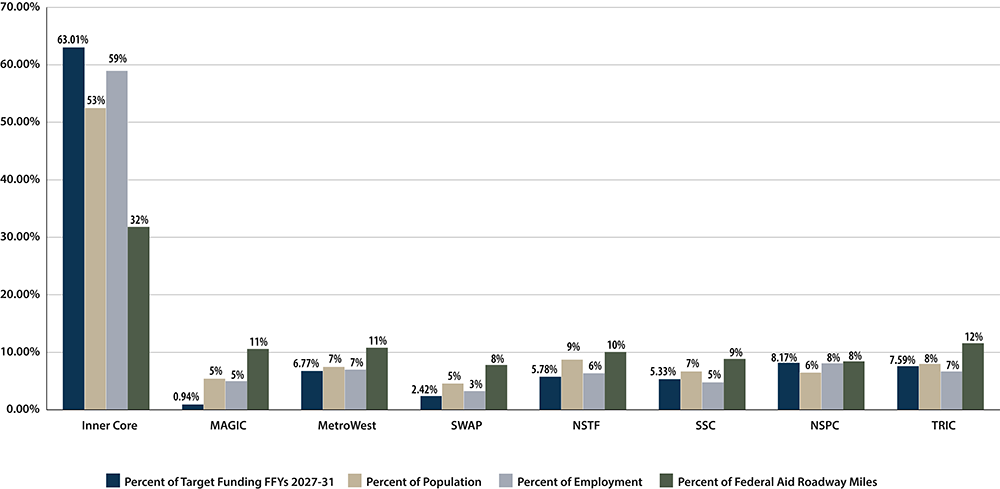
Subregions: ICC = Inner Core Committee. MAGIC = Minuteman Advisory Group on Interlocal Coordination. MWRC = MetroWest Regional Collaborative. NSPC = North Suburban Planning Council. NSTF = North Shore Task Force. SSC = South Shore Coalition. SWAP = SouthWest Advisory Planning Committee. TRIC = Three Rivers Interlocal Council.
Source: Boston Region MPO.
Figure D-2
Distribution of All Federal Highway Funding in the
Boston Region by Subregion (FFYs 2027–31)
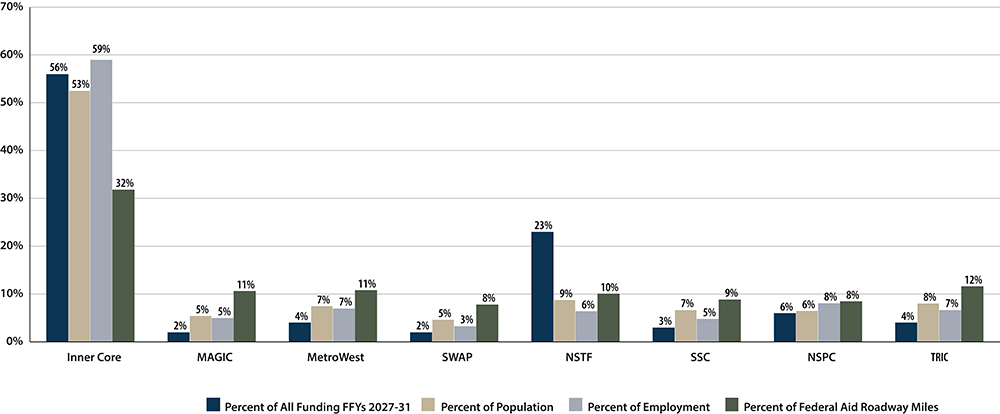
FFY = Federal Fiscal Year.
Subregions: ICC = Inner Core Committee. MAGIC = Minuteman Advisory Group on Interlocal Coordination. MWRC = MetroWest Regional Collaborative. NSPC = North Suburban Planning Council. NSTF = North Shore Task Force. SSC = South Shore Coalition. SWAP = SouthWest Advisory Planning Committee. TRIC = Three Rivers Interlocal Council.
Source: Boston Region MPO.
Figure D-3
Distribution of Regional Target Funding by Subregion (FFYs 2011–31)
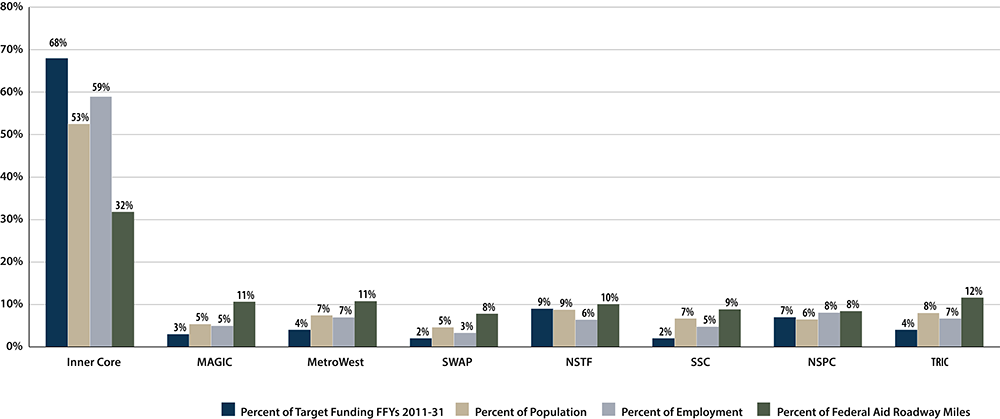
FFY = Federal Fiscal Year.
Subregions: ICC = Inner Core Committee. MAGIC = Minuteman Advisory Group on Interlocal Coordination. MWRC = MetroWest Regional Collaborative. NSPC = North Suburban Planning Council. NSTF = North Shore Task Force. SSC = South Shore Coalition. SWAP = SouthWest Advisory Planning Committee. TRIC = Three Rivers Interlocal Council.
Source: Boston Region MPO.
Figure D-4
Distribution of All Federal Highway Funding in the
Boston Region by Subregion (FFYs 2011–31)
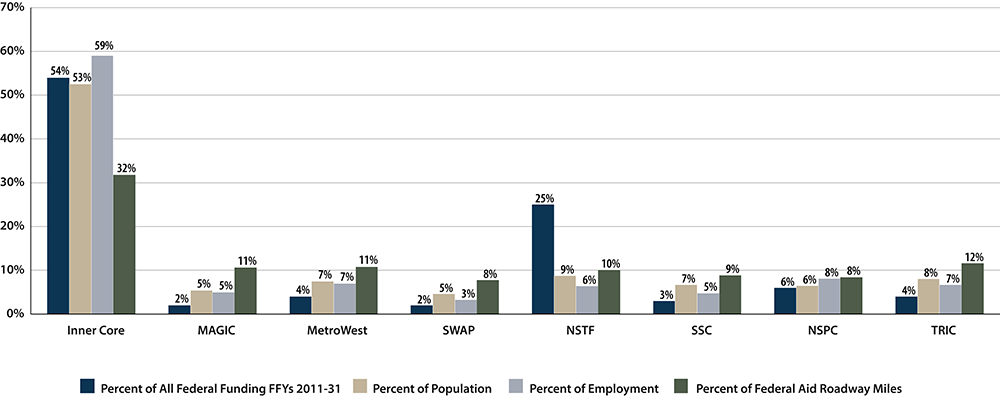
FFY = Federal Fiscal Year.
Subregions: ICC = Inner Core Committee. MAGIC = Minuteman Advisory Group on Interlocal Coordination. MWRC = MetroWest Regional Collaborative. NSPC = North Suburban Planning Council. NSTF = North Shore Task Force. SSC = South Shore Coalition. SWAP = SouthWest Advisory Planning Committee. TRIC = Three Rivers Interlocal Council.
Source: Boston Region MPO.
Table D-1
Federal Highway Programming for Municipalities in the Boston Region (FFYs 2027–31)
| Percent Federal | Regionally Prioritized | Percent Regionally | Percent State | Total Funding | Percent Total Funding | ||||||||||||
| MPO | Aid Roadway | Target Funding | Prioritized | State Prioritized | Prioritized | (Regionally Prioritized | (Regionally Prioritized | FFYs 2011- | FFYs 2011- | FFYs 2011- | Percent FFYs | Percent FFYs | Percent FFYs | ||||
| Municipality | Subregion | Community Type | Pct Pop. | Pct Empl. | Miles (2016) | (FFY 2027-31) | Target Funding | Funding | Funding | and State Prioritized) | and State Prioritized) | 2030 (Target) | 2030 (State) | 2030 (All) | 11-30 Target | 11-30 State | 11-30 All |
| Boston | Inner Core | Inner Core | 20.1% | 33.3% | 11.1% | $112,982,427 | 16.6% | $383,145,158 | 17.7% | $496,127,585 | 17.4% | $383,145,158 | $496,127,585 | $251,924,812 | 22.55% | 16.98% | 16.98% |
| Somerville | Inner Core | Inner Core | 2.4% | 1.5% | 1.2% | $129,010,608 | 19.0% | $349,050,568 | 16.1% | $478,061,176 | 16.8% | $349,050,568 | $478,061,176 | $222,864,836 | 20.55% | 16.36% | 16.36% |
| Hopkinton | SWAP | Developing Suburb | 0.6% | 0.5% | 1.0% | $0 | 0.0% | $7,213,705 | 0.3% | $7,213,705 | 0.3% | $7,213,705 | $7,213,705 | $11,346,584 | 0.42% | 0.25% | 0.25% |
| Beverly | NSTF | Regional Urban Center | 1.3% | 1.2% | 1.2% | $0 | 0.0% | $233,271,001 | 10.8% | $233,271,001 | 8.2% | $38,972,530 | $233,271,001 | $272,243,531 | 2.29% | 7.98% | 7.98% |
| Natick | MetroWest | Maturing Suburb | 1.1% | 1.0% | 1.2% | $250,000 | 0.0% | $4,181,688 | 0.2% | $4,431,688 | 0.2% | $4,181,688 | $4,431,688 | $27,413,832 | 0.25% | 0.15% | 0.15% |
| Cambridge | Inner Core | Inner Core | 3.5% | 7.1% | 1.8% | $1,125,035 | 0.2% | $89,626,182 | 4.1% | $90,751,217 | 3.2% | $89,626,182 | $90,751,217 | $54,236,163 | 5.28% | 3.11% | 3.11% |
| Wilmington | NSPC | Maturing Suburb | 0.7% | 1.1% | 1.3% | $0 | 0.0% | $0 | 0.0% | $0 | 0.0% | $0 | $0 | $43,894,003 | 0.00% | 0.00% | 0.00% |
| Salem | NSTF | Regional Urban Center | 1.3% | 0.9% | 0.7% | $26,767,823 | 3.9% | $243,163,800 | 11.2% | $269,931,623 | 9.5% | $38,566,572 | $248,615,238 | $287,181,810 | 2.27% | 8.51% | 8.51% |
| Lynn | Inner Core | Regional Urban Center | 3.0% | 1.3% | 1.3% | $78,813,139 | 11.6% | $126,050,857 | 5.8% | $204,863,996 | 7.2% | $126,050,857 | $204,863,996 | $105,083,630 | 7.42% | 7.01% | 7.01% |
| Norwood | TRIC | Regional Urban Center | 0.9% | 1.1% | 1.0% | $34,208,923 | 5.0% | $16,217,137 | 0.7% | $50,426,060 | 1.8% | $16,217,137 | $50,426,060 | $42,161,203 | 0.95% | 1.73% | 1.73% |
| Milton | TRIC | Maturing Suburb | 0.9% | 0.1% | 1.3% | $393,750 | 0.1% | $12,951,168 | 0.6% | $13,344,918 | 0.5% | $12,951,168 | $13,344,918 | $862,500 | 0.76% | 0.46% | 0.46% |
| Peabody | NSTF | Regional Urban Center | 1.6% | 1.1% | 1.4% | $2,974,203 | 0.4% | $0 | 0.0% | $2,974,203 | 0.1% | $50,305,978 | $17,874,888 | $68,180,866 | 2.96% | 0.61% | 0.61% |
| Chelsea | Inner Core | Inner Core | 1.2% | 0.8% | 0.6% | $11,071,880 | 1.6% | $23,358,447 | 1.1% | $34,430,327 | 1.2% | $23,358,447 | $34,430,327 | $23,573,018 | 1.38% | 1.18% | 1.18% |
| Framingham | MetroWest | Regional Urban Center | 2.2% | 2.1% | 2.5% | $25,711,037 | 3.8% | $25,838,372 | 1.2% | $51,549,409 | 1.8% | $25,838,372 | $51,549,409 | $54,703,873 | 1.52% | 1.76% | 1.76% |
| Brookline | Inner Core | Inner Core | 1.9% | 0.9% | 1.3% | $39,830,753 | 5.9% | $1,552,103 | 0.1% | $41,382,856 | 1.5% | $1,552,103 | $41,382,856 | $47,199,925 | 0.09% | 1.42% | 1.42% |
| Watertown | Inner Core | Inner Core | 1.1% | 1.0% | 0.6% | $0 | 0.0% | $0 | 0.0% | $0 | 0.0% | $0 | $0 | $28,577,051 | 0.00% | 0.00% | 0.00% |
| Medford | Inner Core | Inner Core | 1.8% | 1.1% | 1.5% | $0 | 0.0% | $30,225,111 | 1.4% | $30,225,111 | 1.1% | $30,225,111 | $30,225,111 | $49,499,689 | 1.78% | 1.03% | 1.03% |
| Revere | Inner Core | Inner Core | 1.9% | 0.5% | 1.3% | $731,904 | 0.1% | $128,648,391 | 5.9% | $129,380,295 | 4.5% | $128,648,391 | $129,380,295 | $1,375,868 | 7.57% | 4.43% | 4.43% |
| Woburn | NSPC | Regional Urban Center | 1.2% | 2.1% | 1.5% | $24,221,545 | 3.6% | $2,572,500 | 0.1% | $26,794,045 | 0.9% | $2,572,500 | $26,794,045 | $64,298,471 | 0.15% | 0.92% | 0.92% |
| Everett | Inner Core | Inner Core | 1.5% | 0.8% | 0.6% | $13,003,872 | 1.9% | $12,380,227 | 0.6% | $25,384,099 | 0.9% | $12,380,227 | $25,384,099 | $42,251,070 | 0.73% | 0.87% | 0.87% |
| Braintree | SSC | Maturing Suburb | 1.2% | 1.3% | 1.4% | $0 | 0.0% | $38,914,578 | 1.8% | $38,914,578 | 1.4% | $38,914,578 | $38,914,578 | $0 | 2.29% | 1.33% | 1.33% |
| Randolph | TRIC | Maturing Suburb | 1.0% | 0.4% | 1.0% | $0 | 0.0% | $0 | 0.0% | $0 | 0.0% | $0 | $0 | $2,000,000 | 0.00% | 0.00% | 0.00% |
| Quincy | Inner Core | Regional Urban Center | 3.0% | 2.4% | 2.1% | $3,900,629 | 0.6% | $1,774,979 | 0.1% | $5,675,608 | 0.2% | $1,774,979 | $5,675,608 | $13,528,469 | 0.10% | 0.19% | 0.19% |
| Canton | TRIC | Maturing Suburb | 0.7% | 1.1% | 1.1% | $393,750 | 0.1% | $9,978,900 | 0.5% | $10,372,650 | 0.4% | $9,978,900 | $10,372,650 | $3,429,820 | 0.59% | 0.36% | 0.36% |
| Newton | Inner Core | Inner Core | 2.6% | 2.6% | 2.6% | $0 | 0.0% | $14,267,229 | 0.7% | $14,267,229 | 0.5% | $14,267,229 | $14,267,229 | $30,244,216 | 0.84% | 0.49% | 0.49% |
| Belmont | Inner Core | Inner Core | 0.8% | 0.4% | 0.6% | $18,934,961 | 2.8% | $1,250,000 | 0.1% | $20,184,961 | 0.7% | $1,250,000 | $20,184,961 | $64,435,075 | 0.07% | 0.69% | 0.69% |
| Lexington | MAGIC | Maturing Suburb | 1.0% | 1.1% | 1.9% | $0 | 0.0% | $13,507,560 | 0.6% | $13,507,560 | 0.5% | $13,507,560 | $13,507,560 | $6,850,000 | 0.80% | 0.46% | 0.46% |
| Weston | MetroWest | Maturing Suburb | 0.4% | 0.3% | 1.3% | $19,999,712 | 2.9% | $0 | 0.0% | $19,999,712 | 0.7% | $0 | $19,999,712 | $34,892,173 | 0.00% | 0.68% | 0.68% |
| Reading | NSPC | Maturing Suburb | 0.8% | 0.4% | 0.8% | $0 | 0.0% | $37,484,180 | 1.7% | $37,484,180 | 1.3% | $37,484,180 | $37,484,180 | $34,093,721 | 2.21% | 1.28% | 1.28% |
| Stoneham | NSPC | Maturing Suburb | 0.7% | 0.3% | 0.8% | $0 | 0.0% | $23,752,071 | 1.1% | $23,752,071 | 0.8% | $23,752,071 | $23,752,071 | $2,606,520 | 1.40% | 0.81% | 0.81% |
| Waltham | Inner Core | Inner Core | 1.9% | 3.2% | 1.6% | $0 | 0.0% | $0 | 0.0% | $0 | 0.0% | $0 | $0 | $0 | 0.00% | 0.00% | 0.00% |
| Burlington | NSPC | Maturing Suburb | 0.8% | 2.4% | 1.3% | $616,816 | 0.1% | $20,252,676 | 0.9% | $20,869,492 | 0.7% | $20,252,676 | $20,869,492 | $15,179,990 | 1.19% | 0.71% | 0.71% |
| Hingham | SSC | Maturing Suburb | 0.7% | 0.8% | 1.3% | $35,778,882 | 5.3% | $0 | 0.0% | $35,778,882 | 1.3% | $0 | $35,778,882 | $45,218,139 | 0.00% | 1.22% | 1.22% |
| Wrentham | SWAP | Developing Suburb | 0.4% | 0.3% | 1.0% | $0 | 0.0% | $10,176,157 | 0.5% | $10,176,157 | 0.4% | $10,176,157 | $10,176,157 | $18,692,390 | 0.60% | 0.35% | 0.35% |
| Boxborough | MAGIC | Developing Suburb | 0.2% | 0.2% | 0.4% | $0 | 0.0% | $0 | 0.0% | $0 | 0.0% | $0 | $0 | $101,660 | 0.00% | 0.00% | 0.00% |
| Bellingham | SWAP | Developing Suburb | 0.5% | 0.3% | 0.9% | $16,414,000 | 2.4% | $5,080,778 | 0.2% | $21,494,778 | 0.8% | $5,080,778 | $21,494,778 | $23,128,278 | 0.30% | 0.74% | 0.74% |
| Cohasset | SSC | Developing Suburb | 0.2% | 0.1% | 0.5% | $0 | 0.0% | $0 | 0.0% | $0 | 0.0% | $0 | $0 | $11,258,807 | 0.00% | 0.00% | 0.00% |
| Milford | SWAP | Regional Urban Center | 0.9% | 0.9% | 1.2% | $0 | 0.0% | $5,080,778 | 0.2% | $5,080,778 | 0.2% | $5,080,778 | $5,080,778 | $6,467,944 | 0.30% | 0.17% | 0.17% |
| Dedham | TRIC | Maturing Suburb | 0.8% | 0.8% | 1.1% | $0 | 0.0% | $7,736,142 | 0.4% | $7,736,142 | 0.3% | $7,736,142 | $7,736,142 | $16,090,272 | 0.46% | 0.26% | 0.26% |
| Weymouth | SSC | Maturing Suburb | 1.7% | 1.0% | 1.5% | $0 | 0.0% | $0 | 0.0% | $0 | 0.0% | $0 | $0 | $25,040,879 | 0.00% | 0.00% | 0.00% |
| Swampscott | NSTF | Maturing Suburb | 0.5% | 0.2% | 0.3% | $8,316,000 | 1.2% | $0 | 0.0% | $8,316,000 | 0.3% | $8,316,000 | $1,762,074 | $10,078,074 | 0.49% | 0.06% | 0.06% |
| Middleton | NSTF | Developing Suburb | 0.3% | 0.2% | 0.5% | $0 | 0.0% | $9,572,178 | 0.4% | $9,572,178 | 0.3% | $0 | $20,701,706 | $20,701,706 | 0.00% | 0.71% | 0.71% |
| Danvers | NSTF | Maturing Suburb | 0.8% | 1.3% | 1.5% | $0 | 0.0% | $17,931,299 | 0.8% | $17,931,299 | 0.6% | $8,836,648 | $52,062,844 | $60,899,492 | 0.52% | 1.78% | 1.78% |
| Winchester | NSPC | Maturing Suburb | 0.7% | 0.4% | 0.6% | $0 | 0.0% | $0 | 0.0% | $0 | 0.0% | $0 | $0 | $1,809,703 | 0.00% | 0.00% | 0.00% |
| Ipswich | NSTF | Developing Suburb | 0.4% | 0.3% | 0.7% | $166,779 | 0.0% | $8,187,107 | 0.4% | $8,353,886 | 0.3% | $1,441,296 | $8,187,107 | $9,628,403 | 0.08% | 0.28% | 0.28% |
| Foxborough | TRIC | Developing Suburb | 0.6% | 0.6% | 1.3% | $0 | 0.0% | $8,034,130 | 0.4% | $8,034,130 | 0.3% | $8,034,130 | $8,034,130 | $0 | 0.47% | 0.27% | 0.27% |
| Acton | MAGIC | Maturing Suburb | 0.7% | 0.5% | 1.1% | $0 | 0.0% | $27,544,004 | 1.3% | $27,544,004 | 1.0% | $27,544,004 | $27,544,004 | $16,737,768 | 1.62% | 0.94% | 0.94% |
| Winthrop | Inner Core | Inner Core | 0.6% | 0.1% | 0.3% | $0 | 0.0% | $0 | 0.0% | $0 | 0.0% | $0 | $0 | $6,617,959 | 0.00% | 0.00% | 0.00% |
| Littleton | MAGIC | Developing Suburb | 0.3% | 0.4% | 1.0% | $0 | 0.0% | $0 | 0.0% | $0 | 0.0% | $0 | $0 | $7,108,563 | 0.00% | 0.00% | 0.00% |
| Lynnfield | NSPC | Maturing Suburb | 0.4% | 0.3% | 0.6% | $0 | 0.0% | $0 | 0.0% | $0 | 0.0% | $0 | $0 | $5,311,191 | 0.00% | 0.00% | 0.00% |
| Wakefield | NSPC | Maturing Suburb | 0.8% | 0.7% | 0.9% | $30,603,120 | 4.5% | $34,401,140 | 1.6% | $65,004,260 | 2.3% | $34,401,140 | $65,004,260 | $30,603,120 | 2.03% | 2.22% | 2.22% |
| Ashland | MetroWest | Maturing Suburb | 0.6% | 0.2% | 0.5% | $0 | 0.0% | $0 | 0.0% | $0 | 0.0% | $0 | $0 | $19,589,554 | 0.00% | 0.00% | 0.00% |
| Nahant | Inner Core | Maturing Suburb | 0.1% | 0.0% | 0.2% | $0 | 0.0% | $0 | 0.0% | $0 | 0.0% | $0 | $0 | $0 | 0.00% | 0.00% | 0.00% |
| Malden | Inner Core | Inner Core | 2.0% | 0.7% | 1.0% | $7,983,824 | 1.2% | $1,221,159 | 0.1% | $9,204,983 | 0.3% | $1,221,159 | $9,204,983 | $11,162,617 | 0.07% | 0.32% | 0.32% |
| Stow | MAGIC | Developing Suburb | 0.2% | 0.1% | 0.6% | $0 | 0.0% | $0 | 0.0% | $0 | 0.0% | $0 | $0 | $101,660 | 0.00% | 0.00% | 0.00% |
| Topsfield | NSTF | Developing Suburb | 0.2% | 0.1% | 0.6% | $0 | 0.0% | $6,478,718 | 0.3% | $6,478,718 | 0.2% | $0 | $9,287,283 | $9,287,283 | 0.00% | 0.32% | 0.32% |
| Hudson | MAGIC | Developing Suburb | 0.6% | 0.5% | 0.7% | $0 | 0.0% | $0 | 0.0% | $0 | 0.0% | $0 | $0 | $12,103,924 | 0.00% | 0.00% | 0.00% |
| Marlborough | MetroWest | Regional Urban Center | 1.2% | 1.6% | 2.0% | $0 | 0.0% | $0 | 0.0% | $0 | 0.0% | $0 | $0 | $6,908,380 | 0.00% | 0.00% | 0.00% |
| Medway | SWAP | Developing Suburb | 0.4% | 0.2% | 0.6% | $0 | 0.0% | $1,693,593 | 0.1% | $1,693,593 | 0.1% | $1,693,593 | $1,693,593 | $12,062,567 | 0.10% | 0.06% | 0.06% |
| Sudbury | MAGIC | Maturing Suburb | 0.6% | 0.3% | 1.0% | $6,399,329 | 0.9% | $0 | 0.0% | $6,399,329 | 0.2% | $0 | $6,399,329 | $18,019,416 | 0.00% | 0.22% | 0.22% |
| Wayland | MetroWest | Maturing Suburb | 0.4% | 0.2% | 0.7% | $0 | 0.0% | $5,270,386 | 0.2% | $5,270,386 | 0.2% | $5,270,386 | $5,270,386 | $0 | 0.31% | 0.18% | 0.18% |
| Hamilton | NSTF | Developing Suburb | 0.2% | 0.1% | 0.4% | $166,779 | 0.0% | $6,143,463 | 0.3% | $6,310,242 | 0.2% | $365,061 | $6,143,463 | $6,508,524 | 0.02% | 0.21% | 0.21% |
| Maynard | MAGIC | Maturing Suburb | 0.3% | 0.2% | 0.3% | $0 | 0.0% | $7,402,470 | 0.3% | $7,402,470 | 0.3% | $7,402,470 | $7,402,470 | $0 | 0.44% | 0.25% | 0.25% |
| Sharon | TRIC | Maturing Suburb | 0.6% | 0.2% | 1.1% | $0 | 0.0% | $18,063,987 | 0.8% | $18,063,987 | 0.6% | $18,063,987 | $18,063,987 | $42,000 | 1.06% | 0.62% | 0.62% |
| Arlington | Inner Core | Inner Core | 1.4% | 0.5% | 0.8% | $0 | 0.0% | $729,288 | 0.0% | $729,288 | 0.0% | $729,288 | $729,288 | $11,191,631 | 0.04% | 0.02% | 0.02% |
| Scituate | SSC | Maturing Suburb | 0.6% | 0.2% | 1.0% | $0 | 0.0% | $0 | 0.0% | $0 | 0.0% | $0 | $0 | $1,572,496 | 0.00% | 0.00% | 0.00% |
| Westwood | TRIC | Maturing Suburb | 0.5% | 0.6% | 0.7% | $16,528,952 | 2.4% | $0 | 0.0% | $16,528,952 | 0.6% | $0 | $16,528,952 | $28,304,369 | 0.00% | 0.57% | 0.57% |
| Bedford | MAGIC | Maturing Suburb | 0.4% | 0.9% | 0.8% | $0 | 0.0% | $0 | 0.0% | $0 | 0.0% | $0 | $0 | $24,507,736 | 0.00% | 0.00% | 0.00% |
| Bolton | MAGIC | Developing Suburb | 0.2% | 0.1% | 0.7% | $0 | 0.0% | $0 | 0.0% | $0 | 0.0% | $0 | $0 | $101,660 | 0.00% | 0.00% | 0.00% |
| Carlisle | MAGIC | Developing Suburb | 0.2% | 0.0% | 0.4% | $0 | 0.0% | $0 | 0.0% | $0 | 0.0% | $0 | $0 | $0 | 0.00% | 0.00% | 0.00% |
| Concord | MAGIC | Maturing Suburb | 0.6% | 0.6% | 1.1% | $0 | 0.0% | $0 | 0.0% | $0 | 0.0% | $0 | $0 | $22,592,311 | 0.00% | 0.00% | 0.00% |
| Dover | SWAP | Developing Suburb | 0.2% | 0.0% | 0.5% | $0 | 0.0% | $0 | 0.0% | $0 | 0.0% | $0 | $0 | $0 | 0.00% | 0.00% | 0.00% |
| Essex | NSTF | Developing Suburb | 0.1% | 0.1% | 0.2% | $166,779 | 0.0% | $0 | 0.0% | $166,779 | 0.0% | $365,061 | $10,659,471 | $11,024,532 | 0.02% | 0.36% | 0.36% |
| Franklin | SWAP | Developing Suburb | 1.0% | 0.8% | 1.2% | $0 | 0.0% | $12,113,370 | 0.6% | $12,113,370 | 0.4% | $12,113,370 | $12,113,370 | $0 | 0.71% | 0.41% | 0.41% |
| Gloucester | NSTF | Regional Urban Center | 0.9% | 0.5% | 1.0% | $359,987 | 0.1% | $94,557,060 | 4.4% | $94,917,047 | 3.3% | $2,843,269 | $110,035,793 | $112,879,062 | 0.17% | 3.77% | 3.77% |
| Holbrook | SSC | Maturing Suburb | 0.3% | 0.1% | 0.3% | $0 | 0.0% | $0 | 0.0% | $0 | 0.0% | $0 | $0 | $3,036,628 | 0.00% | 0.00% | 0.00% |
| Holliston | MetroWest | Developing Suburb | 0.4% | 0.3% | 0.5% | $0 | 0.0% | $1,012,500 | 0.0% | $1,012,500 | 0.0% | $1,012,500 | $1,012,500 | $600,000 | 0.06% | 0.03% | 0.03% |
| Hull | SSC | Maturing Suburb | 0.3% | 0.1% | 0.4% | $393,750 | 0.1% | $1,062,500 | 0.0% | $1,456,250 | 0.1% | $1,062,500 | $1,456,250 | $9,085,922 | 0.06% | 0.05% | 0.05% |
| Lincoln | MAGIC | Maturing Suburb | 0.2% | 0.1% | 0.6% | $0 | 0.0% | $729,288 | 0.0% | $729,288 | 0.0% | $729,288 | $729,288 | $22,492,311 | 0.04% | 0.02% | 0.02% |
| Manchester | NSTF | Developing Suburb | 0.2% | 0.1% | 0.4% | $166,779 | 0.0% | $0 | 0.0% | $166,779 | 0.0% | $365,061 | $5,589,309 | $5,954,370 | 0.02% | 0.19% | 0.19% |
| Marblehead | NSTF | Maturing Suburb | 0.6% | 0.2% | 0.5% | $0 | 0.0% | $0 | 0.0% | $0 | 0.0% | $742,534 | $0 | $742,534 | 0.04% | 0.00% | 0.00% |
| Marshfield | SSC | Maturing Suburb | 0.8% | 0.3% | 1.0% | $0 | 0.0% | $0 | 0.0% | $0 | 0.0% | $0 | $0 | $5,682,660 | 0.00% | 0.00% | 0.00% |
| Medfield | TRIC | Maturing Suburb | 0.4% | 0.2% | 0.5% | $0 | 0.0% | $624,497 | 0.0% | $624,497 | 0.0% | $624,497 | $624,497 | $0 | 0.04% | 0.02% | 0.02% |
| Melrose | Inner Core | Inner Core | 0.9% | 0.3% | 0.4% | $10,453,885 | 1.5% | $0 | 0.0% | $10,453,885 | 0.4% | $0 | $10,453,885 | $14,858,915 | 0.00% | 0.36% | 0.36% |
| Millis | SWAP | Developing Suburb | 0.3% | 0.1% | 0.4% | $0 | 0.0% | $0 | 0.0% | $0 | 0.0% | $0 | $0 | $0 | 0.00% | 0.00% | 0.00% |
| Needham | TRIC | Maturing Suburb | 1.0% | 1.1% | 1.2% | $0 | 0.0% | $0 | 0.0% | $0 | 0.0% | $0 | $0 | $100,365,195 | 0.00% | 0.00% | 0.00% |
| Norfolk | SWAP | Developing Suburb | 0.3% | 0.2% | 0.5% | $0 | 0.0% | $0 | 0.0% | $0 | 0.0% | $0 | $0 | $697,500 | 0.00% | 0.00% | 0.00% |
| North Reading | NSPC | Maturing Suburb | 0.5% | 0.4% | 0.6% | $0 | 0.0% | $0 | 0.0% | $0 | 0.0% | $0 | $0 | $0 | 0.00% | 0.00% | 0.00% |
| Norwell | SSC | Developing Suburb | 0.3% | 0.5% | 0.8% | $0 | 0.0% | $0 | 0.0% | $0 | 0.0% | $0 | $0 | $0 | 0.00% | 0.00% | 0.00% |
| Rockland | SSC | Developing Suburb | 0.5% | 0.4% | 0.6% | $0 | 0.0% | $0 | 0.0% | $0 | 0.0% | $0 | $0 | $0 | 0.00% | 0.00% | 0.00% |
| Rockport | NSTF | Developing Suburb | 0.2% | 0.0% | 0.2% | $166,779 | 0.0% | $0 | 0.0% | $166,779 | 0.0% | $472,449 | $775,913 | $1,248,362 | 0.03% | 0.03% | 0.03% |
| Saugus | Inner Core | Maturing Suburb | 0.9% | 0.5% | 0.8% | $0 | 0.0% | $0 | 0.0% | $0 | 0.0% | $0 | $0 | $0 | 0.00% | 0.00% | 0.00% |
| Sherborn | SWAP | Developing Suburb | 0.1% | 0.0% | 0.4% | $0 | 0.0% | $0 | 0.0% | $0 | 0.0% | $0 | $0 | $1,787,550 | 0.00% | 0.00% | 0.00% |
| Southborough | MetroWest | Maturing Suburb | 0.3% | 0.4% | 1.2% | $0 | 0.0% | $0 | 0.0% | $0 | 0.0% | $0 | $0 | $7,294,520 | 0.00% | 0.00% | 0.00% |
| Walpole | TRIC | Developing Suburb | 0.8% | 0.5% | 1.2% | $0 | 0.0% | $0 | 0.0% | $0 | 0.0% | $0 | $0 | $25,808,571 | 0.00% | 0.00% | 0.00% |
| Wellesley | MetroWest | Maturing Suburb | 0.9% | 0.9% | 0.9% | $0 | 0.0% | $25,020,053 | 1.2% | $25,020,053 | 0.9% | $25,020,053 | $25,020,053 | $78,350,868 | 1.47% | 0.86% | 0.86% |
| Wenham | NSTF | Developing Suburb | 0.1% | 0.1% | 0.4% | $0 | 0.0% | $0 | 0.0% | $0 | 0.0% | $0 | $9,906,121 | $9,906,121 | 0.00% | 0.34% | 0.34% |
FFY = Federal Fiscal Year.
Subregions: ICC = Inner Core Committee. MAGIC = Minuteman Advisory Group on Interlocal Coordination. MWRC = MetroWest Regional Collaborative. NSPC = North Suburban Planning Council. NSTF = North Shore Task Force. SSC = South Shore Coalition. SWAP = SouthWest Advisory Planning Committee. TRIC = Three Rivers Interlocal Council.
Source: Boston Region MPO.
Appendix E:
Regulatory and Policy Framework
This appendix contains detailed background on the regulatory documents, legislation, and guidance that shape the Boston Region Metropolitan Planning Organization’s (MPO) transportation planning process.
Regulatory Framework
The Boston Region MPO is charged with executing its planning activities in line with federal and state regulatory guidance. Maintaining compliance with these regulations allows the MPO to directly support the work of these critical partners and ensures its continued role in helping the region move closer to achieving federal, state, and regional transportation goals. This appendix describes the regulations, policies, and guidance taken into consideration by the MPO during development of the certification documents and other core work the MPO will undertake during federal fiscal year (FFY) 2027.
Federal Regulations and Guidance
The MPO’s planning processes are guided by provisions in federal transportation authorization bills, which are codified in federal statutes and supported by guidance from federal agencies. The Infrastructure Investment and Jobs Act (IIJA) was signed into law on November 15, 2021, as the nation’s five-year surface transportation bill, and covers FFYs 2022–26. This section describes provisions established in the IIJA.
Infrastructure Investment and Jobs Act: National Goals
The purpose of the national transportation goals, outlined in Title 23, section 150, of the United States Code (23 USC § 150), is to increase the accountability and transparency of the Federal-Aid Highway Program and to improve decision-making through performance-based planning and programming. The national transportation goals include the following:
- Safety: Achieve significant reduction in traffic fatalities and serious injuries on all public roads
- Infrastructure condition: Maintain the highway infrastructure asset system in a state of good repair
- Congestion reduction: Achieve significant reduction in congestion on the National Highway System
- System reliability: Improve efficiency of the surface transportation system
- Freight movement and economic vitality: Improve the national freight network, strengthen the ability of rural communities to access national and international trade markets, and support regional economic development
- Environmental sustainability: Enhance performance of the transportation system while protecting and enhancing the natural environment
- Reduced project delivery delays: Reduce project costs, promote jobs and the economy, and expedite movement of people and goods by accelerating project completion by eliminating delays in the project development and delivery process, including by reducing regulatory burdens and improving agencies’ work practices
The Boston Region MPO has incorporated these national goals into its vision, goals, and objectives, which provide a framework for the MPO’s planning processes. More information about the MPO’s vision, goals, and objectives is included in Chapter 1.
Federal Planning Factors
The MPO gives specific consideration to the federal planning factors, described in Title 23, section 134, of the US Code (23 USC § 134), when developing all documents that program federal transportation funds. In accordance with the legislation, studies and strategies undertaken by the MPO shall
- Support the economic vitality of the metropolitan area, especially by enabling global competition, productivity, and efficiency
- Increase the safety of the transportation system for all motorized and nonmotorized users
- Increase the ability of the transportation system to support homeland security and to safeguard the personal security of all motorized and nonmotorized users
- Increase accessibility and mobility of people and freight
- Protect and enhance the environment, promote energy conservation, improve quality of life, and promote consistency between transportation improvements and state and local planned growth and economic development patterns
- Enhance integration and connectivity of the transportation system, across and between modes, for people and freight
- Promote efficient system management and operation
- Emphasize preservation of the existing transportation system
- Improve the resiliency and reliability of the transportation system and reduce or mitigate stormwater impacts of surface transportation
- Enhance travel and tourism
The Boston Region MPO has also incorporated these federal planning factors into its vision, goals, and objectives.
FAST Act: Performance-Based Planning and Programming
The United States Department of Transportation (USDOT), in consultation with states, MPOs, and other stakeholders, established performance measures relevant to the national goals established in the FAST Act. These performance topic areas include roadway safety, transit system safety, National Highway System (NHS) bridge and pavement condition, transit asset condition, NHS reliability for both passenger and freight travel, traffic congestion, and on-road mobile source emissions. The FAST Act and related federal rulemakings require states, MPOs, and public transportation operators to follow performance-based planning and programming practices—such as setting targets—to ensure that transportation investments support progress towards these goals.
1990 Clean Air Act Amendments
The Clean Air Act, most recently amended in 1990, forms the basis of the United States’ air pollution control policy. The act identifies air quality standards, and the US Environmental Protection Agency (EPA) designates geographic areas as attainment (in compliance) or nonattainment (not in compliance) areas with respect to these standards. If air quality in a nonattainment area improves such that it meets EPA standards, the EPA may redesignate that area as a maintenance area for a 20-year period to ensure that the standard is maintained in that area.
The conformity provisions of the Clean Air Act “require that those areas that have poor air quality, or had it in the past, should examine the long-term air quality impacts of their transportation system and ensure its compatibility with the area’s clean air goals.” Agencies responsible for Clean Air Act requirements for nonattainment and maintenance areas must conduct air quality conformity determinations, which are demonstrations that transportation plans, programs, and projects addressing that area are consistent with a State Implementation Plan (SIP) for attaining air quality standards.
Air quality conformity determinations must be performed for capital improvement projects that receive federal funding and for those that are considered regionally significant, regardless of the funding source. These determinations must show that projects in the MPO’s Long-Range Transportation Plan (LRTP) and Transportation Improvement Program (TIP) will not cause or contribute to any new air quality violations; will not increase the frequency or severity of any existing air quality violations in any area; and will not delay the timely attainment of air quality standards in any area. The policy, criteria, and procedures for demonstrating air quality conformity in the Boston region were established in Title 40, parts 51 and 53, of the Code of Federal Regulations (40. C.F.R. 51, 40 C.F.R. 53).
On April 1, 1996, the EPA redesignated the cities of Boston, Cambridge, Chelsea, Everett, Malden, Medford, Quincy, Revere, and Somerville from nonattainment to attainment for carbon monoxide (CO) emissions. Subsequently, the Commonwealth established a CO maintenance plan through the Massachusetts SIP process to ensure that emission levels did not increase. While the maintenance plan was in effect, past TIPs and LRTPs included an air quality conformity analysis for these communities. As of April 1, 2016, the 20-year maintenance period for this maintenance area expired and transportation conformity is no longer required for carbon monoxide in these communities. This ruling is documented in a letter from the EPA dated May 12, 2016.
On April 22, 2002, the EPA classified the City of Waltham as being in attainment for CO emissions with an EPA-approved limited-maintenance plan. In areas that have approved limited-maintenance plans, federal actions requiring conformity determinations under the EPA’s transportation conformity rule are considered to satisfy the conformity test. The MPO is not required to perform a modeling analysis for a conformity determination for carbon monoxide, but it has been required to provide a status report on the timely implementation of projects and programs that will reduce emissions from transportation sources—so-called transportation control measures—which are included in the Massachusetts SIP. In April 2022, the EPA issued a letter explaining that the carbon monoxide limited maintenance area in Waltham has expired. Therefore, the MPO is no longer required to demonstrate transportation conformity for this area, but the rest of the maintenance plan requirements, however, continue to apply, in accordance with the SIP.
On February 16, 2018, the US Court of Appeals for the DC Circuit issued a decision in South Coast Air Quality Management District v. EPA, which struck down portions of the 2008 Ozone National Ambient Air Quality Standards (NAAQS) SIP Requirements Rule concerning the ozone NAAQS. Those portions of the SIP Requirements Rule included transportation conformity requirements associated with the EPA’s revocation of the 1997 ozone NAAQS. Massachusetts was designated as an attainment area in accord with the 2008 ozone NAAQS but as a nonattainment or maintenance area as relates to the 1997 ozone NAAQS. As a result of this court ruling, MPOs in Massachusetts must once again demonstrate conformity for ozone when developing LRTPs and TIPs.
MPOs must also perform conformity determinations if transportation control measures (TCM) are in effect in the region. TCMs are strategies that reduce transportation-related air pollution and fuel use by reducing vehicle-miles traveled and improving roadway operations. The Massachusetts SIP identifies TCMs in the Boston region. SIP-identified TCMs are federally enforceable and projects that address the identified air quality issues must be given first priority when federal transportation dollars are spent. Examples of TCMs that were programmed in previous TIPs include rapid-transit and commuter-rail extension programs (such as the Green Line Extension in Cambridge, Medford, and Somerville, and the Fairmount Line improvements in Boston), parking-freeze programs in Boston and Cambridge, statewide rideshare programs, park-and-ride facilities, residential parking-sticker programs, and the operation of high-occupancy-vehicle (HOV) lanes.
In addition to reporting on the pollutants identified in the 1990 Clean Air Act Amendments, the MPOs in Massachusetts are also required to perform air quality analyses for carbon dioxide as part of the state’s Global Warming Solutions Act (GWSA) (see below).
Nondiscrimination Mandates
The Boston Region MPO complies with Title VI of the Civil Rights Act of 1964, the American with Disabilities Act of 1990 (ADA), and other federal and state nondiscrimination statutes and regulations in all programs and activities it conducts. Per federal and state law, the MPO does not discriminate on the basis of race, color, national origin (including limited-English proficiency), disability, age, sex, and additional protected characteristics. The MPO strives to provide meaningful opportunities for participation of all persons in the region, including those protected by Title VI, the ADA, and other nondiscrimination mandates.
The MPO also assesses the likely benefits and adverse effects of transportation projects on protected populations (populations covered by federal regulations, as identified in the MPO’s Community Transportation Access program) when deciding which projects to fund. This is done through the MPO’s project selection criteria. MPO staff also evaluate the projects that are selected for funding, in the aggregate, to determine their overall impacts and whether they improve transportation outcomes for protected populations. The major federal requirements pertaining to nondiscrimination are discussed below.
Title VI of the Civil Rights Act of 1964
Title VI of the Civil Rights Act of 1964 requires that no person be excluded from participation in, be denied the benefits of, or be subjected to discrimination on the basis of race, color, or national origin, under any program or activity provided by an agency receiving federal financial assistance. In recognition that there are people who, as a result of their nationality, have limited English proficiency and that courts have historically interpreted “national origin discrimination” to include language-based barriers, and continued USDOT requirements to provide language assistance, the MPO provides resources to allow people with limited English proficiency to meaningfully participate in the transportation planning process. This includes the development of a Language Assistance Plan that documents the MPO’s process for providing meaningful language access to people with limited English proficiency who access the MPO’s services and programs.
Americans with Disabilities Act
Title III of the ADA “prohibits states, MPOs, and other public entities from discriminating on the basis of disability in the entities’ services, programs, or activities,” and requires all transportation projects, plans, and programs to be accessible to people with disabilities. Therefore, MPOs must consider the mobility needs of people with disabilities when programming federal funding for studies and capital projects. MPO-sponsored meetings must also be held in accessible venues and be conducted in a manner that provides for accessibility. Also, MPO materials must be made available in accessible formats.
Other Nondiscrimination Mandates
The Age Discrimination Act of 1975 prohibits discrimination on the basis of age in programs or activities that receive federal financial assistance. In addition, the Rehabilitation Act of 1975, and Title 23, section 324, of the US Code (23 USC § 324) prohibit discrimination based on sex.
State Guidance and Priorities
Much of the MPO’s work focuses on encouraging mode shift and diminishing greenhouse gas (GHG) emissions through improving transit service, enhancing bicycle and pedestrian networks, and studying emerging transportation technologies. All of this work helps the Boston region contribute to statewide progress towards the priorities discussed in this section.
Beyond Mobility
Beyond Mobility, the Massachusetts 2050 Transportation Plan, is a planning process that will result in a blueprint for guiding transportation decision-making and investments in Massachusetts. MPO staff continue to coordinate with MassDOT staff so that Destination 2050, the MPO’s Long-Range Transportation Plan, is aligned with the Beyond Mobility plan.
Choices for Stewardship: Recommendations to Meet the Transportation Future
The Commission on the Future of Transportation in the Commonwealth—established by former Massachusetts Governor Charlie Baker’s Executive Order 579—published Choices for Stewardship in 2019. This report makes 18 recommendations across the following five thematic categories to adapt the transportation system in the Commonwealth to emerging needs:
- Modernize existing transportation assets to move more people
- Create a mobility infrastructure to capitalize on emerging transportation technology and behavior trends
- Reduce transportation-related GHG emissions and improve the climate resiliency of the transportation network
- Coordinate land use, housing, economic development, and transportation policy
- Alter current governance structures to better manage emerging and anticipated transportation trends
Beyond Mobility builds upon the Commission report’s recommendations. The Boston Region MPO supports these statewide goals by conducting planning work and making investment decisions that complement MassDOT’s efforts and reflect the evolving needs of the transportation system in the region.
Massachusetts Strategic Highway Safety Plan
The Massachusetts 2023 Strategic Highway Safety Plan (SHSP) identifies the state’s key safety needs and guides investment decisions to achieve significant reductions in highway fatalities and serious injuries on all public roads. The SHSP establishes statewide safety goals and objectives and key safety emphasis areas, and it draws on the strengths of all highway safety partners in the Commonwealth to align and leverage resources to address the state’s safety challenges collectively. The Boston Region MPO considers SHSP goals, emphasis areas, and strategies when developing its plans, programs, and activities.
Massachusetts Transportation Asset Management Plan
The Massachusetts Transportation Asset Management Plan (TAMP) is a risk-based asset management plan for the bridges and pavement that are in the NHS inventory. The plan describes the condition of these assets, identifies assets that are particularly vulnerable following declared emergencies such as extreme weather, and discusses MassDOT’s financial plan and risk management strategy for these assets. The Boston Region MPO considers MassDOT TAMP goals, targets, and strategies when developing its plans, programs, and activities. MassDOT’s TAMP was most recently updated in 2023.
MassDOT Modal Plans
In 2018, MassDOT released the related Commonwealth of Massachusetts State Rail Plan, which outlines short- and long-term investment strategies for Massachusetts’ freight and passenger rail systems (excluding the commuter rail system). In 2019, MassDOT released the Massachusetts Bicycle Transportation Plan and the Massachusetts Pedestrian Transportation Plan, both of which define roadmaps, initiatives, and action plans to improve bicycle and pedestrian transportation in the Commonwealth. These plans were updated in 2021 to reflect new investments in bicycle and pedestrian projects made by MassDOT since their release. In 2023, MassDOT released the Massachusetts Freight Plan, which identifies short- and long-term improvements and strategies for the state’s freight systems. The MPO considers the findings and strategies of MassDOT’s modal plans when conducting its planning, including through its Freight Planning Support and Bicycle/Pedestrian Support Activities programs.
Global Warming Solutions Act
The GWSA makes Massachusetts a leader in setting aggressive and enforceable GHG reduction targets and implementing policies and initiatives to achieve these targets. In keeping with this law, the Massachusetts Executive Office of Energy and Environmental Affairs (EEA), in consultation with other state agencies and the public, developed the Massachusetts Clean Energy and Climate Plan for 2020. This implementation plan, released on December 29, 2010, and updated in 2022 to reflect new interim targets, establishes the following targets for overall statewide GHG emission reductions:
- 33 percent reduction below statewide 1990 GHG emission levels by 2025
- 50 percent reduction below statewide 1990 GHG emission levels by 2030
- 75 percent reduction below statewide 1990 GHG emission levels by 2040
- 85 percent reduction below statewide 1990 GHG emission levels by 2050
In 2018, EEA published its GWSA 10-year Progress Report and the GHG Inventory estimated that 2018 GHG emissions were 22 percent below the 1990 baseline level.
On June 30, 2022, EEA certified its compliance with the 2020 emissions limit of 25 percent below the 1990 levels, noting that there was an estimated emissions reduction of 31.4 percent below the 1990 level in 2020.
MassDOT fulfills its responsibilities, defined in the Massachusetts Clean Energy and Climate Plan for 2050, through a policy directive that sets three principal objectives:
- To reduce GHG emissions by reducing emissions from construction and operations, using more efficient fleets, implementing travel demand management programs, encouraging eco-driving, and providing mitigation for development projects
- To promote healthy transportation modes by improving pedestrian, bicycle, and public transit infrastructure and operations
- To support smart growth development by making transportation investments that enable denser, smart growth development patterns that can support reduced GHG emissions
In January 2015, the Massachusetts Department of Environmental Protection amended Title 310, section 7.00, of the Code of Massachusetts Regulations (310 CMR 60.05), Global Warming Solutions Act Requirements for the Transportation Sector and the Massachusetts Department of Transportation, which was subsequently amended in August 2017. This regulation places a range of obligations on MassDOT and MPOs to support achievement of the Commonwealth’s goals through the programming of transportation funds. For example, MPOs must use GHG impact as a selection criterion when they review projects to be programmed in their TIPs, and they must evaluate and report the GHG emissions impacts of transportation projects in LRTPs and TIPs.
The Commonwealth’s 10 MPOs (and three non-metropolitan planning regions) are integrally involved in supporting the GHG reductions mandated under the GWSA. The MPOs seek to realize these objectives by prioritizing projects in the LRTP and TIP that will help reduce emissions from the transportation sector. The Boston Region MPO uses its TIP project evaluation criteria to score projects based on their GHG emissions impacts, multimodal Complete Streets accommodations, and ability to support smart growth development. Tracking and evaluating GHG emissions by project will enable the MPO to anticipate GHG impacts of planned and programmed projects.
Healthy Transportation Policy Initiatives
On September 9, 2013, MassDOT passed the Healthy Transportation Policy Directive to formalize its commitment to implementing and maintaining transportation networks that allow for various mode choices. This directive will ensure that all MassDOT projects are designed and implemented in ways that provide all users with access to safe and comfortable walking, bicycling, and transit options. MassDOT’s design justification process, which established controlling criteria for bicycle and pedestrian facilities, transit provisions and the length of off- and on-ramps, has helped to operationalize and further the goals of the original Healthy Transportation Policy Directive.
In November 2015, MassDOT released the Separated Bike Lane Planning & Design Guide. This guide represents a step in MassDOT’s continuing commitment to Complete Streets, sustainable transportation, and the creation of safer and more convenient transportation options for Massachusetts’ residents. This guide may be used by project planners and designers as a resource for considering, evaluating, and designing separated bike lanes as part of a Complete Streets approach.
In the current LRTP, Destination 2050, the Boston Region MPO continues to use investment programs—particularly its Complete Streets and Bicycle Network and Pedestrian Connections programs—that support the implementation of Complete Streets projects. In the Unified Planning Work Program, the MPO budgets to support these projects.
Congestion in the Commonwealth 2019
MassDOT developed the Congestion in the Commonwealth 2019 report to identify specific causes of and impacts from traffic congestion on the NHS. The report also made recommendations for reducing congestion, including addressing local and regional bottlenecks, redesigning bus networks within the systems operated by the Massachusetts Bay Transportation Authority (MBTA) and the other regional transit authorities, increasing MBTA capacity, and investigating congestion pricing mechanisms such as managed lanes. These recommendations guide multiple new efforts within MassDOT and the MBTA and are actively considered by the Boston Region MPO when making planning and investment decisions.
Regional Guidance and Priorities
Focus40, The MBTA’s Program for Mass Transportation
On March 18, 2019, MassDOT and the MBTA released Focus40, the MBTA’s Program for Mass Transportation, which is the 25-year investment plan that aims to position the MBTA to meet the transit needs of the Greater Boston region through 2040. Complemented by the MBTA’s Strategic Plan and other internal and external policy and planning initiatives, Focus40 serves as a comprehensive plan guiding all capital planning initiatives at the MBTA. These initiatives include the Rail Vision plan, which will inform the vision for the future of the MBTA’s commuter rail system; the Bus Network Redesign (formerly the Better Bus Project), the plan to re-envision and improve the MBTA’s bus network; and other plans. The next update of the Program for Mass Transportation began in July 2025 and is expected to be completed by the summer of 2027. The Boston Region MPO continues to monitor the status of Focus40 and related MBTA modal plans to inform its decision-making about transit capital investments, which are incorporated into the TIP and LRTP.
MetroCommon 2050
MetroCommon 2050, which was developed by the Metropolitan Area Planning Council (MAPC) and adopted in 2021, is Greater Boston’s regional land use and policy plan. MetroCommon 2050 builds upon MAPC’s previous plan, MetroFuture (adopted in 2008), and includes an updated set of strategies for achieving sustainable growth and prosperity in the region. The MPO considers MetroCommon 2050’s goals, objectives, and strategies in its planning and activities.
MetroCommon 2050 is the foundation for land use projections in the MPO’s LRTP, Destination 2050.
The Boston Region MPO’s Congestion Management Process
The congestion management process (CMP) is a systematic approach for managing congestion that provides accurate, up-to-date information on transportation system performance and assesses alternative strategies for congestion management. Its purpose is to provide for safe and effective integrated management and operation of the multimodal transportation system in the Boston region. The CMP formulates solutions for congestion management by
- establishing performance metrics,
- analyzing congestion on the regional transportation network using the metrics,
- identifying problem areas,
- recommending strategies to reduce congestion,
- moving those strategies into the implementation stage by providing decision-makers in the region with information and recommendations for improving the transportation system’s performance, and
- evaluating the recommendations and effectiveness of projects.
Coordinated Public Transit—Human Services Transportation Plan
Every four years, the Boston Region MPO completes a Coordinated Public Transit‒Human Services Transportation Plan (CPT‒HST), in coordination with the development of the LRTP. The CPT‒HST supports improved coordination of transportation for seniors and people with disabilities in the Boston region by guiding transportation providers in their development of proposals for funding from the Federal Transit Administration’s Section 5310 Program (known in Massachusetts as the Community Transit Grant Program). To be eligible for funding, a proposal must meet a need identified in the CPT‒HST. The CPT‒HST contains information about
- current transportation providers in the Boston region;
- unmet transportation needs for seniors and people with disabilities;
- strategies and actions to meet the unmet needs; and
- priorities for implementing those needs.
The MPO is developing the next CPT-HST, which is expected to go into effect in FFY 2027.
MBTA and Regional Transit Authority (RTA) Transit Asset Management Plans
The MBTA and the region’s RTAs—the Cape Ann Transportation Authority (CATA) and the MetroWest Regional Transit Authority (MWRTA)—are responsible for producing transit asset management plans that describe their asset inventories and the condition of these assets, strategies, and priorities for improving the state of good repair of these assets. The Boston Region MPO considers goals and priorities established in these plans when developing its plans, programs, and activities.
MBTA and RTA Public Transit Agency Safety Plans
The MBTA, CATA, and MWRTA are required to create and annually update Public Transit Agency Safety Plans that describe their approaches for implementing Safety Management Systems on their transit systems. The Boston Region MPO considers goals, targets, and priorities established in these plans when developing its plans, programs, and activities.
Appendix F:
Boston Region Metropolitan Planning Organization Membership
Voting Members
The Boston Region Metropolitan Planning Organization (MPO) includes both permanent members and municipal members who are elected for three-year terms. Details about the MPO’s members are listed below.
The Massachusetts Department of Transportation (MassDOT) was established under Chapter 25 (An Act Modernizing the Transportation Systems of the Commonwealth of Massachusetts) of the Acts of 2009. MassDOT has four divisions: Highway, Rail and Transit, Aeronautics, and the Registry of Motor Vehicles. The MassDOT Board of Directors, composed of 11 members appointed by the governor, oversees all four divisions and MassDOT operations and works closely with the Massachusetts Bay Transportation Authority (MBTA) Board of Directors. MassDOT has three seats on the MPO board, including seats for the Highway Division.
The MassDOT Highway Division has jurisdiction over the roadways, bridges, and tunnels that were overseen by the former Massachusetts Highway Department and Massachusetts Turnpike Authority. The Highway Division also has jurisdiction over many bridges and parkways that previously were under the authority of the Department of Conservation and Recreation. The Highway Division is responsible for the design, construction, and maintenance of the Commonwealth’s state highways and bridges. It is also responsible for overseeing traffic safety and engineering activities for the state highway system. These activities include operating the Highway Operations Control Center to ensure safe road and travel conditions.
The MBTA, created in 1964, is a body politic and corporate, and a political subdivision of the Commonwealth. Under the provisions of Chapter 161A of the Massachusetts General Laws, it has the statutory responsibility within its district of operating the public transportation system in the Boston region, preparing the engineering and architectural designs for transit development projects, and constructing and operating transit development projects. The MBTA district comprises 178 communities, including most of the 97 cities and towns of the Boston Region MPO area.
The MBTA Board of Directors provides oversight for the agency. By statute, the board consists of nine members, including the Secretary of Transportation as an ex-officio member. The MBTA Advisory Board appoints one member who has municipal government experience in the MBTA’s service area and experience in transportation operations, transportation planning, housing policy, urban planning, or public or private finance. The Governor appoints the remaining seven board members, which include an MBTA rider who is a member of a population protected by nondiscrimination regulations, and a person recommended by the President of the American Federation of Labor and Congress of Industrial Organizations.
In 2024, the Regional Transit Authorities (RTA) of the Boston Region, the Cape Ann Transportation Authority (CATA), and the MetroWest Regional Transit Authority (MWRTA) earned a shared seat on the MPO Board. CATA was founded in 1976 and operates public transportation for Gloucester, Rockport, Ipswich, Essex, Manchester-by-the-Sea, and Hamilton across 12 bus routes. CATA offers fixed-route, microtransit, and dial-a-ride service. The MWRTA was formed in 2006 and commenced service on July 1, 2007, making it the youngest of the RTAs in the Commonwealth. The MWRTA serves 16 communities across the MetroWest Region from its headquarters in Framingham. The MWRTA operates fixed route, microtransit, and paratransit service, and offers a shuttle service that provides connections to the MBTA Green Line at Woodland Station.
The Massachusetts Port Authority (Massport) has the statutory responsibility under Chapter 465 of the Acts of 1956, as amended, for planning, constructing, owning, and operating such transportation and related facilities as may be necessary for developing and improving commerce in Boston and the surrounding metropolitan area. Massport owns and operates Boston Logan International Airport, the Port of Boston’s Conley Terminal, Flynn Cruiseport Boston, Hanscom Field, Worcester Regional Airport, and various maritime and waterfront properties, including parks in the Boston neighborhoods of East Boston, South Boston, and Charlestown.
The Metropolitan Area Planning Council (MAPC) is the regional planning agency for the Boston region. It is composed of the chief executive officer (or a designee) of each of the cities and towns in the MAPC’s planning region, 21 gubernatorial appointees, and 12 ex-officio members. It has statutory responsibility for comprehensive regional planning in its region under Chapter 40B of the Massachusetts General Laws. It is the Boston Metropolitan Clearinghouse under Section 204 of the Demonstration Cities and Metropolitan Development Act of 1966 and Title VI of the Intergovernmental Cooperation Act of 1968. Also, its region has been designated an economic development district under Title IV of the Public Works and Economic Development Act of 1965, as amended. MAPC’s responsibilities for comprehensive planning encompass the areas of technical assistance to communities, transportation planning, and development of zoning, land use, demographic, and environmental studies. MAPC activities that are funded with federal metropolitan transportation planning dollars are documented in the Boston Region MPO’s Unified Planning Work Program.
The City of Boston, six elected cities (currently Beverly, Everett, Framingham, Newton, Somerville, and Burlington) and six elected towns (currently Lexington, Arlington, Brookline, Hull, Wrentham, and Norwood) represent the 97 municipalities in the Boston Region MPO area. The City of Boston is a permanent MPO member and has two seats. There is one elected municipal seat for each of the eight MAPC subregions and four seats for at-large elected municipalities (two cities and two towns). The elected at-large municipalities serve staggered three-year terms, as do the eight municipalities representing the MAPC subregions.
The MBTA Advisory Board was created by the Massachusetts Legislature in 1964 through the same legislation that created the MBTA. The Advisory Board consists of representatives of the 178 cities and towns that compose the MBTA’s service area. Cities are represented by either the city manager or mayor, and towns are represented by the chairperson of the board of selectmen. Specific responsibilities of the Advisory Board include reviewing and commenting on the MBTA’s long-range plan, the Program for Mass Transportation; proposed fare increases; the annual MBTA Capital Investment Program; the MBTA’s documentation of net operating investment per passenger; and the MBTA’s operating budget. The MBTA Advisory Board advocates for the transit needs of its member communities and the riding public.
The Boston Region MPO supports a Community Advisory Council to advance public engagement in the 3C planning process. As a public forum that guides MPO planning and decision-making, the Advisory Council includes and elevates diverse perspectives from community organizations and stakeholders representing areas and interests throughout the region. The Advisory Council’s mission is to create opportunities for knowledge-building and productive discussions about regional transportation issues, advise the MPO board and staff, and ensure that planning and policy decisions are responsive to public priorities and consistent with the MPO’s long-range vision and goals.
The Federal Highway Administration (FHWA) and Federal Transit Administration (FTA) participate in the Boston Region MPO in an advisory and nonvoting capacity, reviewing the Long-Range Transportation Plan, Transportation Improvement Program, and Unified Planning Work Program, and other facets of the MPO’s planning process to ensure compliance with federal planning and programming requirements. These two agencies oversee the highway and transit programs, respectively, of the United States Department of Transportation (USDOT) under pertinent legislation and the provisions of the Infrastructure Investment and Jobs Act (IIJA).
Appendix G:
Operating and Maintenance Summary
Abbreviations
| Abbreviation |
Term |
|---|---|
3C |
continuous, comprehensive, cooperative [metropolitan transportation planning process] |
AADT |
annual average daily traffic |
ACS |
American Community Survey [US Census Bureau data] |
ADA |
Americans with Disabilities Act of 1990 |
AFC |
automated fare collection |
CAA |
Clean Air Act |
CAAA |
Clean Air Act Amendments |
CATA |
Cape Ann Transportation Authority |
CFR |
Code of Federal Regulations |
CIP |
Capital Investment Plan |
CMAQ |
Congestion Mitigation and Air Quality [federal funding program] |
CMR |
Code of Massachusetts Regulations |
CMP |
Congestion Management Process |
CNG |
compressed natural gas |
CO |
carbon monoxide |
CO2 |
carbon dioxide |
CPT–HST |
Coordinated Public Transit–Human Services Transportation Plan |
CTPS |
Central Transportation Planning Staff |
CY |
calendar year |
DEP |
Department of Environmental Protection [Massachusetts] |
DOT |
Department of Transportation |
EDTTT |
excessive delay threshold travel time |
EEA |
Massachusetts Executive Office of Energy and Environmental Affairs |
EPA |
United States Environmental Protection Agency |
EV |
electric vehicle |
FFY |
federal fiscal year |
FHWA |
Federal Highway Administration |
FR |
Federal Register |
FTA |
Federal Transit Administration |
FY |
fiscal year |
GANS |
grant anticipation notes [municipal bond financing] |
GHG |
greenhouse gas |
GWSA |
Global Warming Solutions Act of 2008 [Massachusetts] |
HOV |
high-occupancy vehicle |
HSIP |
Highway Safety Improvement Program [federal funding program] |
ICC |
Inner Core Committee [MAPC municipal subregion] |
IRI |
International Roughness Index |
IIJA |
Infrastructure Investment and Jobs Act |
ITS |
intelligent transportation systems |
kg |
kilograms |
LEP |
limited English proficiency |
LOTTR |
level of travel time ratio |
LRTP |
Long-Range Transportation Plan [MPO certification document] |
MAGIC |
Minuteman Advisory Group on Interlocal Coordination [MAPC municipal subregion] |
MAP-21 |
Moving Ahead for Progress in the 21st Century Act |
MAPC |
Metropolitan Area Planning Council |
MARPA |
Massachusetts Association of Regional Planning Agencies |
MassDOT |
Massachusetts Department of Transportation |
Massport |
Massachusetts Port Authority |
MBTA |
Massachusetts Bay Transportation Authority |
MOVES |
Motor Vehicle Emissions Simulator [EPA air quality model] |
MOU |
memorandum of understanding |
MPO |
metropolitan planning organization |
MWRC |
MetroWest Regional Collaborative [MAPC municipal subregion] |
MWRTA |
MetroWest Regional Transit Authority |
NAAQS |
National Ambient Air Quality Standards |
NH DOT |
New Hampshire Department of Transportation |
NHS |
National Highway System |
NHTSA |
National Highway Traffic Safety Administration |
NMCOG |
Northern Middlesex Council of Governments |
NOx |
nitrogen oxides |
NPMRDS |
National Performance Measure Research Data Set [FHWA] |
NSPC |
North Suburban Planning Council [MAPC municipal subregion] |
NSTF |
North Shore Task Force [MAPC municipal subregion] |
NTD |
National Transit Database |
PATI |
Plan for Accessible Transit Infrastructure [MBTA] |
PBPP |
performance-based planning and programming |
PHED |
peak hours of excessive delay |
PL |
metropolitan planning funds [FHWA] or public law funds |
ppm |
parts per million |
PRC |
Project Review Committee [MassDOT] |
PSAC |
Project Selection Advisory Council [MassDOT] |
PSI |
Pavement Serviceability Index |
PTASP |
Public Transportation Agency Safety Plan |
RITIS |
Regional Integrated Transportation Information System |
RRIF |
Railroad Rehabilitation and Improvement Financing |
RRFB |
rectangular rapid flashing beacon |
RTA |
regional transit authority |
SFY |
state fiscal year |
SHSP |
Strategic Highway Safety Plan |
SIP |
State Implementation Plan |
SMS |
safety management systems |
SOV |
single-occupant vehicle |
SSC |
South Shore Coalition [MAPC municipal subregion] |
STIP |
State Transportation Improvement Program |
SWAP |
South West Advisory Planning Committee [MAPC municipal subregion] |
TAM |
Transit Asset Management Plan |
TAMP |
Transportation Asset Management Plan |
TCM |
transportation control measure |
TERM |
Transit Economic Requirements Model [FTA] |
TFPC |
Total Federal Participating Cost |
TIFIA |
Transportation Infrastructure and Innovation Act |
TIP |
Transportation Improvement Program [MPO certification document] |
TMA |
transportation management association |
TMG |
Transportation Program Managers Group |
TNC |
transportation network company |
TRIC |
Three Rivers Interlocal Council [MAPC municipal subregion] |
TSP |
transit signal priority |
TTTR |
Truck Travel Time Reliability Index |
ULB |
useful life benchmark |
UPWP |
Unified Planning Work Program [MPO certification document] |
USC |
United States Code |
USDOT |
United States Department of Transportation |
UZA |
urbanized area |
VMT |
vehicle-miles traveled |
VOCs |
volatile organic compounds |
VRM |
vehicle revenue-miles |