The Federal Fiscal Years (FFYs) 2027–31 Transportation Improvement Program (TIP) is the Boston Region Metropolitan Planning Organization’s (MPO) five-year capital investment plan for the Boston region’s transportation system.
Guided by the Boston Region MPO’s vision, goals, and objectives, the TIP prioritizes investments that fund arterial roadway and intersection improvements, maintenance and expansion of the public transit system, shared-use path construction, first-and-last-mile improvements for users of active transportation, and major highway reconstruction.
The Boston Region MPO is guided by a 23-member board with representatives of state agencies, regional organizations, and municipalities. Its jurisdiction extends roughly from Boston north to Ipswich, south to Marshfield, and west to municipalities along Interstate 495. Each year, the MPO conducts a process to decide how to spend federal transportation funds for capital projects. The Central Transportation Planning Staff (CTPS), which is the staff to the MPO, manages the TIP development process.
MPO staff coordinates the evaluation of project funding requests, proposes programming of current and new projects based on anticipated funding levels, supports the MPO board in developing a draft TIP document, and facilitates a public review of the draft before the MPO board endorses the final document.
The complete TIP project list is available in Chapter 3 of this document and online at bostonmpo.org/tip. The TIP tables provide details of how funding is allocated to each programmed project and capital investment program. These tables are organized by federal fiscal year and are grouped by highway and transit programs.
The Highway Program of the TIP funds the priority transportation projects advanced by the Massachusetts Department of Transportation (MassDOT) and the cities and towns within the Boston region. The program is devoted primarily to preserving and modernizing the existing roadway network by reconstructing arterial roadways, resurfacing highways, and replacing bridges. In the FFYs 2027–31 TIP, roadway, bridge, bicycle, and pedestrian projects and programs account for more than $3 billion in funding to the Boston region.
In Massachusetts, Federal-Aid Highway Program funding is apportioned by MassDOT, which allocates funding to various statewide programs and to MPOs in the state. The funding provided to the MPOs, referred to as Regional Target funding, may be programmed for projects at the discretion of each MPO, whereas MassDOT has discretion to propose its recommended projects for statewide programs such as those related to bridge repairs and interstate highway maintenance.
The Transit Program of the TIP provides funding for projects and programs that address the capital needs prioritized by the three transit authorities in the region: the Massachusetts Bay Transportation Authority (MBTA), the Cape Ann Transportation Authority (CATA), and the MetroWest Regional Transit Authority (MWRTA). The Transit Program is predominantly dedicated to achieving and maintaining a state of good repair for all assets throughout the transit system.
The FFYs 2027–31 TIP includes $3.3 billion in transit investments by the transit authorities that will support state of good repair, modernize transit systems, and increase access to transit.
During FFYs 2027–31, the Boston Region MPO plans to fund 41 projects with its Regional Target funding. In total, 12 new projects were added to the MPO’s Regional Target Program during this TIP cycle. These projects included three in the Bikeshare Support program and seven in the Transit Transformation program. Two design projects were funded through the Bicycle and Pedestrian program. Details on these projects are available in Table ES-1.
Table ES-1
New Regional Target Projects Funded in the FFYs 2027–31 TIP
| Project Name |
Proponent |
MPO Investment Program |
FFYs of Funding |
Regional Target Dollars Programmed in FFYs 2027–31 |
|||
|---|---|---|---|---|---|---|---|
Brookline- Bluebikes Expansion, 5 Stations |
Brookline |
Bikeshare Support |
2027 |
$190,354 |
|||
CATA- Access for All |
CATA |
Transit Transformation |
2027 |
$492,229 |
|||
CATA- Cape Ann Dialysis Transportation |
CATA |
Transit Transformation |
2027 |
$508,446 |
|||
CATA- Magnolia Shuttle |
CATA |
Transit Transformation |
2027 |
$193,208 |
|||
MAPC- Boston, Brookline, Cambridge, and Somerville Bluebikes Replacement of 60 Stations |
Boston, Brookline, Cambridge, Somerville |
Bikeshare Support |
2027 |
$2,500,141 |
|||
MBTA- Locomotive Procurement |
MBTA |
Transit Transformation |
2027 |
$25,000,000 |
|||
Revere- Revere Beach Connector (Design Only) |
Revere |
Bicycle and Pedestrian |
2027 |
$500,000 |
|||
Quincy- Bluebikes Expansion, 10 Stations |
Quincy |
Bikeshare Support |
2027 |
$434,500 |
|||
MBTA- Symphony Station Accessibility Project |
MBTA |
Transit Transformation |
2027-28 |
$35,600,000 |
|||
MWRTA- Construction of Vehicle Maintenance and Fueling Facility |
MWRTA |
Transit Transformation |
2027-28 |
$25,000,000 |
|||
MBTA- Bus Priority and Accessibility Improvements |
MBTA |
Transit Transformation |
2028 |
$3,000,000 |
|||
Natick- Cochituate Rail Trail Extension (MBTA Station to Main Street, Design Only) |
Natick |
Bicycle and Pedestrian |
2028 |
$250,000 |
|||
Total |
N/A |
N/A |
N/A |
$93,668,878 |
|
||
Note: Funding amounts in this table include both federal and non-federal funds, including matching funds.
CATA = Cape Ann Transportation Authority. FFY = federal fiscal year. MAPC = Metropolitan Area Planning Council. MBTA = Massachusetts Bay Transportation Authority. MPO = metropolitan planning organization. MWRTA = MetroWest Regional Transit Authority. N/A = not applicable. TIP = Transportation Improvement Program.
Source: Boston Region MPO.
During the development of the FFYs 2027–31 TIP, the MPO adapted and implemented policies for programming Regional Target funds to better predict the progress of projects’ designs and minimize cost risk. Implementation of these policies highlighted that many TIP projects required a delayed programming year. In turn, many projects were delayed to FFY 2030 or 2031 and substantial amounts of funding became available to program in FFYs 2027, 2028, and 2029. Combined with project cost increases, these delays hindered the funding of new TIP projects in FFYs 2030 and 2031.
Four projects programmed for FFY 2026 in the previous TIP were delayed until FFY 2027 as part of both the development of the FFYs 2027–31 TIP and an accompanying Amendment 3 to the FFYs 2026–30 TIP. The unprogrammed balance in FFY 2026 was addressed through Amendment 3 by funding the following projects:
In December 2025, the MPO adopted updated programming guidelines relating to project readiness. These guidelines informed the decision-making about the programming of Regional Target projects for the FFYs 2027–31 TIP by identifying the most suitable programming years for projects. The guidelines were developed using data derived from the performance of recently advertised Regional Target projects and reinforced the MPO’s Programming Policies to Address Project Cost Increases from 2021. More information on the updated project programming guidelines may be found in Appendix A.
During this TIP development cycle, five projects were removed from the Regional Target Program.
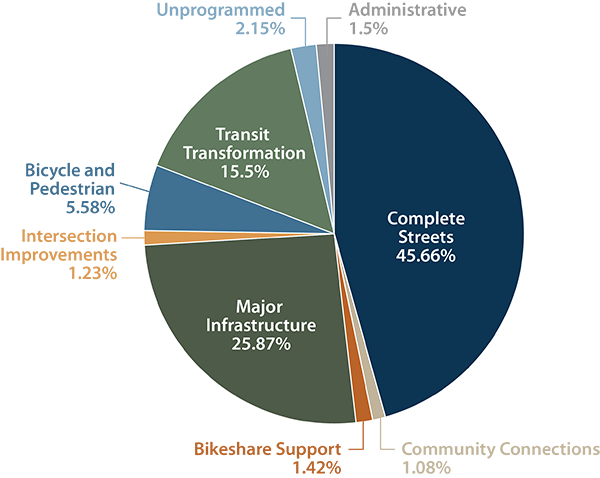
Figure ES-1 shows the distribution of Regional Target funding by investment program in the FFYs 2027–31 TIP. As shown in the figure, the Boston Region MPO’s Regional Target Program is devoted primarily to enhancing mobility and safety for all travel modes through significant investments in Complete Streets projects. A large portion of the MPO’s funding also supports the modernization of key regional roadways and transit infrastructure through investments in Major Infrastructure and Transit Transformation projects. The MPO has programmed more than 95.6 percent of its available funding over five years, electing to leave approximately $16.7 million unprogrammed.
Figure ES-1
FFYs 2027–31 TIP Regional Target Funding by MPO Investment Program
FFY = federal fiscal year. MPO = metropolitan planning organization. TIP = Transportation Improvement Program.
Source: Boston Region MPO.
Table ES-2 further details the number of projects and the allocation of funds across each program in the FFYs 2027–31 TIP. More details about every project funded through the MPO’s Regional Target Program are available in Chapter 3.
Table ES-2
FFYs 2027–31 Boston Region MPO Regional Target Investment Summary
MPO Investment Program |
Number of Projects |
Regional Target Dollars Programmed |
Bicycle Network and Pedestrian Connections |
7 |
$43,595,151 |
Bikeshare Support |
3 |
$3,124,995 |
Bikeshare Support (not yet allocated to projects) |
1 |
$8,000,000 |
Community Connections (allocated to projects) |
1 |
$463,807 |
Community Connections (not yet allocated to projects)* |
1 |
$8,000,000 |
Complete Streets |
15 |
$356,736,419 |
Intersection Improvements |
2 |
$9,634,290 |
Major Infrastructure—Roadway |
3 |
$202,084,845 |
Transit Transformation (allocated to projects) |
7 |
$94,568,883 |
Transit Transformation (not yet allocated to projects) |
1 |
$26,500,000 |
Administrative |
N/A |
$11,750,000 |
Unprogrammed |
N/A |
$16,780,862 |
Total |
41 |
$781,239,252 |
Note: Funding amounts in this table include both federal and non-federal funds, including matching funds.
FFY = federal fiscal year. MPO = metropolitan planning organization. N/A = not applicable.
Source: Boston Region MPO.
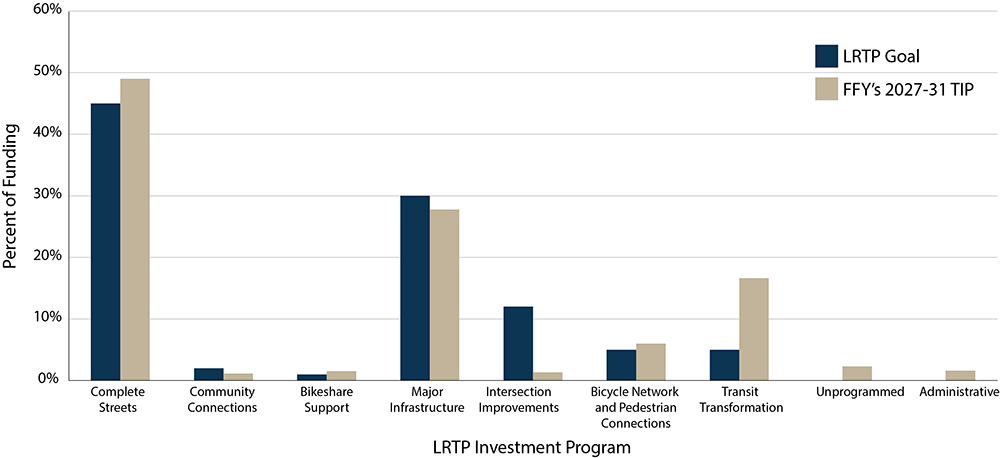
When making decisions about which projects to fund, the MPO considers how the allocation of funds to each investment program compares to the funding goals outlined in the MPO’s current Long-Range Transportation Plan (LRTP), Destination 2050. The funding goals for investment programs set forth in the LRTP reflect the types and mix of projects the MPO seeks to fund to help it achieve its goals and objectives for the region, from enhancing safety for all users to promoting mobility and accessibility across the region. More information on the MPO’s goals and objectives is available in Chapter 1, and a comparison between LRTP investment program goals and program funding levels in the FFYs 2027–31 TIP is shown in Figure ES-2.
Figure ES-2
FFYs 2027–31 TIP: Regional Target Funding Levels Relative to LRTP Investment Program Goals
FFY = federal fiscal year. LRTP = Long-Range Transportation Plan. TIP = Transportation Improvement Program.
Source: Boston Region MPO.
The investments made in the FFYs 2027–31 TIP will be implemented throughout the Boston region. Figure ES-3 illustrates the distribution of Regional Target funding among the eight subregions within the Boston Region MPO’s jurisdiction, as defined by the Metropolitan Area Planning Council (MAPC). This figure also shows how the distribution of funds compares to key metrics for measuring the need for funding by subregion, including the percent of regional population, employment, and Federal-Aid roadway miles within each subregion.
Figure ES-3
FFYs 2027–31 TIP: Regional Target Funding Levels Relative to Key Indicators
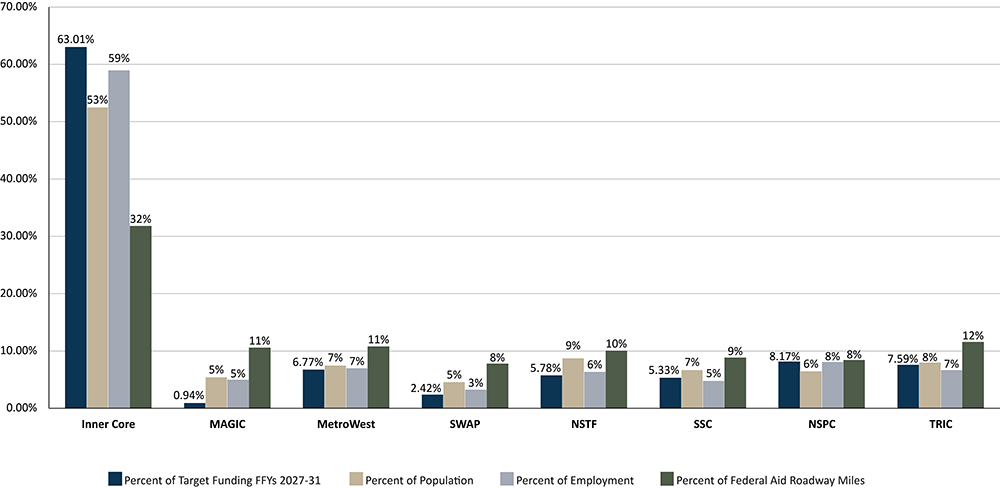
Note: Unprogrammed funds and funds held for the MPO’s Transit Transformation and Community Connections programs are not included in this figure.
FFY = federal fiscal year. MAGIC = Minuteman Advisory Group on Interlocal Coordination. MAPC = Metropolitan Area Planning Council. MetroWest = MetroWest Regional Collaborative. NSPC = North Suburban Planning Council. NSTF = North Shore Task Force. SSC = South Shore Coalition. SWAP = South West Advisory Committee. TIP = Transportation Improvement Program. TRIC = Three Rivers Interlocal Council.
Source: Boston Region MPO.
Additional information on the geographic distribution of Regional Target funding across the region, including a breakdown of funding by municipality, is included in Appendix D.
The TIP Highway Program was developed with the assumption that funding for Massachusetts from the Federal-Aid Highway Program would range between $838.1 million and $891.7 million annually over the next five years. These figures do not include matching funds provided for projects by the state or local entities. Projects are typically funded with 80 percent federal dollars and 20 percent state dollars, but the share may vary depending on the funding program. MassDOT customarily provides the local match (which can also be provided by other entities). Costs for project design are often borne by the proponent of the project, though the Boston Region MPO began allocating Regional Target funds for design support beginning with the FFYs 2025–29 TIP, a practice which continues through the FFYs 2027–31 TIP. With the addition of matching funds, approximately $1.04 billion to $1.10 billion was available statewide for projects in FFYs 2027–31.
The process of determining the MPO’s share of this federal funding for the Boston region follows several steps. First, MassDOT reserves funding for Grant Anticipation Notes (GANs) debt service payments. Then, the remaining Federal-Aid Highway Program funds are budgeted to support state and regional (i.e., MPO) priorities.
Next, MassDOT allocates funding across the following funding categories:
Finally, MassDOT allocates the remaining funding among the state’s 13 MPOs for programming. This discretionary funding for MPOs is suballocated by formula to determine the Regional Target amounts. The Boston Region MPO receives the largest portion of MPO funding in the state, with approximately 43 percent of Massachusetts’ Regional Target funds allocated to the region. MassDOT develops these targets in consultation with the Massachusetts Association of Regional Planning Agencies (MARPA). This TIP was programmed with the assumption that the Boston Region MPO will have between $159 million and $153 million annually for Regional Target amounts, which consist of federal funding and state funding for the local match.
Each MPO may decide how to prioritize its Regional Target funding. Given that the Regional Target funding originates from the Federal-Aid Highway Program, the Boston Region MPO typically programs the majority of funding for roadway projects; however, the MPO has flexed portions of its highway funding to the TIP Transit Program for transit expansion projects and through its Transit Transformation and Community Connections programs. The TIP Highway Program details the projects that will receive Regional Target funding from the Boston Region MPO and statewide infrastructure projects within the Boston region. Details on these investments are outlined in Chapter 3.
The Federal Transit Administration (FTA) allocates the funds programmed in the TIP Transit Program according to formula. The three regional transit authorities in the Boston Region MPO area that are recipients of these funds are the MBTA, CATA, and MWRTA. The MBTA, with its extensive transit program and infrastructure, is the recipient of the preponderance of the region’s federal transit funds.
The current federal transportation legislation, the Infrastructure Investment and Jobs Act, allocates funding to transit projects through the following formula programs:
When determining which projects to fund through the Regional Target funding process, MPO members collaborate with municipalities, state agencies, members of the public, advocacy groups, and other stakeholders. The MPO board uses evaluation criteria in its project selection process to help identify and prioritize projects that advance progress across the MPO’s six goal areas:
More information on the MPO’s goal areas can be found on the Destination 2050 web page: https://www.https://bostonmpo.org/lrtp.
As shown in Figure ES-1 and Table ES-2, the MPO has established investment programs designed to direct Regional Target funding towards MPO priority areas during the next 20 years:
Projects that the MPO selects to receive Regional Target funding through the TIP development process are included in one of the seven investment programs listed above. More information about the MPO’s investment programs are available in Chapter 2.
The MPO incorporates performance-based planning and programming (PBPP) practices into its TIP development and other processes. These practices are designed to help direct MPO funds towards achieving specific and measurable outcomes for the transportation system. MPO investments directly relate to the PBPP framework and further the MPO’s goals and performance targets. The MPO will continue to closely link its performance targets, investment decisions, and monitoring and evaluation activities. More information on PBPP is available in Chapter 4.
The outreach process for the TIP begins early in the federal fiscal year. Cities and towns designate TIP contacts and the MPO staff ask them to begin developing a list of priority projects to be considered for federal funding. MPO staff compiles the project funding requests into a Universe of Projects, which is a list of all projects identified as potential candidates to receive funding through the TIP.
Priority projects from regional transit authorities—the MBTA, MWRTA, and CATA—are typically identified as part of the authorities’ annual program development process. The MPO staff accepts the RTA’s applications for Transit Transformation funding in the fall. Projects that MPO staff receive applications for, that are not immediately selected for funding through the TIP, may be added to the Universe of Projects.
The Universe includes projects at varying levels of readiness, from those with significant engineering and design work complete to those still early in the conceptual or planning stage. MPO staff collects data on each project in the Universe so that the projects may be evaluated.
MPO staff evaluates projects based on how well they address the MPO’s goals. For MPO staff to conduct a complete project evaluation, projects eligible for Bicycle Network and Pedestrian Connections, Complete Streets, Intersection Improvements, and Major Infrastructure program funding must have a functional design report or the project plans must include the level of detail defined in a functional design report, a threshold typically reached when a project nears the 25 percent design stage. To complete an evaluation for projects under consideration through the MPO’s Community Connections program, project proponents must submit a completed application to MPO staff. More information on Project Evaluation is available in Appendix A.
An important step toward TIP programming takes place midway through the TIP development cycle at a meeting—referred to as TIP Readiness Day—that both MassDOT and MPO staff attend. At this meeting, MassDOT project managers provide updates about cost and schedule changes related to currently programmed projects. These cost and schedule changes must be taken into account as MPO staff helps the MPO board consider updates to the already programmed years of the TIP and the addition of new projects in the outermost year of the TIP.
In December 2025, the MPO adopted Revised Readiness Requirements to inform project programming alongside MassDOT recommendations. These requirements established a minimum design requirement for a project to be funded in each programming year of the TIP. More information on MPO programming policies is available in Appendix A.
Using the evaluation results and information about project readiness (i.e., the extent to which a project is fully designed and ready for construction), MPO staff prepares a series of recommendations for how to program the Regional Target funding in the TIP. The staff recommendation is always financially constrained—meaning, subject to available funding. There was approximately $785 million of Regional Target funding available to the Boston Region MPO for FFYs 2027–31.
In addition to prioritizing the Regional Target funding, the MPO board reviews and endorses the statewide highway program that MassDOT recommends for programming. The board also reviews and endorses programming of funds for the MBTA’s, CATA’s, and MWRTA’s transit capital programs.
After selecting a preferred programming scenario, usually in April, the MPO board votes to release the draft TIP for a 21-day public review period. The comment period typically begins in late April, and during this time the MPO invites members of the public, municipal officials, and other stakeholders in the Boston region to review the proposed program and submit feedback. During the public review period, MPO staff may host public meetings to discuss the draft TIP document and elicit additional comments.
After the public review period ends, the MPO board reviews all municipal and public comments and may change elements of the document or its programming. The MPO board then endorses the TIP and submits it to the Federal Highway Administration (FHWA) and the Federal Transit Administration (FTA) for approval. MassDOT incorporates the MPO-endorsed TIP into the State Transportation Improvement Program (STIP). The FHWA, FTA, and United States Environmental Protection Agency review the STIP for certification by September 30, the close of the federal fiscal year.
Even after the TIP has been finalized, administrative modifications, amendments, and adjustments often must be introduced because of changes in project schedules, project costs, funding sources, or available revenues. This may necessitate reprogramming a project in a different funding year or programming additional funds for a project.
Notices of administrative modifications and amendments are posted on the MPO’s website. If an amendment is necessary, the MPO notifies affected municipalities, stakeholders, and members of the public via email. The MPO typically holds a 21-day public review period before taking final action on an amendment. In extraordinary circumstances, the MPO may vote to shorten the public comment period to a minimum of 15 days. Administrative modifications and adjustments are minor and usually do not warrant a public review period.
Public engagement is an important aspect of the transportation planning process. Please visit bostonmpo.org for more information about the MPO, to view the entire TIP, and to submit your comments. You also may wish to sign up for email news updates and notices by visiting bostonmpo.org/subscribe and submitting your contact information. To request a copy of the TIP in accessible formats, please contact the MPO staff by any of the following means:
Mail: Boston Region MPO c/o CTPS MPO Activities Group, 10 Park Plaza, Suite 2150, Boston, MA 02116-3968
Telephone: 857.702.3700 (voice)
For people with hearing or speaking difficulties, connect through the state MassRelay service:
Email: publicinfo@ctps.org
Translations of the Executive Summary of the FFYs 2027–31 TIP are also available: